
Smart Nanomaterials Market 2026
By Type (Carbon-Based Nanomaterials, Metal-Based Nanomaterials, Polymeric Nanomaterials, Other Types), By Functionality (Structural Nanomaterials, Functional Nanomaterials), By Form (Powder, Suspension, Composite), By End Use (Pharmaceuticals, Transportation, Electronics, Construction, Environment, Other End-Uses), And By Region, Opportunities And Strategies – Global Forecast To 2035
Smart Nanomaterials Market Definition
Smart nanomaterials refer to a class of engineered nanoscale materials designed to respond in a controlled manner to external stimuli such as temperature, light, pH, electric or magnetic fields, or mechanical stress. These materials are developed with functionalities that enable them to alter their physical or chemical properties upon exposure to specific environmental conditions. The smart nanomaterials market consists of sales, by entities (organizations, sole traders or partnerships) of smart nanomaterials that are used across a broad range of industries including pharmaceuticals, electronics, construction, transportation and environmental services. Smart nanomaterials are utilized when there is a need for responsive, adaptive or intelligent material behavior in products—such as drug carriers that release therapeutic agents at targeted sites, coatings that self-heal after damage, or sensors that respond to minute environmental changes.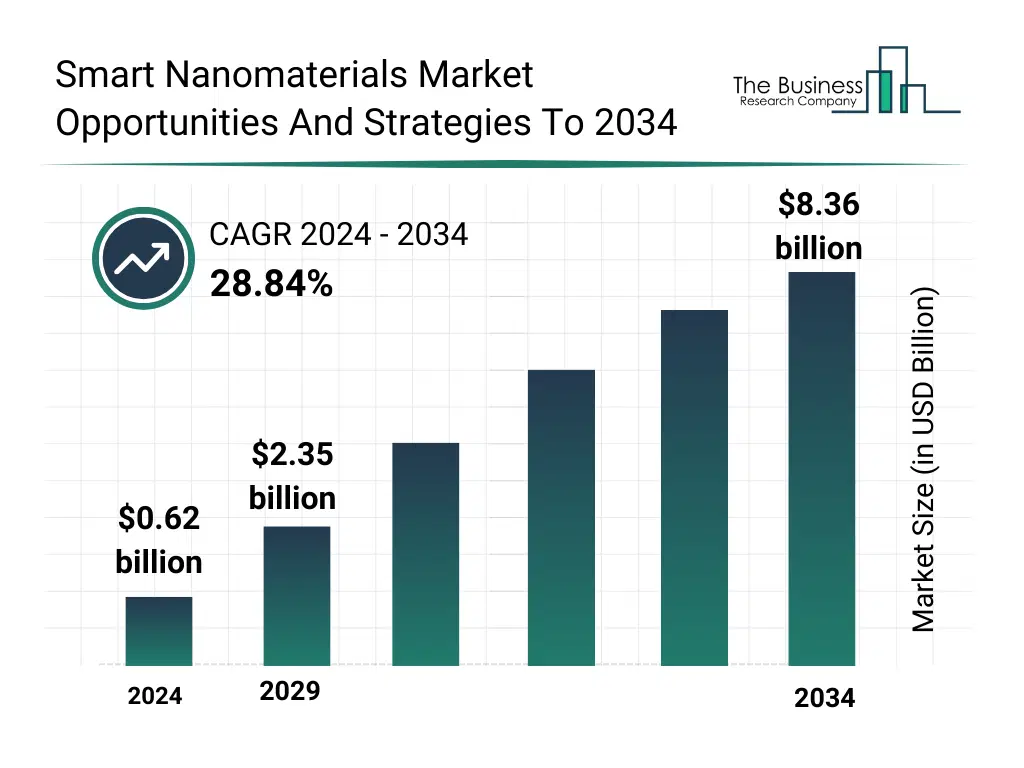
Smart Nanomaterials Market Size
The global smart nanomaterials market reached a value of nearly $620.89 million in 2024, having grown at a compound annual growth rate (CAGR) of 31.98% since 2019. The market is expected to grow from $620.89 million in 2024 to $2,354.60 million in 2029 at a rate of 30.55%. The market is then expected to grow at a CAGR of 28.84% from 2029 and reach $8,358.43 million in 2034. Growth in the historic period resulted from the government funding and R&D programs in nanotechnology, growing demand for consumer electronics, rising healthcare spending and increasing demand for energy-efficient solutions. Factors that negatively affected growth in the historic period were skilled-workforce shortages and high production and processing costs. Going forward, rising use of smart and protective coatings, growth of electric vehicles, increasing consumer demand for high-performance packaging and increasing prevalence of chronic diseases will drive the growth. Factors that could hinder the growth of the smart nanomaterials market in the future include limited standardization and regulatory uncertainty, complex waste-management & disposal challenges and impact of trade war and tariff.Smart Nanomaterials Market Drivers
The key drivers of the smart nanomaterials market include: Rising Use Of Smart And Protective Coatings During the forecast period, the rising use of smart and protective coatings will propel the growth of the smart nanomaterials market. As industries increasingly seek advanced surface solutions that provide corrosion resistance, durability, self-healing capabilities and enhanced environmental protection, the demand for nanomaterial-based coatings continues to expand. Smart coatings incorporate functional nanostructures that improve barrier performance, mechanical strength, thermal stability and surface responsiveness, making them essential for applications in automotive, aerospace, construction, electronics and marine industries. Moreover, the growing focus on sustainability, longer asset lifecycles and reduced maintenance costs is encouraging the adoption of next-generation coatings that can sense, repair, or prevent damage more effectively than conventional materials. As manufacturers adopt these advanced protective systems to enhance product performance and meet stricter operational standards, the need for high-performance smart nanomaterials rises correspondingly, thereby driving the growth of the smart nanomaterials market. The rising use of smart and protective coatings growth contribution during the forecast period in 2024 is 1.25%.Smart Nanomaterials Market Restraints
The key restraints on the smart nanomaterials market include: Limited Standardization And Regulatory Uncertainty During the forecast period, limited standardization and regulatory uncertainty will restrain the growth of the smart nanomaterials market. The absence of universally accepted testing methods, coating classifications and safety frameworks creates challenges for manufacturers and end-users who must navigate complex and inconsistent regulatory environments. Many smart nanomaterials solutions face hurdles in certification, approval, or market entry because regulators in different regions apply varying definitions, requirements and risk-assessment protocols. Consequently, this uncertain regulatory climate discourages investment, slows product launches and reduces the willingness of industries to adopt nano-enabled solutions, thereby impeding the expansion of the smart nanomaterials market. Growth affected by limited standardization and regulatory uncertainty across regions during the forecast period in 2024 is -1.75%.Smart Nanomaterials Market Trends
Major trends shaping the smart nanomaterials market include: Introduction Of Fully-Animated Nano-Optic Features Major companies in the smart nanomaterials market are focusing on the introduction of fully-animated nano-optic features designed to meet the growing need for advanced security solutions in banknotes, identity documents and brand-protection applications. These innovations focus on delivering highly sophisticated visual effects, improved anti-counterfeiting performance and seamless integration into a variety of substrates, while also offering customizable formats that cater to the diverse requirements of global security issues. For instance, in May 2025, Meta Materials Inc., a Canada-based company specializing in nano-optic and metamaterial technologies, launched the world’s first fully animated nano-optic banknote security product, engineered to provide dynamic, motion-based imagery that cannot be replicated using conventional printing or holographic methods. This new solution incorporates digitally controlled nanoscale structures that produce vivid animation, enhanced durability and strong overt security cues, offering central banks and document authorities a next-generation alternative to traditional security foils. By leveraging advanced nano-fabrication capabilities and scalable production processes, the company aims to deliver security features that combine optical sophistication, material robustness and widespread applicability across global high-security markets. Development Of Integrated Theranostic Smart Nanomaterials Major companies and research institutions in the smart nanomaterials market are increasingly focusing on the development of integrated theranostic nanomaterials designed to address complex neurological conditions through simultaneous diagnosis and treatment. These innovations emphasize multifunctional nanoparticles capable of crossing physiological barriers, sensing pathological changes and delivering targeted therapeutic payloads with high precision. In November 2025, Pusan National University researchers, led by Professor Yun Hak Kim, developed advanced smart theranostic nanomaterials capable of simultaneously detecting and treating traumatic brain injuries (TBI). These nanomaterials are engineered nanoparticles that can cross the blood-brain barrier and deliver neuroprotective or anti-inflammatory drugs precisely to injured brain sites while also acting as nanosensors to monitor biological changes in real time. They respond to biochemical cues in injured neural tissue, such as changes in pH, oxidative stress markers and enzyme activity, enabling real-time modulation of drug release and enhanced imaging for diagnosis and treatment monitoring. This integrated theranostic approach addresses the limitations of traditional TBI treatments by enabling personalized, minimally invasive therapies that combine diagnosis, targeted drug delivery and recovery monitoring.Opportunities And Recommendations In The Smart Nanomaterials Market
Opportunities – The top opportunities in the smart nanomaterials market segmented by type will arise in the carbon-based nanomaterials segment, which will gain $617.79 million of global annual sales by 2029. The top opportunities in the smart nanomaterials market segmented by functionality will arise in the functional nanomaterials segment, which will gain $1,183.44 million of global annual sales by 2029. The top opportunities in the smart nanomaterials market segmented by form will arise in the powder segment, which will gain $784.48 million of global annual sales by 2029. The top opportunities in the smart nanomaterials market segmented by application will arise in the drug delivery segment, which will gain $518.54 million of global annual sales by 2029. The top opportunities in the smart nanomaterials market segmented by end-use will arise in the pharmaceuticals segment, which will gain $559.47 million of global annual sales by 2029. The smart nanomaterials market size will gain the most in the USA at $485.80 million. Recommendations- To take advantage of the opportunities, The Business Research Company recommends the smart nanomaterials companies to focus on advanced nano-optic security solutions for high-value applications, focus on integrated theranostic nanomaterials for neurological care, focus on easy-clean antimicrobial nanocoatings for scalable hygiene demand, focus on PFAS-free oleophobic coatings to meet regulatory and sustainability demands, focus on scalable and low-carbon carbon nanotube manufacturing, focus on halogen-free plasma nanocoatings for reliable and sustainable electronics, focus on polymeric nanomaterials for scalable growth, focus on functional nanomaterials for market leadership, focus on suspension-based formats for accelerated scale and adoption, expand in emerging markets, focus on expanding multi-channel distribution reach, focus on value-based and segment-specific pricing discipline, promotion strategy focused on credibility and demand conversion, partnership-led and thought leadership–driven promotion framework, focus on drug delivery applications for high-growth value creation, focus on pharmaceuticals end use to maximize growth and strategic value.
Smart Nanomaterials Market Segmentation
The smart nanomaterials market is segmented by type, by functionality, by form, by application and end user.By Type–
The smart nanomaterials market is segmented by type into:
- a) Carbon-Based Nanomaterials
- b) Metal-Based Nanomaterials
- b) Polymeric Nanomaterials
- b) Other Types
By Functionality–
The smart nanomaterials market is segmented by functionality into:
- a) Structural Nanomaterials
- b) Functional Nanomaterials
By Form–
The smart nanomaterials market is segmented by form into:
- a) Powder
- b) Suspension
- c) Composite
By Application–
The smart nanomaterials market is segmented by application into:
- a) Display Technology
- b) Drug Delivery
- c) Coating And Nanofilms
- c) Monitoring And Biosensing
- c) Water Treatment
- c) Other Applications
By End Use–
The smart nanomaterials market is segmented by end use into:
- a) Pharmaceuticals
- b) Transportation
- c) Electronics
- c) Construction
- c) Environment
- c) Other End-Uses
By Geography - The smart nanomaterials market is segmented by geography into:
- • China
- • India
- • Japan
- • Australia
- • Indonesia
- • South Korea
- • USA
- • Canada
- • Brazil
- • France
- • Germany
- • UK
- • Italy
- • Spain
- • Russia
-
o Asia Pacific
o Africa