
Smart Operating Room Global Market Opportunities And Strategies To 2035
By Type (Integrated Smart Operating Room, Cloud Platform Smart Operating Room, Other Types), By Component (Hardware, Software, Services), By Application (General Surgery, Minimally Invasive And Image-Guided Surgery, Interventional Procedures, Dental Procedures, Other Applications), And By Region, Opportunities And Strategies – Global Forecast To 2035
Smart Operating Room Market Definition
Smart operating rooms are technologically advanced surgical environments that integrate digital systems, medical devices, imaging technologies and data platforms into a centralized and interconnected operating suite. These systems allow seamless communication between surgical equipment, real-time data visualization and automated workflow management, often incorporating technologies such as robotic surgery, artificial intelligence and advanced imaging. The primary purpose of smart operating rooms is to enhance surgical precision, improve clinical workflow efficiency and increase patient safety. The smart operating room market consists of sales by entities (organizations, sole traders and partnerships) of integrated digital operating room systems, technologies and services designed to enhance surgical efficiency, connectivity and patient outcomes. These solutions combine advanced hardware, software platforms and communication technologies to enable seamless integration of surgical devices, imaging systems, data management tools and hospital information systems within the operating theater.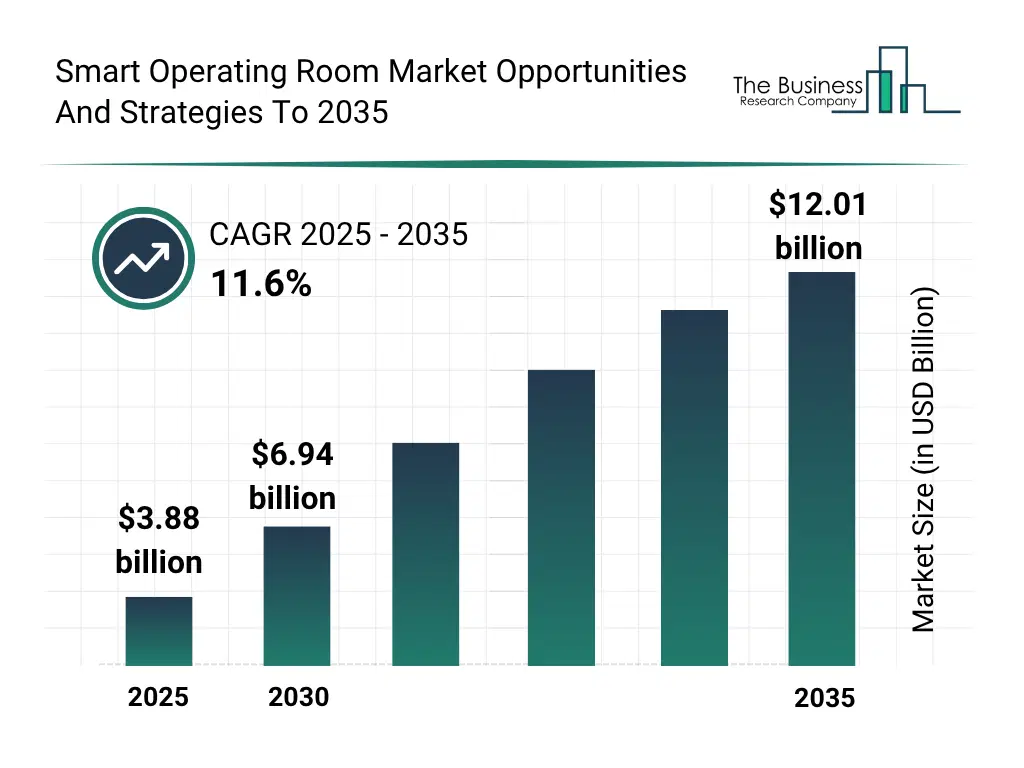
Smart Operating Room Market Size
The global smart operating room market reached a value of nearly $3,876.5 million in 2025, having grown at a compound annual growth rate (CAGR) of 13.5% since 2020. The market is expected to grow from $3,876.5 million in 2025 to $6,937.5 million in 2030 at a rate of 12.3%. The market is then expected to grow at a CAGR of 11.6% from 2030 and reach $12,005.6 million in 2035. Growth in the historic period resulted from increasing healthcare expenditure and infrastructure development, growth of ambulatory surgical centers (ASCs), growing prevalence of chronic diseases and increasing volume of surgical procedure. Factors that negatively affected growth in the historic period were data privacy and cybersecurity concerns and high dependency on stable network connectivity. Going forward, government support towards hospital digitization and smart hospital initiative, increasing adoption of minimally invasive surgeries, increasing focus on patient safety and reduction of surgical complications and rising adoption of smart medical devices in surgical environments will drive the growth. Factors that could hinder the growth of the smart operating room market in the future include high initial capital investment, shortage of skilled professionals and impact of trade wars and tariffs.
Smart Operating Room Market Segmentation
The smart operating room market is segmented by type, by component and by application.
By Type–
The smart operating room market is segmented by type into:
By Component –
The smart operating room market is segmented by component into:
By Application –
The smart operating room market is segmented by application into:
By Geography - The smart operating room market is segmented by geography into:
By Type–
The smart operating room market is segmented by type into:
- a) Integrated Smart Operating Room
- b) Cloud Platform Smart Operating Room
- c) Other Types
By Component –
The smart operating room market is segmented by component into:
- a) Hardware
- b) Software
- c) Services
By Application –
The smart operating room market is segmented by application into:
- a) General Surgery
- b) Minimally Invasive and Image-Guided Surgery
- c) Interventional Procedures
- d) Dental Procedures
- e) Other Applications
By Geography - The smart operating room market is segmented by geography into:
- China
- India
- Japan
- Australia
- Indonesia
- South Korea
- USA
- Canada
- Brazil
- France
- Germany
- UK
- Italy
- Spain
- Russia
-
o Asia Pacific
o Africa