
Smart Pole Global Market Opportunities And Strategies To 2035
By Hardware (Lighting Lamp, Pole Bracket And Pole Body, Communication Device, Controller, Other Hardware), By Installation Type (New Installation, Retrofit Installation), By Application (Highways And Roadways, Public Places, Railways And Harbors, Other Applications), And By Region, Opportunities And Strategies – Global Forecast To 2035
Smart Pole Market Definition
Smart poles refer to advanced, multi-functional urban infrastructure systems that integrate lighting, communication, surveillance, and environmental monitoring technologies into a single pole structure. These poles are designed to support smart city initiatives by enabling efficient energy usage, enhanced public safety, and improved connectivity. The smart pole market consists of sales by entities (organizations, sole traders and partnerships) of smart pole that are used by municipal authorities, urban planners, transportation departments, and utility providers, as well as private entities managing large campuses or commercial zones. They are deployed in both new urban developments and existing infrastructure upgrades, typically in areas requiring high levels of illumination, connectivity, and monitoring. Smart poles are used continuously, particularly in urban environments, to provide lighting, facilitate wireless communication, host sensors, and support applications such as traffic management, surveillance, and environmental monitoring.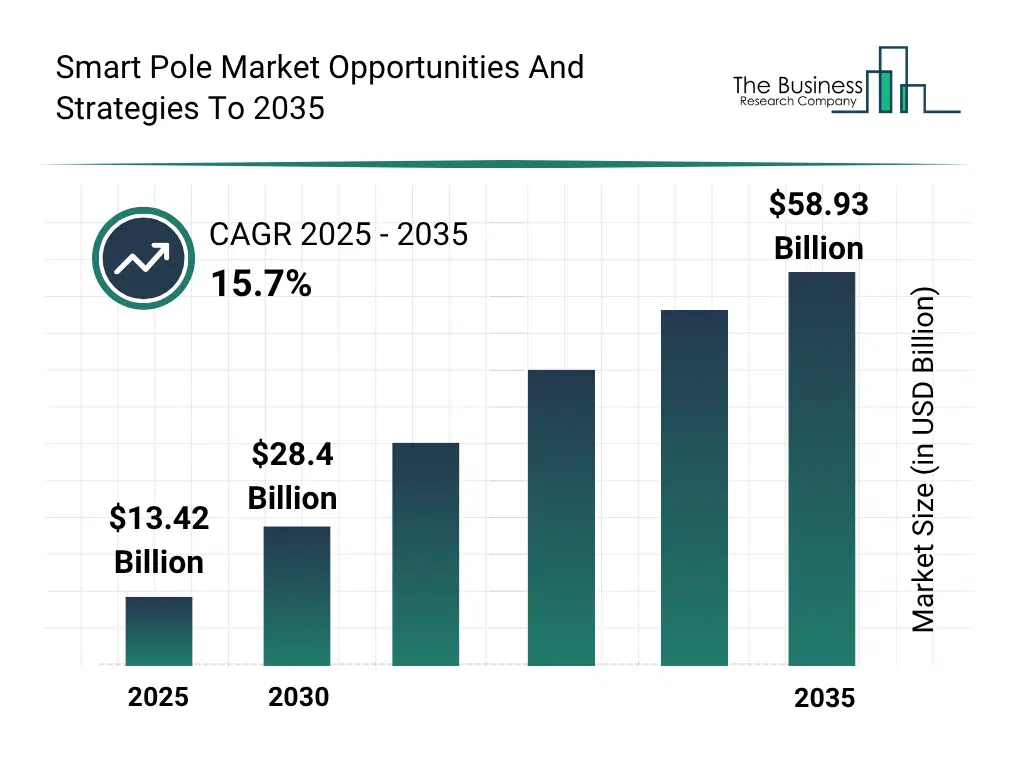
Smart Pole Market Size
The global smart pole market reached a value of nearly $13,420.0 million in 2025, having grown at a compound annual growth rate (CAGR) of 16.4% since 2020. The market is expected to grow from $13,420.0 million in 2025 to $28,397.8 million in 2030 at a rate of 16.2%. The market is then expected to grow at a CAGR of 15.7% from 2030 and reach $58,932.2 million in 2035. Growth in the historic period resulted from rising use of street furniture for telecom infrastructure leasing (pole-as-a-service models), expansion of smart cities, rise in government infrastructure investments and increasing public safety concerns. Factors that negatively affected growth in the historic period were lack of skilled workforce and limited availability of suitable existing pole infrastructure. Going forward, traffic congestion and urban mobility issues, growing focus towards adoption of renewable-powered smart poles, growing deployment of smart parking and centralized enforcement systems and focus towards need for energy-efficient lighting systems (LED adoption) will drive the growth. Factors that could hinder the growth of the smart pole market in the future include land use and urban planning restrictions, dependence on stable power and backhaul connectivity and impact of trade war and tariff.
Smart Pole Market Segmentation
The smart pole market is segmented by hardware, by installation type and by application.By Hardware –
The smart pole market is segmented by hardware into:
- a) Lighting Lamp
- b) Pole Bracket And Pole Body
- c) Communication Device
- d) Controller
- e) Other Hardware
By Installation Type –
The smart pole market is segmented by installation type into:
- a) New Installation
- b) Retrofit Installation
By Application –
The smart pole market is segmented by application into:
- a) Highways And Roadways
- b) Public Places
- c) Railways And Harbors
- d) Other Applications
By Geography - The smart pole market is segmented by geography into:
- China
- India
- Japan
- Australia
- Taiwan
- South Korea
- Indonesia
- USA
- Canada
- Brazil
- France
- Germany
- UK
- Italy
- Spain
- Russia
-
o Asia Pacific
o Africa