
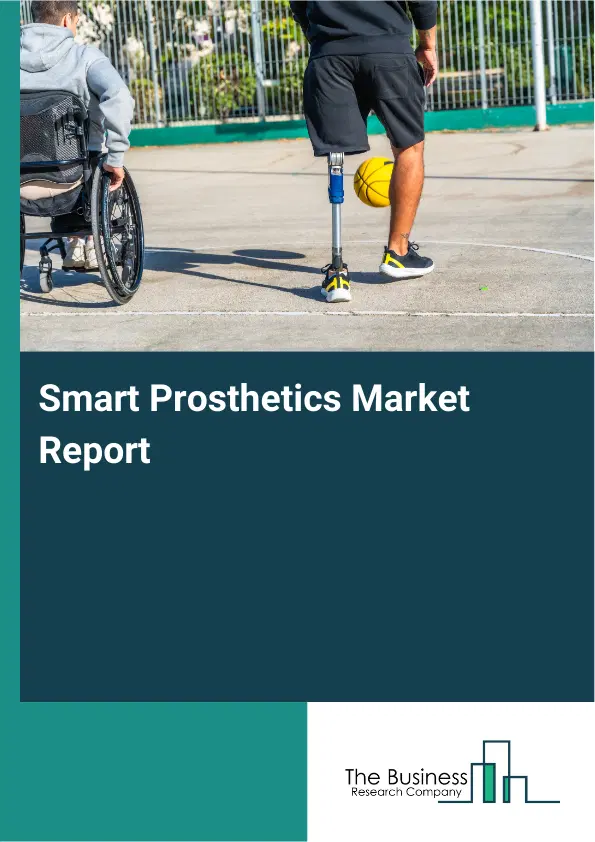
Smart Prosthetics Market Report 2026
Global Outlook – By Product Type (Bionic Limbs, Myoelectric Prosthetics, Hybrid Prosthetics), By Technology (Microprocessor-Controlled, Bluetooth-Enabled, Sensor-Integrated, Other Technologies), By Distribution Channel (Direct Sales, Distributors, Online Sales, Other Distribution Channels), By Application (Orthopedic Clinics, Hospitals, Rehabilitation Centers, Other Applications), By End-User (Adults, Pediatrics) – Market Size, Trends, Strategies, and Forecast to 2030
Smart Prosthetics Market Overview
• Smart Prosthetics market size has reached to $2.03 billion in 2025 • Expected to grow to $3.18 billion in 2030 at a compound annual growth rate (CAGR) of 9.3% • Growth Driver: Rising Prevalence Of Limb Loss Fueling The Growth Of The Market Due To Increasing Diabetes-Related Complications And Vascular Diseases • Market Trend: Innovative Advancements In Prosthetic Microprocessor Knees Elevate User Mobility And Comfort • North America was the largest region in 2025 and Asia-Pacific is the fastest growing region.What Is Covered Under Smart Prosthetics Market?
Smart prosthetics are advanced artificial limbs equipped with embedded microprocessors and, in some cases, artificial intelligence, designed to closely replicate natural movements and offer users enhanced control and responsiveness. They can detect muscle signals and adjust in real time to various activities, greatly enhancing mobility, comfort, and overall functionality compared to conventional prosthetics. The main product types of smart prosthetics are bionic limbs, myoelectric prosthetics, hybrid prosthetics, and others. Bionic limbs are advanced prosthetic devices that integrate electronic and mechanical components to mimic the function of natural limbs. It includes various technologies such as microprocessor-controlled, Bluetooth-enabled, sensor-integrated, and others, and is distributed through several distribution channels such as direct sales, distributors, online sales, and others. It is applied in various applications, including orthopedic clinics, hospitals, rehabilitation centers, and others, catering to diverse end users, such as adults and pediatrics.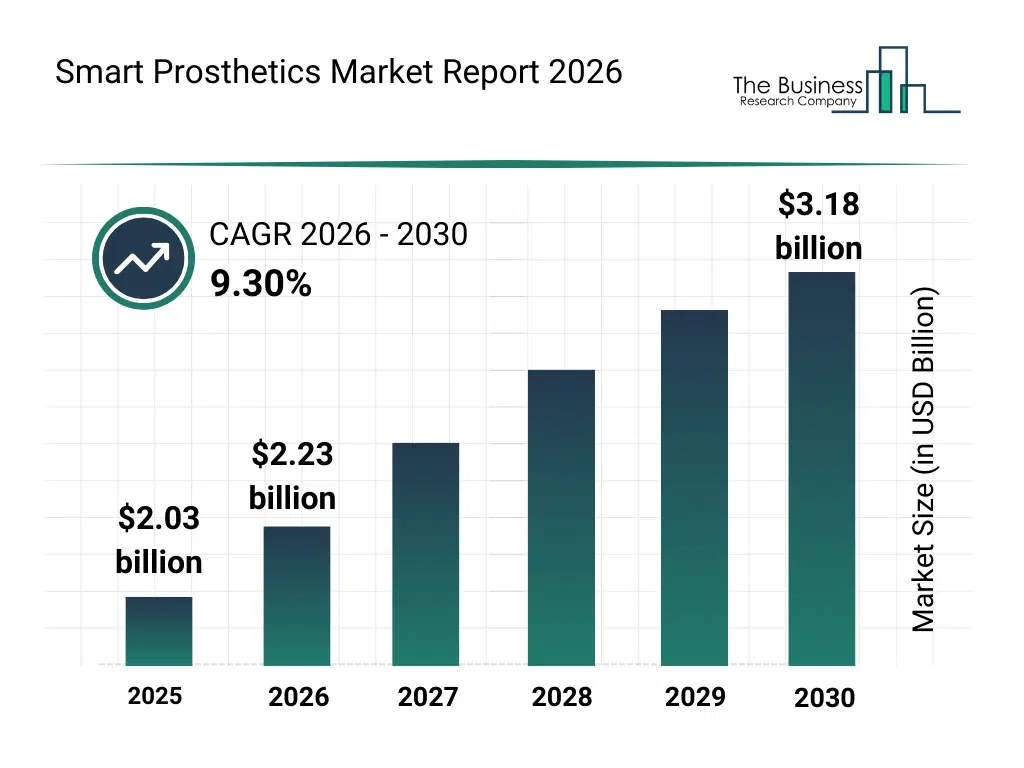
What Is The Smart Prosthetics Market Size and Share 2026?
The smart prosthetics market size has grown strongly in recent years. It will grow from $2.03 billion in 2025 to $2.23 billion in 2026 at a compound annual growth rate (CAGR) of 9.9%. The growth in the historic period can be attributed to limited functionality of conventional prosthetics, reliance on mechanical prosthetic limbs, growing orthopedic clinic infrastructure, increasing awareness of mobility solutions, early adoption of rehabilitation centers.What Is The Smart Prosthetics Market Growth Forecast?
The smart prosthetics market size is expected to see strong growth in the next few years. It will grow to $3.18 billion in 2030 at a compound annual growth rate (CAGR) of 9.3%. The growth in the forecast period can be attributed to advancements in bionic and hybrid prosthetic technologies, integration of ai and sensor-based systems, rising adoption in pediatric applications, increasing geriatric population requiring prosthetics, expansion of direct and online sales channels. Major trends in the forecast period include rising adoption of microprocessor-controlled prosthetics, integration of sensor-based movement recognition, growing demand for myoelectric and hybrid prosthetics, expansion of rehabilitation and orthopedic clinics, focus on pediatric and adult prosthetic customization.
Global Smart Prosthetics Market Segmentation
1) By Product Type: Bionic Limbs, Myoelectric Prosthetics, Hybrid Prosthetics 2) By Technology: Microprocessor-Controlled, Bluetooth-Enabled, Sensor-Integrated, Other Technologies 3) By Distribution Channel: Direct Sales, Distributors, Online Sales, Other Distribution Channels 4) By Application: Orthopedic Clinics, Hospitals, Rehabilitation Centers, Other Applications 5) By End-User: Adults, Pediatrics Subsegments: 1) By Bionic Limbs: Upper-Limb Bionic Prosthetics, Lower-Limb Bionic Prosthetics, Modular Bionic Limbs, Lightweight Bionic Limbs 2) By Myoelectric Prosthetics: Single-Joint Myoelectric Prosthetics, Multi-Joint Myoelectric Prosthetics, Sensor-Integrated Myoelectric Prosthetics, Adaptive Myoelectric Prosthetics 3) By Hybrid Prosthetics: Combination Mechanical-Electrical Prosthetics, Sensor-Assisted Hybrid Prosthetics, Custom-Fit Hybrid Prosthetics, Multi-Functional Hybrid ProstheticsWhat Is The Driver Of The Smart Prosthetics Market?
The increasing prevalence of limb loss is expected to propel the growth of the smart prosthetics market going forward. Limb loss refers to the condition of having one or more limbs partially or completely removed due to injury, disease, or congenital factors. The prevalence of limb loss is rising due to the growth in global incidence of diabetes-related complications, particularly peripheral artery disease and neuropathic ulcers that often lead to non-traumatic lower limb amputations. Smart prosthetics assist limb loss patients in restoring natural movement by interpreting muscle signals and adapting to activities in real time, enhancing mobility and independence while improving dexterity, control, and comfort to boost daily functionality and quality of life. For instance, in December 2024, according to the Archives of Rehabilitation Research and Clinical Translation, a US-based peer-reviewed medical journal, an estimated 2,309,000 people in the US live with limb loss, with approximately 91% having undergone lower extremity amputations and 9.2% upper extremity amputations, and this number is projected to increase by 145% by 2060. Therefore, the increasing prevalence of limb loss is driving the growth of the smart prosthetics industry.Key Players In The Global Smart Prosthetics Market
Major companies operating in the smart prosthetics market are Hanger Inc., Ottobock SE & Co. KGaA, Össur hf., Blatchford Group Limited, Trulife Limited, RSLSteeper, PROTEOR SAS, Fillauer LLC, WillowWood LLC, CURE International Inc., Advanced Arm Dynamics Inc., Open Bionics Ltd., Syntouch LLC, Coapt LLC, COVVI Ltd., Endolite India Private Limited, Medical Center Orthotics & Prosthetics Inc., Infinite Biomedical Technologies, Taska Prosthetics, LimbLogic Prosthetics
This chart is for illustrative purposes; the full report includes a detailed competitor analysis and comprehensive overview of the top 10 companies in the market.
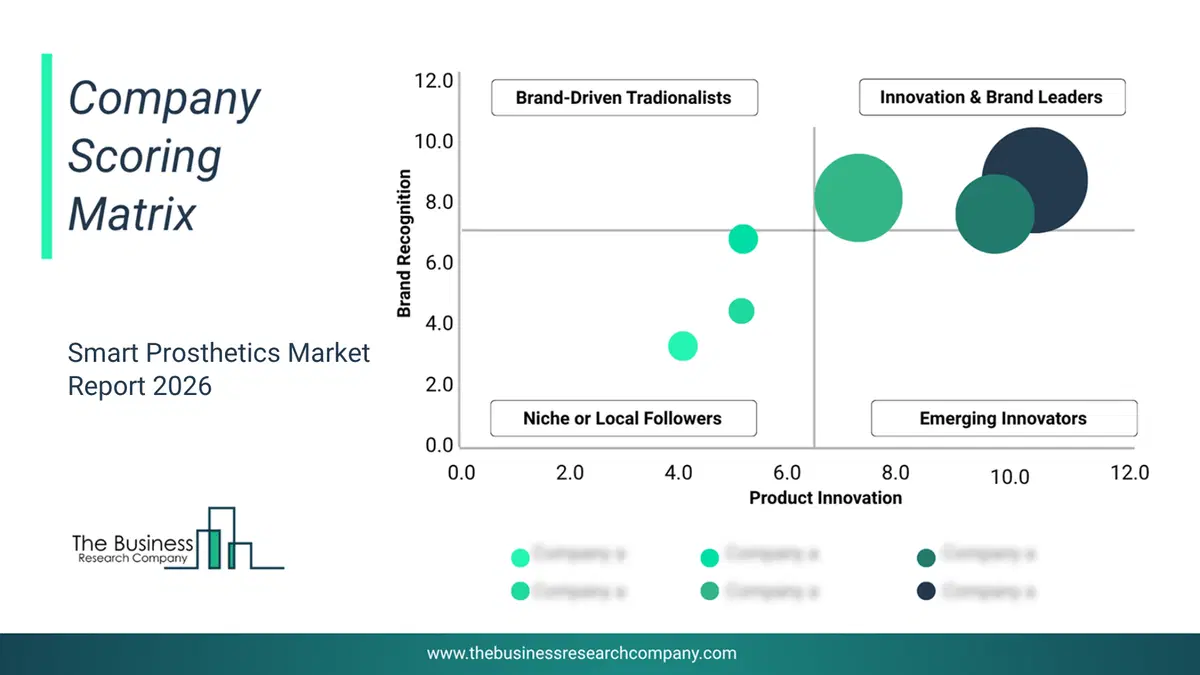
This chart maps companies by product innovation and brand strength, with bubble size indicating relative revenue, helping identify market leaders, challengers, and niche players. This is an illustrative chart; the full report provides a complete and accurate competitive analysis.
Global Smart Prosthetics Market Trends and Insights
Major companies operating in the smart prosthetics market are focusing on developing innovative products, such as prosthetic microprocessor knees, to enhance user mobility, improve stability, and reduce energy expenditure during movement. Prosthetic microprocessor knees are artificial knee joints with built-in computers that automatically adjust movement for smoother, safer, and more natural walking. For instance, in July 2024, Ottobock UK, a UK-based company that manufactures medical equipment, launched the Genium X4, the next generation of their prosthetic microprocessor knee (MPK), representing a major advancement in mobility technology. The Genium X4 features Optimized Physiological Gait (OPG) 3.0 technology, offering a smooth and almost natural walking experience. Key capabilities include improved slope climbing, a start-to-walk function, enhanced stance phase stability, dynamic backward movement, and an intuitive cycling mode. The knee is fully waterproof and corrosion-resistant, provides up to five days of battery life, and offers customizable MyMode presets.What Are Latest Mergers And Acquisitions In The Smart Prosthetics Market?
In February 2025, Amparo Prosthetics Ltd., a Germany-based company focused on redesigning prosthetic care, acquired Adapttech for an undisclosed amount. With this acquisition, Amparo aims to combine its expertise in direct-fit prosthetic sockets with Adapttech's data-driven smart prosthetic technology to create a comprehensive suite of advanced prosthetic solutions that enhance patient outcomes, accelerate innovation, and expand global reach in prosthetic care. Adapttech is a Portugal-based biomedical company that offers smart prosthetic technologies.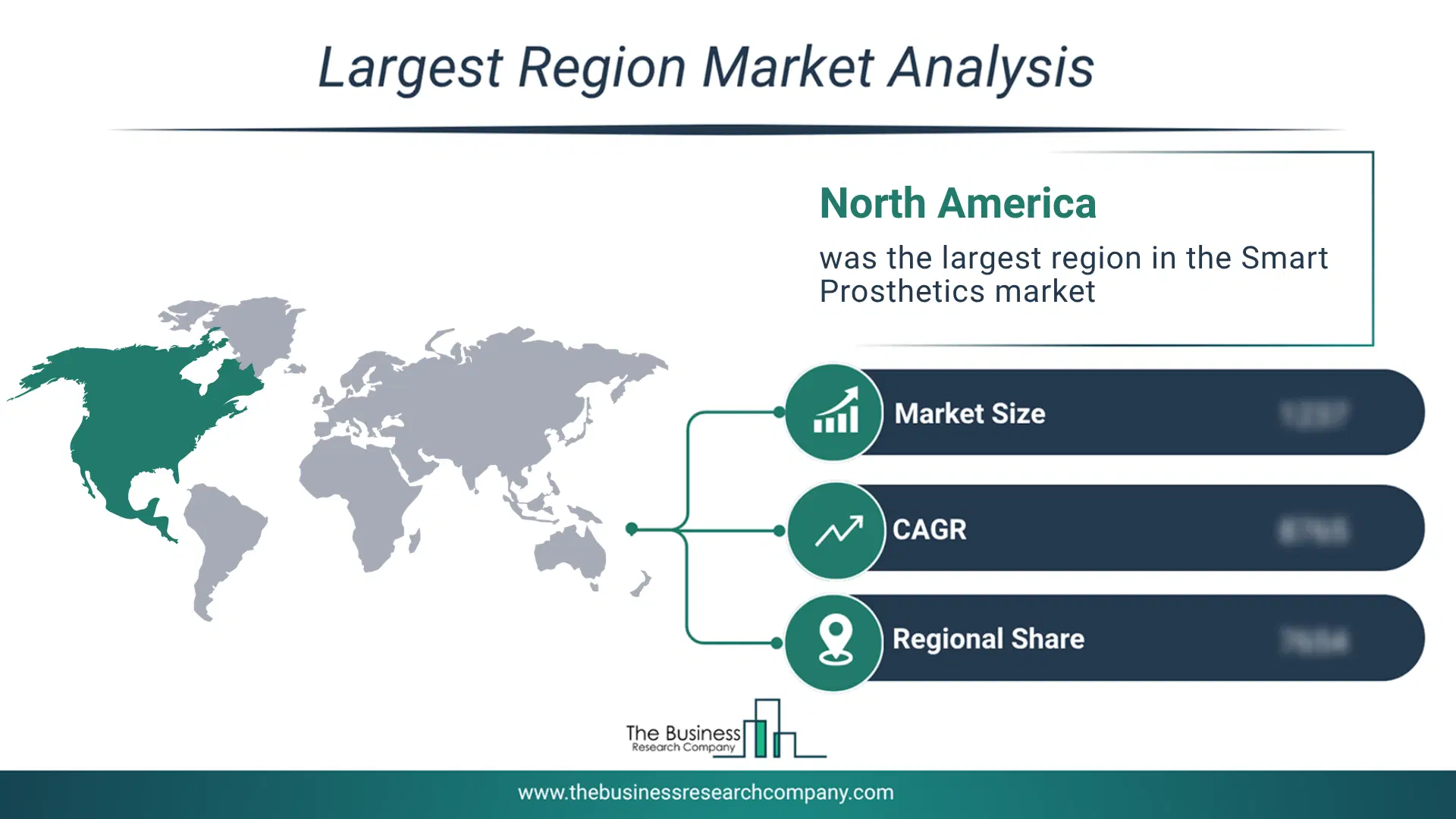
Regional Outlook
North America was the largest region in the smart prosthetics market in 2025. Asia-Pacific is expected to be the fastest-growing region in the forecast period. The regions covered in this market report are Asia-Pacific, South East Asia, Western Europe, Eastern Europe, North America, South America, Middle East, Africa. The countries covered in this market report are Australia, Brazil, China, France, Germany, India, Indonesia, Japan, Taiwan, Russia, South Korea, UK, USA, Canada, Italy, SpainWhat Defines the Smart Prosthetics Market?
The smart prosthetics market consists of revenues earned by entities by providing services such as adaptive movement assistance, muscle signal interpretation, real-time feedback, and rehabilitation support. The market value includes the value of related goods sold by the service provider or included within the service offering. The smart prosthetics market also includes sales of bionic hands, AI-powered prosthetic legs, smart knee joints, and brain-computer interface-enabled prosthetics. Values in this market are ‘factory gate’ values, that is, the value of goods sold by the manufacturers or creators of the goods, whether to other entities (including downstream manufacturers, wholesalers, distributors, and retailers) or directly to end customers. The value of goods in this market includes related services sold by the creators of the goods.How is Market Value Defined and Measured?
The market value is defined as the revenues that enterprises gain from the sale of goods and/or services within the specified market and geography through sales, grants, or donations in terms of the currency (in USD unless otherwise specified). The revenues for a specified geography are consumption values that are revenues generated by organizations in the specified geography within the market, irrespective of where they are produced. It does not include revenues from resales along the supply chain, either further along the supply chain or as part of other products.
This chart presents market attractiveness based on a quantitative evaluation of growth, competition, strategic alignment, and risk, offering a clear view of opportunity areas for decision-making. This chart is for illustrative purposes; the full report contains the complete analysis.

This chart highlights the Total Addressable Market (TAM) by estimating the maximum revenue opportunity using an assumption-driven approach, supporting strategic planning and opportunity sizing across markets. The chart is illustrative; the full report provides a more comprehensive analysis.
What Key Data and Analysis Are Included in the Smart Prosthetics Market Report 2026?
The smart prosthetics market research report is one of a series of new reports from The Business Research Company that provides market statistics, including industry global market size, regional shares, competitors with the market share, detailed market segments, market trends and opportunities, and any further data you may need to thrive in the smart prosthetics industry. The market research report delivers a complete perspective of everything you need, with an in-depth analysis of the current and future state of the industry.Smart Prosthetics Market Report Forecast Analysis
| Report Attribute | Details |
|---|---|
| Market Size Value In 2026 | $2.23 billion |
| Revenue Forecast In 2030 | $3.18 billion |
| Growth Rate | CAGR of 9.3% from 2026 to 2030 |
| Base Year For Estimation | 2025 |
| Actual Estimates/Historical Data | 2020-2025 |
| Forecast Period | 2026 - 2030 |
| Market Representation | Revenue in USD Billion and CAGR from 2026 to 2030 |
| Segments Covered | Product Type, Technology, Distribution Channel, Application, End-User |
| Regional Scope | Asia-Pacific, Western Europe, Eastern Europe, North America, South America, Middle East, Africa |
| Country Scope | The countries covered in the report are Australia, Brazil, China, France, Germany, India, Indonesia, Japan, Taiwan, Russia, South Korea, UK, USA, Canada, Italy, Spain. |
| Key Companies Profiled | Hanger Inc., Ottobock SE & Co. KGaA, Össur hf., Blatchford Group Limited, Trulife Limited, RSLSteeper, PROTEOR SAS, Fillauer LLC, WillowWood LLC, CURE International Inc., Advanced Arm Dynamics Inc., Open Bionics Ltd., Syntouch LLC, Coapt LLC, COVVI Ltd., Endolite India Private Limited, Medical Center Orthotics & Prosthetics Inc., Infinite Biomedical Technologies, Taska Prosthetics, LimbLogic Prosthetics |
| Customization Scope | Request for Customization |
| Pricing And Purchase Options | Explore Purchase Options |