
Smart Seed Planting Machine Market Report 2026
Global Outlook – By Type (Vacuum Precision Planters, Pneumatic Precision Planters, Mechanical Seed Drills, Automatic Multi Crop Seed Cum Fertilizer Drills, Other Seed Planting Machine Types), By Technology (Global Positioning System Enabled Systems, Internet Of Things Integrated Systems, Artificial Intelligence And Machine Learning Based Systems, Sensor Based Variable Rate Technology Systems, Robotics And Autonomous Control Systems), By Crop Type (Row Crops, Grains And Cereals, Pulses And Oilseeds, Vegetables And Fruits, Forestry), By Distribution Channel (Direct Sales, Indirect Sales), By Farm Size (Small Farms Below 400 Hectares, Large Farms Above 400 Hectares) – Market Size, Trends, Strategies, and Forecast to 2035
Smart Seed Planting Machine Market Overview
• Smart Seed Planting Machine market size has reached to $9.21 billion in 2025 • Expected to grow to $14.08 billion in 2030 at a compound annual growth rate (CAGR) of 8.9% • Growth Driver: Rising Labor Costs Driving The Market Growth Due To Increasing Need For Cost-Efficient Agricultural Automation • Market Trend: Next-Generation Seed Placement Technology Improving Germination And Yield Outcomes • North America was the largest region in 2025 and Asia-Pacific is the fastest growing region.What Is Covered Under Smart Seed Planting Machine Market?
Smart seed planting machines refer to advanced agricultural equipment designed to automate and optimize the process of sowing seeds with high precision and efficiency. These machines integrate technologies such as sensors, GPS guidance, IoT connectivity, and automated control systems to enable accurate seed placement, consistent spacing, and uniform planting depth. They improve operational efficiency by reducing manual intervention, minimizing seed wastage, and enhancing overall planting accuracy through data-driven control mechanisms. The main types of smart seed planting machine include vacuum precision planters, pneumatic precision planters, mechanical seed drills, automatic multi crop seed cum fertilizer drills, and other seed planting machine types. Vacuum precision planters refer to advanced planting systems that use air suction technology to place seeds at precise spacing and depth for improved crop yield. These machines are integrated with technologies such as global positioning system enabled systems, internet of things integrated systems, artificial intelligence and machine learning based systems, sensor based variable rate technology systems, and robotics and autonomous control systems and they are used for crop types including row crops, grains and cereals, pulses and oilseeds, vegetables and fruits, and forestry. These machines are distributed through direct sales and indirect sales channels and the various applications involved are small farms below 400 hectares and large farms above 400 hectares.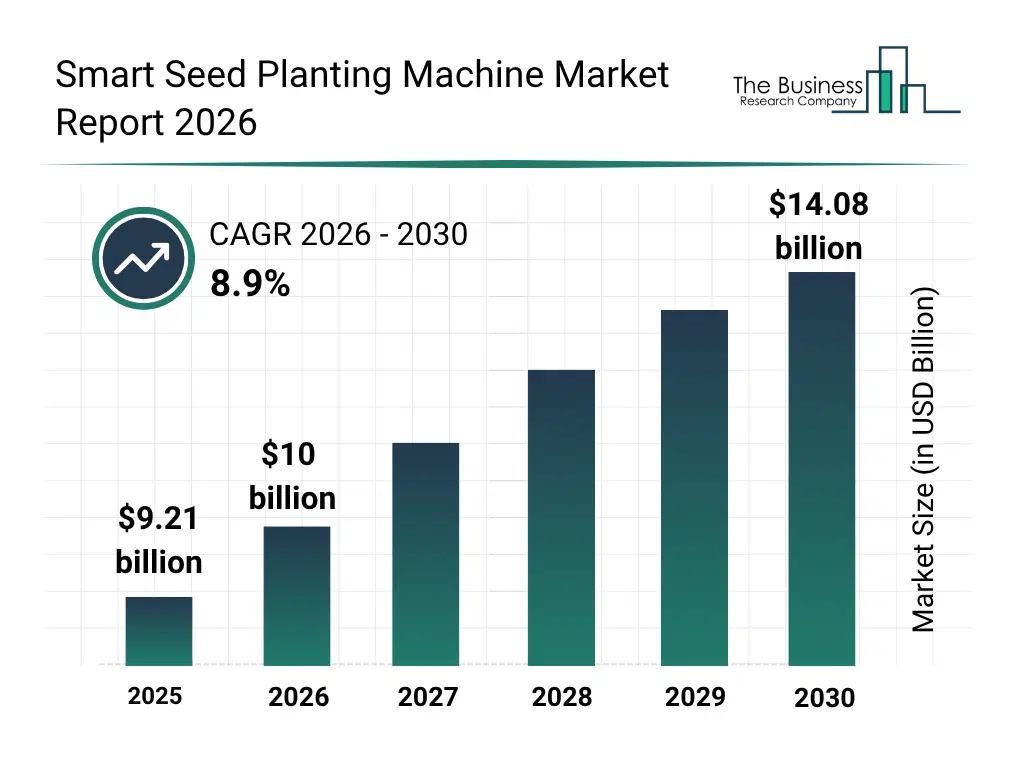
What Is The Smart Seed Planting Machine Market Size and Share 2026?
The smart seed planting machine market size has grown strongly in recent years. It will grow from $9.21 billion in 2025 to $10 billion in 2026 at a compound annual growth rate (CAGR) of 8.7%. The growth in the historic period can be attributed to mechanization of traditional farming practices, increasing demand for food production efficiency, adoption of basic seed drills in agriculture, rising labor shortages in rural farming, early introduction of mechanized planting equipment.What Is The Smart Seed Planting Machine Market Growth Forecast?
The smart seed planting machine market size is expected to see strong growth in the next few years. It will grow to $14.08 billion in 2030 at a compound annual growth rate (CAGR) of 8.9%. The growth in the forecast period can be attributed to increasing adoption of precision agriculture techniques, rising demand for sustainable farming practices, expansion of autonomous farm machinery usage, integration of AI based crop yield optimization, growing need for efficient large scale agricultural production. Major trends in the forecast period include gps enabled precision seeding automation in large scale farms, variable rate seed placement for yield optimization, sensor based soil condition adaptive planting systems, iot connected smart seeder fleet management solutions, autonomous tractor integrated seed planting systems.
Global Smart Seed Planting Machine Market Segmentation
1) By Type: Vacuum Precision Planters, Pneumatic Precision Planters, Mechanical Seed Drills, Automatic Multi Crop Seed Cum Fertilizer Drills, Other Seed Planting Machine Types 2) By Technology: Global Positioning System Enabled Systems, Internet Of Things Integrated Systems, Artificial Intelligence And Machine Learning Based Systems, Sensor Based Variable Rate Technology Systems, Robotics And Autonomous Control Systems 3) By Crop Type: Row Crops, Grains And Cereals, Pulses And Oilseeds, Vegetables And Fruits, Forestry 4) By Distribution Channel: Direct Sales, Indirect Sales 5) By Farm Size: Small Farms Below 400 Hectares, Large Farms Above 400 Hectares Subsegments: 1) By Vacuum Precision Planters: Single Row Vacuum Precision Planters, Multi Row Vacuum Precision Planters, High Accuracy Vacuum Precision Planters, Global Positioning System Enabled Vacuum Precision Planters 2) By Pneumatic Precision Planters: Single Row Pneumatic Precision Planters, Multi Row Pneumatic Precision Planters, High Speed Pneumatic Precision Planters, Variable Rate Pneumatic Precision Planters 3) By Mechanical Seed Drills: Conventional Mechanical Seed Drills, No Till Mechanical Seed Drills, Row Crop Mechanical Seed Drills, Towed Mechanical Seed Drills 4) By Automatic Multi Crop Seed Cum Fertilizer Drills: Fully Automatic Seed And Fertilizer Drills, Sensor Based Multi Crop Drills, Precision Controlled Seed Cum Fertilizer Drills, Computer Controlled Agricultural Drills 5) By Other Seed Planting Machine Types: Robotic Seed Planting Machines, Drone Assisted Seed Planting Systems, Handheld Smart Seeders, Hybrid Seed Planting MachinesWhat Is The Driver Of The Smart Seed Planting Machine Market?
The rising labor costs is expected to propel the growth of the smart seed planting machine market going forward. Labor costs in farming operations refer to the expenses incurred for hiring and managing workers involved in agricultural activities such as planting, harvesting, and farm maintenance. Labor costs are growing due to labor shortages in farming and increasing wage demands, as fewer workers are available for physically demanding agricultural tasks. Labor costs in farming operations drive the adoption of smart seed planting machines by encouraging farmers to reduce dependence on manual labor through automated planting solutions that improve efficiency, lower operational expenses, and ensure timely and accurate seeding. For instance, in September 2023, the U.S. Department of Agriculture’s Economic Research Service (ERS), a US-based Government agency, total cash labor expenses in the U.S. agriculture sector reached $43.35 billion in 2023, an increase of $0.78 billion (1.8%) from the 2022 level of $42.57 billion. Therefore, the rising labor costs is driving the growth of the smart seed planting machine industry.Key Players In The Global Smart Seed Planting Machine Market
Major companies operating in the smart seed planting machine market are Deere & Company, CNH Industrial N.V., Kubota Corporation, Mahindra & Mahindra Limited, AGCO Corporation, CLAAS KGaA mbH, Väderstad AB, Kinze Manufacturing Inc., Bourgault Industries Ltd., Jumil S.A., Amazonen-Werke H. Dreyer SE & Co. KG, Horsch Maschinen GmbH, Semeato S.A., Almaco Group Inc., Yetter Manufacturing Company Inc., Agrisem International SAS, Maschio Gaspardo S.p.A., Dharti Agro Engineering, Crucianelli S.A., Sfoggia Agriculture Division S.r.l.Global Smart Seed Planting Machine Market Trends and Insights
Major companies operating in the smart seed planting machine market are focusing on developing innovative products such as, electronic singulation-based smart seeders to improve seed placement accuracy, enhance crop uniformity, and increase overall planting efficiency. Electronic singulation-based smart seeders are precision planting systems that electronically separate and place individual seeds at uniform spacing and depth, helping improve germination consistency, reduce seed wastage, and increase crop yield and planting efficiency compared to conventional seeding methods. For instance, in November 2025, Clean Seed Capital Group Ltd., a Canada-based agricultural technology company, launched the SMART Seeder Mini-MAX with an advanced electronic singulation system designed to deliver seed-by-seed precision planting. The system is powered by a digital control platform that allows real-time adjustment of seed spacing and monitoring of seed delivery, ensuring uniform distribution across crops such as corn, maize, and soybean. It also supports retrofit capabilities, enabling existing seeding equipment to be upgraded with smart electronic modules, thereby improving scalability and adoption across diverse farming operations while enhancing sustainability and yield outcomes.What Are Latest Mergers And Acquisitions In The Smart Seed Planting Machine Market?
In May 2025, Dotcom IoT LLP, an India-based IoT solutions and embedded systems company, partnered with Dharti Agro Engineering to develop the Smart Seed Planter for precision sowing using automated, speed-based seed spacing control. With this partnership, both companies aim to enable precision agriculture by automating seed placement based on real-time machine speed, thereby improving sowing efficiency, reducing manual effort, and increasing crop productivity. Dharti Agro Engineering is an India-based agricultural machinery manufacturing company specializing in providing advanced, automatic seed drilling and planting machines.Regional Outlook/Insights
North America was the largest region in the smart seed planting machine market in 2025. Asia-Pacific is expected to be the fastest-growing region in the forecast period. The regions covered in this market report are Asia-Pacific, South East Asia, Western Europe, Eastern Europe, North America, South America, Middle East, Africa. The countries covered in this market report are Australia, Brazil, China, France, Germany, India, Indonesia, Japan, Taiwan, Russia, South Korea, UK, USA, Canada, Italy, Spain.What Defines the Smart Seed Planting Machine Market?
The smart seed planting machine market consists of sales of precision seed drills, automated seeders, GPS-enabled planters, robotic seed planting systems, pneumatic planters, variable rate seeders, and other smart planting equipment used for mechanized sowing operations. Values in this market are ‘factory gate’ values, that is, the value of goods sold by the manufacturers or creators of the goods, whether to other entities (including downstream manufacturers, wholesalers, distributors, and retailers) or directly to end customers. The value of goods in this market includes related services sold by the creators of the goods.How is Market Value Defined and Measured?
The market value is defined as the revenues that enterprises gain from the sale of goods and/or services within the specified market and geography through sales, grants, or donations in terms of the currency (in USD unless otherwise specified). The revenues for a specified geography are consumption values that are revenues generated by organizations in the specified geography within the market, irrespective of where they are produced. It does not include revenues from resales along the supply chain, either further along the supply chain or as part of other products.What Key Data and Analysis Are Included in the Smart Seed Planting Machine Market Report 2026?
The smart seed planting machine market research report is one of a series of new reports from The Business Research Company that provides market statistics, including industry global market size, regional shares, competitors with the market share, detailed market segments, market trends and opportunities, and any further data you may need to thrive in the smart seed planting machine industry. The market research report delivers a complete perspective of everything you need, with an in-depth analysis of the current and future state of the industry.Smart Seed Planting Machine Market Report Forecast Analysis
| Report Attribute | Details |
|---|---|
| Market Size Value In 2026 | $10 billion |
| Revenue Forecast In 2035 | $14.08 billion |
| Growth Rate | CAGR of 8.9% from 2026 to 2035 |
| Base Year For Estimation | 2025 |
| Actual Estimates/Historical Data | 2020-2025 |
| Forecast Period | 2026 - 2030 - 2035 |
| Market Representation | Revenue in USD Billion and CAGR from 2026 to 2035 |
| Segments Covered | Type, Technology, Crop Type, Distribution Channel, Farm Size |
| Regional Scope | Asia-Pacific, Western Europe, Eastern Europe, North America, South America, Middle East, Africa |
| Country Scope | The countries covered in the report are Australia, Brazil, China, France, Germany, India, Indonesia, Japan, Taiwan, Russia, South Korea, UK, USA, Canada, Italy, Spain. |
| Key Companies Profiled | Deere & Company, CNH Industrial N.V., Kubota Corporation, Mahindra & Mahindra Limited, AGCO Corporation, CLAAS KGaA mbH, Väderstad AB, Kinze Manufacturing Inc., Bourgault Industries Ltd., Jumil S.A., Amazonen-Werke H. Dreyer SE & Co. KG, Horsch Maschinen GmbH, Semeato S.A., Almaco Group Inc., Yetter Manufacturing Company Inc., Agrisem International SAS, Maschio Gaspardo S.p.A., Dharti Agro Engineering, Crucianelli S.A., Sfoggia Agriculture Division S.r.l. |
| Customization Scope | Request for Customization |
| Pricing And Purchase Options | Explore Purchase Options |