

Smart Shoes Market Report 2026
Global Outlook – By Product Type (Fitness Tracking Shoes, Running Smart Shoes, Walking Smart Shoes, Sports Performance Smart Shoes, Navigation Smart Shoes, Medical Monitoring Smart Shoes, Self Lacing Smart Shoes, Other Product Types), By Technology (Sensor Based Technology, Global Positioning System Technology, Bluetooth Connectivity, Wireless Fidelity Enabled Technology, Near Field Communication Technology, Artificial Intelligence Integrated Technology, Pressure Monitoring Technology, Motion Tracking Technology, Other Technologies), By Distribution Channel (Online Retail, Specialty Stores, Supermarkets And Hypermarkets, Brand Outlets, Electronic Stores, Other Distribution Channels), By Application (Fitness And Sports, Healthcare Monitoring, Lifestyle And Fashion, Military And Defense, Industrial Safety, Rehabilitation And Therapy, Other Applications), By End User (Athletes And Fitness Enthusiasts, Recreational Users, Medical And Rehabilitation Patients, Geriatric Population, Professional Sports Teams) – Market Size, Trends, Strategies, and Forecast to 2030
Smart Shoes Market Overview
• Smart Shoes market size has reached to $0.82 billion in 2025 • Expected to grow to $2.12 billion in 2030 at a compound annual growth rate (CAGR) of 20.8% • Growth Driver: Rising Prevalence Of Lifestyle-Related Health Issues Driving The Market Due To Increasing Sedentary Lifestyles Leading To Higher Obesity, Diabetes, And Heart Disease Cases • Market Trend: AI-Enabled Sensor-Integrated Adaptive Footwear Advancing Personalized Health Monitoring And Movement Optimization • North America was the largest region in 2025 and Asia-Pacific is the fastest growing region.What Is Covered Under Smart Shoes Market?
Smart shoes are intelligent footwear equipped with advanced technologies, including embedded electronics and sensors, to monitor user activity, health metrics, gait, posture, and location in real time. They are designed to improve comfort, fitness tracking, safety, and overall performance by collecting and analyzing movement data, making them suitable for sports, healthcare, industrial, and everyday use. The main product types of smart shoes include fitness tracking shoes, running smart shoes, walking smart shoes, sports performance smart shoes, navigation smart shoes, medical monitoring smart shoes, self lacing smart shoes, and other product types. Fitness tracking shoes refer to intelligent footwear equipped with embedded sensors and connectivity features that monitor physical activity, movement patterns, and performance metrics in real time. These shoes incorporate technologies such as sensor based technology, global positioning system technology, Bluetooth connectivity, wireless fidelity enabled technology, near field communication technology, artificial intelligence integrated technology, pressure monitoring technology, motion tracking technology, and other technologies and are distributed through online retail, specialty stores, supermarkets and hypermarkets, brand outlets, electronic stores, and other distribution channels. The key applications of fitness and sports, healthcare monitoring, lifestyle and fashion, military and defense, industrial safety, rehabilitation and therapy, and others, while the end-users athletes and fitness enthusiasts, recreational users, medical and rehabilitation patients, geriatric population, and professional sports teams.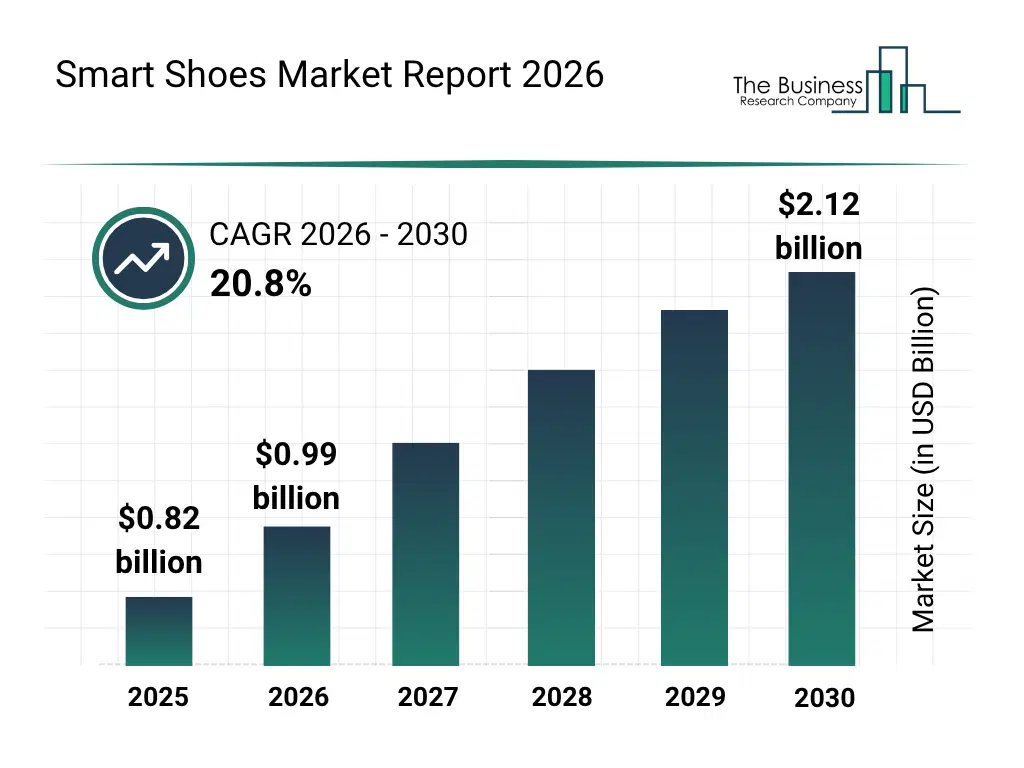
What Is The Smart Shoes Market Size and Share 2026?
The smart shoes market size has grown exponentially in recent years. It will grow from $0.82 billion in 2025 to $0.99 billion in 2026 at a compound annual growth rate (CAGR) of 21.3%. The growth in the historic period can be attributed to increasing popularity of wearable fitness products, rising health and wellness awareness among consumers, growing adoption of activity tracking devices, expanding sports and fitness participation, increasing demand for performance enhancing footwear.What Is The Smart Shoes Market Growth Forecast?
The smart shoes market size is expected to see exponential growth in the next few years. It will grow to $2.12 billion in 2030 at a compound annual growth rate (CAGR) of 20.8%. The growth in the forecast period can be attributed to growing demand for advanced health monitoring footwear, rising adoption of connected lifestyle products, expanding applications in medical rehabilitation and elderly care, increasing integration of smart features in everyday footwear, growing demand for personalized fitness and sports performance solutions. Major trends in the forecast period include increasing demand for personalized smart footwear solutions, rising adoption of footwear integrated with advanced comfort features, growing preference for connected footwear with real time performance insights, expanding use of intelligent shoes for safety and rehabilitation applications, increasing focus on lightweight and durable smart footwear designs.
Global Smart Shoes Market Segmentation
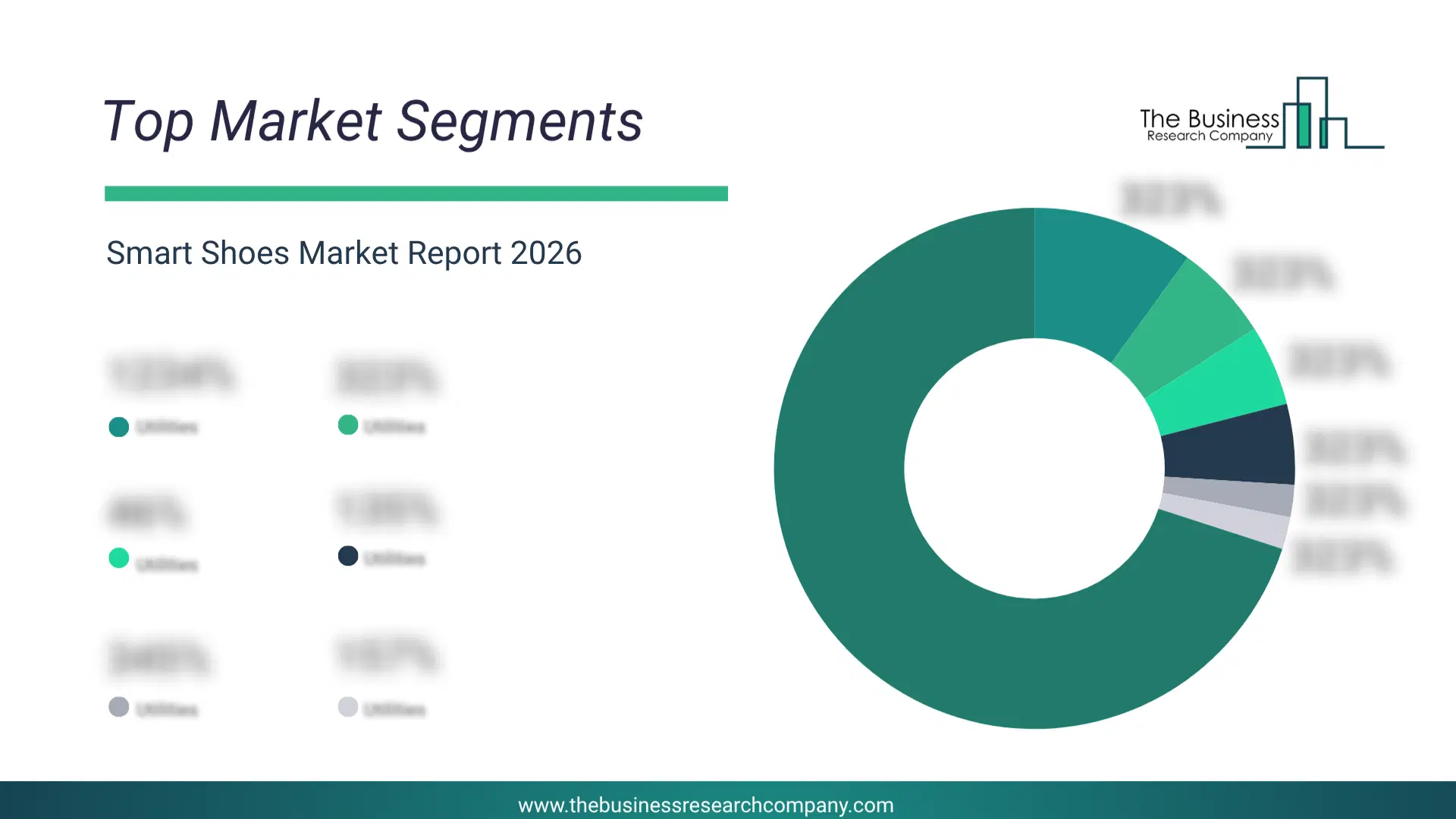
1) By Product Type: Fitness Tracking Shoes, Running Smart Shoes, Walking Smart Shoes, Sports Performance Smart Shoes, Navigation Smart Shoes, Medical Monitoring Smart Shoes, Self Lacing Smart Shoes, Other Product Types 2) By Technology: Sensor Based Technology, Global Positioning System Technology, Bluetooth Connectivity, Wireless Fidelity Enabled Technology, Near Field Communication Technology, Artificial Intelligence Integrated Technology, Pressure Monitoring Technology, Motion Tracking Technology, Other Technologies 3) By Distribution Channel: Online Retail, Specialty Stores, Supermarkets And Hypermarkets, Brand Outlets, Electronic Stores, Other Distribution Channels 4) By Application: Fitness And Sports, Healthcare Monitoring, Lifestyle And Fashion, Military And Defense, Industrial Safety, Rehabilitation And Therapy, Other Applications 5) By End User: Athletes And Fitness Enthusiasts, Recreational Users, Medical And Rehabilitation Patients, Geriatric Population, Professional Sports Teams Subsegments: 1) By Fitness Tracking Shoes: Activity Tracking Shoes, Biometric Monitoring Shoes, Gait Analysis Shoes, Posture Monitoring Shoes 2) By Running Smart Shoes: Performance Tracking Running Shoes, Stride Analysis Running Shoes, Impact Monitoring Running Shoes, Adaptive Cushioning Running Shoes 3) By Walking Smart Shoes: Daily Activity Walking Shoes, Health Monitoring Walking Shoes, Posture Correction Walking Shoes, Fall Detection Walking Shoes 4) By Sports Performance Smart Shoes: Training Optimization Sports Shoes, Force Measurement Sports Shoes, Motion Analysis Sports Shoes, Real Time Coaching Sports Shoes 5) By Navigation Smart Shoes: Global Positioning System Enabled Navigation Shoes, Haptic Feedback Navigation Shoes, Turn By Turn Guidance Shoes, Location Tracking Safety Shoes 6) By Medical Monitoring Smart Shoes: Diabetic Foot Monitoring Shoes, Pressure Ulcer Prevention Shoes, Rehabilitation Monitoring Shoes, Circulation Monitoring Shoes 7) By Self Lacing Smart Shoes: Automatic Fit Adjustment Shoes, Application Controlled Lacing Shoes, Pressure Responsive Lacing Shoes, Adaptive Tension Control Shoes 8) By Other Product Types: Hybrid Smart Shoes, Modular Smart Shoes, Multi Sensor Smart Shoes, Convertible Function Smart ShoesWhat Is The Driver Of The Smart Shoes Market?
The increasing prevalence of lifestyle-related health issues is expected to propel the growth of the smart shoes market going forward. Lifestyle-related health issues are diseases and conditions that develop mainly due to unhealthy habits such as poor diet, lack of exercise, smoking, alcohol use, and chronic stress. Lifestyle-related health issues are increasing mainly due to sedentary lifestyles, where reduced physical activity from desk jobs and screen-based habits leads to obesity, diabetes, and heart-related diseases. Smart shoes help reduce lifestyle-related health issues by tracking activity and encouraging more movement, which supports healthier habits and lowers the risk of obesity, diabetes, and heart diseases. For instance, in March 2024, according to the National Library of Medicine, a US-based medical library, projections suggest that the number of diabetes (one of the lifestyle-related health issues) cases will rise to 783 million by 2045. Therefore, the increasing prevalence of lifestyle-related health issues is driving the growth of the smart shoes industry.Key Players In The Global Smart Shoes Market
Major companies operating in the smart shoes market are NIKE Inc., Xiaomi Corporation, adidas AG, PUMA SE, ASICS Corporation, Skechers U.S.A. Inc., Under Armour Inc., New Balance Holding Inc., Li Ning Company Limited, Mizuno Corporation, Sensoria Health Inc., Digitsole SAS, SALTED Co. Ltd., Powerlace Technology Inc., FeetMe SAS, ORPHE Inc., Zhor-Tech, Ducere Technologies Private Limited, Boltt Sports Technologies Private Limited, ReTiSense Tech India Private Limited, Intellinium SAS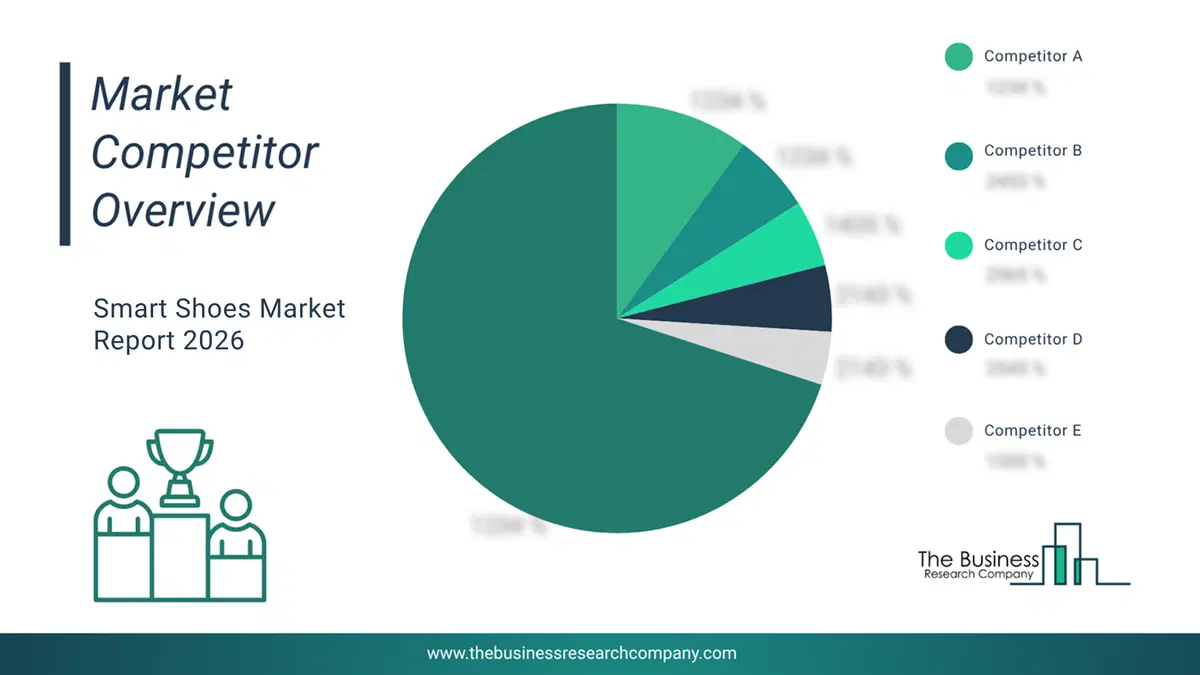
This chart is for illustrative purposes; the full report includes a detailed competitor analysis and comprehensive overview of the top 10 companies in the market.
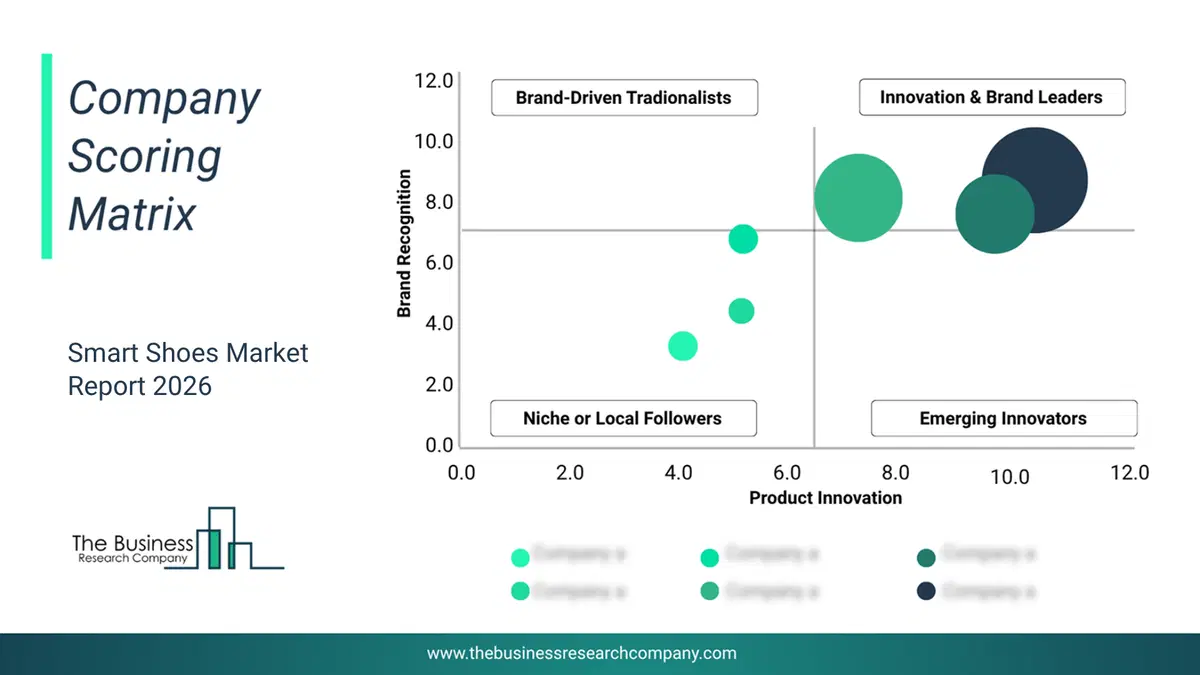
This chart maps companies by product innovation and brand strength, with bubble size indicating relative revenue, helping identify market leaders, challengers, and niche players. This is an illustrative chart; the full report provides a complete and accurate competitive analysis.
Global Smart Shoes Market Trends and Insights
Major companies operating in the smart shoes market are focusing on developing innovative solutions such as artificial intelligence (AI) powered smart footwear to enhance user safety, wellness monitoring, and connected fitness experiences. AI-powered smart footwear integrates intelligent sensors and connectivity features to enable functions such as activity tracking, fall detection, and emergency alerts. For instance, in October 2025, Ajanta Shoes Pvt. Ltd., an India-based footwear manufacturer, launched the Impakto Navigator, an AI-powered smart shoe. The product integrates SOS alerts, fall detection, and gamified fitness tracking to enhance user safety, health monitoring, and engagement. It strengthens Ajanta Shoes' presence in the smart footwear market by combining artificial intelligence-driven technology with everyday footwear.What Are Latest Mergers And Acquisitions In The Smart Shoes Market?
In October 2025, Nike Inc., a US-based sportswear and footwear company, partnered with Dephy Inc. to develop Project Amplify, a powered footwear system designed to enhance running and walking performance. Through this partnership, Nike and Dephy aim to improve everyday athletic movement by integrating a lightweight motor, drive belt, rechargeable battery, motion algorithms, and a carbon fiber-plated running shoe to provide additional power and reduce the effort required for running and walking. Dephy Inc. is a US-based robotics technology company that develops wearable robotic systems and powered movement technologies relevant to smart footwear.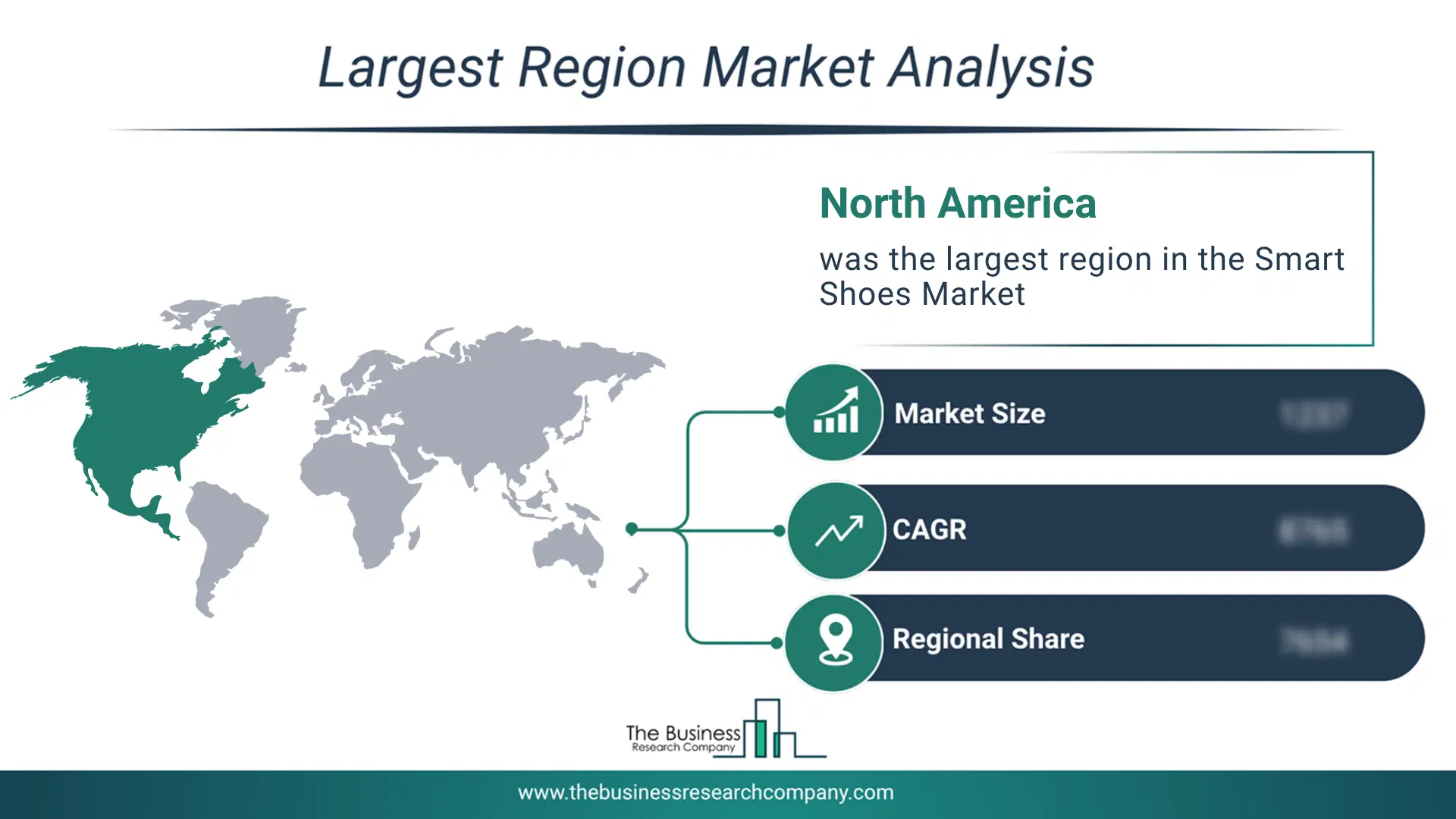
Regional Outlook
North America was the largest region in the smart shoes market in 2025. Asia-Pacific is expected to be the fastest-growing region in the forecast period. The regions covered in this market report are Asia-Pacific, South East Asia, Western Europe, Eastern Europe, North America, South America, Middle East, Africa. The countries covered in this market report are Australia, Brazil, China, France, Germany, India, Indonesia, Japan, Taiwan, Russia, South Korea, UK, USA, Canada, Italy, Spain.What Defines the Smart Shoes Market?
The smart shoes market consists of revenues earned by entities by providing services such as navigation and wayfinding smart shoes, fall detection and emergency alert solutions, indoor positioning and location tracking, and workforce and employee tracking solutions. The market value includes the value of related goods sold by the service provider or included within the service offering. The smart shoes market also includes sales of posture correction smart shoes, rehabilitation smart shoes, and industrial safety smart shoes. Values in this market are ‘factory gate’ values, that is, the value of goods sold by the manufacturers or creators of the goods, whether to other entities (including downstream manufacturers, wholesalers, distributors, and retailers) or directly to end customers. The value of goods in this market includes related services sold by the creators of the goods.How is Market Value Defined and Measured?
The market value is defined as the revenues that enterprises gain from the sale of goods and/or services within the specified market and geography through sales, grants, or donations in terms of the currency (in USD unless otherwise specified). The revenues for a specified geography are consumption values that are revenues generated by organizations in the specified geography within the market, irrespective of where they are produced. It does not include revenues from resales along the supply chain, either further along the supply chain or as part of other products.
This chart presents market attractiveness based on a quantitative evaluation of growth, competition, strategic alignment, and risk, offering a clear view of opportunity areas for decision-making. This chart is for illustrative purposes; the full report contains the complete analysis.

This chart highlights the Total Addressable Market (TAM) by estimating the maximum revenue opportunity using an assumption-driven approach, supporting strategic planning and opportunity sizing across markets. The chart is illustrative; the full report provides a more comprehensive analysis.
What Key Data and Analysis Are Included in the Smart Shoes Market Report 2026?
The smart shoes market research report is one of a series of new reports from The Business Research Company that provides market statistics, including industry global market size, regional shares, competitors with the market share, detailed market segments, market trends and opportunities, and any further data you may need to thrive in the smart shoes industry. The market research report delivers a complete perspective of everything you need, with an in-depth analysis of the current and future state of the industry.Smart Shoes Market Report Forecast Analysis
| Report Attribute | Details |
|---|---|
| Market Size Value In 2026 | $0.99 billion |
| Revenue Forecast In 2030 | $2.12 billion |
| Growth Rate | CAGR of 20.8% from 2026 to 2030 |
| Base Year For Estimation | 2025 |
| Actual Estimates/Historical Data | 2020-2025 |
| Forecast Period | 2026 - 2030 |
| Market Representation | Revenue in USD Billion and CAGR from 2026 to 2030 |
| Segments Covered | Product Type, Technology, Distribution Channel, Application, End User |
| Regional Scope | Asia-Pacific, Western Europe, Eastern Europe, North America, South America, Middle East, Africa |
| Country Scope | The countries covered in the report are Australia, Brazil, China, France, Germany, India, Indonesia, Japan, Taiwan, Russia, South Korea, UK, USA, Canada, Italy, Spain. |
| Key Companies Profiled | NIKE Inc., Xiaomi Corporation, adidas AG, PUMA SE, ASICS Corporation, Skechers U.S.A. Inc., Under Armour Inc., New Balance Holding Inc., Li Ning Company Limited, Mizuno Corporation, Sensoria Health Inc., Digitsole SAS, SALTED Co. Ltd., Powerlace Technology Inc., FeetMe SAS, ORPHE Inc., Zhor-Tech, Ducere Technologies Private Limited, Boltt Sports Technologies Private Limited, ReTiSense Tech India Private Limited, Intellinium SAS |
| Customization Scope | Request for Customization |
| Pricing And Purchase Options | Explore Purchase Options |