
Smart Street Lighting Market Report 2026
Global Outlook – By Type ( Light Emitting Diode, Compact Fluorescent lamps, Incandescent, Other Types), By Communication Technology ( NB-IOT, Powerline Communication, Radio Frequency, Other Communication Technologies), By Energy Source ( Traditional And Other Renewable Energy, Solar), By Application ( Environment Monitoring, Traffic Optimization, Smart Parking, Other Applications), By End User ( Commercial, Residential, Industrial) – Market Size, Trends, Strategies, and Forecast to 2030
Smart Street Lighting Market Overview
• Smart Street Lighting market size has reached to $2.96 billion in 2025 • Expected to grow to $7.49 billion in 2030 at a compound annual growth rate (CAGR) of 20.4% • Growth Driver: Smart City Initiatives Propel Surge In Smart Street Lighting Market Growth • Market Trend: Connected Streetlight Platform Redefining Smart Street Lighting Solutions • North America was the largest region in 2025.Market Gains By 2030 – Top Opportunities By Segment
Market Gain identifies the most promising market opportunities by highlighting the segments or products expected to generate the highest incremental revenue growth over the next five years.
What Is Covered Under Smart Street Lighting Market?
Smart street lighting refers to a type of streetlight used for general illumination that includes technology like cameras, light-sensing photocells and other sensors. Smart street lighting is used in traffic, parking, pedestrian crossings, seismic activity and atmospheric changes can all be monitored with the use of smart street lighting. The main types of smart street lighting are light emitting diode, compact fluorescent lamps, incandescent and others. LED refers to a semiconductor device when electric current flows through a Light Emitting Diode (LED), which can emit light. The various communication technologies involved are NB-IOT, powerline communication, radio frequency and others that use traditional and other renewable energy and solar energy source. The various application involved are environmental monitoring, traffic optimization, smart parking and others that are used by commercial, residential and industrial end users.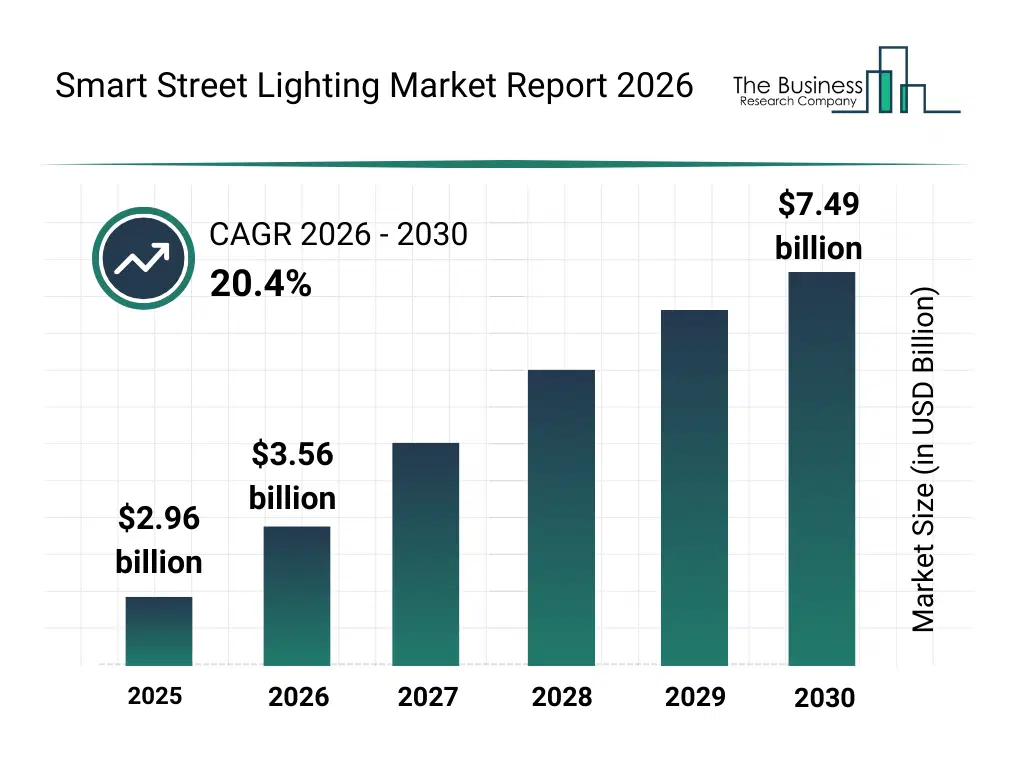
What Is The Smart Street Lighting Market Size 2026 And Growth Rate?
The smart street lighting market size has grown exponentially in recent years. It will grow from $2.96 billion in 2025 to $3.56 billion in 2026 at a compound annual growth rate (CAGR) of 20.4%. The growth in the historic period can be attributed to growth in municipal street lighting upgrades, expansion of urban infrastructure projects, reliance on traditional lighting systems, early adoption of led-based lighting, development of centralized streetlight monitoring.What Is The Smart Street Lighting Market Growth Forecast?
The smart street lighting market size is expected to see exponential growth in the next few years. It will grow to $7.49 billion in 2030 at a compound annual growth rate (CAGR) of 20.4%. The growth in the forecast period can be attributed to increasing deployment of connected streetlight platforms, rising demand for renewable-powered lighting systems, growth in smart city initiatives worldwide, expansion of sensor-based environmental monitoring, development of advanced traffic optimization solutions. Major trends in the forecast period include expansion of IoT-enabled street lighting networks, adoption of energy-efficient led smart lighting, development of autonomous lighting control systems, advancement of AI-based urban monitoring solutions, integration of smart mobility and traffic lighting platforms.
Global Smart Street Lighting Market Segmentation
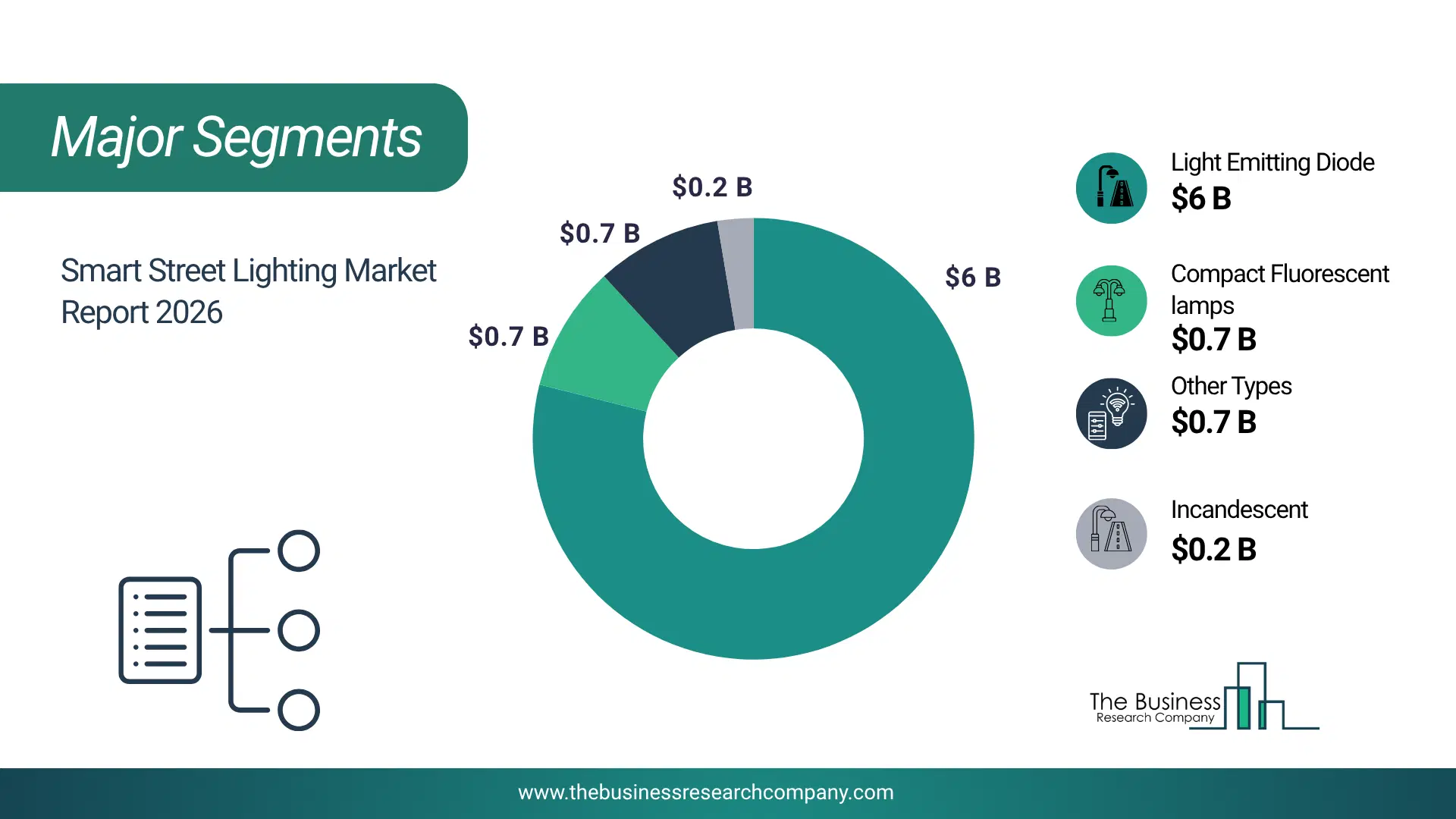
1) By Type: Light Emitting Diode, Compact Fluorescent lamps, Incandescent, Other Types 2) By Communication Technology: NB-IOT, Powerline Communication, Radio Frequency, Other Communication Technologies 3) By Energy Source: Traditional And Other Renewable Energy, Solar 4) By Application: Environment Monitoring, Traffic Optimization, Smart Parking, Other Applications 5) By End User: Commercial, Residential, Industrial Subsegments: 1) By Light Emitting Diode (LED): Standard LED, Smart LED 2) By Compact Fluorescent Lamps (CFL): Standard CFL, Smart CFL 3) By Incandescent: Standard Incandescent, Smart Incandescent 4) By Other Types: Solar-Powered Lights, High-Intensity Discharge (HID) Lights, Induction Lamps The top segments in the smart street lighting market will be: • Light Emitting Diode will reach $5.85 Billion by 2030. • Compact Fluorescent lamps will reach $0.72 Billion by 2030. • Other Types will reach $0.65 Billion by 2030. • Incandescent will reach $0.19 Billion by 2030.What Is The Driver Of The Smart Street Lighting Market?
Emerging smart cities are significantly contributing to the growth of the smart street lighting market. A smart city is a municipality that makes use of information and communication technology (ICT) to boost administrative effectiveness, disseminate information to the general public, and enhance the standard of public services as well as the welfare of its residents. Installing intelligent lighting can assist in increasing citizen satisfaction with security and safety while giving towns significant savings in power consumption and lighting system maintenance, in addition to enabling cities to offer the right amount of street light for local conditions. For instance, in March 2024, according to AXA Investment Managers, a France-based investment management firm, the global smart cities sector is projected to reach a valuation of US$3.7 trillion by 2030, indicating significant growth potential and strong investment opportunities. Therefore, emerging smart cities are driving the growth of the smart street lighting industry.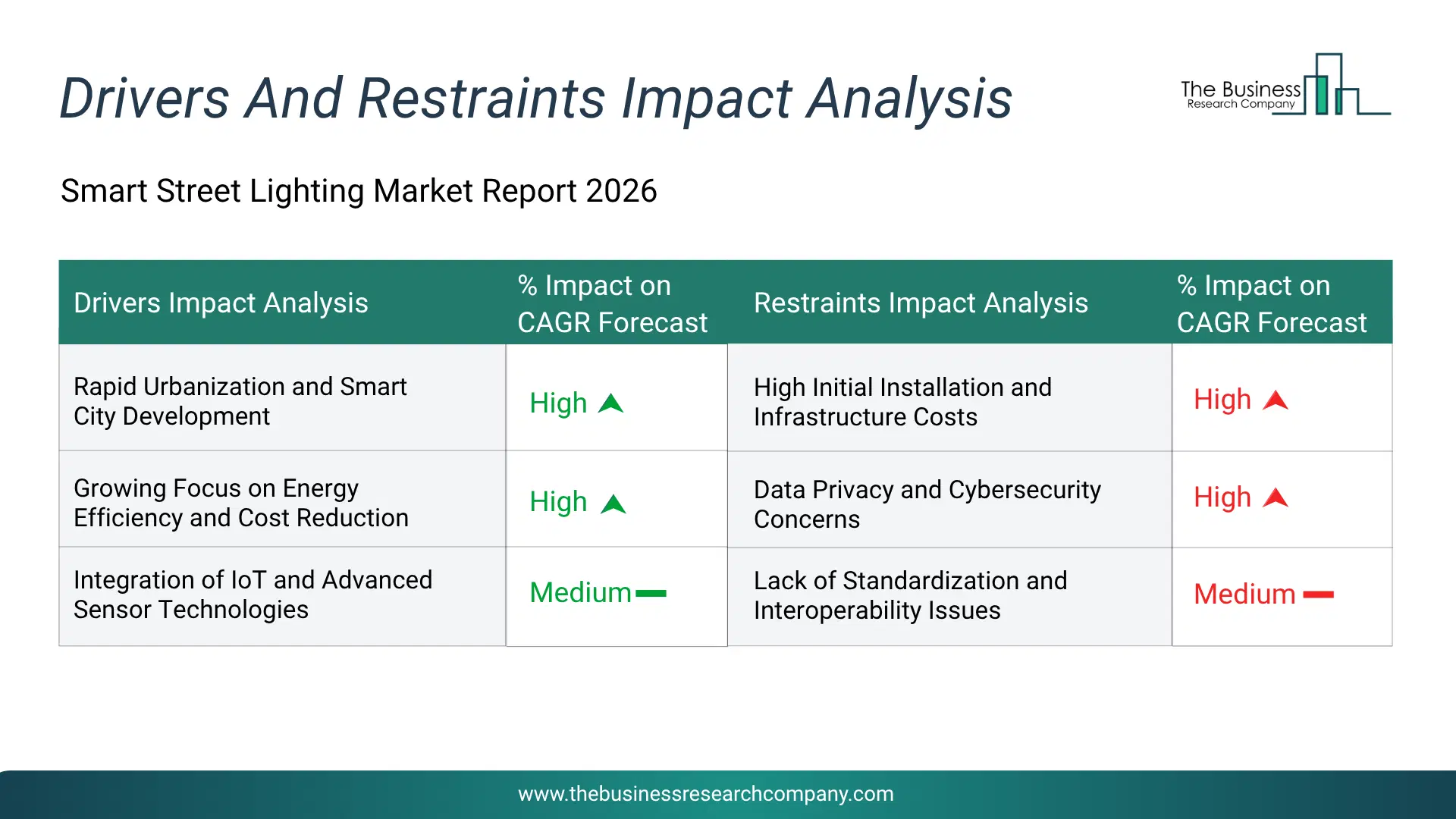
Infographic Chart Showing Key Market Drivers Analysis And Restraints For Smart Street Lighting Market
The chart presents an impact analysis of key drivers and restraints, quantifying their relative influence on the market's growth rate and helping assess the balance between growth enablers and limiting factors. This chart offers a high-level perspective; the full report contains more detailed insights.
How Will The Drivers Impact Growth In The Global Smart Street Lighting Market?
• Rapid Urbanization and Smart City Development (High) – rapid urbanization and smart city development is expected to become a key growth driver for the smart street lighting market by 2030. The increasing pace of urbanization across both developed and emerging economies is a major factor driving demand for smart street lighting solutions. As cities expand, there is a growing need for efficient, scalable, and intelligent infrastructure to manage public utilities such as lighting. Governments are investing heavily in smart city initiatives, where connected street lighting systems act as foundational infrastructure. These systems enable integration with traffic monitoring, environmental sensing, and public safety networks. Smart streetlights also support centralized control and automation, reducing operational costs and improving service delivery. Furthermore, urban planners prioritize sustainable and technology-driven solutions, accelerating adoption. • Growing Focus on Energy Efficiency and Cost Reduction (High) – During the forecast period, the growing focus on energy efficiency and cost reduction is expected to emerge as a major factor driving the expansion of the smart street lighting market by 2030. Energy efficiency is a key driver influencing the adoption of smart street lighting systems globally. Traditional street lighting systems consume significant amounts of electricity and require frequent maintenance, leading to high operational expenses. Smart lighting solutions, particularly those integrated with LED technology and adaptive controls, significantly reduce energy consumption by adjusting brightness based on real-time conditions. Sensors and automated dimming features help optimize energy usage, especially during low-traffic hours. Additionally, remote monitoring and predictive maintenance capabilities minimize downtime and repair costs. Governments and municipalities are increasingly adopting these systems to meet sustainability targets and reduce carbon footprints. • Integration of IoT and Advanced Sensor Technologies (Medium) – During the forecast period, the integration of IoT and advanced sensor technologies is expected to act as a key growth catalyst for the smart street lighting market by 2030. The integration of Internet of Things (IoT) and advanced sensor technologies is significantly boosting the adoption of smart street lighting systems. These technologies enable streetlights to function beyond illumination by collecting and transmitting real-time data on traffic, weather, pollution, and public safety. Connected lighting infrastructure allows municipalities to monitor urban environments more effectively and make data-driven decisions. Features such as motion detection, adaptive lighting, and fault detection enhance operational efficiency and responsiveness. Moreover, IoT-enabled systems facilitate seamless communication between devices, improving coordination across city services. The increasing deployment of smart sensors and communication networks enhances the value proposition of smart street lighting.How Will The Restraints Impact Growth In The Global Smart Street Lighting Market?
• High Initial Installation and Infrastructure Costs (High) – During the forecast period, high initial installation and infrastructure costs are significantly restricting the growth of the smart street lighting market. The substantial capital required for smart lighting systems, including sensors, controllers, communication networks, and retrofitting existing infrastructure, is limiting adoption, particularly in developing and budget-constrained municipalities. • Data Privacy and Cybersecurity Concerns (High) – During the forecast period, data privacy and cybersecurity concerns are significantly restricting the growth of the smart street lighting market. Increasing reliance on connected systems and data-driven infrastructure raises risks related to data breaches, unauthorized access, and cyberattacks, which limits confidence in large-scale adoption of smart lighting solutions. • Lack of Standardization and Interoperability Issues (Medium) – During the forecast period, lack of standardization and interoperability issues are significantly restricting the growth of the smart street lighting market. The absence of unified communication protocols and compatibility across different vendors’ systems creates integration challenges, increases deployment complexity, and limits seamless scalability of smart lighting networks.Key Players In The Global Smart Street Lighting Market
Major companies operating in the smart street lighting market are Hubbell Lighting Inc., GE Lighting, Osram Licht AG, Koninklijke Philips N.V, Acuity Brands Lighting Inc., Eaton Corporation PLC, Schneider Electric SE, CREE Inc., Signify Holding, Telensa Limited, Itron Inc., Suzhou Rongwen KubAI Lighting Systems Co. Ltd., DimOnOff, Echelon Corp., SYSKA LED Lights, Rongwen Group, Havells Ltd., Tvilight Smart City Lighting, Petra Systems Inc., ShanghAI Sansi Technology Co. Ltd., Zumtobel Group, Flashnet, TVILIGHT Projects B.V., Bridgelux Inc., Liveable Cities, Quantela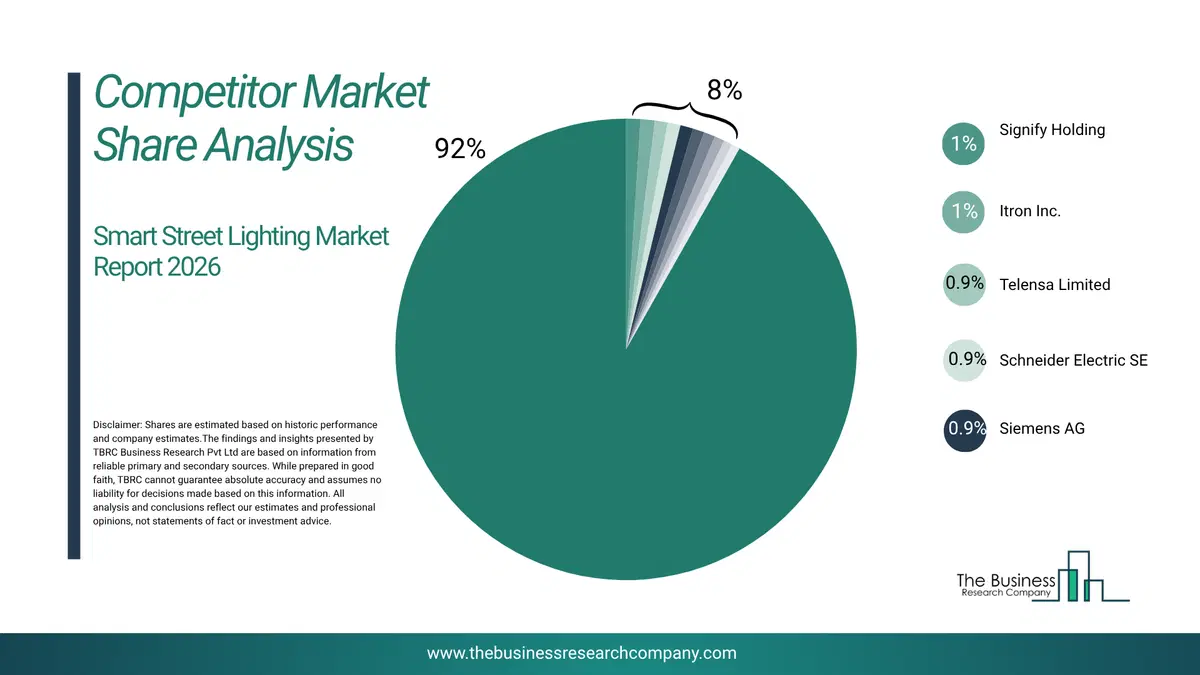
This chart is for illustrative purposes; the full report includes a detailed competitor analysis and comprehensive overview of the top 10 companies in the market.
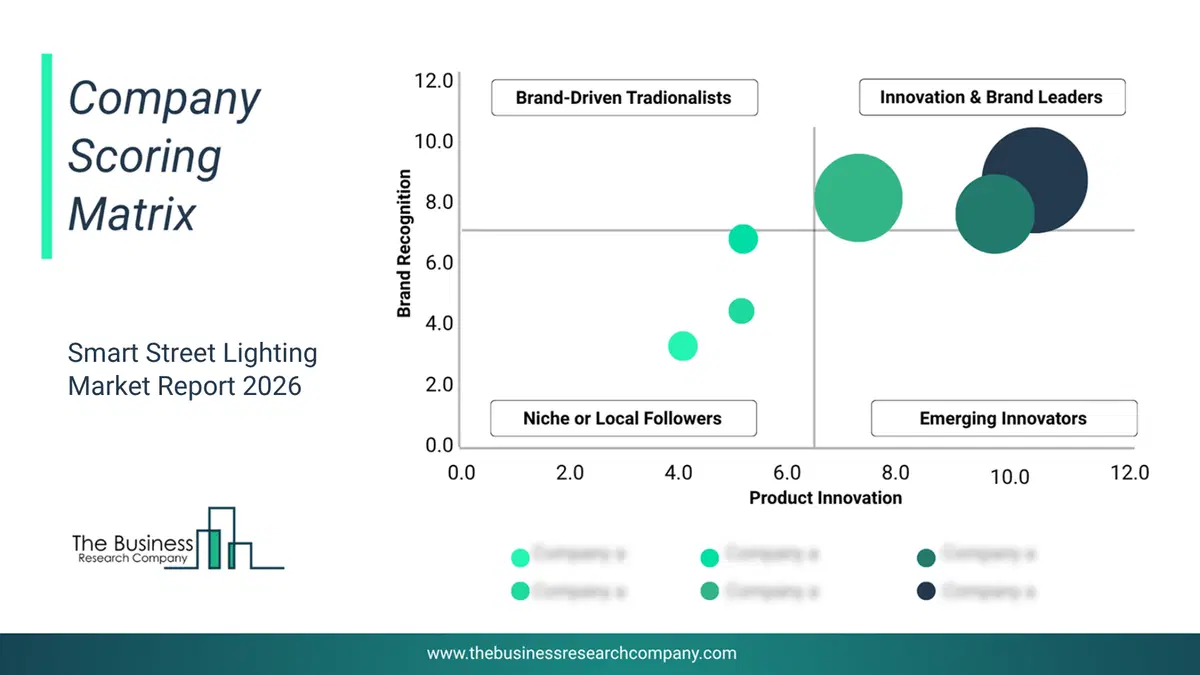
This chart maps companies by product innovation and brand strength, with bubble size indicating relative revenue, helping identify market leaders, challengers, and niche players. This is an illustrative chart; the full report provides a complete and accurate competitive analysis.
Global Smart Street Lighting Market Trends and Insights
Major companies operating in the smart street lighting market are introducing connected streetlight platform to sustain their position in the market. A connected streetlight platform is an integrated system that enables remote monitoring, control, and data management of streetlights through interconnected technologies. For instance, in October 2023, Telensa, a UK-based company that provides smart streetlight solutions, launched tech-neutral. Tech-neutral is a connected streetlight platform designed to provide a pragmatic approach for saving costs on energy bills and streamlining asset management. Tech-neutral platform uses hybrid approach to create unbeatable, precisely tailored smart streetlight solutions for customers, with radio and cellular wireless technologies working interchangeably from the management dashboard. Tech-neutral provides greater flexibility and choice in implementing smart street lighting solutions to customers for all geographies.What Are Latest Mergers And Acquisitions In The Smart Street Lighting Market?
In April 2025, Signify, a Netherlands-based provider of smart lighting systems, connected luminaires, and Internet of Things (IoT)-enabled lighting solutions, partnered with Cornerstone deploy city-wide multi-operator wireless network through street lighting. With this partnership, Signify aimed to expand its smart street lighting infrastructure into multi-operator wireless connectivity, enhancing its technological capabilities and diversifying its role within smart city ecosystems. Cornerstone is a UK-based provider of multi-operator wireless network infrastructure and neutral-host connectivity solutions designed to support smart city and telecommunications networks.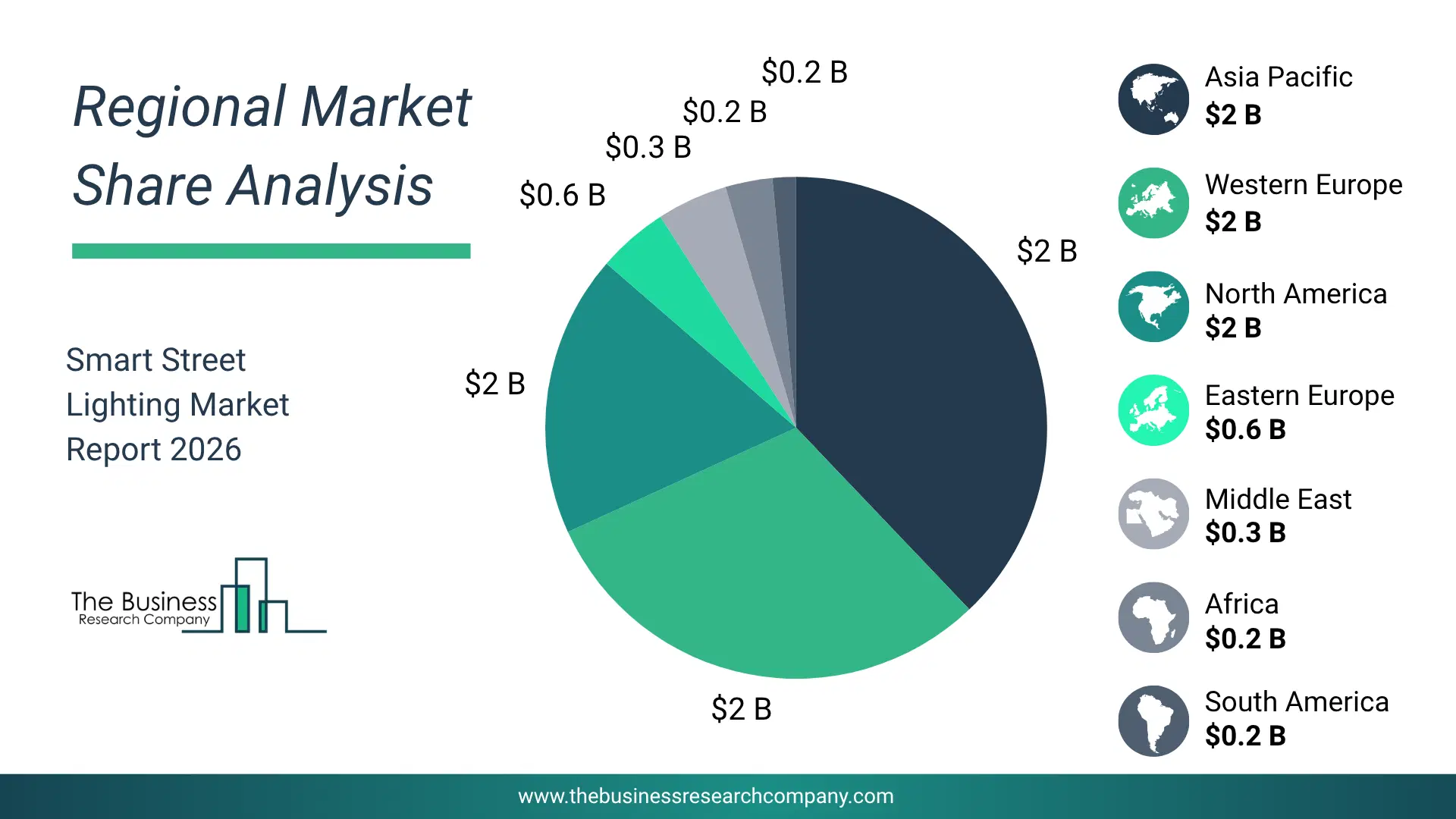
Regional Outlook
North America was the largest region in the smart street lighting market in 2025. The regions covered in this market report are Asia-Pacific, South East Asia, Western Europe, Eastern Europe, North America, South America, Middle East, Africa. The countries covered in this market report are Australia, Brazil, China, France, Germany, India, Indonesia, Japan, Taiwan, Russia, South Korea, UK, USA, Canada, Italy, Spain.What Defines the Smart Street Lighting Market?
The smart street lighting market consists of sales of wired street lighting and wireless street light. Values in this market are ‘factory gate’ values, that is the value of goods sold by the manufacturers or creators of the goods, whether to other entities (including downstream manufacturers, wholesalers, distributors and retailers) or directly to end customers. The value of goods in this market includes related services sold by the creators of the goods.How is Market Value Defined and Measured?
The market value is defined as the revenues that enterprises gain from the sale of goods and/or services within the specified market and geography through sales, grants, or donations in terms of the currency (in USD unless otherwise specified). The revenues for a specified geography are consumption values that are revenues generated by organizations in the specified geography within the market, irrespective of where they are produced. It does not include revenues from resales along the supply chain, either further along the supply chain or as part of other products.
This chart presents market attractiveness based on a quantitative evaluation of growth, competition, strategic alignment, and risk, offering a clear view of opportunity areas for decision-making. This chart is for illustrative purposes; the full report contains the complete analysis.

This chart highlights the Total Addressable Market (TAM) by estimating the maximum revenue opportunity using an assumption-driven approach, supporting strategic planning and opportunity sizing across markets. The chart is illustrative; the full report provides a more comprehensive analysis.
What Key Data and Analysis Are Included in the Smart Street Lighting Market Report 2026?
The smart street lighting market research report is one of a series of new reports from The Business Research Company that provides market statistics, including industry global market size, regional shares, competitors with the market share, detailed market segments, market trends and opportunities, and any further data you may need to thrive in the smart street lighting industry. The market research report delivers a complete perspective of everything you need, with an in-depth analysis of the current and future state of the industry.Smart Street Lighting Market Report Forecast Analysis Market Report Forecast Analysis
| Report Attribute | Details |
|---|---|
| Market Size Value In 2026 | $3.56 billion |
| Revenue Forecast In 2030 | $7.49 billion |
| Growth Rate | CAGR of 20.4% from 2026 to 2030 |
| Base Year For Estimation | 2025 |
| Actual Estimates/Historical Data | 2020-2025 |
| Forecast Period | 2026 - 2030 |
| Market Representation | Revenue in USD Billion and CAGR from 2026 to 2030 |
| Segments Covered | Type, Communication Technology, Energy Source, Application, End User |
| Regional Scope | Asia-Pacific, Western Europe, Eastern Europe, North America, South America, Middle East, Africa |
| Country Scope | The countries covered in the report are Australia, Brazil, China, France, Germany, India, Indonesia, Japan, Taiwan, Russia, South Korea, UK, USA, Canada, Italy, Spain. |
| Key Companies Profiled | Hubbell Lighting Inc., GE Lighting, Osram Licht AG, Koninklijke Philips N.V, Acuity Brands Lighting Inc., Eaton Corporation PLC, Schneider Electric SE, CREE Inc., Signify Holding, Telensa Limited, Itron Inc., Suzhou Rongwen KubAI Lighting Systems Co. Ltd., DimOnOff, Echelon Corp., SYSKA LED Lights, Rongwen Group, Havells Ltd., Tvilight Smart City Lighting, Petra Systems Inc., ShanghAI Sansi Technology Co. Ltd., Zumtobel Group, Flashnet, TVILIGHT Projects B.V., Bridgelux Inc., Liveable Cities, Quantela |
| Customization Scope | Request for Customization |
| Pricing And Purchase Options | Explore Purchase Options |