
Smart Streetlight Wildlife Sensor Market Report 2026
Global Outlook – By Sensor Type (Infrared Sensors, Ultrasonic Sensors, Camera-Based Sensors, Acoustic Sensors, Other Sensor Type), By Connectivity (Wired, Wireless), By Application (Urban Areas, Highways, Parks, Residential Areas, Other Application), By End-User (Municipalities, Smart Cities, Transportation Authorities, Environmental Agencies, Other End-User) – Market Size, Trends, Strategies, and Forecast to 2030
Smart Streetlight Wildlife Sensor Market Overview
• Smart Streetlight Wildlife Sensor market size has reached to $1.21 billion in 2025 • Expected to grow to $2.34 billion in 2030 at a compound annual growth rate (CAGR) of 13.9% • Growth Driver: Increasing Focus On Biodiversity And Wildlife Protection Fueling The Growth Of The Market Due To Rising Conservation Commitments • Market Trend: Smart Solar Streetlight Initiative Enhances Safety And Conservation In Ecologically Sensitive Regions • North America was the largest region in 2025 and Asia-Pacific is the fastest growing region.What Is Covered Under Smart Streetlight Wildlife Sensor Market?
A smart streetlight wildlife sensor is an advanced technology embedded in street lighting systems that continuously monitors the surrounding area for the presence or movement of animals using sensors, enabling real-time detection even in low-light conditions. It is designed to capture and process detailed data on wildlife activity, enabling precise and real-time monitoring across diverse environmental conditions and varying levels of visibility. The main sensor types of smart streetlight wildlife sensors are infrared sensors, ultrasonic sensors, camera-based sensors, acoustic sensors, and others. Infrared sensors refer to devices that detect and measure heat emitted by objects, enabling the sensing of presence, movement, or temperature without physical contact. It includes various connectivity types, such as wired and wireless, used for applications such as urban areas, highways, parks, residential areas, and others. Key end-users include municipalities, smart cities, transportation authorities, environmental agencies, and others.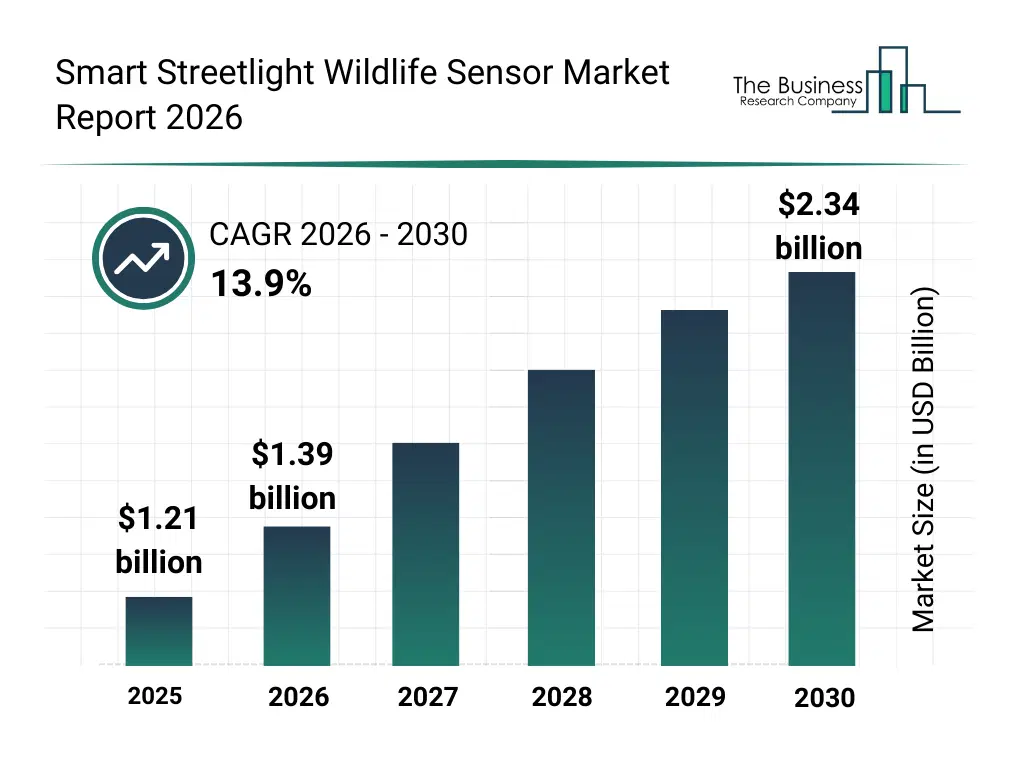
What Is The Smart Streetlight Wildlife Sensor Market Size and Share 2026?
The smart streetlight wildlife sensor market size has grown rapidly in recent years. It will grow from $1.21 billion in 2025 to $1.39 billion in 2026 at a compound annual growth rate (CAGR) of 14.9%. The growth in the historic period can be attributed to expansion of smart city lighting projects, increasing road wildlife collision incidents, early adoption of sensor-based monitoring, growth in environmental monitoring initiatives, availability of low-light sensing technologies.What Is The Smart Streetlight Wildlife Sensor Market Growth Forecast?
The smart streetlight wildlife sensor market size is expected to see rapid growth in the next few years. It will grow to $2.34 billion in 2030 at a compound annual growth rate (CAGR) of 13.9%. The growth in the forecast period can be attributed to increasing investments in smart city infrastructure, rising focus on wildlife conservation technologies, expansion of intelligent transportation safety systems, growing adoption of ai-based monitoring platforms, increasing integration with urban analytics systems. Major trends in the forecast period include increasing deployment of ai-enabled wildlife detection systems, rising integration with smart streetlight networks, expansion of multi-sensor monitoring platforms, growing use in road safety applications, enhanced focus on biodiversity protection.
Global Smart Streetlight Wildlife Sensor Market Segmentation
1) By Sensor Type: Infrared Sensors, Ultrasonic Sensors, Camera-Based Sensors, Acoustic Sensors, Other Sensor Type 2) By Connectivity: Wired, Wireless 3) By Application: Urban Areas, Highways, Parks, Residential Areas, Other Application 4) By End-User: Municipalities, Smart Cities, Transportation Authorities, Environmental Agencies, Other End-User Subsegments: 1) By Infrared Sensors: Passive Infrared Sensors, Active Infrared Sensors, Thermal Infrared Sensors 2) By Ultrasonic Sensors: Single Beam Ultrasonic Sensors, Multi Beam Ultrasonic Sensors, 3D Ultrasonic Sensors 3) By Camera-Based Sensors: Thermal Imaging Cameras, Low Light Cameras, High Resolution Cameras, Multispectral Cameras 4) By Acoustic Sensors: Directional Acoustic Sensors, Omnidirectional Acoustic Sensors, Ultrasonic Acoustic Sensors, Passive Acoustic Sensors 5) By Other Sensor Type: Radar Sensors, Lidar Sensors, Magnetic Sensors, Hybrid Multi-Sensor UnitsWhat Are The Drivers Of The Smart Streetlight Wildlife Sensor Market?
The increasing focus on biodiversity and wildlife protection is expected to propel the growth of the smart streetlight wildlife sensor market going forward. Biodiversity and wildlife protection refer to the preservation and sustainable management of species, habitats, and ecosystems to maintain ecological balance and ensure the survival of flora and fauna. The focus on biodiversity and wildlife protection is increasing as the accelerating impacts of climate change lead to widespread habitat loss, disrupting ecosystems and threatening the survival of countless species that are essential for maintaining ecological balance and supporting human livelihoods. Smart streetlight wildlife sensors are useful for biodiversity and wildlife protection as they detect animal movement, reduce light pollution, and minimize human-wildlife conflicts while ensuring safer coexistence. For instance, in October 2024, according to the Parliament of the United Kingdom, a UK-based governing body, under the international Convention on Biological Diversity (CBD), the UK has pledged to conserve 30% of its land and sea for nature by 2030. Therefore, the increasing focus on biodiversity and wildlife protection is driving the growth of the smart streetlight wildlife sensor industry. Expansion of smart city initiatives is expected to propel the growth of the smart streetlight wildlife sensor market going forward. Smart city initiatives refer to urban development programs that integrate digital technologies such as IoT, advanced sensors, and data analytics into city infrastructure to improve efficiency, sustainability, and quality of life for residents. As smart cities increasingly deploy connected infrastructure and sensor networks to monitor environmental conditions and urban mobility, integrating wildlife sensors into smart streetlight systems helps cities enhance safety, reduce light pollution, and support ecological monitoring thereby creating demand for wildlife‑aware street lighting solutions. For instance, in 2025, according to the IMD Business School (IMD) a Switzerland-based business school, the number of smart cities worldwide increased from 141 in 2023 to 142 in 2024, and further to 146 in 2025. Therefore, expansion of smart city initiatives is driving the growth of the smart streetlight wildlife sensor industry.Key Players In The Global Smart Streetlight Wildlife Sensor Market
Major companies operating in the smart streetlight wildlife sensor market are Huawei Technologies Co. Ltd., Eaton Corporation plc, Delta Electronics Inc., Signify N.V., OSRAM Licht AG, Acuity Brands Inc., Itron Inc., Silicon Laboratories Inc., Schreder Group, Lucy Group Ltd., CIMCON Lighting Inc., Ubicquia Inc., Telensa Limited, Leotek Electronics USA LLC, Dimonoff Inc., Soluxio Solar Lighting, Tvilight B.V., FlexSol Solutions, Citilight Holdings Pte. Ltd.,GE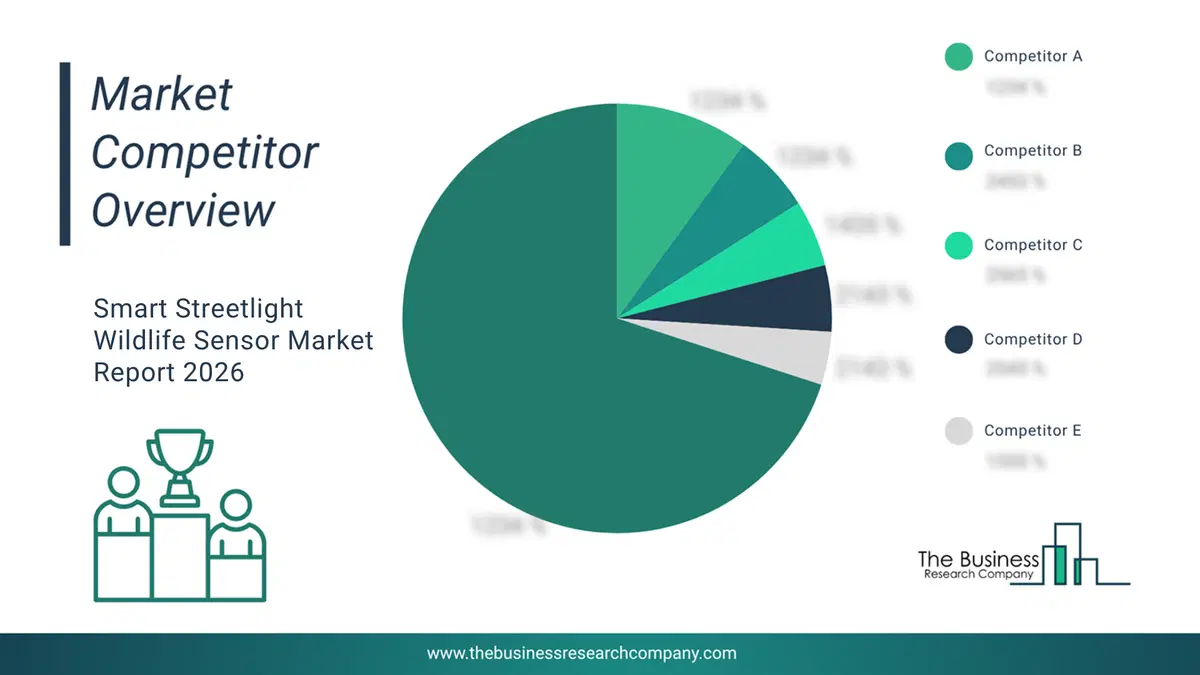
This chart is for illustrative purposes; the full report includes a detailed competitor analysis and comprehensive overview of the top 10 companies in the market.
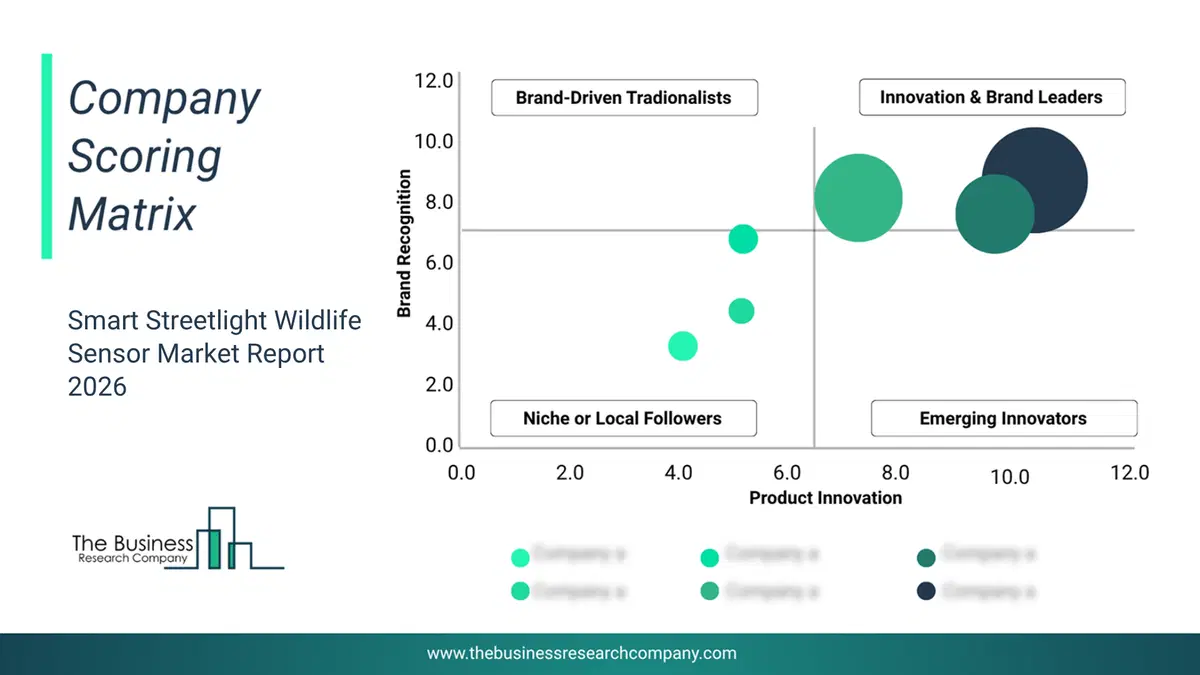
This chart maps companies by product innovation and brand strength, with bubble size indicating relative revenue, helping identify market leaders, challengers, and niche players. This is an illustrative chart; the full report provides a complete and accurate competitive analysis.
Global Smart Streetlight Wildlife Sensor Market Trends and Insights
Major companies operating in the smart streetlight wildlife sensor market are increasingly adopting innovative solutions such as energy-efficient LED and solar-powered streetlights to lower environmental impact, reduce human-wildlife conflicts, and improve safety in ecologically sensitive regions. Energy-efficient LED and solar streetlights are sustainable systems that combine low-power LEDs with solar energy to deliver cost-effective and eco-friendly lighting. For instance, in April 2025, Signify N.V., a Netherlands-based lighting company, launched a large-scale community lighting initiative in Bahraich, Uttar Pradesh, particularly around the Katarniaghat Wildlife Division. The project installed more than 5,000 LED and solar streetlights across over 300 forest villages, enhancing safety in areas prone to wildlife encounters. This initiative not only improved villagers’ nighttime mobility but also supported extended livelihood opportunities and enabled children to access evening education. Implemented in collaboration with FINISH Society and the local forest department, the program also introduced an awareness calendar on forest and wildlife conservation, underscoring Signify’s commitment to rural empowerment and sustainable development through the transformative power of light.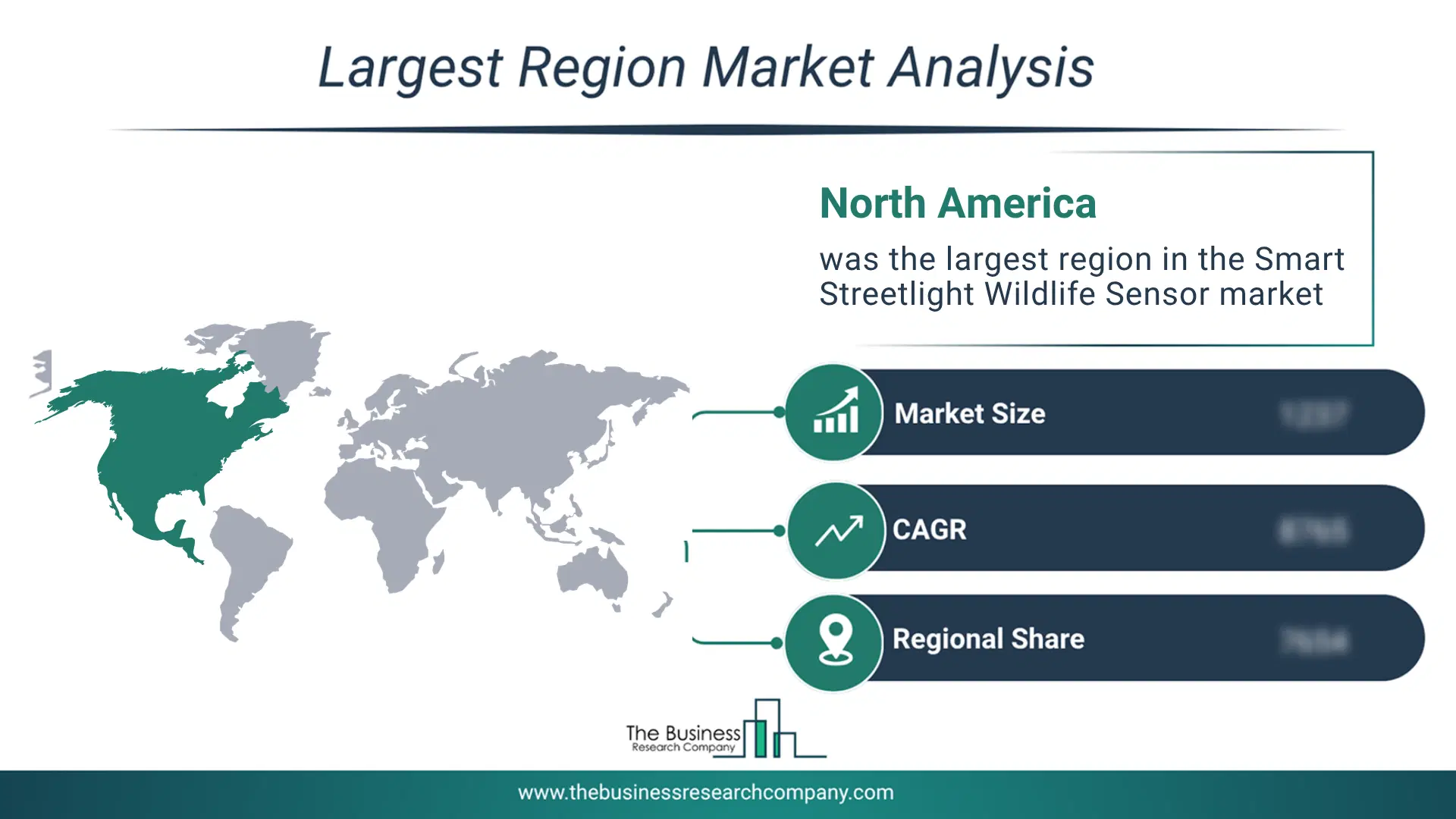
Regional Outlook
North America was the largest region in the smart streetlight wildlife sensor market in 2025. Asia-Pacific is expected to be the fastest-growing region in the forecast period. The regions covered in this market report are Asia-Pacific, South East Asia, Western Europe, Eastern Europe, North America, South America, Middle East, Africa. The countries covered in this market report are Australia, Brazil, China, France, Germany, India, Indonesia, Japan, Taiwan, Russia, South Korea, UK, USA, Canada, Italy, SpainWhat Defines the Smart Streetlight Wildlife Sensor Market?
The smart streetlight wildlife sensor market includes sales of products, such as motion-activated lighting systems, infrared wildlife detection sensors, acoustic monitoring devices, adaptive dimming controllers, and camera-based wildlife activity trackers. Values in this market are ‘factory gate’ values, that is, the value of goods sold by the manufacturers or creators of the goods, whether to other entities (including downstream manufacturers, wholesalers, distributors, and retailers) or directly to end customers. The value of goods in this market includes related services sold by the creators of the goods.How is Market Value Defined and Measured?
The market value is defined as the revenues that enterprises gain from the sale of goods and/or services within the specified market and geography through sales, grants, or donations in terms of the currency (in USD unless otherwise specified). The revenues for a specified geography are consumption values that are revenues generated by organizations in the specified geography within the market, irrespective of where they are produced. It does not include revenues from resales along the supply chain, either further along the supply chain or as part of other products.
This chart presents market attractiveness based on a quantitative evaluation of growth, competition, strategic alignment, and risk, offering a clear view of opportunity areas for decision-making. This chart is for illustrative purposes; the full report contains the complete analysis.

This chart highlights the Total Addressable Market (TAM) by estimating the maximum revenue opportunity using an assumption-driven approach, supporting strategic planning and opportunity sizing across markets. The chart is illustrative; the full report provides a more comprehensive analysis.
What Key Data and Analysis Are Included in the Smart Streetlight Wildlife Sensor Market Report 2026?
The smart streetlight wildlife sensor market research report is one of a series of new reports from The Business Research Company that provides market statistics, including Market Report 2026?global market size, regional shares, competitors with the market share, detailed market segments, market trends and opportunities, and any further data you may need to thrive in the smart streetlight wildlife sensor Market Report 2026? The market research report delivers a complete perspective of everything you need, with an in-depth analysis of the current and future state of the Market Report 2026?Smart Streetlight Wildlife Sensor Market Report Forecast Analysis
| Report Attribute | Details |
|---|---|
| Market Size Value In 2026 | $1.39 billion |
| Revenue Forecast In 2030 | $2.34 billion |
| Growth Rate | CAGR of 14.9% from 2026 to 2030 |
| Base Year For Estimation | 2025 |
| Actual Estimates/Historical Data | 2020-2025 |
| Forecast Period | 2026 - 2030 - 2030 |
| Market Representation | Revenue in USD Billion and CAGR from 2026 to 2030 |
| Segments Covered | Sensor Type, Connectivity, Application, End-User |
| Regional Scope | Asia-Pacific, Western Europe, Eastern Europe, North America, South America, Middle East, Africa |
| Country Scope | The countries covered in the report are Australia, Brazil, China, France, Germany, India, Indonesia, Japan, Taiwan, Russia, South Korea, UK, USA, Canada, Italy, Spain. |
| Key Companies Profiled | Huawei Technologies Co. Ltd., Eaton Corporation plc, Delta Electronics Inc., Signify N.V., OSRAM Licht AG, Acuity Brands Inc., Itron Inc., Silicon Laboratories Inc., Schreder Group, Lucy Group Ltd., CIMCON Lighting Inc., Ubicquia Inc., Telensa Limited, Leotek Electronics USA LLC, Dimonoff Inc., Soluxio Solar Lighting, Tvilight B.V., FlexSol Solutions, Citilight Holdings Pte. Ltd.,GE |
| Customization Scope | Request for Customization |
| Pricing And Purchase Options | Explore Purchase Options |