

Smart Tissue Autonomous Robot (STAR) Market Report 2026
Global Outlook – By Component (Hardware, Software), By Surgical Technique (Open Surgery, Minimally Invasive Surgery, Endoscopic Surgery), By Technology (Artificial Intelligence, Machine Learning, Computer Vision, Robotic Manipulation), By Application (Soft Tissue Surgery, Plastic And Reconstructive Surgery, Orthopedic Surgery, Gastrointestinal Surgery, Cardiothoracic Surgery), By End-User (Hospitals, Ambulatory Surgical Centers, Research Institutions, Clinics) – Market Size, Trends, Strategies, and Forecast to 2030
Smart Tissue Autonomous Robot (STAR) Market Overview
• Smart Tissue Autonomous Robot (STAR) market size has reached to $0.3 billion in 2025 • Expected to grow to $0.77 billion in 2030 at a compound annual growth rate (CAGR) of 20.5% • Growth Driver: Surge In Minimally Invasive Surgical Procedures Fueling The Growth Of The Market Due To Enhanced Patient Safety And Reduced Recovery Time • North America was the largest region in 2025 and Asia-Pacific is the fastest growing region.What Is Covered Under Smart Tissue Autonomous Robot (STAR) Market?
Smart tissue autonomous robot (STAR) refers to Surgical Robotics technology designed to automate soft-tissue procedures using advanced imaging, autonomous suturing algorithms, real-time tissue tracking, and robotic manipulation systems. It integrates sensors, computer vision, force-feedback tools, and AI-based decision systems to enhance precision, reduce human error, and improve surgical outcomes in soft-tissue operations. This technology helps optimize procedure accuracy, increase reproducibility, and support minimally invasive surgical workflows. The main components of smart tissue autonomous robot (STAR) are hardware and software. Hardware refers to the physical robotic systems, surgical instruments, sensors, and control units that enable autonomous or semi-autonomous surgical procedures. These solutions are designed for different surgical techniques, including open surgery, minimally invasive surgery, and endoscopic surgery, and leverage various technologies, such as artificial intelligence, machine learning, computer vision, and robotic manipulation. They are used across multiple applications, including soft tissue surgery, plastic and reconstructive surgery, orthopedic surgery, gastrointestinal surgery, and cardiothoracic surgery, and cater to diverse end-users, such as hospitals, ambulatory surgical centers, research institutions, and clinics.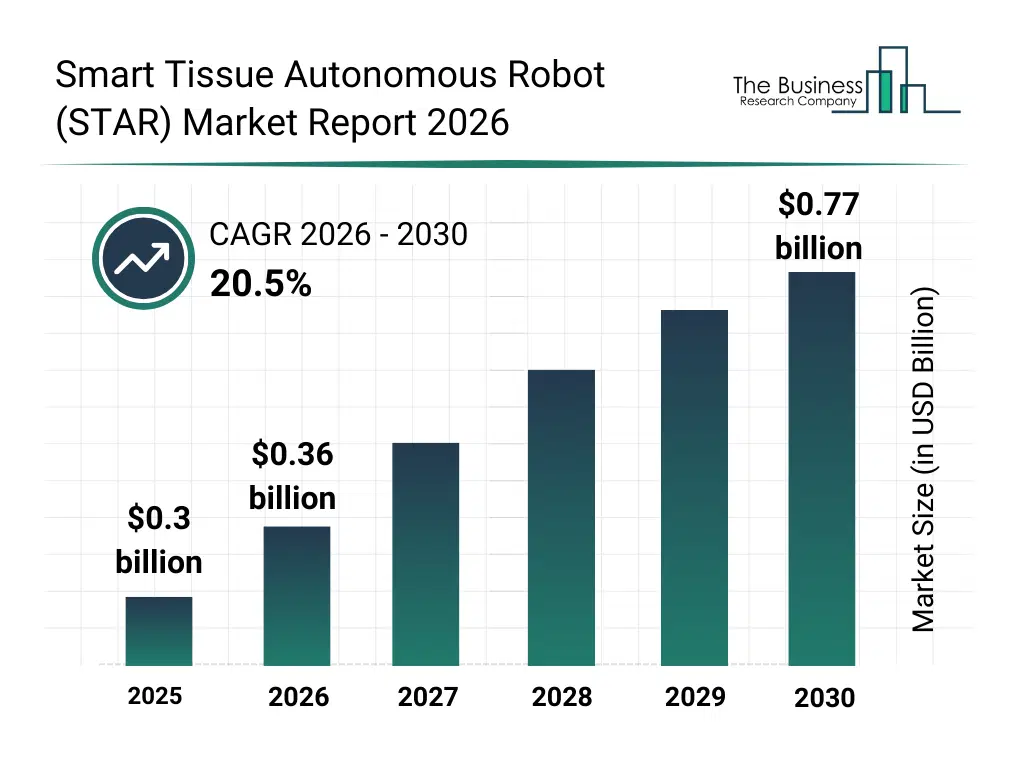
What Is The Smart Tissue Autonomous Robot (STAR) Market Size and Share 2026?
The smart tissue autonomous robot (star) market size has grown exponentially in recent years. It will grow from $0.3 billion in 2025 to $0.36 billion in 2026 at a compound annual growth rate (CAGR) of 20.3%. The growth in the historic period can be attributed to growth in robotic surgery platforms, minimally invasive surgery demand, surgical imaging advances, hospital robotics investments, precision surgery requirements.What Is The Smart Tissue Autonomous Robot (STAR) Market Growth Forecast?
The smart tissue autonomous robot (star) market size is expected to see exponential growth in the next few years. It will grow to $0.77 billion in 2030 at a compound annual growth rate (CAGR) of 20.5%. The growth in the forecast period can be attributed to autonomous surgery research expansion, AI surgical workflow integration, advanced sensing instrument demand, reproducible surgery outcomes focus, next generation surgical robotics funding. Major trends in the forecast period include autonomous soft tissue suturing systems, AI guided surgical decision engines, real time tissue tracking robotics, force feedback surgical instruments, image driven robotic navigation.
Global Smart Tissue Autonomous Robot (STAR) Market Segmentation
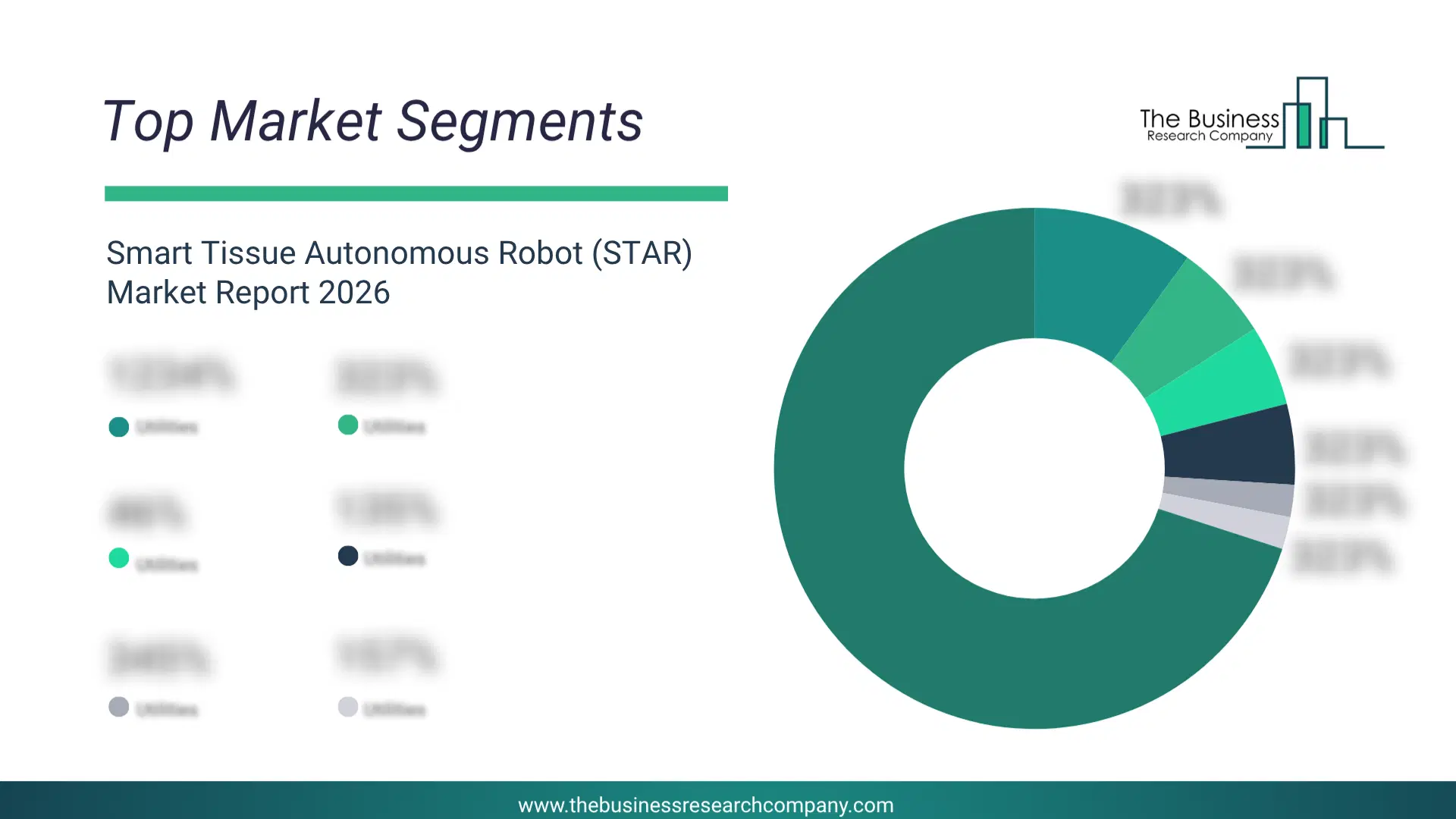
1) By Component: Hardware; Software 2) By Surgical Technique: Open Surgery; Minimally Invasive Surgery; Endoscopic Surgery 3) By Technology: Artificial Intelligence; Machine Learning; Computer Vision; Robotic Manipulation 4) By Application: Soft Tissue Surgery; Plastic And Reconstructive Surgery; Orthopedic Surgery; Gastrointestinal Surgery; Cardiothoracic Surgery 5) By End-User: Hospitals; Ambulatory Surgical Centers; Research Institutions; Clinics Subsegments: 1) By Hardware: Sensors; Actuators; Robotic Arms; Control Units; Imaging Modules; Power Systems 2) By Software: Algorithmic Control Software; Machine Learning Platforms; Surgical Planning Software; Real Time Navigation Software; Image Processing Software; Data Analytics SoftwareWhat Are The Drivers Of The Smart Tissue Autonomous Robot (STAR) Market?
The rising demand for minimally invasive surgical procedures is expected to propel the growth of the smart tissue autonomous robot (STAR) market going forward. Minimally invasive surgical procedures refer to surgeries performed through small incisions or natural openings using specialized instruments to reduce tissue trauma, blood loss, and recovery time while maintaining surgical precision. Rising demand for minimally invasive surgical procedures is driven by enhanced patient safety. Smart tissue autonomous robot (STAR) supports rising demand for minimally invasive surgical procedures by precisely executing complex soft-tissue manipulations through small incisions, reducing human error, minimizing tissue trauma, and improving overall surgical accuracy and patient recovery. For instance, in June 2024, according to the American Society of Plastic Surgeons, a US-based non-profit organization, hyaluronic acid filler minimally invasive procedures totaled 5.29 million in 2023, an 8% increase over 2022. Therefore, the rising demand for minimally invasive surgical procedures is driving the growth of the smart tissue autonomous robot (STAR) industry. The expanding hospital investments in robotic infrastructure are expected to propel the growth of the smart tissue autonomous robot (STAR) market going forward. Robotic infrastructure refers to the combination of robotic systems, supporting software, hardware, and facilities required to install, operate, and maintain robotic technologies effectively within an organization. The expanding hospital investments in robotic infrastructure are driven by the need to improve surgical precision. Smart tissue autonomous robot (STAR) supports expanding hospital investments in robotic infrastructure by offering an advanced autonomous surgical platform that integrates artificial intelligence, imaging, and precision robotics, enabling hospitals to enhance surgical capabilities, improve clinical outcomes, and maximize the value of their robotic technology investments. For instance, in Nov 2025, according to Springer Nature, a Germany-based academic and scientific publishing company, reported that surgical robot ownership among trusts rose by 42% from 36 to 51, with usage expanding to 49 trusts for general surgery and doubling for emergency procedures from 13 to 26 trusts. Therefore, the expanding hospital investments in robotic infrastructure are driving the growth of the smart tissue autonomous robot (STAR) industry. The shortage of skilled surgeons is expected to propel the growth of the smart tissue autonomous robot (STAR) market going forward. Skilled surgeons refer to qualified and experienced medical professionals with specialized training and expertise to accurately perform surgical procedures, manage complications, and ensure patient safety. The shortage of skilled surgeons is driven by increasing retirement rates. Smart tissue autonomous robot (STAR) supports the shortage of skilled surgeons by autonomously performing complex soft-tissue tasks with high precision, reducing dependence on continuous human expertise and helping surgical teams maintain efficiency and consistency despite workforce constraints. For instance, in April 2024, according to the American Association of Neurological Surgeons (AANS), a leading US-based scientific and educational association reported that projections warning that the United States may experience a physician shortfall of up to 86,000 by 2036. Therefore, the shortage of skilled surgeons is driving the growth of the smart tissue autonomous robot (STAR) industry.Key Players In The Global Smart Tissue Autonomous Robot (STAR) Market
Major companies operating in the smart tissue autonomous robot (star) market are Johnson & Johnson, Medtronic, ABB Ltd, Siemens Healthineers, Stryker Corporation, Philips, Boston Scientific, Zimmer Biomet Holdings, Inc., Intuitive Surgical, Smith & Nephew plc, KARL STORZ, Globus Medical, Inc., Renishaw plc, CMR Surgical Limited, Osso VR, Caresyntax, Think Surgical, Inc, Activ Surgical, Tuodao Medical, Sina Robotics & Medical Innovators Co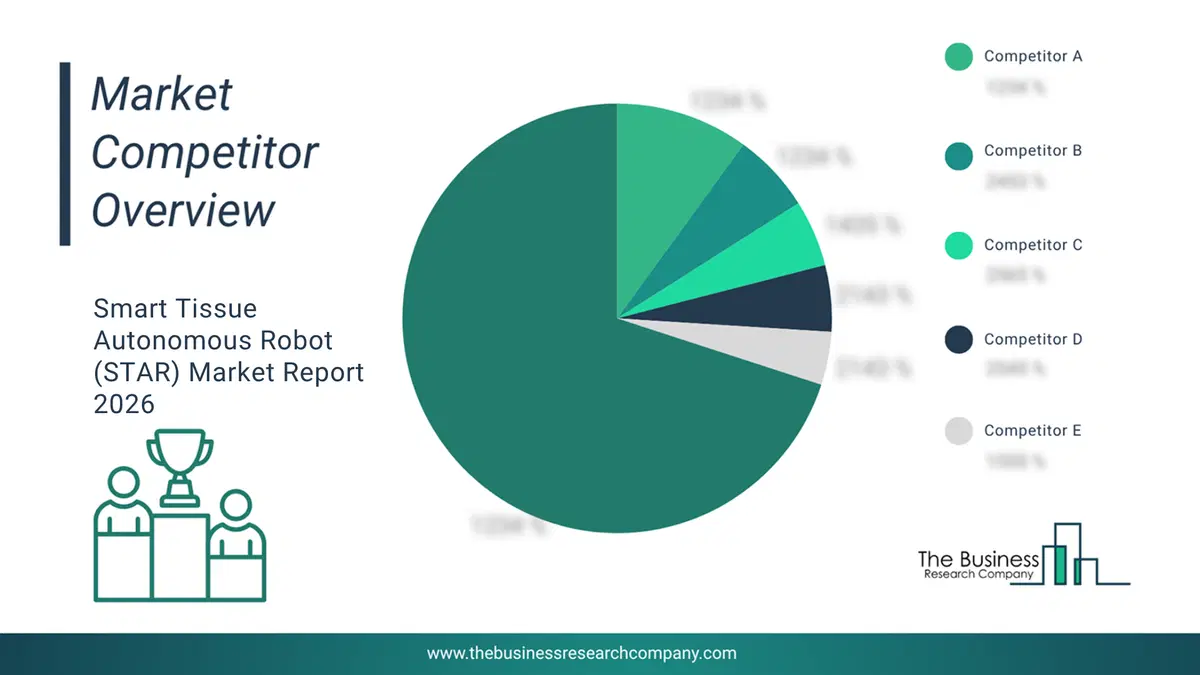
This chart is for illustrative purposes; the full report includes a detailed competitor analysis and comprehensive overview of the top 10 companies in the market.
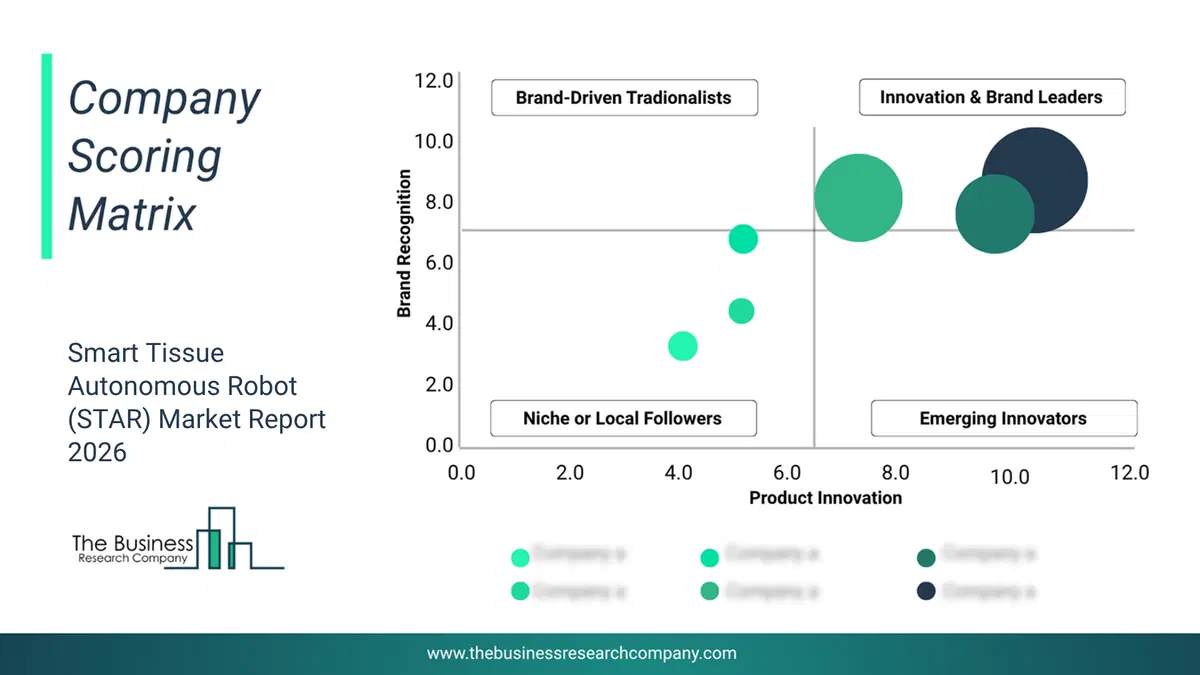
This chart maps companies by product innovation and brand strength, with bubble size indicating relative revenue, helping identify market leaders, challengers, and niche players. This is an illustrative chart; the full report provides a complete and accurate competitive analysis.

Regional Insights
North America was the largest region in the smart tissue autonomous robot (STAR) market in 2025. Asia-Pacific is expected to be the fastest-growing region in the forecast period. The regions covered in this market report are Asia-Pacific, South East Asia, Western Europe, Eastern Europe, North America, South America, Middle East, Africa. The countries covered in this market report are Australia, Brazil, China, France, Germany, India, Indonesia, Japan, Taiwan, Russia, South Korea, UK, USA, Canada, Italy, Spain.What Defines the Smart Tissue Autonomous Robot (STAR) Market?
The smart tissue autonomous robot (STAR) market consists of sales of robotic surgical systems, autonomous suturing devices, 3D imaging and navigation modules, force-sensing instruments, AI-driven control software, and real-time tissue monitoring systems. Values in this market are ‘factory gate’ values, that is, the value of goods sold by the manufacturers or creators of the goods, whether to other entities (including downstream manufacturers, wholesalers, distributors, and retailers) or directly to end customers. The value of goods in this market includes related services sold by the creators of the goods.How is Market Value Defined and Measured?
The market value is defined as the revenues that enterprises gain from the sale of goods and/or services within the specified market and geography through sales, grants, or donations in terms of the currency (in USD unless otherwise specified). The revenues for a specified geography are consumption values that are revenues generated by organizations in the specified geography within the market, irrespective of where they are produced. It does not include revenues from resales along the supply chain, either further along the supply chain or as part of other products.
This chart presents market attractiveness based on a quantitative evaluation of growth, competition, strategic alignment, and risk, offering a clear view of opportunity areas for decision-making. This chart is for illustrative purposes; the full report contains the complete analysis.

This chart highlights the Total Addressable Market (TAM) by estimating the maximum revenue opportunity using an assumption-driven approach, supporting strategic planning and opportunity sizing across markets. The chart is illustrative; the full report provides a more comprehensive analysis.
What Key Data and Analysis Are Included in the Smart Tissue Autonomous Robot (STAR) Market Report 2026?
The smart tissue autonomous robot (star) market research report is one of a series of new reports from The Business Research Company that provides market statistics, including industry global market size, regional shares, competitors with the market share, detailed market segments, market trends and opportunities, and any further data you may need to thrive in the smart tissue autonomous robot (star) industry. The market research report delivers a complete perspective of everything you need, with an in-depth analysis of the current and future state of the industry.Smart Tissue Autonomous Robot (STAR) Market Report Forecast Analysis
| Report Attribute | Details |
|---|---|
| Market Size Value In 2026 | $0.36 billion |
| Revenue Forecast In 2030 | $0.77 billion |
| Growth Rate | CAGR of 20.5% from 2026 to 2030 |
| Base Year For Estimation | 2025 |
| Actual Estimates/Historical Data | 2020-2025 |
| Forecast Period | 2026 - 2030 |
| Market Representation | Revenue in USD Billion and CAGR from 2026 to 2030 |
| Segments Covered | Component, Surgical Technique, Technology, Application, End-User |
| Regional Scope | Asia-Pacific, Western Europe, Eastern Europe, North America, South America, Middle East, Africa |
| Country Scope | The countries covered in the report are Australia, Brazil, China, France, Germany, India, Indonesia, Japan, Taiwan, Russia, South Korea, UK, USA, Canada, Italy, Spain. |
| Key Companies Profiled | Johnson & Johnson, Medtronic, ABB Ltd, Siemens Healthineers, Stryker Corporation, Philips, Boston Scientific, Zimmer Biomet Holdings, Inc., Intuitive Surgical, Smith & Nephew plc, KARL STORZ, Globus Medical, Inc., Renishaw plc, CMR Surgical Limited, Osso VR, Caresyntax, Think Surgical, Inc, Activ Surgical, Tuodao Medical, Sina Robotics & Medical Innovators Co |
| Customization Scope | Request for Customization |
| Pricing And Purchase Options | Explore Purchase Options |