
Smart Trash Bin Market Report 2026
Global Outlook – By Product Type ( Sensor-Enabled Smart Bins, Compacting Smart Bins, Recycling Smart Bins, Compost Smart Bins, General Waste Smart Bins), By Technology Integration ( IoT-Connected Smart Bins, Mobile Application Support, Voice-Activated Smart Bins, AI-Based Smart Sorting Systems, Solar-Powered Smart Bins), By Capacity ( Small, Medium, Large, Extra Large), By Distribution Channel ( Online, Offline), By End User Industry ( Residential, Commercial, Municipal Services) – Market Size, Trends, Strategies, and Forecast to 2030
Smart Trash Bin Market Overview
• Smart Trash Bin market size has reached to $1.98 billion in 2025 • Expected to grow to $5.2 billion in 2030 at a compound annual growth rate (CAGR) of 21.3% • Growth Driver: Rising Waste Volumes Fuelling The Growth Of The Market Due To Increasing Consumerism And Urbanization • Market Trend: Advancements In AI Technology Driving Automation And Efficiency In Waste Sorting • North America was the largest region in 2025 and Asia-Pacific is the fastest growing region.What Is Covered Under Smart Trash Bin Market?
Smart trash bins are technologically enhanced waste containers that use sensors and connectivity to optimize waste management. They can detect fill levels, sort waste automatically, and send alerts when they need to be emptied. These bins contribute to better recycling, less overflow, and higher garbage collection efficiency overall. The main product types of smart trash bins are sensor-enabled smart bins, compacting smart bins, recycling smart bins, compost smart bins, and general waste smart bins. Sensor-enabled smart bins are waste containers equipped with sensors that detect fill levels, motion, or usage patterns to enable real-time monitoring and optimize Waste Collection efficiency. It uses various technologies such as IoT-connected smart bins, mobile application support, voice-activated smart bins, AI-based smart sorting systems, and solar-powered smart bins, and it offers various capacities, including small, medium, large, and extra large. It is distributed through online and offline channels and is used by residential, commercial, industrial, municipal services, and educational institutions.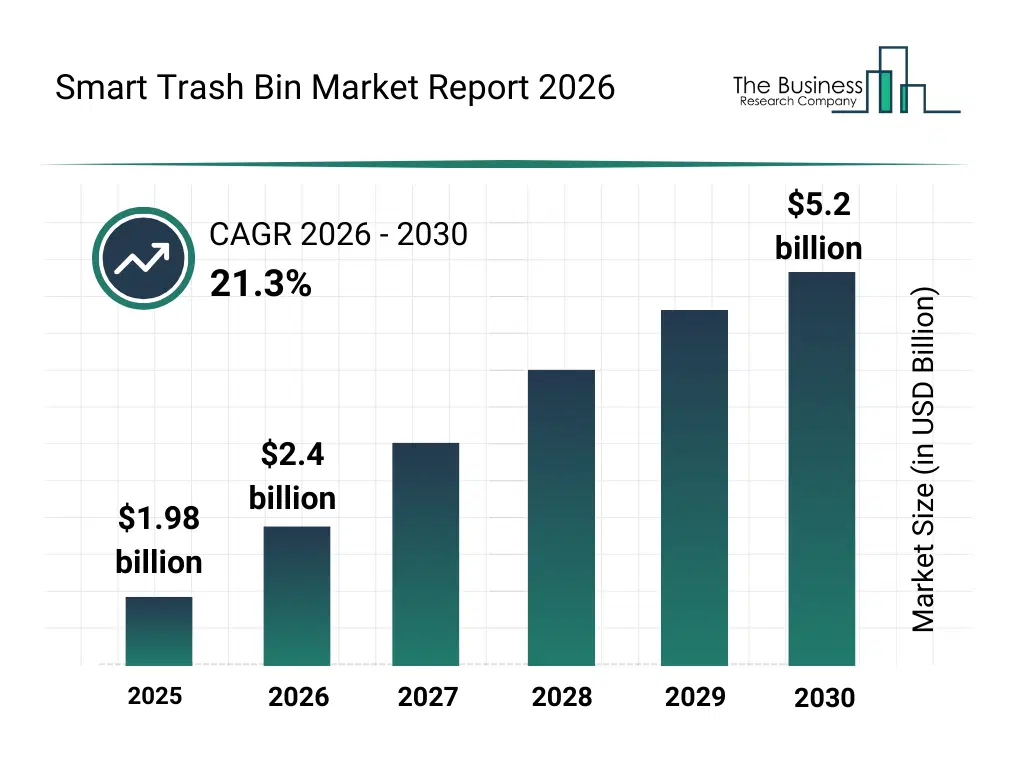
What Is The Smart Trash Bin Market Size 2026 And Growth Rate?
The smart trash bin market size has grown exponentially in recent years. It will grow from $1.98 billion in 2025 to $2.4 billion in 2026 at a compound annual growth rate (CAGR) of 21.4%. The growth in the historic period can be attributed to urban population growth, increasing municipal waste volumes, adoption of basic sensor technologies, government-led waste management programs, rising landfill capacity constraints.What Is The Smart Trash Bin Market Growth Forecast?
The smart trash bin market size is expected to see exponential growth in the next few years. It will grow to $5.2 billion in 2030 at a compound annual growth rate (CAGR) of 21.3%. The growth in the forecast period can be attributed to smart city infrastructure investments, stricter waste segregation regulations, demand for operational efficiency in waste collection, advancements in sensor accuracy and AI models, growth of connected public infrastructure. Major trends in the forecast period include AI-enabled waste classification, sustainable waste collection infrastructure, iot-connected urban waste systems, intelligent manufacturing of smart bins, data-driven waste management platforms.
Global Smart Trash Bin Market Segmentation
1) By Product Type: Sensor-Enabled Smart Bins, Compacting Smart Bins, Recycling Smart Bins, Compost Smart Bins, General Waste Smart Bins 2) By Technology Integration: IoT-Connected Smart Bins, Mobile Application Support, Voice-Activated Smart Bins, AI-Based Smart Sorting Systems, Solar-Powered Smart Bins 3) By Capacity: Small, Medium, Large, Extra Large 4) By Distribution Channel: Online, Offline 5) By End User Industry: Residential, Commercial, Municipal Services Subsegments: 1) By Sensor-Enabled Smart Bins: Infrared Sensor Bins, Ultrasonic Sensor Bins, Weight Sensor Bins, Motion Sensor Bins, Proximity Sensor Bins 2) By Compacting Smart Bins: Automatic Compacting Bins, Solar-Powered Compacting Bins, Smart Grid-Connected Compacting Bins 3) By Recycling Smart Bins: Single-Stream Recycling Bins, Multi-Compartment Recycling Bins, AI-Sorting Recycling Bins, Plastic-Focused Recycling Bins, Paper and Cardboard Recycling Bins 4) By Compost Smart Bins: Indoor Compost Smart Bins, Outdoor Compost Smart Bins, Electric Composting Bins, Bioenzyme-Assisted Compost Bins 5) By General Waste Smart Bins: Home Use Smart Bins, Commercial Smart Bins, Public Infrastructure Smart Bins, Industrial Smart Bins, App-Connected Smart BinsWhat Is The Driver Of The Smart Trash Bin Market?
The increasing waste generation is projected to drive the growth of the smart trash bins market going forward. Waste generation is the process by which individuals, households, businesses, or industries produce unwanted or unusable materials as a result of daily activities, consumption, or production. Waste generation is rising due to increasing consumerism, with higher living standards and population growth leading to more consumption and discarded packaging. Smart trash bins are required for waste generation management because they optimize collection efficiency by monitoring fill levels in real time, reducing overflows, cutting operational costs, and ensuring cleaner environments. For instance, in February 2024, according to the report published by the United Nations Environment Programme, a Kenya-based environmental authority, municipal solid waste is predicted to increase dramatically from 2023 to 2050, from 2.1 billion tons to over 3.8 billion tons. Therefore, the increasing waste generation will propel the growth of the smart trash bins industry.Key Players In The Global Smart Trash Bin Market
Major companies operating in the smart trash bin market are Bigbelly, Ecube Labs, Enevo, Sensoneo, CleanRobotics, iTouchless, Nine Stars, Ausko, Compology, OnePlus Systems, Evreka, Bin-e, Urbiotica, Nordsense, WasteHero, RecycleSmart, Hangzhou Bosheen, PEL Equipment, Sehaj Synergy, SAGE Automation
This chart is for illustrative purposes; the full report includes a detailed competitor analysis and comprehensive overview of the top 10 companies in the market.
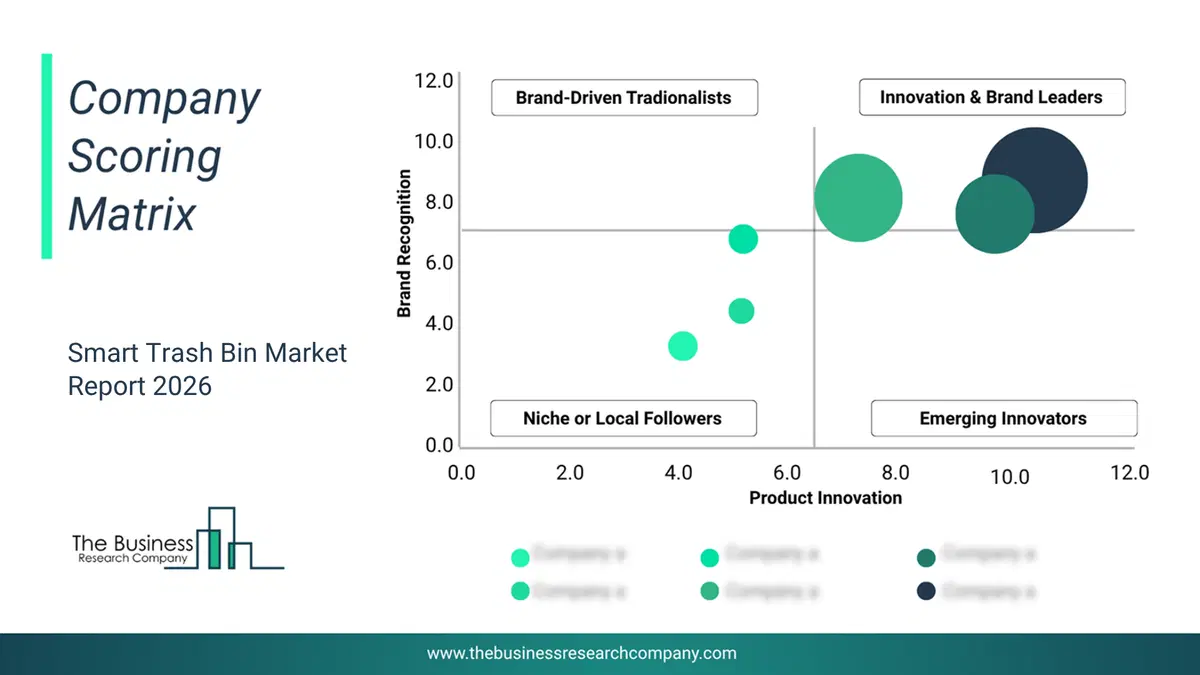
This chart maps companies by product innovation and brand strength, with bubble size indicating relative revenue, helping identify market leaders, challengers, and niche players. This is an illustrative chart; the full report provides a complete and accurate competitive analysis.
Global Smart Trash Bin Market Trends and Insights
Major companies operating in the smart trash bins market are developing technologically advanced products, such as AI-driven waste sorting machines, to improve sorting accuracy, reduce manual labour, and enhance recycling efficiency. An AI-driven waste sorting machine is an automated system that uses artificial intelligence, including image recognition and machine learning, to identify, classify, and separate different types of waste for efficient recycling and disposal. For instance, in November 2024, Green AI Technology Limited, a Hong Kong-based company specializing in AI visual recognition technology for smart waste sorting solutions, launched the AI-powered smart bin for waste segregation. A unique feature of Green AI’s smart bins lies in their integration of advanced technologies, including scanners, conveyor belts, and digital scales, that enable precise waste segregation and efficient compression to maximize storage capacity. Designed to boost recycling efforts, these AI-powered bins are initially focused on high-footfall locations such as shopping centres, hotels, and commercial buildings, particularly those owned by publicly listed companies, where accurate sorting significantly enhances the value of recyclable waste.What Are Latest Mergers And Acquisitions In The Smart Trash Bin Market?
In March 2023, Recycle Track Systems Inc a US-based waste management and sustainability technology company, acquired RecycleSmart Solutions Inc. for an undisclosed amount. Through this acquisition, RTS aims to expand its smart waste management portfolio and enhance IoT-enabled bin solutions and data-driven waste diversion across North America. RecycleSmart Solutions Inc. is a Canada-based company that provide smart trash bins.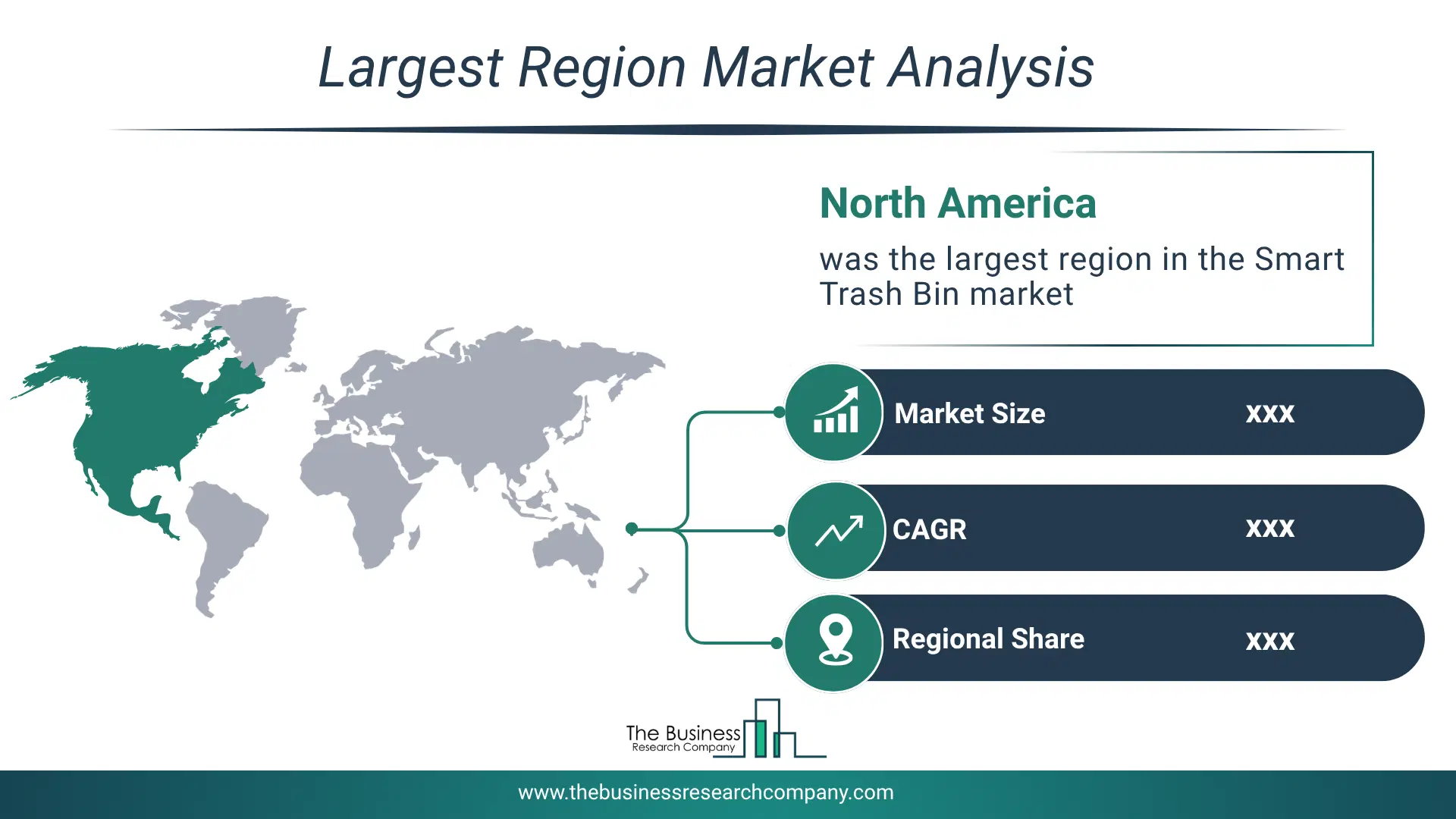
Regional Outlook
North America was the largest region in the smart trash bin market in2025. Asia-Pacific is expected to be the fastest-growing region in the forecast period. The regions covered in this market report are Asia-Pacific, South East Asia, Western Europe, Eastern Europe, North America, South America, Middle East, Africa. The countries covered in this market report are Australia, Brazil, China, France, Germany, India, Indonesia, Japan, Taiwan, Russia, South Korea, UK, USA, Canada, Italy, Spain.What Defines the Smart Trash Bin Market?
The smart trash bins market consists of revenues earned by entities providing services such as predictive waste collection, odour and sanitation management, waste sorting and categorization assistance. The market value includes the value of related goods sold by the service provider or included within the service offering. The smart trash bins market also includes sales of touchless smart trash bins, fill-level monitoring smart bins and bluetooth-enabled bins. Values in this market are ‘factory gate’ values, that is, the value of goods sold by the manufacturers or creators of the goods, whether to other entities (including downstream manufacturers, wholesalers, distributors, and retailers) or directly to end customers. The value of goods in this market includes related services sold by the creators of the goods.How is Market Value Defined and Measured?
The market value is defined as the revenues that enterprises gain from the sale of goods and/or services within the specified market and geography through sales, grants, or donations in terms of the currency (in USD unless otherwise specified). The revenues for a specified geography are consumption values that are revenues generated by organizations in the specified geography within the market, irrespective of where they are produced. It does not include revenues from resales along the supply chain, either further along the supply chain or as part of other products.
This chart presents market attractiveness based on a quantitative evaluation of growth, competition, strategic alignment, and risk, offering a clear view of opportunity areas for decision-making. This chart is for illustrative purposes; the full report contains the complete analysis.

This chart highlights the Total Addressable Market (TAM) by estimating the maximum revenue opportunity using an assumption-driven approach, supporting strategic planning and opportunity sizing across markets. The chart is illustrative; the full report provides a more comprehensive analysis.
What Key Data and Analysis Are Included in the Smart Trash Bin Market Report 2026?
The smart trash bin market research report is one of a series of new reports from The Business Research Company that provides market statistics, including industry global market size, regional shares, competitors with the market share, detailed market segments, market trends and opportunities, and any further data you may need to thrive in the smart trash bin industry. The market research report delivers a complete perspective of everything you need, with an in-depth analysis of the current and future state of the industry.Smart Trash Bin Market Report Forecast Analysis
| Report Attribute | Details |
|---|---|
| Market Size Value In 2026 | $2.4 billion |
| Revenue Forecast In 2030 | $5.2 billion |
| Growth Rate | CAGR of 21.3% from 2026 to 2030 |
| Base Year For Estimation | 2025 |
| Actual Estimates/Historical Data | 2020-2025 |
| Forecast Period | 2026 - 2030 |
| Market Representation | Revenue in USD Billion and CAGR from 2026 to 2030 |
| Segments Covered | Product Type, Technology Integration, Capacity, Distribution Channel, End User Industry |
| Regional Scope | Asia-Pacific, Western Europe, Eastern Europe, North America, South America, Middle East, Africa |
| Country Scope | The countries covered in the report are Australia, Brazil, China, France, Germany, India, Indonesia, Japan, Taiwan, Russia, South Korea, UK, USA, Canada, Italy, Spain. |
| Key Companies Profiled | Bigbelly, Ecube Labs, Enevo, Sensoneo, CleanRobotics, iTouchless, Nine Stars, Ausko, Compology, OnePlus Systems, Evreka, Bin-e, Urbiotica, Nordsense, WasteHero, RecycleSmart, Hangzhou Bosheen, PEL Equipment, Sehaj Synergy, SAGE Automation |
| Customization Scope | Request for Customization |
| Pricing And Purchase Options | Explore Purchase Options |