
Smart Ultraviolet (UV) Index Sensor Market Report 2026
Global Outlook – By Product Type (Wearable Ultraviolet Index Sensors, Portable Ultraviolet Index Sensors, Fixed Ultraviolet Index Sensors), By Connectivity (Wired, Wireless), By Distribution Channel (Online, Offline), By Application (Consumer Electronics, Healthcare, Environmental Monitoring, Industrial, Other Applications), By End-User (Individuals, Commercial, Industrial, Research Institutes) – Market Size, Trends, Strategies, and Forecast to 2030
Smart Ultraviolet (UV) Index Sensor Market Overview
• Smart Ultraviolet (UV) Index Sensor market size has reached to $1.16 billion in 2025 • Expected to grow to $2.15 billion in 2030 at a compound annual growth rate (CAGR) of 13.1% • Growth Driver: Rising Public Awareness Of UV Health Risks Fueling The Growth Of The Market Due To The Need For Real-time Sun Protection Monitoring • Market Trend: Advancing Precision And Real Time environmental monitoring Through Intelligent UV Sensing Technologies • North America was the largest region in 2025 and Asia-Pacific is the fastest growing region.What Is Covered Under Smart Ultraviolet (UV) Index Sensor Market?
Smart ultraviolet index sensor is an advanced device designed to measure the intensity of ultraviolet (uv) radiation from the sun in real time. It provides accurate and instantaneous uv index readings, helping to monitor exposure levels for safety and health purposes. The sensor integrates intelligent technology to deliver precise data, often with connectivity features for alerts, tracking, and analysis. The main product types of smart UV index sensor include wearable ultraviolet index sensors, portable ultraviolet index sensors, and fixed ultraviolet index sensors. Wearable ultraviolet index sensors are designed for personal, on-the-go monitoring of UV exposure. Different connectivity's are wired, wireless, and other types. Multiple distribution channels include online, offline, and others. Various applications involved are consumer electronics, healthcare, environmental monitoring, industrial settings, and others, and they are used by several end-users such as individuals, commercial entities, industrial users, research institutes, and others.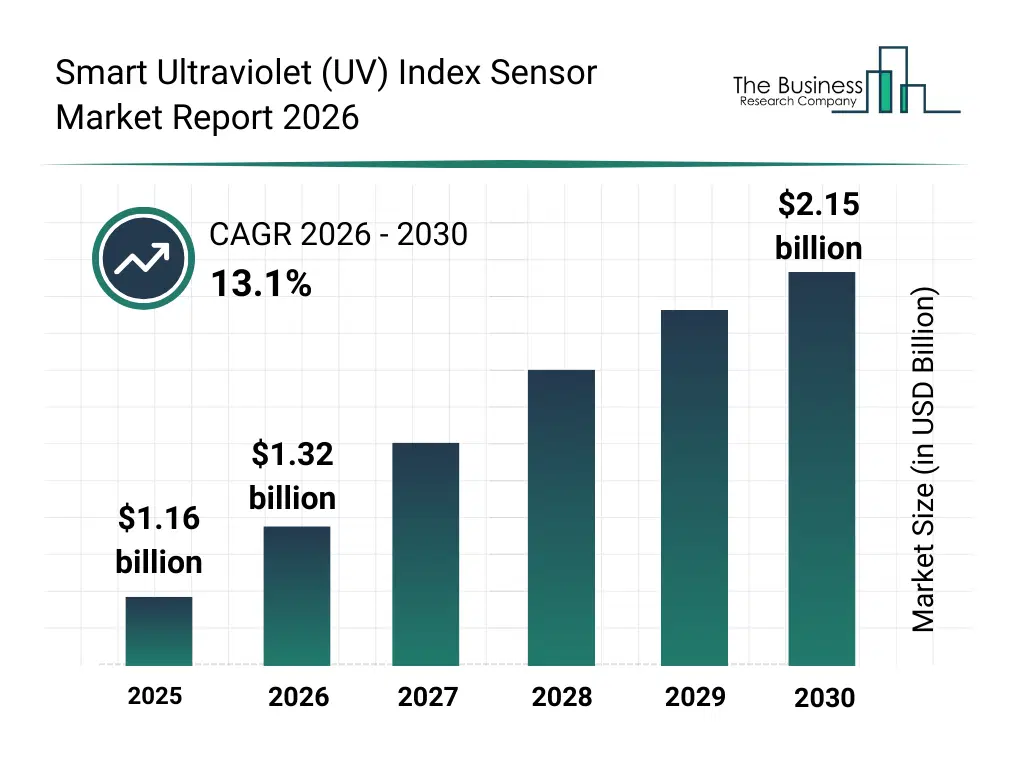
What Is The Smart Ultraviolet (UV) Index Sensor Market Size and Share 2026?
The smart ultraviolet index sensor market size has grown rapidly in recent years. It will grow from $1.16 billion in 2025 to $1.32 billion in 2026 at a compound annual growth rate (CAGR) of 13.4%. The growth in the historic period can be attributed to growing awareness of UV exposure risks, early adoption of wearable health devices, expansion of environmental monitoring programs, initial integration of UV sensors into consumer electronics, and a rise in outdoor recreational activities.What Is The Smart Ultraviolet (UV) Index Sensor Market Growth Forecast?
The smart ultraviolet index sensor market size is expected to see rapid growth in the next few years. It will grow to $2.15 billion in 2030 at a compound annual growth rate (CAGR) of 13.1%. The growth in the forecast period can be attributed to increasing demand for cloud-based UV analytics, growth of smart city environmental networks, rising use of UV monitoring in dermatology and skincare, adoption of sensors in agriculture for crop optimization, and an increase in wireless IoT connectivity. Major trends in the forecast period include integration of UV sensors into multi-sensor modules, miniaturization of low-power UV components, expansion of mobile UV tracking apps, emergence of solar-powered UV monitoring devices, and increasing use in industrial outdoor safety systems.
Global Smart Ultraviolet (UV) Index Sensor Market Segmentation
1) By Product Type: Wearable Ultraviolet Index Sensors, Portable Ultraviolet Index Sensors, Fixed Ultraviolet Index Sensors 2) By Connectivity: Wired, Wireless 3) By Distribution Channel: Online, Offline 4) By Application: Consumer Electronics, Healthcare, Environmental Monitoring, Industrial, Other Applications 5) By End-User: Individuals, Commercial, Industrial, Research Institutes Subsegments: 1) By Wearable Ultraviolet Index Sensors: Wristbands, Smart Watches, Clip-On Devices 2) By Portable Ultraviolet Index Sensors: Handheld Devices, Pocket Sensors, Travel Monitors 3) By Fixed Ultraviolet Index Sensors: Wall-Mounted Sensors, Stationary Outdoor Sensors, Roof-Mounted SensorsWhat Is The Driver Of The Smart Ultraviolet (UV) Index Sensor Market?
The rising public awareness of ultraviolet (UV) health risks is expected to propel the growth of the smart ultraviolet (UV) index sensor market going forward. Ultraviolet (UV) health risks refer to the potential adverse effects of overexposure to ultraviolet radiation from the sun, including sunburn, premature aging, and an increased risk of skin cancer. The rise in public awareness of ultraviolet (UV) health risks is due to increasing educational campaigns and health initiatives, as they encourage individuals to adopt proactive measures for sun protection during peak radiation hours. Smart ultraviolet (UV) index sensors support public awareness of ultraviolet (UV) health risks by monitoring real-time environmental data and alerting users to dangerous radiation levels, owing to their ability to provide personalized, location-based safety recommendations via connected devices. For instance, in September 2024, according to the Australian Bureau of Statistics, an Australia based national statistical agency, nearly two in five people aged 15 years and over used sunscreen on most days between November 2023 and February 2024, with usage at 38.1%, while females showed significantly higher regular use than males at 48.8% versus 27.0%, and women aged 35 to 44 recorded the highest disparity at 60.0% compared to 31.8% for males of the same age. Therefore, rising public awareness of UV health risks is driving the growth of the smart ultraviolet (UV) index sensor industry.Key Players In The Global Smart Ultraviolet (UV) Index Sensor Market
Major companies operating in the smart ultraviolet (uv) index sensor market are Panasonic Corporation, Broadcom Inc., Honeywell International Inc., Texas Instruments Incorporated, STMicroelectronics N.V., TE Connectivity Ltd., Murata Manufacturing Co. Ltd., Analog Devices Inc., AMS OSRAM, Vishay Intertechnology Inc., ROHM Co. Ltd., Hamamatsu Photonics K.K., Silicon Laboratories Inc., Sensirion AG, Bosch Sensortec GmbH, Seeed Studio Inc., SparkFun Electronics, Adafruit Industries LLC, Libelium Comunicaciones S.L., Solar Light Company LLC
This chart is for illustrative purposes; the full report includes a detailed competitor analysis and comprehensive overview of the top 10 companies in the market.
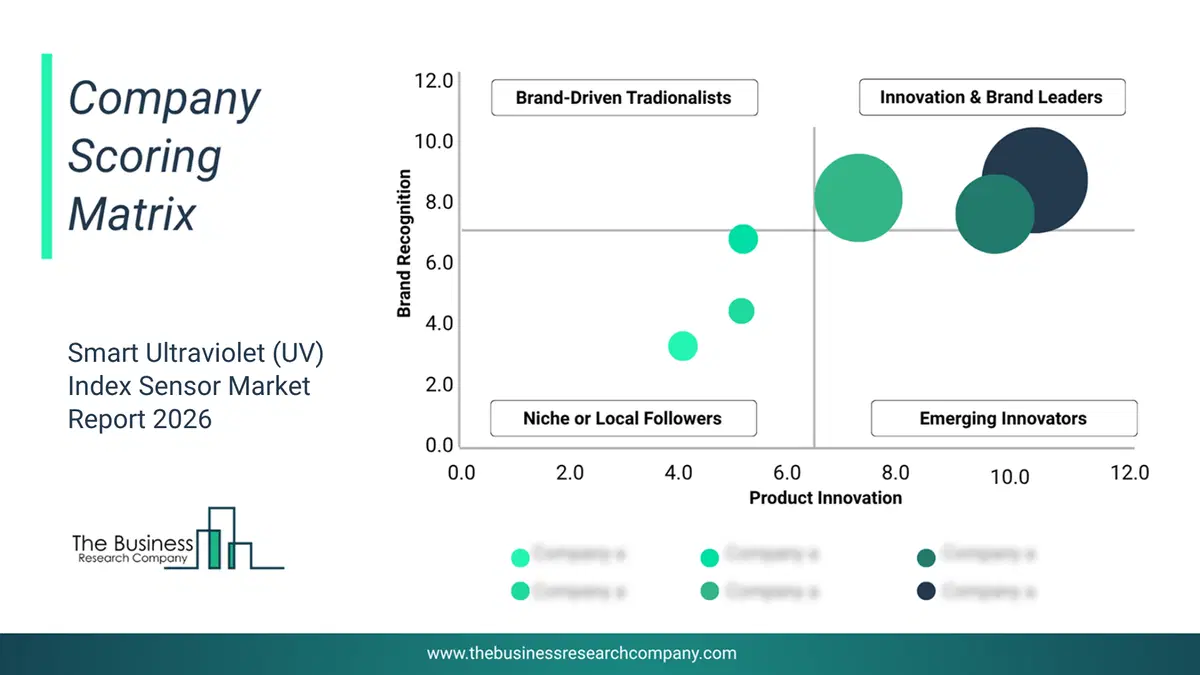
This chart maps companies by product innovation and brand strength, with bubble size indicating relative revenue, helping identify market leaders, challengers, and niche players. This is an illustrative chart; the full report provides a complete and accurate competitive analysis.
Global Smart Ultraviolet (UV) Index Sensor Market Trends and Insights
Major companies operating in the smart ultraviolet (UV) index sensor market are focusing on cutting-edge technologies, such as iEdge 4.0 technology, to enable high precision UV radiation measurement, real time data processing, and seamless integration across diverse monitoring environments. iEdge 4.0 technology refers to an advanced sensing and data integration framework that enhances measurement accuracy, reliability, and responsiveness for environmental and health related applications. For instance, in September 2024, Polysense Technologies Inc., a US-based environmental sensing solutions company, launched its iEdge 4.0 enabled full covered UV sensor portfolio, including UVA, UVB, UVC, and broad spectrum UVABC sensors. These sensors are designed to deliver high accuracy, real time ultraviolet radiation monitoring for both indoor and outdoor environments, supporting applications across healthcare, agriculture, manufacturing, and environmental science. The indoor variants offer a wide detection range suitable for UV disinfection, curing processes, and laboratory research, while the outdoor models are engineered for harsh conditions with multiple output options for easy system integration.What Are Latest Mergers And Acquisitions In The Smart Ultraviolet (UV) Index Sensor Market?
In September 2024, Nubila Network, a Singapore-based environmental, social, and governance (ESG) data solutions provider, acquired BloomSky Inc. for an undisclosed amount. With this acquisition, Nubila Network sought to expand its smart UV index sensor and hyperlocal weather data network by integrating BloomSky’s global fleet of connected weather stations, which capture parameters such as temperature, humidity, rainfall, and ultraviolet (UV) index alongside sky images for advanced analytics. BloomSky Inc. is a US-based provider of smart environmental sensing devices, offering smart ultraviolet (UV) index sensors.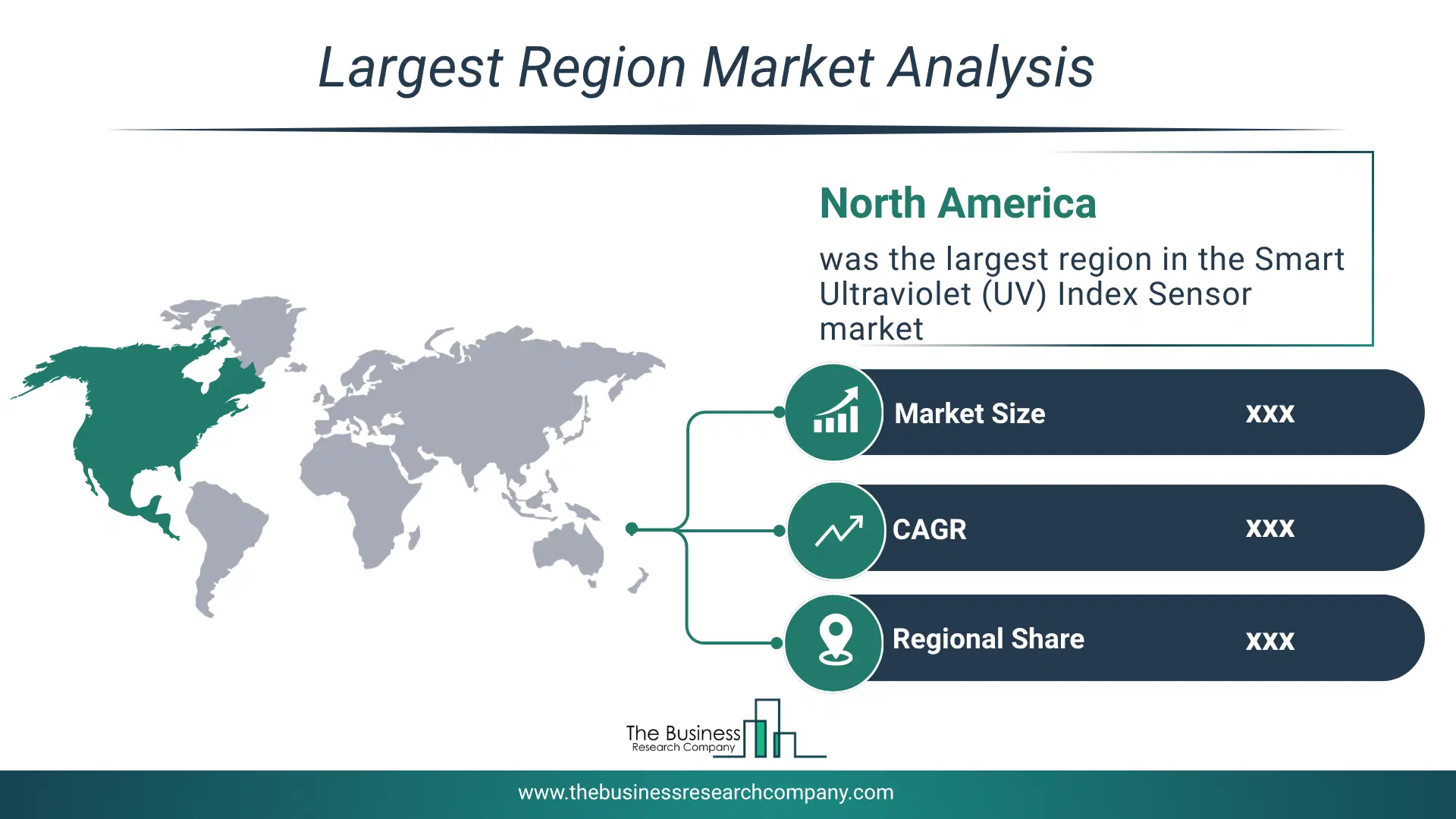
Regional Insights
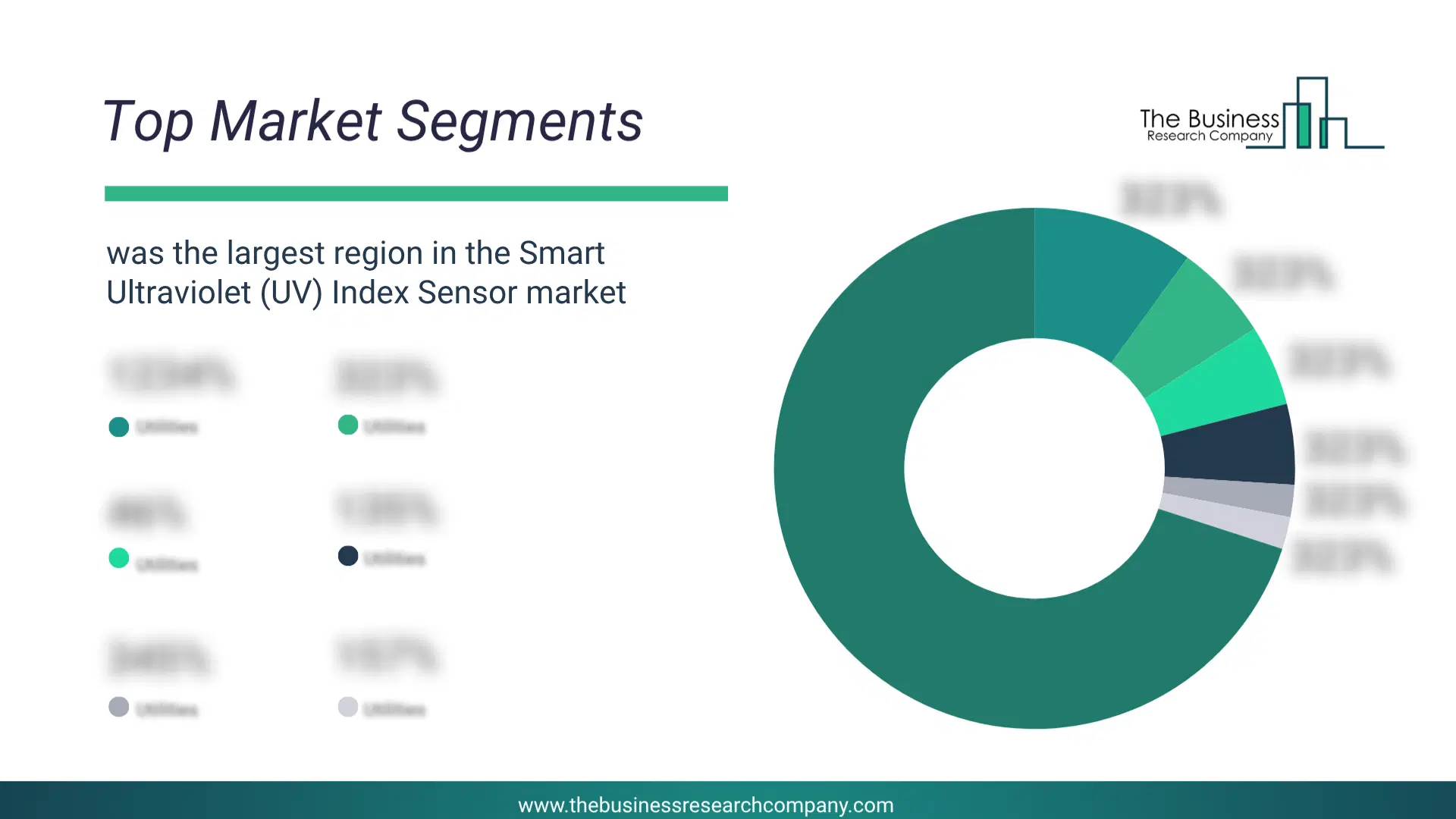
North America was the largest region in the smart ultraviolet index sensor market in 2025. Asia-Pacific is expected to be the fastest-growing region in the forecast period. The regions covered in this market report are Asia-Pacific, South East Asia, Western Europe, Eastern Europe, North America, South America, Middle East, Africa. The countries covered in this market report are Australia, Brazil, China, France, Germany, India, Indonesia, Japan, Taiwan, Russia, South Korea, UK, USA, Canada, Italy, Spain.What Defines the Smart Ultraviolet (UV) Index Sensor Market?
The smart ultraviolet index sensor market consists of revenues earned by entities by providing services such as data monitoring, remote support, software updates, integration services, and training, technical support. The market value includes the value of related goods sold by the service provider or included within the service offering. The smart ultraviolet index sensor market includes sales of portable ultraviolet measuring instruments, ultraviolet data loggers, and weather station ultraviolet modules. Values in this market are ‘factory gate’ values, that is, the value of goods sold by the manufacturers or creators of the goods, whether to other entities (including downstream manufacturers, wholesalers, distributors, and retailers) or directly to end customers. The value of goods in this market includes related services sold by the creators of the goods.How is Market Value Defined and Measured?
The market value is defined as the revenues that enterprises gain from the sale of goods and/or services within the specified market and geography through sales, grants, or donations in terms of the currency (in USD unless otherwise specified). The revenues for a specified geography are consumption values that are revenues generated by organizations in the specified geography within the market, irrespective of where they are produced. It does not include revenues from resales along the supply chain, either further along the supply chain or as part of other products.
This chart presents market attractiveness based on a quantitative evaluation of growth, competition, strategic alignment, and risk, offering a clear view of opportunity areas for decision-making. This chart is for illustrative purposes; the full report contains the complete analysis.

This chart highlights the Total Addressable Market (TAM) by estimating the maximum revenue opportunity using an assumption-driven approach, supporting strategic planning and opportunity sizing across markets. The chart is illustrative; the full report provides a more comprehensive analysis.
What Key Data and Analysis Are Included in the Smart Ultraviolet (UV) Index Sensor Market Report 2026?
The smart ultraviolet (uv) index sensor market research report is one of a series of new reports from The Business Research Company that provides market statistics, including industry global market size, regional shares, competitors with the market share, detailed market segments, market trends and opportunities, and any further data you may need to thrive in the smart ultraviolet (uv) index sensor industry. The market research report delivers a complete perspective of everything you need, with an in-depth analysis of the current and future state of the industry.Smart Ultraviolet (UV) Index Sensor Market Report Forecast Analysis
| Report Attribute | Details |
|---|---|
| Market Size Value In 2026 | $1.32 billion |
| Revenue Forecast In 2030 | $2.15 billion |
| Growth Rate | CAGR of 13.4% from 2026 to 2030 |
| Base Year For Estimation | 2025 |
| Actual Estimates/Historical Data | 2020-2025 |
| Forecast Period | 2026 - 2030 |
| Market Representation | Revenue in USD Billion and CAGR from 2026 to 2030 |
| Segments Covered | Product Type, Connectivity, Distribution Channel, Application, End-User |
| Regional Scope | Asia-Pacific, Western Europe, Eastern Europe, North America, South America, Middle East, Africa |
| Country Scope | The countries covered in the report are Australia, Brazil, China, France, Germany, India, Indonesia, Japan, Taiwan, Russia, South Korea, UK, USA, Canada, Italy, Spain. |
| Key Companies Profiled | Panasonic Corporation, Broadcom Inc., Honeywell International Inc., Texas Instruments Incorporated, STMicroelectronics N.V., TE Connectivity Ltd., Murata Manufacturing Co. Ltd., Analog Devices Inc., AMS OSRAM, Vishay Intertechnology Inc., ROHM Co. Ltd., Hamamatsu Photonics K.K., Silicon Laboratories Inc., Sensirion AG, Bosch Sensortec GmbH, Seeed Studio Inc., SparkFun Electronics, Adafruit Industries LLC, Libelium Comunicaciones S.L., Solar Light Company LLC |
| Customization Scope | Request for Customization |
| Pricing And Purchase Options | Explore Purchase Options |