
Smart Villa Market Report 2026
Global Outlook – By Product Type (Smart Lighting Systems, Automated Climate Control, Intelligent Security Solutions, Integrated Entertainment Systems), By Home Automation (Lighting Control, Heating Ventilation And Air Conditioning Control, Security And Access Control, Entertainment Control, Energy Management), By Psychographic (Lifestyle Choices, Personality Traits, Values And Beliefs ), By Technological (Smart Home Technology, Integration With Internet Of Things, Level Of Connectivity), By Application (Commercial Building, Residential Building) – Market Size, Trends, Strategies, and Forecast to 2030
Smart Villa Market Overview
• Smart Villa market size has reached to $4.53 billion in 2025 • Expected to grow to $9.11 billion in 2030 at a compound annual growth rate (CAGR) of 14.9% • Growth Driver: Increasing Adoption Of IOT Fueling The Growth Of The Market Due To Enhanced Device Connectivity And Control • Market Trend: Integrated Home Automation Systems Enhance Technological Advancements In The Smart Villa • North America was the largest region and fastest growing region.What Is Covered Under Smart Villa Market?
Smart villa refers to a technologically advanced residential property equipped with automated systems that control lighting, climate, security, entertainment, and other home functions through interconnected devices. Its purpose is to enhance comfort, security, energy efficiency, and convenience by enabling remote and intelligent management of household systems. The main product types of smart villas include smart lighting systems, automated climate control, intelligent security solutions, and integrated entertainment systems. Smart lighting systems use sensors, wireless connectivity, and automation to adjust brightness, color, and timing, often controlled via apps or voice assistants to enhance convenience and energy efficiency. Home automation features include lighting control, heating, ventilation, and air conditioning (HVAC) control, security and access control, entertainment control, and energy management, and are influenced by psychographic factors such as lifestyle choices, personality traits, values, and beliefs. Technology aspects cover smart home technology, integration with the Internet of Things, and level of connectivity, and applications include commercial buildings and residential buildings.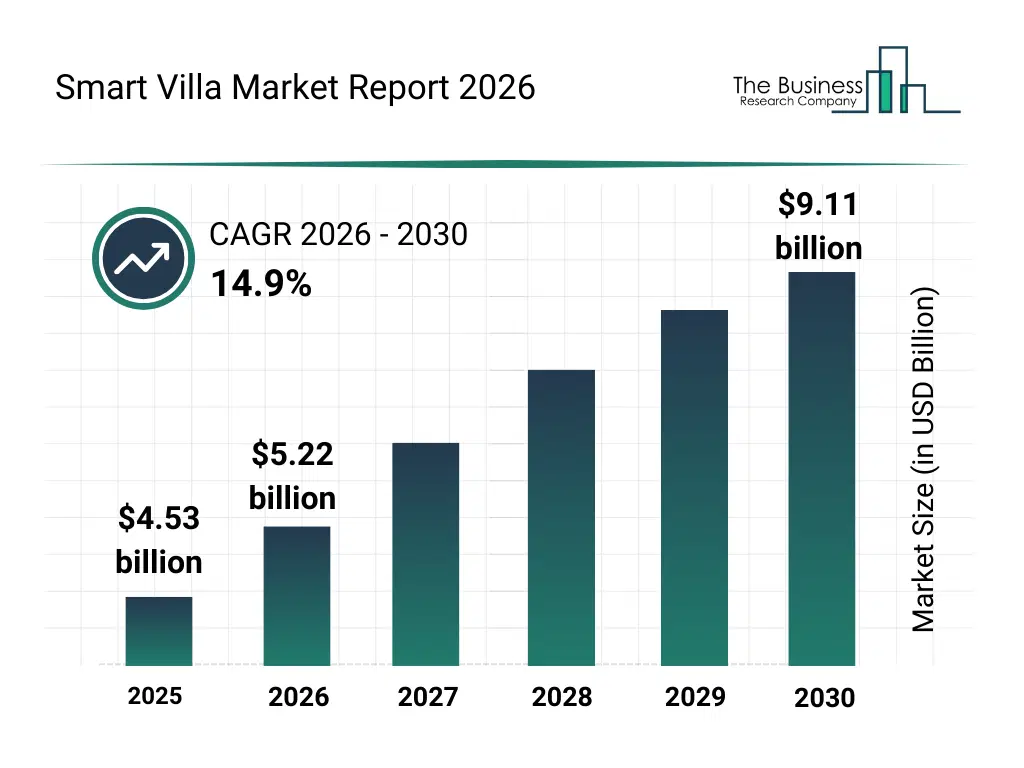
What Is The Smart Villa Market Size and Share 2026?
The smart villa market size has grown rapidly in recent years. It will grow from $4.53 billion in 2025 to $5.22 billion in 2026 at a compound annual growth rate (CAGR) of 15.2%. The growth in the historic period can be attributed to increasing adoption of smart home devices, rising integration of connected security systems, growth in luxury residential construction, reliance on imported smart electronics, expanding use of energy monitoring technologies.What Is The Smart Villa Market Growth Forecast?
The smart villa market size is expected to see rapid growth in the next few years. It will grow to $9.11 billion in 2030 at a compound annual growth rate (CAGR) of 14.9%. The growth in the forecast period can be attributed to increasing development of AI-enabled smart control systems, rising use of sustainable automation technologies, expansion of premium residential projects, growing adoption of integrated smart entertainment systems, increasing deployment of IoT-based household management tools. Major trends in the forecast period include integration of AI-driven home automation platforms, expansion of IOT-connected smart villa ecosystems, growth of cloud-based security and energy management, adoption of sustainable smart living technologies, enhancement of ar/vr-based entertainment and control systems.
Global Smart Villa Market Segmentation
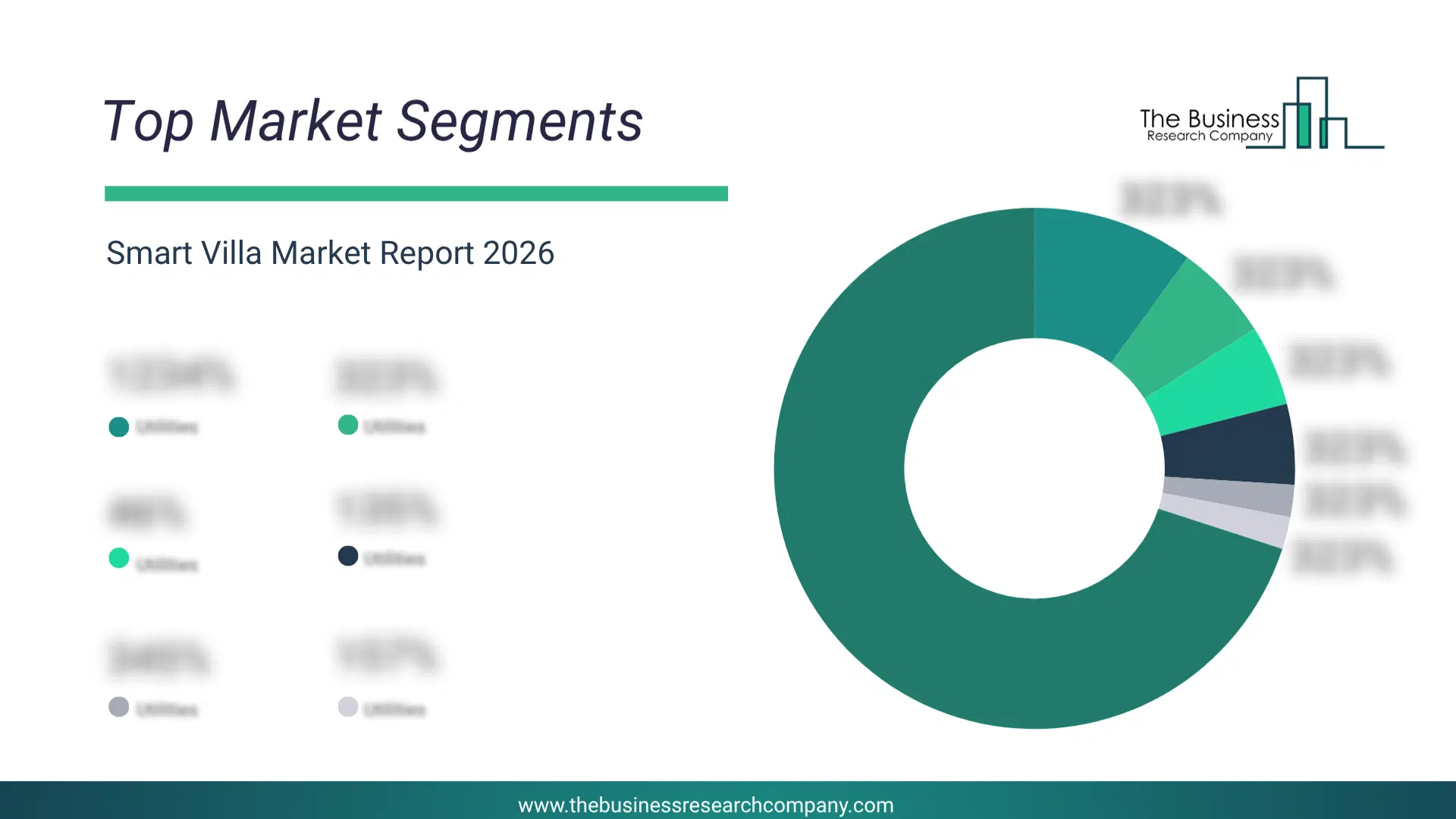
1) By Product Type: Smart Lighting Systems, Automated Climate Control, Intelligent Security Solutions, Integrated Entertainment Systems 2) By Home Automation: Lighting Control, Heating Ventilation And Air Conditioning Control, Security And Access Control, Entertainment Control, Energy Management 3) By Psychographic: Lifestyle Choices, Personality Traits, Values And Beliefs 4) By Technological: Smart Home Technology, Integration With Internet Of Things, Level Of Connectivity 5) By Application: Commercial Building, Residential Building Subsegments: 1) By Smart Lighting Systems: Smart Bulbs, Smart Switches and Dimmers, Motion-Sensing Lights, Voice-Controlled Lighting, Daylight Sensors and Adaptive Lighting, App-Controlled Lighting Systems, Scene/Zone-Based Lighting Controls, Outdoor Smart Lighting 2) By Automated Climate Control: Smart Thermostats, Automated HVAC Systems, Zoned Climate Control Solutions, Smart Air Conditioners and Heaters, Humidity and Air Quality Sensors, Voice and App-Controlled Climate Devices, Smart Ceiling Fans, Geofencing-Based Temperature Control 3) By Intelligent Security Solutions: Smart Surveillance Cameras, Video Doorbells, Smart Locks and Deadbolts, Motion and Entry Sensors, Alarm and Siren Systems, Facial Recognition Systems, 24/7 Monitoring Services, Integration with Law Enforcement or Emergency Services, Remote Access and Control Platforms 4) By Integrated Entertainment Systems: Whole-Home Audio Systems, Smart TVs and Streaming Hubs, Voice-Controlled Entertainment Systems, Centralized AV Control Panels, Multi-Room Video Distribution, Smart Projectors and Home Theaters, Automated Blinds and Lighting for Theater Modes, Gaming System Integration, Augmented and Virtual Reality Systems (AR/VR)What Is The Driver Of The Smart Villa Market?
The increasing adoption of the internet of things is expected to propel the growth of the smart villa market going forward. The internet of things is a networked system of interconnected computing devices and mechanical and electronic machinery with unique identities (UIDs) and the capacity to transfer data without needing human-to-human or human-to-computer contact. Rising adoption of the internet of things is due to the growing penetration of smartphones, which serve as central hubs for controlling smart devices. Smart Villa supports the adoption of the internet of things by providing an integrated ecosystem where smart devices communicate and operate cohesively to enhance comfort, security, and energy efficiency. For instance, in April 2025, according to Telefonaktiebolaget LM Ericsson, a Sweden-based telecommunications company, the global IoT connections reached 18.8 billion connections in 2024 and are expected to increase by 15% to 43 billion connections by 2029. Therefore, the increasing adoption of the internet of things is driving the growth of the smart villa industry.Key Players In The Global Smart Villa Market
Major companies operating in the smart villa market are Control4 Corporation, Crestron Electronics, Inc., Savant Systems, Inc., Honeywell International Inc., Schneider Electric SE, Siemens AG (Smart Infrastructure Division), Legrand SA, ABB Ltd., Bosch Smart Home GmbH, Signify N.V. (Philips Hue), Samsung Electronics Co., Ltd. (SmartThings), Amazon.com, Inc. (Amazon Smart Home/Alexa Devices), Xiaomi Corporation (Mi Smart Home), ADT Inc., Johnson Controls International plc, Resideo Technologies, Inc., Lutron Electronics Co., Inc., Vivint Smart Home, Inc., Ecobee Inc., Ring LLC.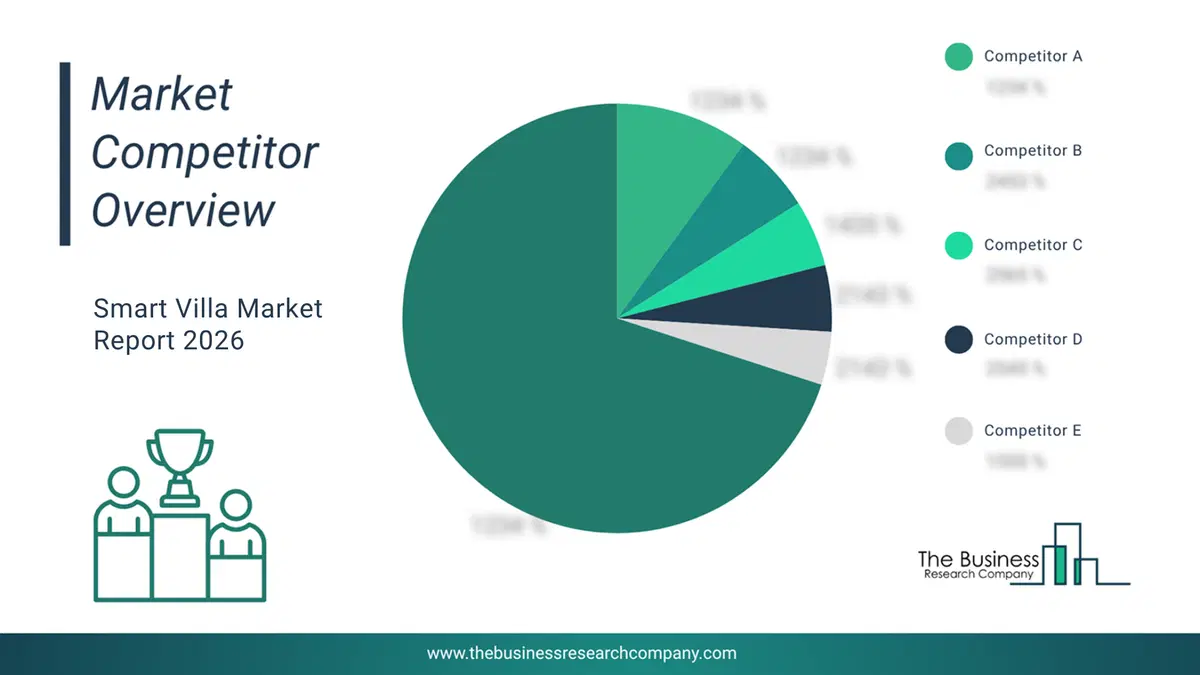
This chart is for illustrative purposes; the full report includes a detailed competitor analysis and comprehensive overview of the top 10 companies in the market.
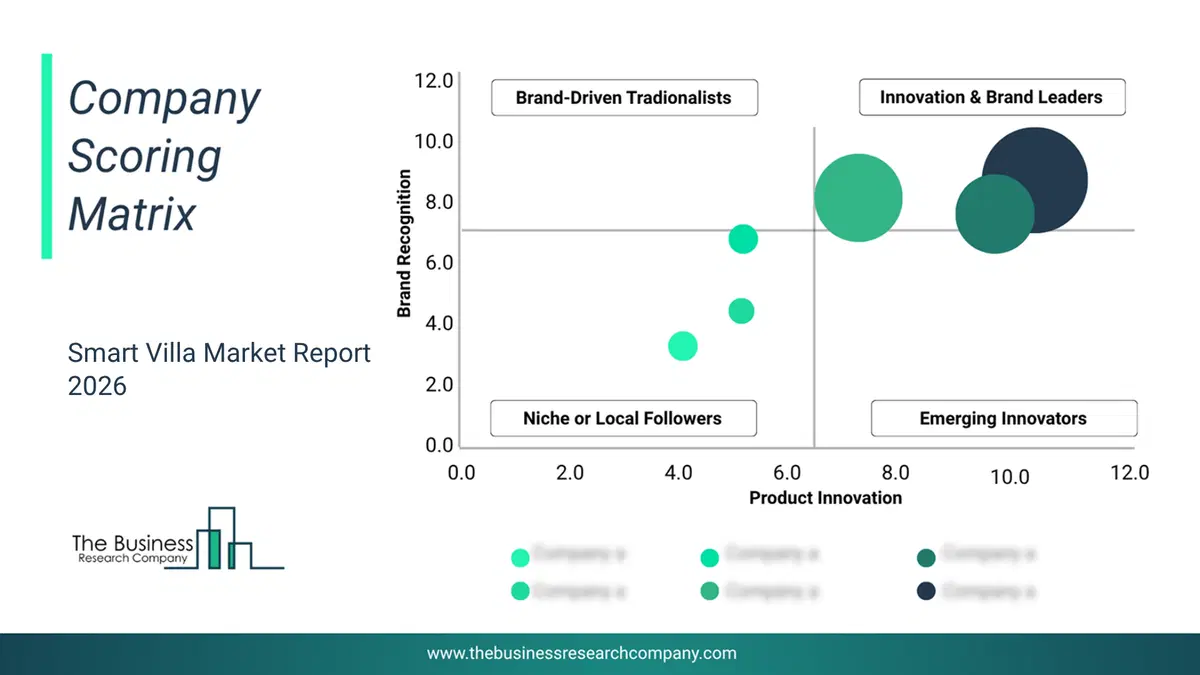
This chart maps companies by product innovation and brand strength, with bubble size indicating relative revenue, helping identify market leaders, challengers, and niche players. This is an illustrative chart; the full report provides a complete and accurate competitive analysis.
Global Smart Villa Market Trends and Insights
Major companies operating in the smart villa market are focusing on developing technological advancements such as smart home automation to enhance and provide greater convenience and security for residents. Smart home automation refers to the integration of technology that enables automatic or remote control of home systems such as lighting, climate, security, and appliances. For instance, in October 2024, Subha Builders and Developers Pvt. Ltd., an India-based real estate development company, launched Villamor, a 15-acre luxury smart villa township located near Electronic City. Designed for modern, intelligent living, Villamor offers centralized automation, voice control, and advanced security features. Each villa is equipped with smart surveillance systems, sensor-based lighting, integrated climate control, a digital door lock, a video door phone, and a modular kitchen with IoT-enabled appliances. The community also promotes sustainability and connectivity through EV charging stations, solar-powered street lighting, and high-speed fiber-optic internet.What Are Latest Mergers And Acquisitions In The Smart Villa Market?
In December 2024, Gewiss S.p.A., an Italy-based electrical systems company, acquired Tvilight B.V. for an undisclosed amount. The acquisition aims to accelerate innovation in smart lighting by integrating Tvilight’s advanced technologies with Gewiss’ extensive infrastructure capabilities, strengthening their position in the smart city solutions market. Tvilight B.V. is a Netherlands-based company specializing in wireless smart city lighting solutions.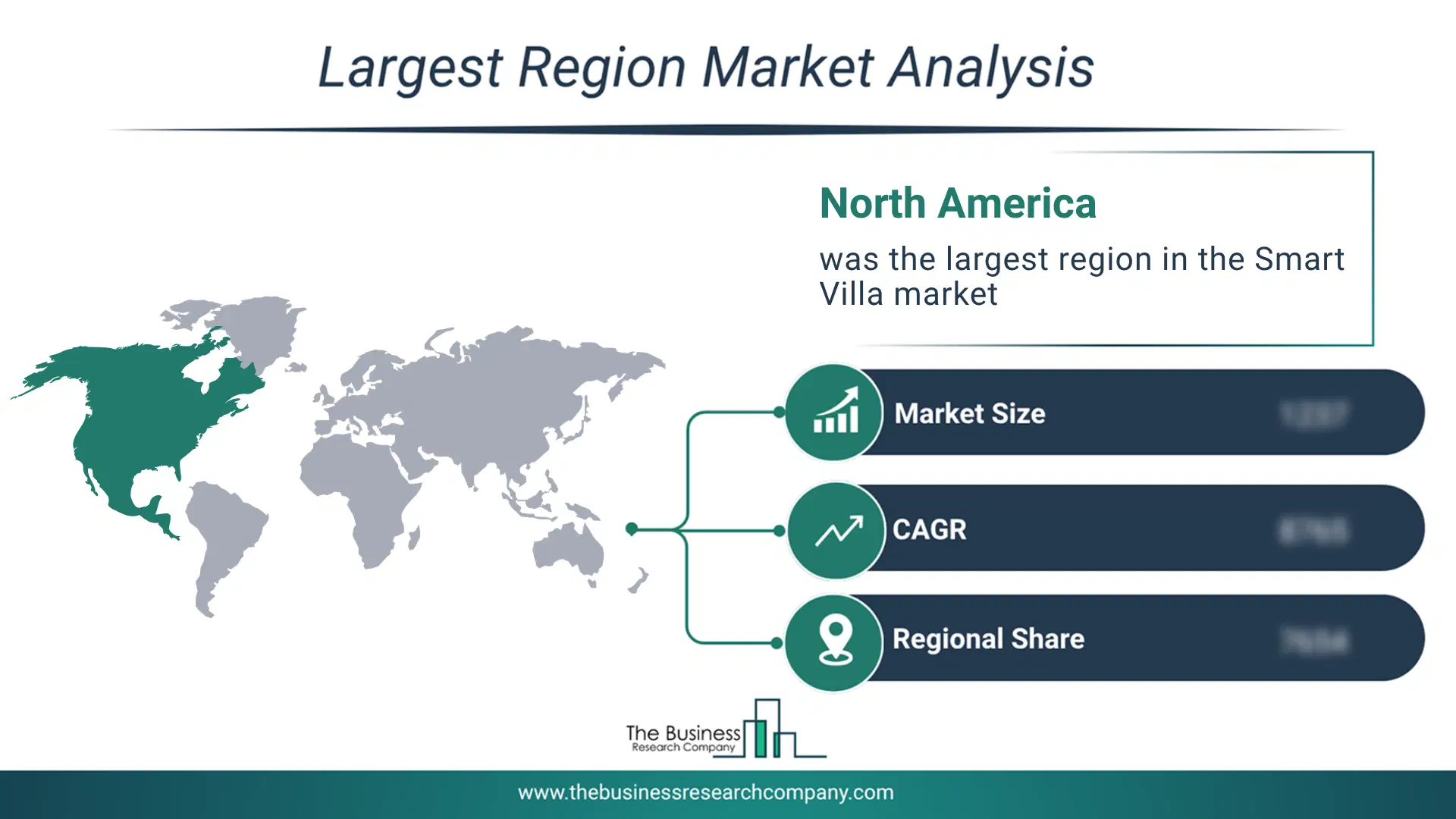
Regional Insights
North America was the largest region in the smart villa market in 2025. Asia-Pacific is expected to be the fastest-growing region in the forecast period. The regions covered in this market report are Asia-Pacific, South East Asia, Western Europe, Eastern Europe, North America, South America, Middle East, Africa. The countries covered in this market report are Australia, Brazil, China, France, Germany, India, Indonesia, Japan, Taiwan, Russia, South Korea, UK, USA, Canada, Italy, Spain.What Defines the Smart Villa Market?
The smart villa market consists of revenues earned by entities by providing services such as automated climate management, smart security systems, and energy monitoring. The market value includes the value of related goods sold by the service provider or included within the service offering. The smart villa market also includes sales of smart lighting systems, smart security devices, and access control systems. Values in this market are ‘factory gate’ values, that is the value of goods sold by the manufacturers or creators of the goods, whether to other entities (including downstream manufacturers, wholesalers, distributors and retailers) or directly to end customers. The value of goods in this market includes related services sold by the creators of the goods.How is Market Value Defined and Measured?
The market value is defined as the revenues that enterprises gain from the sale of goods and/or services within the specified market and geography through sales, grants, or donations in terms of the currency (in USD unless otherwise specified). The revenues for a specified geography are consumption values that are revenues generated by organizations in the specified geography within the market, irrespective of where they are produced. It does not include revenues from resales along the supply chain, either further along the supply chain or as part of other products.
This chart presents market attractiveness based on a quantitative evaluation of growth, competition, strategic alignment, and risk, offering a clear view of opportunity areas for decision-making. This chart is for illustrative purposes; the full report contains the complete analysis.

This chart highlights the Total Addressable Market (TAM) by estimating the maximum revenue opportunity using an assumption-driven approach, supporting strategic planning and opportunity sizing across markets. The chart is illustrative; the full report provides a more comprehensive analysis.
What Key Data and Analysis Are Included in theSmart Villa Market Report 2026?
The smart villa market research report is one of a series of new reports from The Business Research Company that provides market statistics, including industry global market size, regional shares, competitors with the market share, detailed market segments, market trends and opportunities, and any further data you may need to thrive in the smart villa industry. The market research report delivers a complete perspective of everything you need, with an in-depth analysis of the current and future state of the industry.Smart Villa Market Report Forecast Analysis
| Report Attribute | Details |
|---|---|
| Market Size Value In 2026 | $5.22 billion |
| Revenue Forecast In 2030 | $9.11 billion |
| Growth Rate | CAGR of 15.2% from 2026 to 2030 |
| Base Year For Estimation | 2025 |
| Actual Estimates/Historical Data | 2020-2025 |
| Forecast Period | 2026 - 2030 |
| Market Representation | Revenue in USD Billion and CAGR from 2026 to 2030 |
| Segments Covered | Product Type, Home Automation, Psychographic, Technological, Application |
| Regional Scope | Asia-Pacific, Western Europe, Eastern Europe, North America, South America, Middle East, Africa |
| Country Scope | The countries covered in this market report are Australia, Brazil, China, France, Germany, India, Indonesia, Japan, Taiwan, Russia, South Korea, UK, USA, Canada, Italy, Spain |
| Key Companies Profiled | Control4 Corporation, Crestron Electronics, Inc., Savant Systems, Inc., Honeywell International Inc., Schneider Electric SE, Siemens AG (Smart Infrastructure Division), Legrand SA, ABB Ltd., Bosch Smart Home GmbH, Signify N.V. (Philips Hue), Samsung Electronics Co., Ltd. (SmartThings), Amazon.com, Inc. (Amazon Smart Home/Alexa Devices), Xiaomi Corporation (Mi Smart Home), ADT Inc., Johnson Controls International plc, Resideo Technologies, Inc., Lutron Electronics Co., Inc., Vivint Smart Home, Inc., Ecobee Inc., Ring LLC. |
| Customization Scope | Request for Customization |
| Pricing And Purchase Options | Explore Purchase Options |