
Smart Walker Balance Robot Market Report 2026
Global Outlook – By Product Type (Sensor-Assisted Smart Walker Balance Robots, Motorized Smart Walker Balance Robots, AI-Enabled Smart Walker Balance Robots, Autonomous Smart Walker Balance Robots), By Distribution Channel (Specialty Stores, Direct Sales, Other Distribution Channels), By Application (Elderly Care, Rehabilitation Centers, Hospitals, Other Applications), By End-User (Individuals, Healthcare Facilities, Other End-Users) – Market Size, Trends, Strategies, and Forecast to 2030
Smart Walker Balance Robot Market Overview
• Smart Walker Balance Robot market size has reached to $1.7 billion in 2025 • Expected to grow to $3.56 billion in 2030 at a compound annual growth rate (CAGR) of 15.8% • Growth Driver: Surge In Neurological Disorders Fueling The Growth Of The Market Due To Ageing Populations And Chronic Conditions • Market Trend: Innovation In Smart Mobility Aids And Monitoring Improving Safety And Rehabilitation Outcomes • North America was the largest region in 2025 and Asia-Pacific is the fastest growing region.What Is Covered Under Smart Walker Balance Robot Market?
A smart walker balance robot is an intelligent robotic system that utilizes sensors, actuators, and control algorithms to achieve dynamic stability while moving or standing. It operates on the principle of continuous real-time feedback, adjusting its posture and motion to maintain balance in varying conditions. The robot combines mechanical design with computational intelligence, enabling precise coordination between movement and balance control mechanisms. The main product types of smart walker balance robots are manual smart walker balance robots and automated smart walker balance robots. Manual smart walker balance robots are mobility aids that rely primarily on user propulsion while incorporating sensors and stability mechanisms to assist with balance and prevent falls. The different technologies are sensor-based, artificial intelligence-powered, Internet of Things-enabled, and others. The multiple distribution channels include online retail, specialty stores, direct sales, and others. The various applications involved are elderly care, rehabilitation centers, hospitals, homecare settings, and others, and they are used by several end-users such as individuals, healthcare facilities, and others.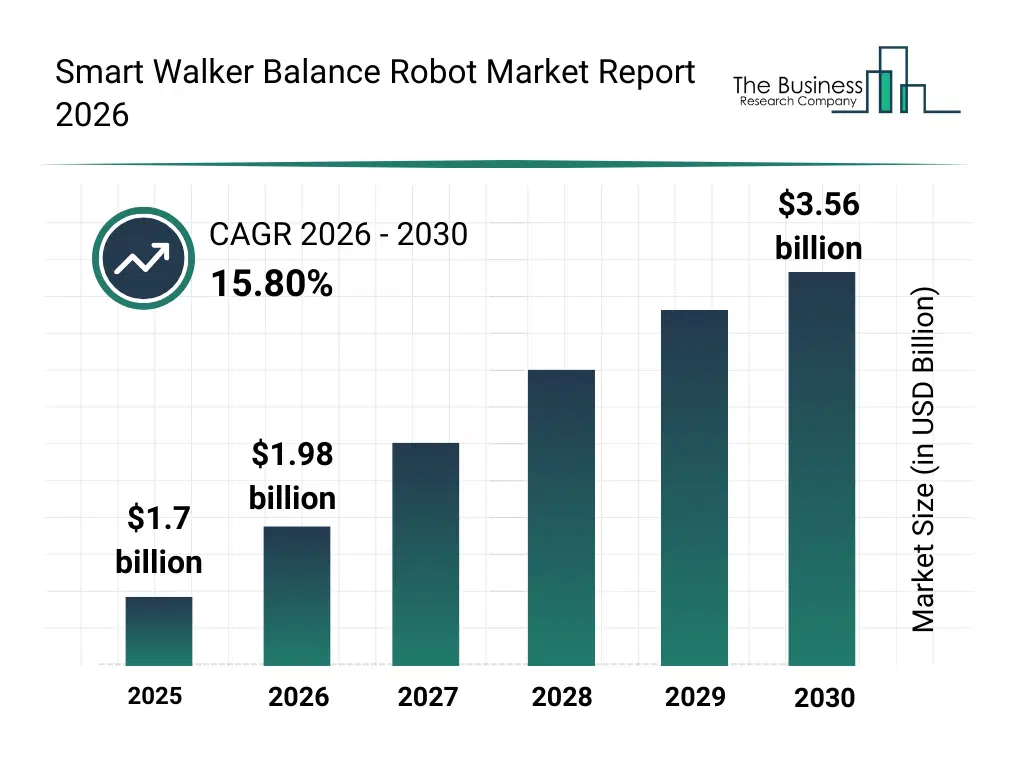
What Is The Smart Walker Balance Robot Market Size and Share 2026?
The smart walker balance robot market size has grown rapidly in recent years. It will grow from $1.7 billion in 2025 to $1.98 billion in 2026 at a compound annual growth rate (CAGR) of 16.1%. The growth in the historic period can be attributed to aging population growth, increase in mobility impairments, rehabilitation technology adoption, demand for assisted walking devices, advancements in robotics.What Is The Smart Walker Balance Robot Market Growth Forecast?
The smart walker balance robot market size is expected to see rapid growth in the next few years. It will grow to $3.56 billion in 2030 at a compound annual growth rate (CAGR) of 15.8%. The growth in the forecast period can be attributed to AI-powered gait analysis, homecare mobility solutions growth, smart rehabilitation demand, integration with healthcare monitoring, rising elderly independence focus. Major trends in the forecast period include dynamic balance control systems, sensor-assisted gait stabilization, obstacle detection and avoidance, ai-based mobility assistance, adaptive posture adjustment.
Global Smart Walker Balance Robot Market Segmentation
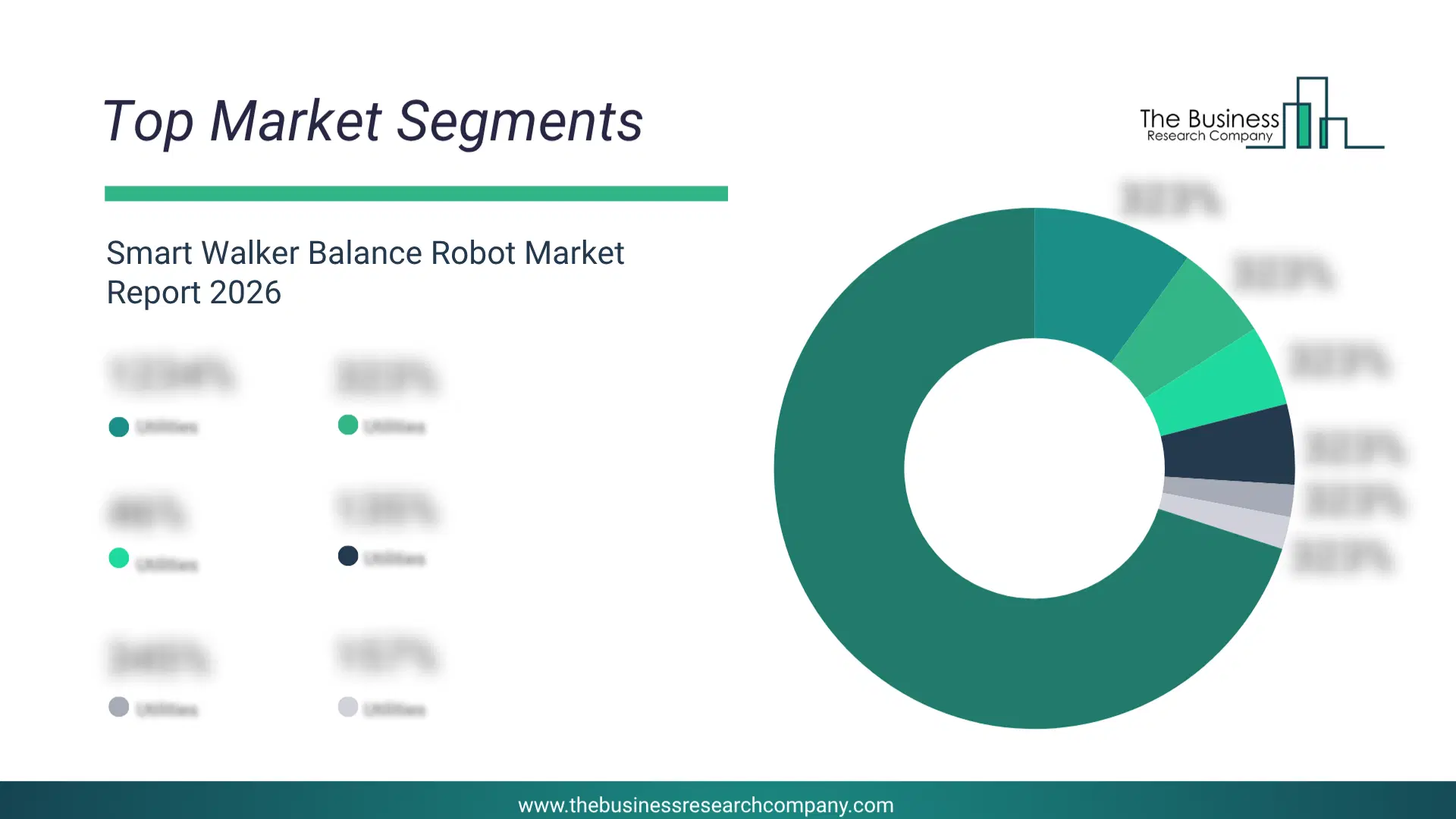
1) By Product Type: Sensor-Assisted Smart Walker Balance Robots, Motorized Smart Walker Balance Robots, AI-Enabled Smart Walker Balance Robots, Autonomous Smart Walker Balance Robots 2) By Distribution Channel: Specialty Stores, Direct Sales, Other Distribution Channels 3) By Application: Elderly Care, Rehabilitation Centers, Hospitals, Other Applications 4) By End-User: Individuals, Healthcare Facilities, Other End-Users Subsegments: 1) By Sensor-Assisted Smart Walker Balance Robots: Inertial Sensor-Based Balance Walkers, Pressure-Sensor Gait Support Walkers, Proximity-Sensor Obstacle-Aware Walkers, Multi-Sensor Fusion Balance Walkers 2) By Motorized Smart Walker Balance Robots: Power-Assisted Drive Walkers, Self-Propelled Motorized Balance Walkers, Adaptive Speed-Control Walkers, Terrain-Responsive Motorized Walkers 3) By AI-Enabled Smart Walker Balance Robots: AI Gait-Analysis Walkers, Predictive Balance-Correction Walkers, Machine-Learning Adaptive Walkers, Fall-Risk Detection Walkers 4) By Autonomous Smart Walker Balance Robots: Self-Navigating Smart Walkers, Autonomous Obstacle-Avoidance Walkers, Path-Planning Robotic Walkers, Fully Autonomous Balance-Stabilizing WalkersWhat Are The Drivers Of The Smart Walker Balance Robot Market?
The growing prevalence of neurological disorders is expected to propel the growth of the smart walker balance robot market going forward. Neurological disorders are conditions affecting the brain, spinal cord, or nerves, causing issues with movement, sensation, or cognition. The rise in neurological disorders is due to aging populations, who are more vulnerable to conditions like stroke, epilepsy, and Alzheimer’s disease. Smart walker balance robots support neurological patients by providing gait support, fall prevention, and real-time feedback to improve mobility and independence. For instance, in October 2023, according to the World Federation of Neurology (WFN), a UK-based non-profit organization, over 40% of the global population suffered from neurological conditions, a figure expected to nearly double by 2050. Therefore, the growing prevalence of neurological disorders is driving the growth of the smart walker balance robot industry. The rising healthcare expenditure is expected to propel the growth of the smart walker balance robot market going forward. Healthcare expenditure is the overall spending by individuals, institutions, and governments on medical care, health services, and related activities over a given time. Healthcare expenditure is rising due to the growing prevalence of chronic diseases, which increases the need for continuous medical care, long-term treatments, and regular use of prescription medications. Healthcare expenditure supports the adoption of smart walker balance robots, as increased funding in healthcare enables hospitals and clinics to invest in advanced mobility aids that enhance patient safety and rehabilitation outcomes. For instance, in April 2025, according to the Office for National Statistics, a UK-based government agency, government-funded healthcare accounted for the majority of total health spending in UK, reaching £258 billion in 2024, reflecting a 2.5% real-terms growth compared to 2023. Therefore, the rising healthcare expenditure is driving the growth of the smart walker balance robot industry.Key Players In The Global Smart Walker Balance Robot Market
Major companies operating in the smart walker balance robot market are UPnRIDE Robotics Ltd., Camino Mobility, Trexo Robotics, Rex Bionics, Wandercraft, Ekso Bionics Holdings Inc., UBTECH Robotics Corp. Ltd., Shenzhen Zuowei Technology Co. Ltd., Siyi Intelligent Technology, ReWalk Robotics, Bionik Laboratories, Cyberdyne Inc., Toyota Motor Corporation, Honda Motor Co. Ltd., Hyundai Motor Company, Panasonic Corporation, Walk-E, Roam Robotics, Indego, Parker Hannifin
This chart is for illustrative purposes; the full report includes a detailed competitor analysis and comprehensive overview of the top 10 companies in the market.
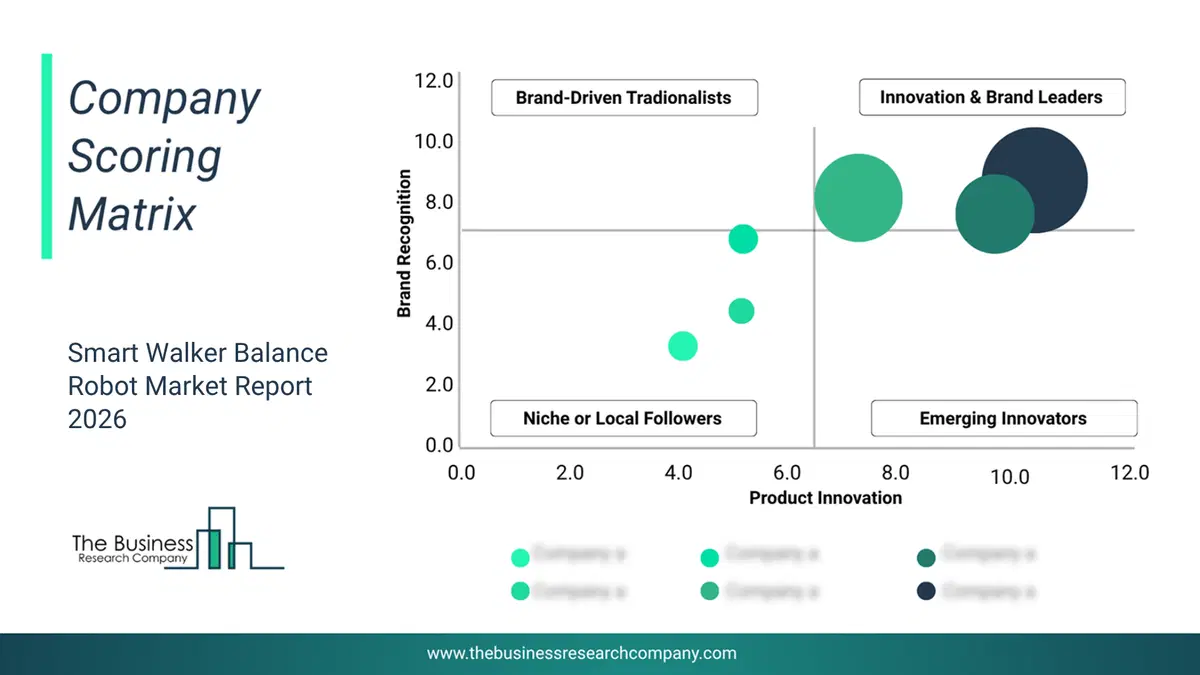
This chart maps companies by product innovation and brand strength, with bubble size indicating relative revenue, helping identify market leaders, challengers, and niche players. This is an illustrative chart; the full report provides a complete and accurate competitive analysis.
Global Smart Walker Balance Robot Market Trends and Insights
Major companies operating in the smart walker balance robot market are focusing on developing innovative approaches, such as artificial intelligence (AI)-powered gait analysis, to enhance mobility assistance, improve fall prevention, and deliver personalized rehabilitation support for users. Artificial intelligence (AI)-powered gait analysis refers to the use of artificial intelligence (AI) algorithms and sensor data to assess and interpret a person’s walking patterns for mobility, safety, and rehabilitation purposes. For instance, in January 2023, Camino Mobility, a US-based wellness and fitness technology company, launched the world’s first smart walker. This Smart Walker is equipped with embedded cameras and artificial intelligence (AI) that monitor a user’s gait in real time, offering adaptive auto-boost and intelligent braking to ensure safer movement. Its compact folding design allows it to pass through narrow spaces such as airplane aisles, while optional add-ons increase user convenience. Connected to a cloud-based artificial intelligence (AI) health platform, it provides mobility data, safety notifications, and remote monitoring for caregivers and families. This connectivity supports early interventions, helping users maintain independence, safety, and healthy aging.
Regional Outlook
North America was the largest region in the smart walker balance robot market in 2025. Asia-Pacific is expected to be the fastest-growing region in the forecast period. The regions covered in this market report are Asia-Pacific, South East Asia, Western Europe, Eastern Europe, North America, South America, Middle East, Africa. The countries covered in this market report are Australia, Brazil, China, France, Germany, India, Indonesia, Japan, Taiwan, Russia, South Korea, UK, USA, Canada, Italy, SpainWhat Defines the Smart Walker Balance Robot Market?
The smart walker balance robot market consists of revenues earned by entities by providing services such as installation, maintenance, training, customer support, remote monitoring, telehealth integration, and rehabilitation support. The market value includes the value of related goods sold by the service provider or included within the service offering. The smart walker balance robot market also includes sales of smart walkers, robotic rollators, gait training robots, mobility assist robots, rehabilitation exoskeletons, and sensor-integrated walkers. Values in this market are ‘factory gate’ values, that is the value of goods sold by the manufacturers or creators of the goods, whether to other entities (including downstream manufacturers, wholesalers, distributors and retailers) or directly to end customers. The value of goods in this market includes related services sold by the creators of the goods.How is Market Value Defined and Measured?
The market value is defined as the revenues that enterprises gain from the sale of goods and/or services within the specified market and geography through sales, grants, or donations in terms of the currency (in USD unless otherwise specified). The revenues for a specified geography are consumption values that are revenues generated by organizations in the specified geography within the market, irrespective of where they are produced. It does not include revenues from resales along the supply chain, either further along the supply chain or as part of other products.
This chart presents market attractiveness based on a quantitative evaluation of growth, competition, strategic alignment, and risk, offering a clear view of opportunity areas for decision-making. This chart is for illustrative purposes; the full report contains the complete analysis.

This chart highlights the Total Addressable Market (TAM) by estimating the maximum revenue opportunity using an assumption-driven approach, supporting strategic planning and opportunity sizing across markets. The chart is illustrative; the full report provides a more comprehensive analysis.
What Key Data and Analysis Are Included in the Smart Walker Balance Robot Market Report 2026?
The smart walker balance robot market research report is one of a series of new reports from The Business Research Company that provides market statistics, including industry global market size, regional shares, competitors with the market share, detailed market segments, market trends and opportunities, and any further data you may need to thrive in the smart walker balance robot industry. The market research report delivers a complete perspective of everything you need, with an in-depth analysis of the current and future state of the industry.Smart Walker Balance Robot Market Report Forecast Analysis
| Report Attribute | Details |
|---|---|
| Market Size Value In 2026 | $1.98 billion |
| Revenue Forecast In 2030 | $3.56 billion |
| Growth Rate | CAGR of 15.8% from 2026 to 2030 |
| Base Year For Estimation | 2025 |
| Actual Estimates/Historical Data | 2020-2025 |
| Forecast Period | 2026 - 2030 |
| Market Representation | Revenue in USD Billion and CAGR from 2026 to 2030 |
| Segments Covered | Product Type, Distribution Channel, Application, End-User |
| Regional Scope | Asia-Pacific, Western Europe, Eastern Europe, North America, South America, Middle East, Africa |
| Country Scope | The countries covered in the report are Australia, Brazil, China, France, Germany, India, Indonesia, Japan, Taiwan, Russia, South Korea, UK, USA, Canada, Italy, Spain. |
| Key Companies Profiled | UPnRIDE Robotics Ltd., Camino Mobility, Trexo Robotics, Rex Bionics, Wandercraft, Ekso Bionics Holdings Inc., UBTECH Robotics Corp. Ltd., Shenzhen Zuowei Technology Co. Ltd., Siyi Intelligent Technology, ReWalk Robotics, Bionik Laboratories, Cyberdyne Inc., Toyota Motor Corporation, Honda Motor Co. Ltd., Hyundai Motor Company, Panasonic Corporation, Walk-E, Roam Robotics, Indego, Parker Hannifin |
| Customization Scope | Request for Customization |
| Pricing And Purchase Options | Explore Purchase Options |