
Smart Wearable Blood Pressure Monitor Market Report 2026
Global Outlook – By Product Type (Wrist-Based Smart Blood Pressure Monitors, Arm-Based Smart Wearable Blood Pressure Monitors, Finger-Based Smart Blood Pressure Monitors), By Technology (Bluetooth, Wireless Fidelity (Wi-Fi), Cellular, Other Technologies), By Distribution Channel (Online Stores, Pharmacies, Specialty Stores, Other Distribution Channels), By Application (Home Healthcare, Remote Patient Monitoring, Sports and Fitness, Other Applications), By End User (Hospitals And Clinics, Ambulatory Surgical Centers, Individuals, Other End Users) – Market Size, Trends, Strategies, and Forecast to 2030
Smart Wearable Blood Pressure Monitor Market Overview
• Smart Wearable Blood Pressure Monitor market size has reached to $1.84 billion in 2025 • Expected to grow to $4.25 billion in 2030 at a compound annual growth rate (CAGR) of 18.2% • Growth Driver: Rising Global Prevalence Of Hypertension Driving Demand For The Market Due To Sedentary Lifestyles • Market Trend: Next-Generation Sensing Technologies Enabling Non-Invasive Monitoring • North America was the largest region in 2025 and Asia-Pacific is the fastest growing region.What Is Covered Under Smart Wearable Blood Pressure Monitor Market?
Smart wearable blood pressure monitors are advanced digital devices designed to continuously measure and track blood pressure through sensor-based technology integrated into wearable forms such as wristbands or smartwatches. These devices combine biosensing, data analytics, and wireless connectivity to provide real-time health insights and long-term cardiovascular monitoring. They represent an intersection of healthcare and technology, enabling proactive health management through intelligent data-driven solutions. The main product types of smart wearable blood pressure monitors are wrist-based, arm-based, finger-based, and other product types. Wrist-based refers to compact devices worn on the wrist that enable convenient blood pressure monitoring for users. They operate using technologies such as Bluetooth, Wireless Fidelity (Wi-Fi), cellular, and other technologies and are distributed through online stores, pharmacies, specialty stores, and other distribution channels. Key applications include home healthcare, remote patient monitoring, sports and fitness, and others. The primary end users are hospitals and clinics, ambulatory surgical centers, individuals, and others.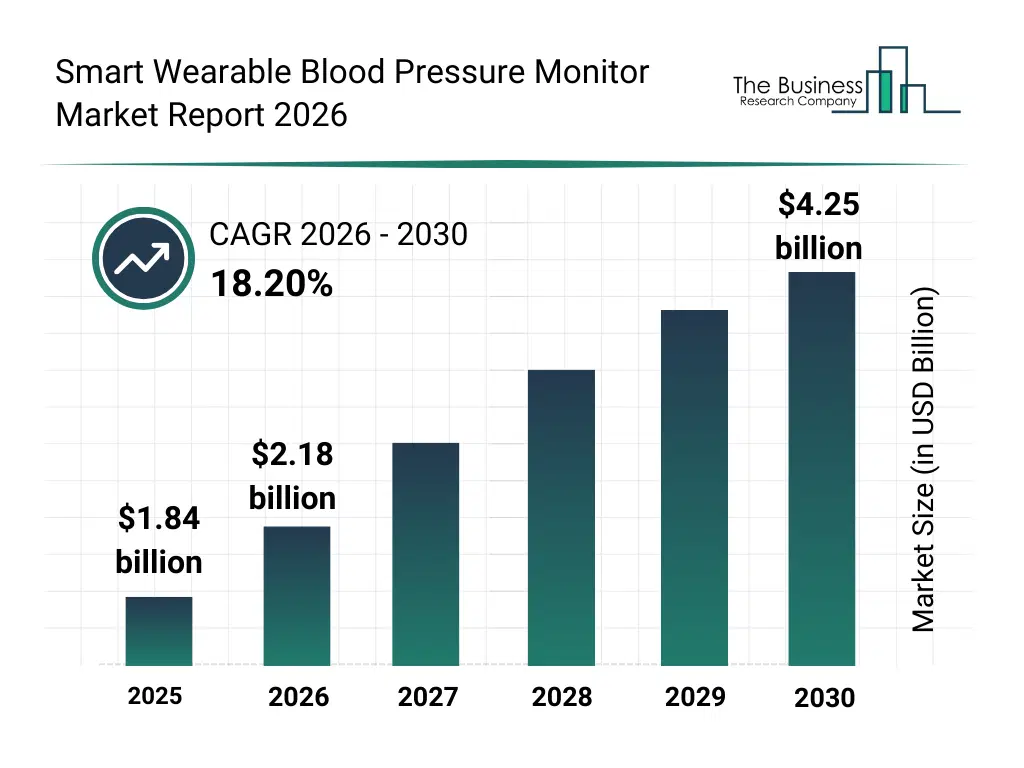
What Is The Smart Wearable Blood Pressure Monitor Market Size and Share 2026?
The smart wearable blood pressure monitor market size has grown rapidly in recent years. It will grow from $1.84 billion in 2025 to $2.18 billion in 2026 at a compound annual growth rate (CAGR) of 18.4%. The growth in the historic period can be attributed to rising hypertension prevalence, growth of wearable devices, demand for home health monitoring, limitations of traditional cuffs, digital health adoption.What Is The Smart Wearable Blood Pressure Monitor Market Growth Forecast?
The smart wearable blood pressure monitor market size is expected to see rapid growth in the next few years. It will grow to $4.25 billion in 2030 at a compound annual growth rate (CAGR) of 18.2%. The growth in the forecast period can be attributed to remote patient monitoring expansion, ai-based cardiovascular insights, preventive healthcare focus, smartwatch integration growth, value-based healthcare models. Major trends in the forecast period include continuous blood pressure monitoring, cuffless blood pressure measurement, wearable cardiovascular tracking, real-time health alerts, long-term hypertension analytics.
Global Smart Wearable Blood Pressure Monitor Market Segmentation
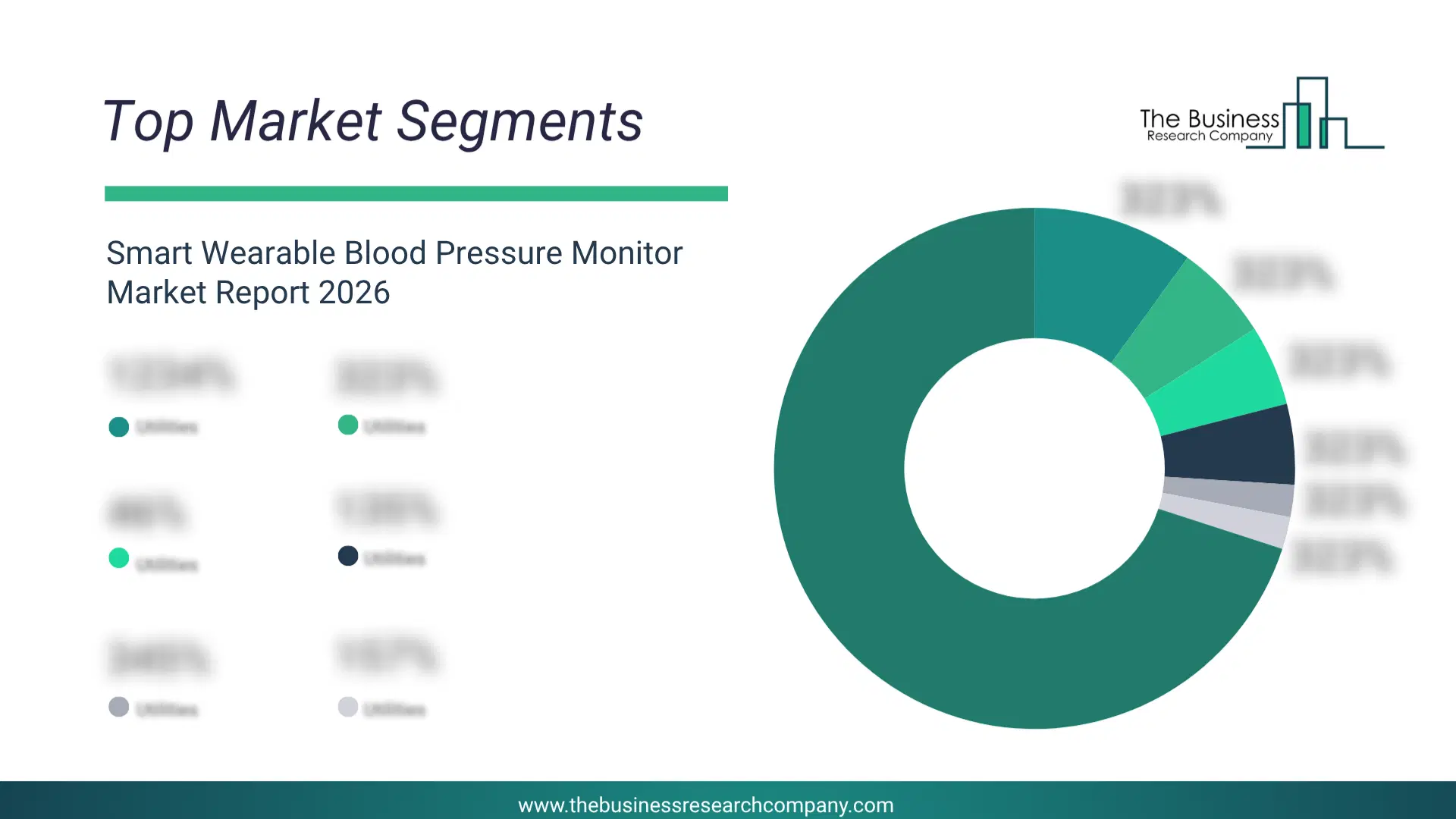
1) By Product Type: Wrist-Based Smart Blood Pressure Monitors, Arm-Based Smart Wearable Blood Pressure Monitors, Finger-Based Smart Blood Pressure Monitors 2) By Technology: Bluetooth, Wireless Fidelity (Wi-Fi), Cellular, Other Technologies 3) By Distribution Channel: Online Stores, Pharmacies, Specialty Stores, Other Distribution Channels 4) By Application: Home Healthcare, Remote Patient Monitoring, Sports and Fitness, Other Applications 5) By End User: Hospitals And Clinics, Ambulatory Surgical Centers, Individuals, Other End Users Subsegments: 1) By Wrist-Based Smart Blood Pressure Monitors: Digital Display Wrist Wearables, Touchscreen-Enabled Smart Wrist Wearables, Cuffless Wrist-Based Blood Pressure Monitors 2) By Arm-Based Smart Wearable Blood Pressure Monitors: Upper-Arm Wearable Smart Blood Pressure Monitors, Lower-Arm Wearable Smart Blood Pressure Monitors, Automatic Sensor-Based Arm Wearable Blood Pressure Monitors 3) By Finger-Based Smart Blood Pressure Monitors: Ring-Style Blood Pressure Wearables, Clip-Style Wearable Blood Pressure MonitorsWhat Is The Driver Of The Smart Wearable Blood Pressure Monitor Market?
The growing prevalence of hypertension is expected to propel the growth of the smart wearable blood pressure monitor market going forward. Hypertension is a chronic medical condition characterized by persistently elevated blood pressure in the arteries, which increases the risk of heart disease, stroke, and other cardiovascular complications. The growing prevalence of hypertension reflects a rising number of people developing sustained high arterial pressure over time, driven by broad population-level changes that increase both the incidence and detection of the condition. Smart wearable blood pressure monitors support hypertension patients by providing continuous, real-time tracking of blood pressure levels, enabling early detection of fluctuations, personalized health insights, and timely medical interventions that help improve treatment adherence, optimize medication management, and reduce the risk of cardiovascular complications. For instance, in September 2025, according to the World Health Organization, a Switzerland-based health organization, an estimated 1.4 billion adults aged 30–79 years worldwide were living with hypertension, accounting for approximately 33% of the global population within this age group in the year 2024. Therefore, the growing prevalence of hypertension drives the smart wearable blood pressure monitor industry.Key Players In The Global Smart Wearable Blood Pressure Monitor Market
Major companies operating in the smart wearable blood pressure monitor market are Aktiia SA, Biobeat Technologies Ltd, Corsano Health, HealthSTATS International, Blipcare, Omron Healthcare, Withings SA, Qardio Inc, iHealth Labs Inc, Beurer GmbH, A&D Company Limited, Samsung Electronics Co. Ltd, Huawei Technologies Co. Ltd, Xiaomi Corporation, YHE Technology, BPL Medical Technologies, Med-Watch, CareTaker Medical, Viatom Technology, ForaCare Suisse AG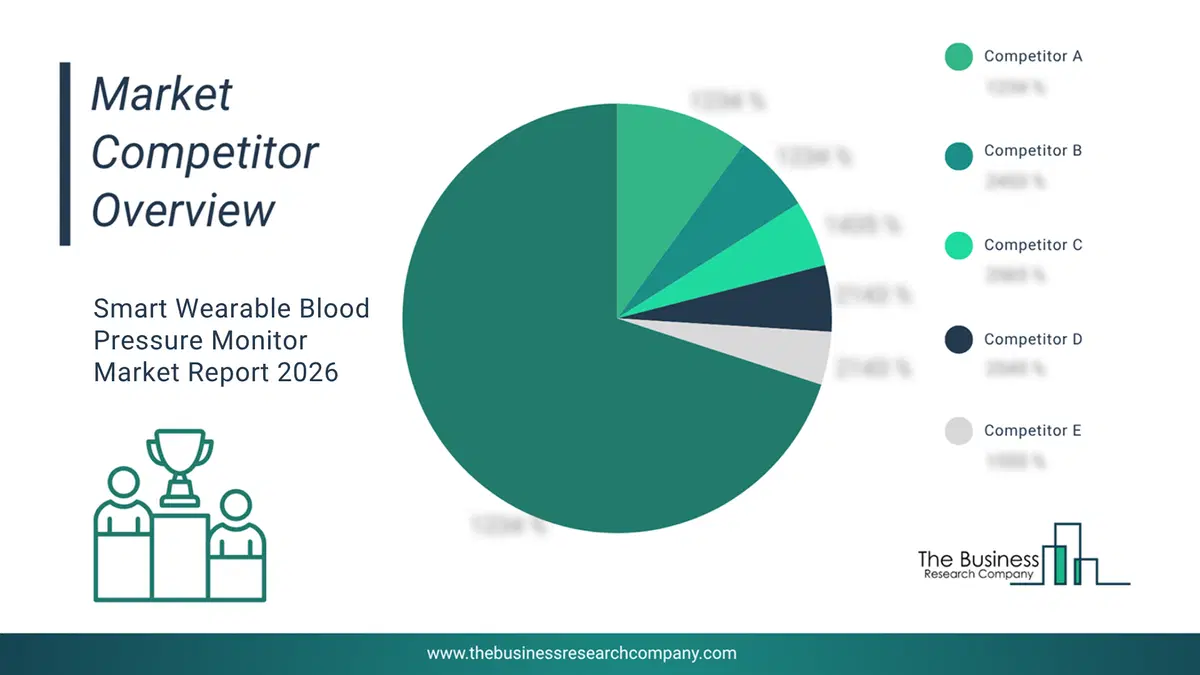
This chart is for illustrative purposes; the full report includes a detailed competitor analysis and comprehensive overview of the top 10 companies in the market.
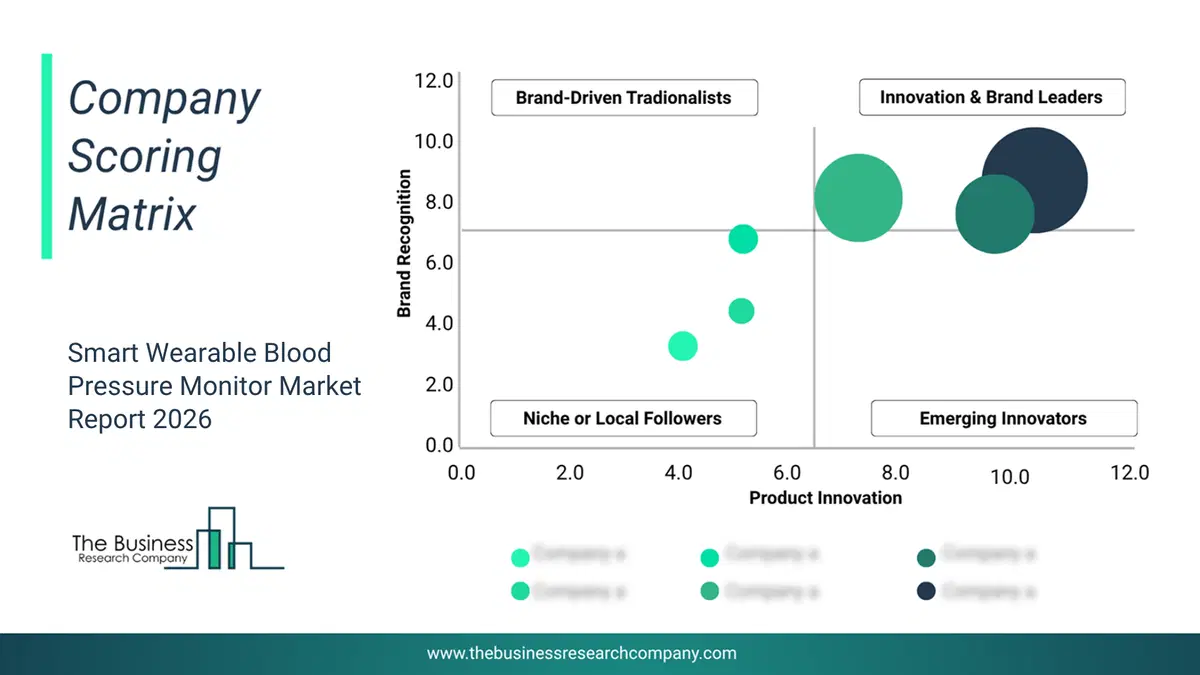
This chart maps companies by product innovation and brand strength, with bubble size indicating relative revenue, helping identify market leaders, challengers, and niche players. This is an illustrative chart; the full report provides a complete and accurate competitive analysis.
Global Smart Wearable Blood Pressure Monitor Market Trends and Insights
Major companies operating in the smart wearable blood pressure monitor market are focusing on advancements such as ultrasonic blood pressure monitoring solutions to enhance user comfort, provide continuous and accurate monitoring, and support early detection of cardiovascular risks through cuffless measurement. Ultrasonic blood pressure monitoring refers to a non-invasive method that uses ultrasound waves to detect arterial wall movements and changes in blood flow, enabling blood pressure measurement without an inflatable cuff. For instance, in October 2024, Novosound, a UK-based deep-tech sensors company, launched an advanced ultrasonic blood pressure monitoring solution built on its proprietary Slanj platform. The innovation leverages thin-film ultrasound sensors to miniaturize blood pressure measurement for integration into wearable devices such as smartwatches and rings. This technology delivers accuracy comparable to traditional cuff-based systems, while enabling continuous, stable monitoring and enhancing user adoption through seamless daily wearability.What Are Latest Mergers And Acquisitions In The Smart Wearable Blood Pressure Monitor Market?
In September 2024, Becton, Dickinson and Company, a US-based company that offers healthcare solutions acquired Edwards Lifesciences' Critical Care for an undisclosed amount. With this acquisition, Becton, Dickinson and Company aims to strengthen its position in advanced patient monitoring and hemodynamic management by integrating Edwards Lifesciences’ Critical Care portfolio of smart monitoring technologies, enabling the company to expand its capabilities in data-driven clinical decision support, enhance critical care innovation, and deliver more comprehensive solutions across intensive care and perioperative settings. Edwards Lifesciences is a US-based company that offers smart wearable blood pressure monitors.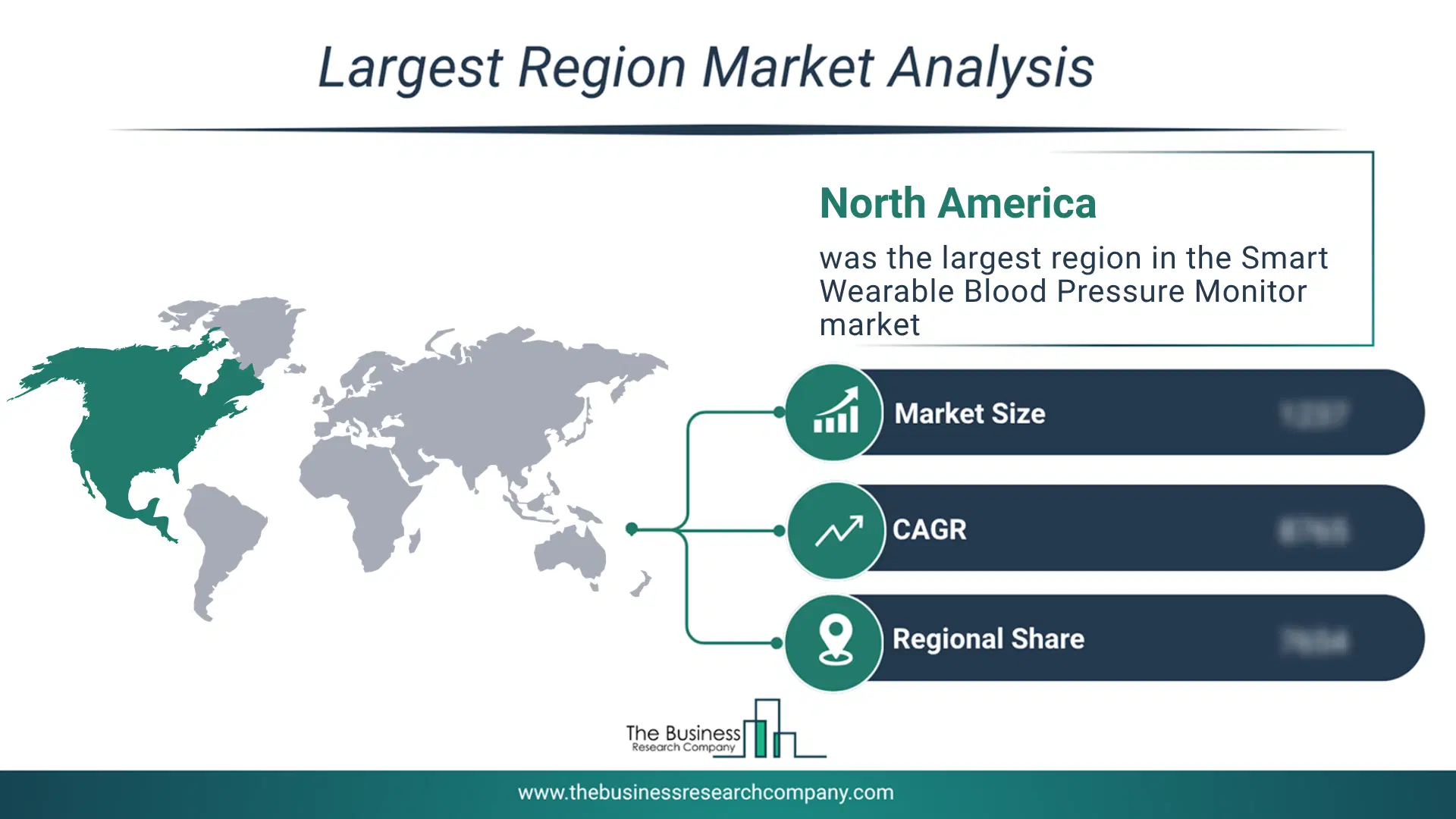
Regional Outlook
North America was the largest region in the smart wearable blood pressure Monitor market in 2025. Asia-Pacific is expected to be the fastest-growing region in the forecast period. The regions covered in this market report are Asia-Pacific, South East Asia, Western Europe, Eastern Europe, North America, South America, Middle East, Africa. The countries covered in this market report are Australia, Brazil, China, France, Germany, India, Indonesia, Japan, Taiwan, Russia, South Korea, UK, USA, Canada, Italy, SpainWhat Defines the Smart Wearable Blood Pressure Monitor Market?
The smart wearable blood pressure monitors market consists of revenues earned by entities by providing services such as telehealth integration services, cloud-based health data analytics, device calibration and maintenance services, personalized health coaching platforms and subscription-based health monitoring services. The market value includes the value of related goods sold by the service provider or included within the service offering. The smart wearable blood pressure monitors market includes sales of smart rings with blood pressure sensors, blood pressure monitoring patches, smart glasses with health monitoring functions, AI-powered smart clothing and multi-parameter smart bands. Values in this market are ‘factory gate’ values, that is the value of goods sold by the manufacturers or creators of the goods, whether to other entities (including downstream manufacturers, wholesalers, distributors and retailers) or directly to end customers. The value of goods in this market includes related services sold by the creators of the goods.How is Market Value Defined and Measured?
The market value is defined as the revenues that enterprises gain from the sale of goods and/or services within the specified market and geography through sales, grants, or donations in terms of the currency (in USD unless otherwise specified). The revenues for a specified geography are consumption values that are revenues generated by organizations in the specified geography within the market, irrespective of where they are produced. It does not include revenues from resales along the supply chain, either further along the supply chain or as part of other products.
This chart presents market attractiveness based on a quantitative evaluation of growth, competition, strategic alignment, and risk, offering a clear view of opportunity areas for decision-making. This chart is for illustrative purposes; the full report contains the complete analysis.

This chart highlights the Total Addressable Market (TAM) by estimating the maximum revenue opportunity using an assumption-driven approach, supporting strategic planning and opportunity sizing across markets. The chart is illustrative; the full report provides a more comprehensive analysis.
What Key Data and Analysis Are Included in the Smart Wearable Blood Pressure Monitor Market Report 2026?
The smart wearable blood pressure monitor market research report is one of a series of new reports from The Business Research Company that provides market statistics, including industry global market size, regional shares, competitors with the market share, detailed market segments, market trends and opportunities, and any further data you may need to thrive in the smart wearable blood pressure monitor industry. The market research report delivers a complete perspective of everything you need, with an in-depth analysis of the current and future state of the industry.Smart Wearable Blood Pressure Monitor Market Report Forecast Analysis
| Report Attribute | Details |
|---|---|
| Market Size Value In 2026 | $2.18 billion |
| Revenue Forecast In 2030 | $4.25 billion |
| Growth Rate | CAGR of 18.2% from 2026 to 2030 |
| Base Year For Estimation | 2025 |
| Actual Estimates/Historical Data | 2020-2025 |
| Forecast Period | 2026 - 2030 |
| Market Representation | Revenue in USD Billion and CAGR from 2026 to 2030 |
| Segments Covered | Product Type, Technology, Distribution Channel, Application, End User |
| Regional Scope | Asia-Pacific, Western Europe, Eastern Europe, North America, South America, Middle East, Africa |
| Country Scope | The countries covered in the report are Australia, Brazil, China, France, Germany, India, Indonesia, Japan, Taiwan, Russia, South Korea, UK, USA, Canada, Italy, Spain. |
| Key Companies Profiled | Aktiia SA, Biobeat Technologies Ltd, Corsano Health, HealthSTATS International, Blipcare, Omron Healthcare, Withings SA, Qardio Inc, iHealth Labs Inc, Beurer GmbH, A&D Company Limited, Samsung Electronics Co. Ltd, Huawei Technologies Co. Ltd, Xiaomi Corporation, YHE Technology, BPL Medical Technologies, Med-Watch, CareTaker Medical, Viatom Technology, ForaCare Suisse AG |
| Customization Scope | Request for Customization |
| Pricing And Purchase Options | Explore Purchase Options |