

Smart Wearable Breathing Trainer Market Report 2026
Global Outlook – By Product Type (Electronic Breathing Trainers, Hybrid Breathing Trainers, Other Product Types), By Distribution Channel (Online Stores, Specialty Stores, Pharmacies, Other Distribution Channels), By Application (Sports and Fitness, Medical and Healthcare, Wellness and Rehabilitation, Other Applications), By End-User (Adults, Children, Elderly) – Market Size, Trends, Strategies, and Forecast to 2030
Smart Wearable Breathing Trainer Market Overview
• Smart Wearable Breathing Trainer market size has reached to $1.16 billion in 2025 • Expected to grow to $2.35 billion in 2030 at a compound annual growth rate (CAGR) of 15% • Growth Driver: Rising Prevalence Of Respiratory Disorders Fueling The Growth Of The Market Due To Increasing Air Pollution Levels • Market Trend: Advancements In Smart Wearable Breathing Trainers Market To Enhance Respiratory Health And Performance • North America was the largest region in 2025 and Asia-Pacific is the fastest growing region.What Is Covered Under Smart Wearable Breathing Trainer Market?
A smart wearable breathing trainer is a portable device worn on the body to monitor and guide breathing exercises using sensors and real-time feedback. It helps users improve lung function, breathing patterns, and overall respiratory health. These devices often connect to mobile apps for personalized training, progress tracking, and health insights. The main product types of smart wearable breathing trainers include electronic breathing trainers, mechanical breathing trainers, and hybrid breathing trainers. Electronic breathing trainer devices utilize sensors, microprocessors, and Bluetooth or Wi-Fi connectivity to monitor breathing and provide real-time feedback via mobile apps. These products are distributed through various channels, including online stores, specialty stores, pharmacies, and others, and are used across multiple applications such as sports and fitness, medical and healthcare, wellness and rehabilitation, among others. The key end users of these devices include adults, children, and elderly.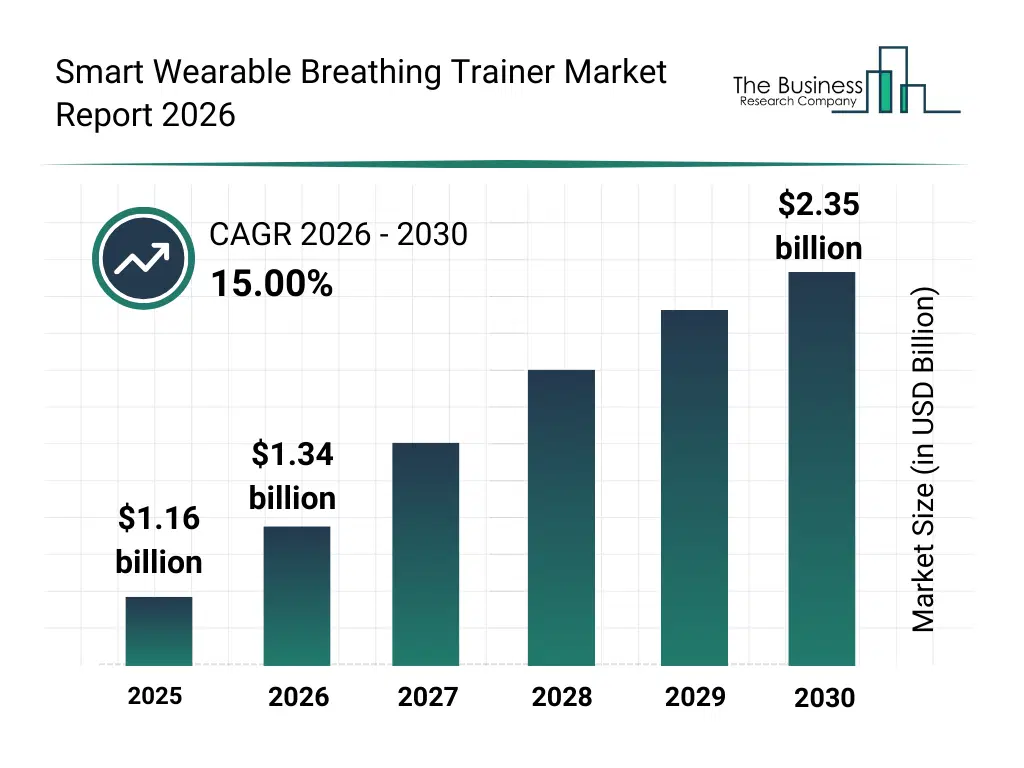
What Is The Smart Wearable Breathing Trainer Market Size and Share 2026?
The smart wearable breathing trainer market size has grown rapidly in recent years. It will grow from $1.16 billion in 2025 to $1.34 billion in 2026 at a compound annual growth rate (CAGR) of 15.3%. The growth in the historic period can be attributed to limited awareness of respiratory health devices, reliance on traditional mechanical trainers, growing fitness and wellness trends, increasing prevalence of respiratory disorders, nascent wearable technology adoption.What Is The Smart Wearable Breathing Trainer Market Growth Forecast?
The smart wearable breathing trainer market size is expected to see rapid growth in the next few years. It will grow to $2.35 billion in 2030 at a compound annual growth rate (CAGR) of 15.0%. The growth in the forecast period can be attributed to advancements in ai-guided breathing trainers, expansion of sensor-integrated respiratory wearables, rising adoption of hybrid and electronic-mechanical dual feedback devices, increasing integration with telehealth and mobile applications, growing demand for personalized wellness and rehabilitation solutions. Major trends in the forecast period include rising adoption of smart wearable respiratory devices, integration with mobile apps for personalized breathing training, growing use in sports, fitness, and rehabilitation programs, increased focus on home healthcare and remote monitoring, enhanced user engagement through real-time feedback and biofeedback.
Global Smart Wearable Breathing Trainer Market Segmentation
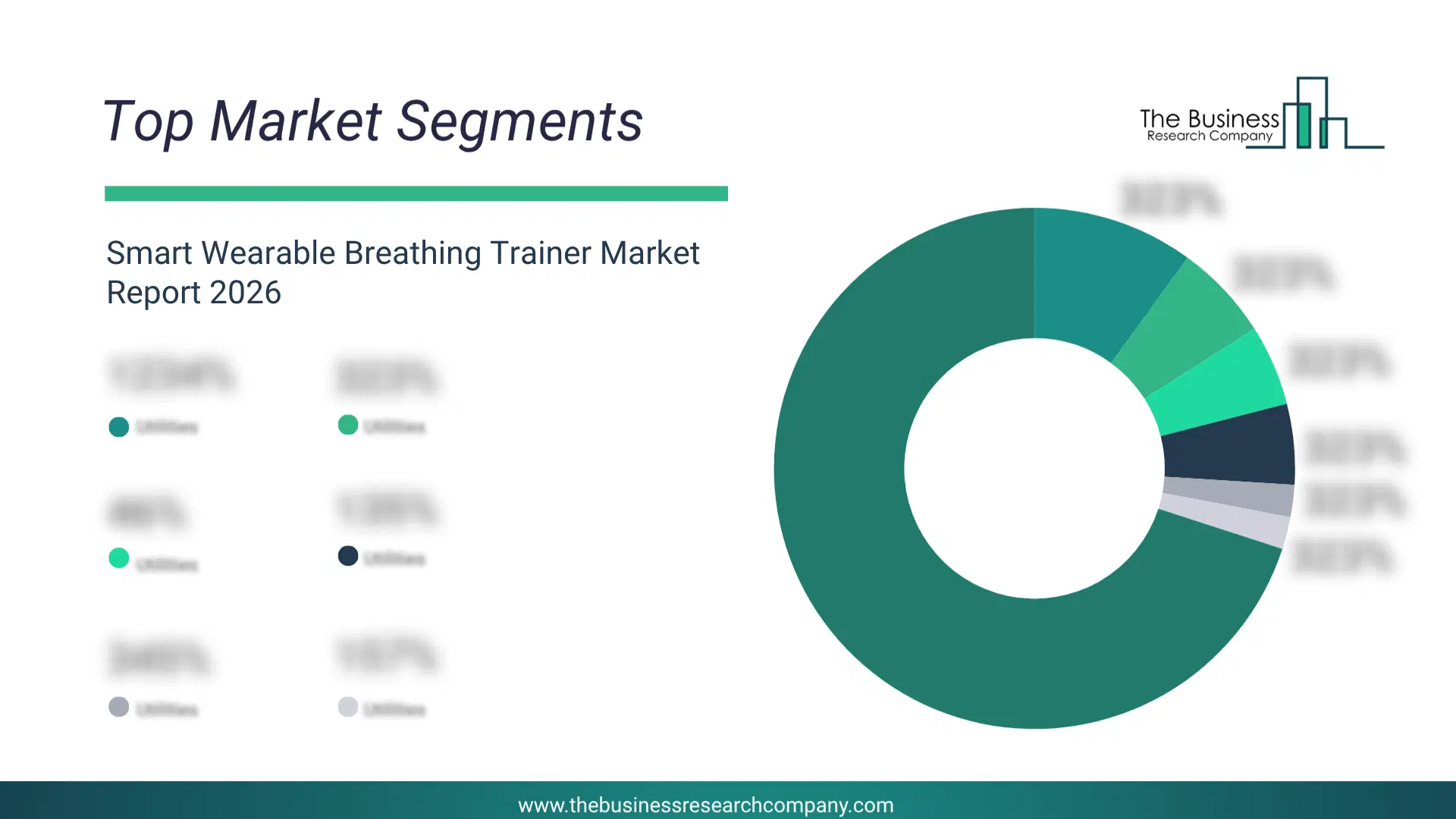
1) By Product Type: Electronic Breathing Trainers, Hybrid Breathing Trainers, Other Product Types 2) By Distribution Channel: Online Stores, Specialty Stores, Pharmacies, Other Distribution Channels 3) By Application: Sports and Fitness, Medical and Healthcare, Wellness and Rehabilitation, Other Applications 4) By End-User: Adults, Children, Elderly Subsegments: 1) By Electronic Breathing Trainers: Sensor-Enabled Electronic Breathing Trainers, Mobile App-Connected Electronic Breathing Trainers, Feedback-Based Electronic Breathing Trainers, Adaptive Electronic Breathing Trainers 2) By Hybrid Breathing Trainers: Mechanical-Electronic Hybrid Breathing Trainers, Sensor-Assisted Hybrid Breathing Trainers, Smart Hybrid Breathing Trainers, Multi-Function Hybrid Breathing Trainers 3) By Other Product Types: Portable Breathing Trainers, Wearable Respiratory Monitoring Devices, Biofeedback-Integrated Breathing Trainers, Customizable Breathing Trainer DevicesWhat Is The Driver Of The Smart Wearable Breathing Trainer Market?
The rising prevalence of respiratory disorders is expected to propel the growth of the smart wearable breathing trainer market going forward. Respiratory disorders refer to a range of conditions that affect the lungs and airways, including asthma, chronic obstructive pulmonary disease (COPD), and sleep apnea, often leading to reduced lung function and breathing difficulties. The prevalence of respiratory disorders is increasing due to growing air pollution levels, as prolonged exposure to polluted air damages lung function and increases vulnerability to chronic respiratory conditions. A smart wearable breathing trainer supports respiratory disorders by providing real-time feedback and guided breathing exercises that help improve lung function and respiratory muscle strength. For instance, in March 2024, according to the Centers for Disease Control and Prevention, a US-based government agency, the number of tuberculosis cases rose from 8,320 in 2022 to 9,615 in 2023, reflecting an increase of 1,295 cases. Therefore, the rising prevalence of respiratory disorders propels the growth of the smart wearable breathing trainer industry.Key Players In The Global Smart Wearable Breathing Trainer Market
Major companies operating in the smart wearable breathing trainer market are Oxa Life Ltd., B-Arm Medical Co. Ltd., Airofit A/S, Powerbreathe International Ltd., Oumua Inc., CHASKi Health Technologies Inc., POWERbreathe International Ltd., Hexoskin (Carré Technologies Inc.), Prana Tech LLC, SpiroTiger (Idiag AG), Tymewear Inc., ProSwimwear Ltd., Alvio Inc., Shenzhen Viatom Technology Co. Ltd, Opump Health Technology Co. Ltd., HelloEd Ltd., BRISH Co. Ltd., Zhongshan Huagong Technology Co. Ltd., GH Innotek Co. Ltd., Shenzhen Lanxiaozhichuang Technology Co. Ltd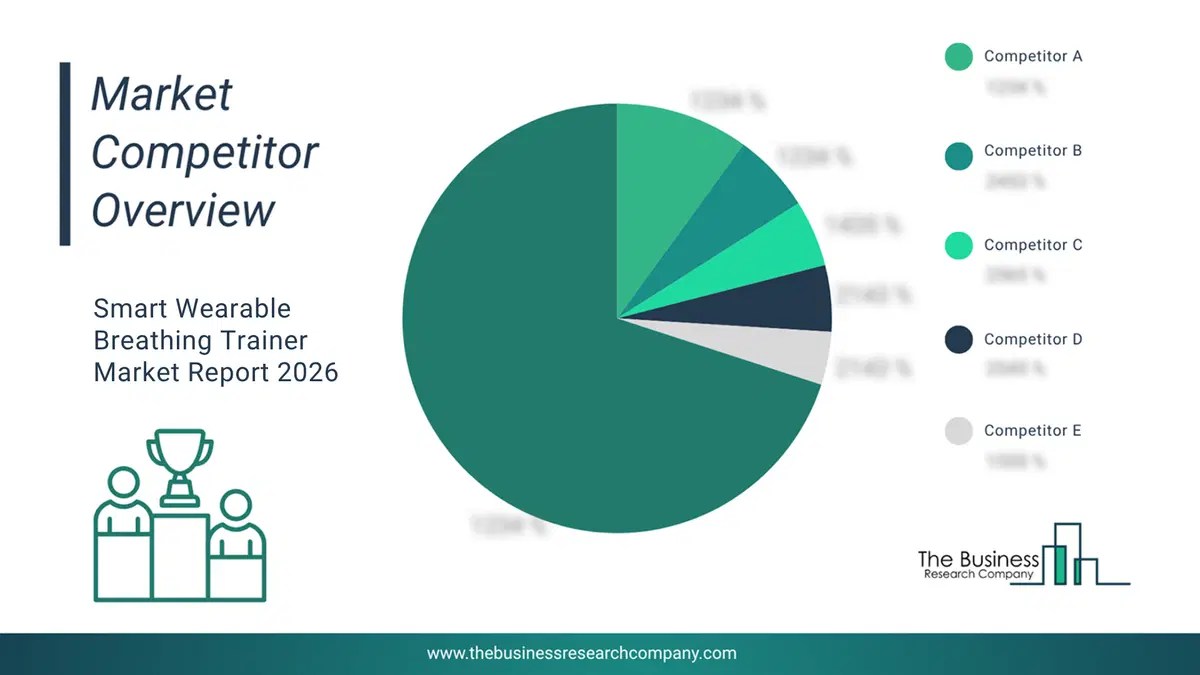
This chart is for illustrative purposes; the full report includes a detailed competitor analysis and comprehensive overview of the top 10 companies in the market.
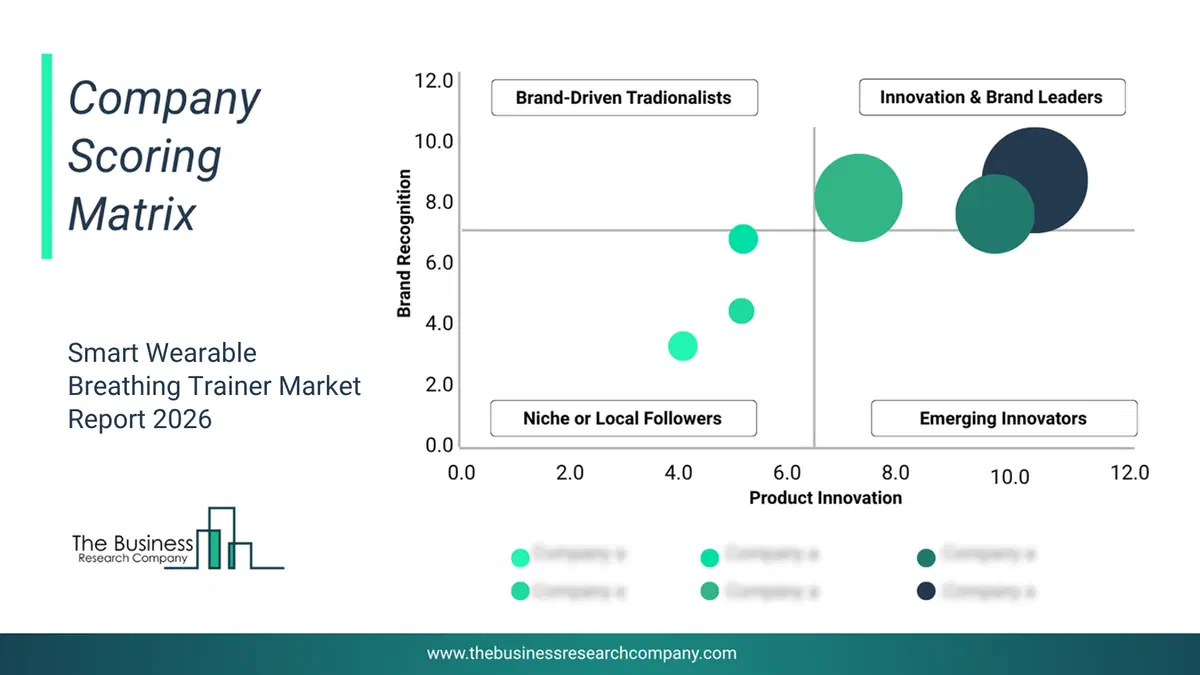
This chart maps companies by product innovation and brand strength, with bubble size indicating relative revenue, helping identify market leaders, challengers, and niche players. This is an illustrative chart; the full report provides a complete and accurate competitive analysis.
Global Smart Wearable Breathing Trainer Market Trends and Insights
Major companies in the smart wearable breathing trainer market are advancing technologies such as Bluetooth-enabled smart adaptors paired with mobile coaching apps to meet growing demand for data-driven respiratory training, remote monitoring, and personalized lung health optimization. A smart breathing adaptor connects conventional inspiratory or expiratory muscle training (IMT/EMT) devices to a smartphone via Bluetooth, enabling users to receive real-time feedback, track performance metrics, and follow customized workout plans—capabilities not possible with purely mechanical trainers. For example, in December 2024, POWERbreathe International, a UK-based respiratory device company, launched its Smart Adaptor alongside the ActiBreathe app, converting its established breathing trainers into a fully connected system. The product features a small, rechargeable adaptor that attaches to existing POWERbreathe Plus (IMT) and EX1 (EMT) devices, linking via Bluetooth to the app. Through the app, users can perform strength tests, engage in guided breathing exercises with real-time feedback, and monitor progress over weeks, months, or years. The system provides personalized training plans for medical users, athletes, or general wellness enthusiasts, offering motivation through achievements and objective insights into respiratory muscle performance.What Are Latest Mergers And Acquisitions In The Smart Wearable Breathing Trainer Market?
In September 2024, Wellinks Inc., a US-based technology company, acquired Spire Health for an undisclosed amount. With this acquisition, Wellinks’ predictive care model integrates Spire’s clinical-grade remote monitoring, enabling earlier detection of exacerbations in patients with chronic cardiopulmonary conditions. Spire Health is a US-based digital healthcare company that developed smart wearable devices.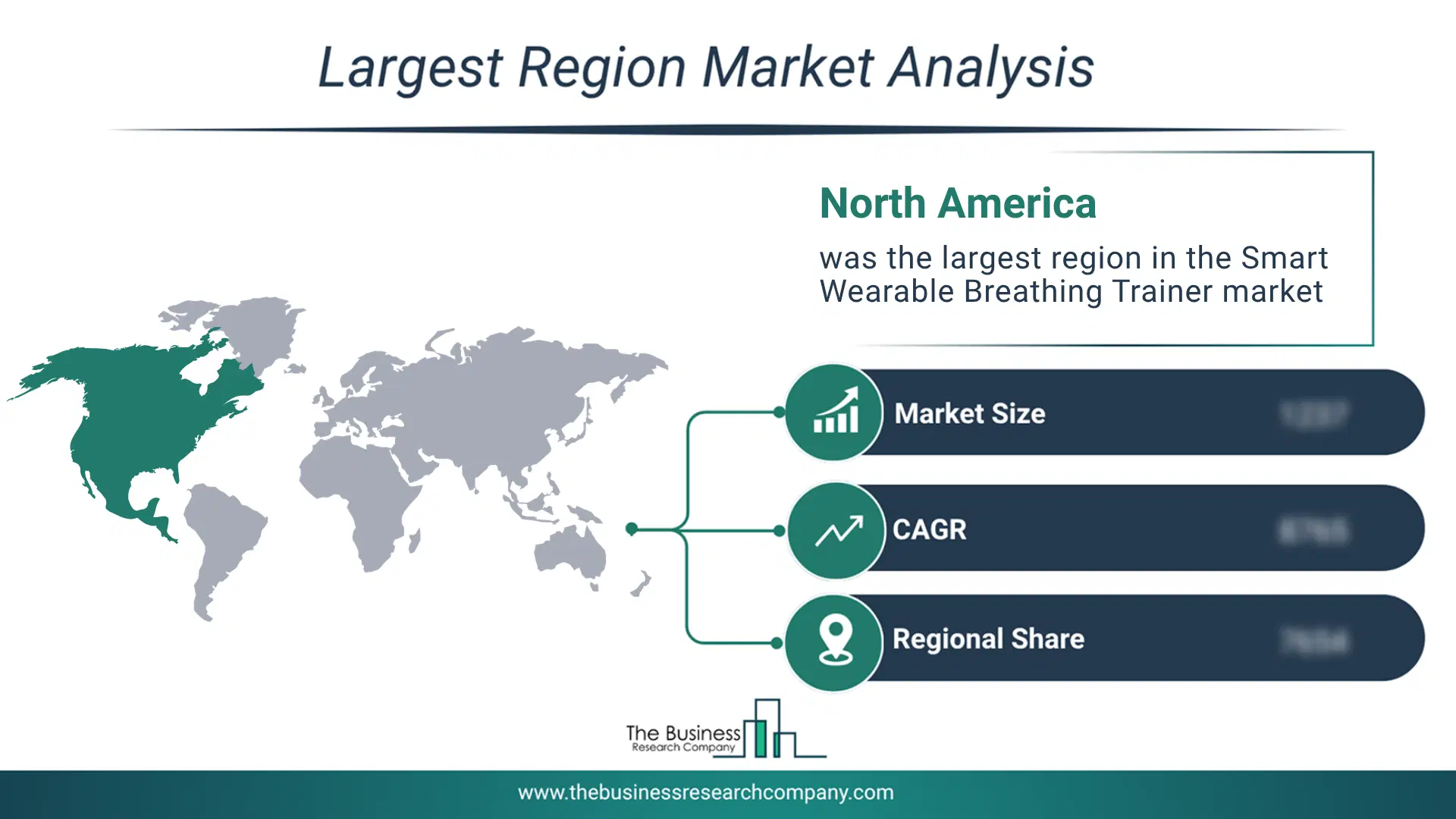
Regional Outlook
North America was the largest region in the smart wearable breathing trainer market in 2025. Asia-Pacific is expected to be the fastest-growing region in the forecast period. The regions covered in this market report are Asia-Pacific, South East Asia, Western Europe, Eastern Europe, North America, South America, Middle East, Africa. The countries covered in this market report are Australia, Brazil, China, France, Germany, India, Indonesia, Japan, Taiwan, Russia, South Korea, UK, USA, Canada, Italy, SpainWhat Defines the Smart Wearable Breathing Trainer Market?
The smart wearable breathing trainer market consists of sales of chest-worn breathing monitors, mouthpiece-based trainers, and virtual reality (VR)-integrated breathing trainers. Values in this market are ‘factory gate’ values, that is the value of goods sold by the manufacturers or creators of the goods, whether to other entities (including downstream manufacturers, wholesalers, distributors and retailers) or directly to end customers. The value of goods in this market includes related services sold by the creators of the goods.How is Market Value Defined and Measured?
The market value is defined as the revenues that enterprises gain from the sale of goods and/or services within the specified market and geography through sales, grants, or donations in terms of the currency (in USD unless otherwise specified). The revenues for a specified geography are consumption values that are revenues generated by organizations in the specified geography within the market, irrespective of where they are produced. It does not include revenues from resales along the supply chain, either further along the supply chain or as part of other products.
This chart presents market attractiveness based on a quantitative evaluation of growth, competition, strategic alignment, and risk, offering a clear view of opportunity areas for decision-making. This chart is for illustrative purposes; the full report contains the complete analysis.

This chart highlights the Total Addressable Market (TAM) by estimating the maximum revenue opportunity using an assumption-driven approach, supporting strategic planning and opportunity sizing across markets. The chart is illustrative; the full report provides a more comprehensive analysis.
What Key Data and Analysis Are Included in the Smart Wearable Breathing Trainer Market Report 2026?
The smart wearable breathing trainer market research report is one of a series of new reports from The Business Research Company that provides market statistics, including industry global market size, regional shares, competitors with the market share, detailed market segments, market trends and opportunities, and any further data you may need to thrive in the smart wearable breathing trainer industry. The market research report delivers a complete perspective of everything you need, with an in-depth analysis of the current and future state of the industry.Smart Wearable Breathing Trainer Market Report Forecast Analysis
| Report Attribute | Details |
|---|---|
| Market Size Value In 2026 | $1.34 billion |
| Revenue Forecast In 2030 | $2.35 billion |
| Growth Rate | CAGR of 15% from 2026 to 2030 |
| Base Year For Estimation | 2025 |
| Actual Estimates/Historical Data | 2020-2025 |
| Forecast Period | 2026 - 2030 |
| Market Representation | Revenue in USD Billion and CAGR from 2026 to 2030 |
| Segments Covered | Product Type, Distribution Channel, Application, End-User |
| Regional Scope | Asia-Pacific, Western Europe, Eastern Europe, North America, South America, Middle East, Africa |
| Country Scope | The countries covered in the report are Australia, Brazil, China, France, Germany, India, Indonesia, Japan, Taiwan, Russia, South Korea, UK, USA, Canada, Italy, Spain. |
| Key Companies Profiled | Oxa Life Ltd., B-Arm Medical Co. Ltd., Airofit A/S, Powerbreathe International Ltd., Oumua Inc., CHASKi Health Technologies Inc., POWERbreathe International Ltd., Hexoskin (Carré Technologies Inc.), Prana Tech LLC, SpiroTiger (Idiag AG), Tymewear Inc., ProSwimwear Ltd., Alvio Inc., Shenzhen Viatom Technology Co. Ltd, Opump Health Technology Co. Ltd., HelloEd Ltd., BRISH Co. Ltd., Zhongshan Huagong Technology Co. Ltd., GH Innotek Co. Ltd., Shenzhen Lanxiaozhichuang Technology Co. Ltd |
| Customization Scope | Request for Customization |
| Pricing And Purchase Options | Explore Purchase Options |