

Smoking Cessation Products Market Report 2026
Global Outlook – By Product Type (Nicotine Replacement Therapy, Prescription Drugs, Over-The-Counter Drugs, Electronic Cigarettes), By Formulation Type (Gums, Lozenges, Patches, Inhalers, Nasal Sprays), By Distribution Channel (Pharmacies, Online Retail, Supermarkets, Health Care Providers), By End-User (Adults, Teenagers, Pregnant Women) – Market Size, Trends, Strategies, and Forecast to 2030
Smoking Cessation Products Market Overview
• Smoking Cessation Products market size has reached to $24.13 billion in 2025 • Expected to grow to $35.59 billion in 2030 at a compound annual growth rate (CAGR) of 8% • Growth Driver: Rising Smoking-Related Diseases Driving Growth Of The Market Due To Increasing Health Risks And Awareness • Market Trend: De-Addiction Campaigns Driving Awareness And Support To Combat Tobacco Addiction • North America was the largest region in 2025 and Asia-Pacific is the fastest growing region.What Is Covered Under Smoking Cessation Products Market?
Smoking cessation products are a category of therapeutic aids designed to help individuals reduce or eliminate their dependence on tobacco by addressing the physical and psychological aspects of nicotine addiction. These products function by either gradually lowering nicotine levels in the body or by providing alternatives that reduce withdrawal symptoms and cravings. The main types of smoking cessation products include nicotine replacement therapy, prescription drugs, over-the-counter drugs, and electronic cigarettes. Nicotine replacement therapy (NRT) is a medical treatment that provides controlled doses of nicotine to help people quit smoking by reducing withdrawal symptoms. It is available in various formulations, including gums, lozenges, patches, inhalers, and nasal sprays, and is distributed through pharmacies, online retailers, supermarkets, and healthcare providers. It is used by various end-users, including adults, teenagers, and pregnant women.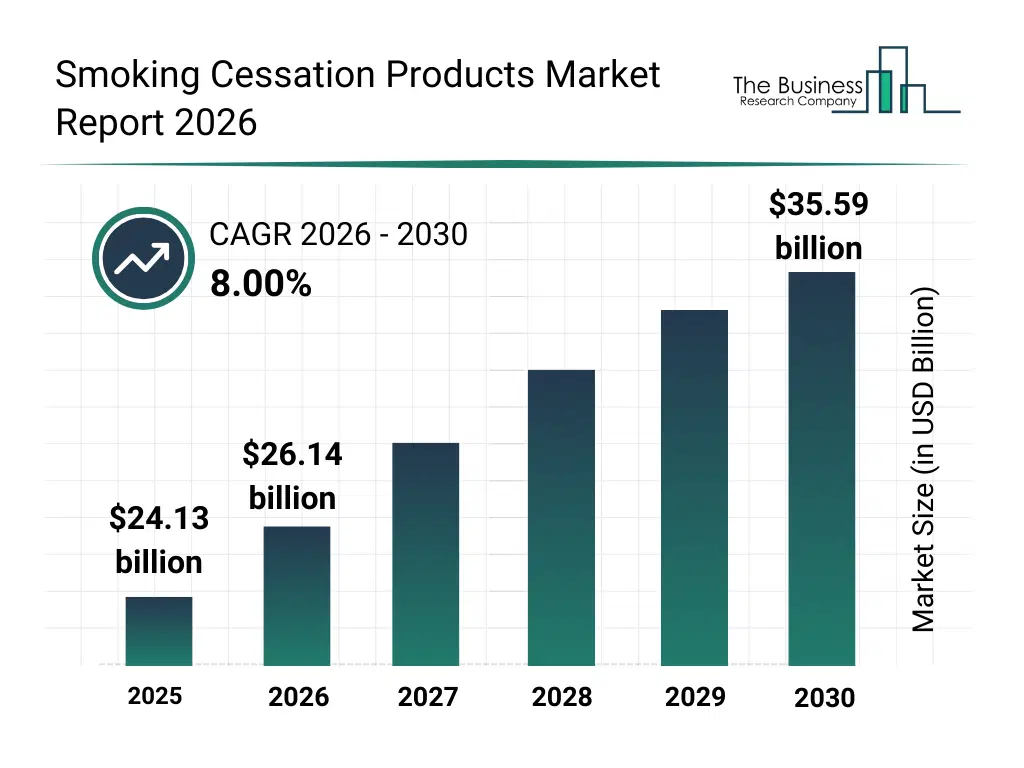
What Is The Smoking Cessation Products Market Size and Share 2026?
The smoking cessation products market size has grown strongly in recent years. It will grow from $24.13 billion in 2025 to $26.14 billion in 2026 at a compound annual growth rate (CAGR) of 8.3%. The growth in the historic period can be attributed to high prevalence of smoking globally, limited awareness of cessation aids, traditional reliance on behavioral therapies, high nicotine addiction rates, lack of structured government programs.What Is The Smoking Cessation Products Market Growth Forecast?
The smoking cessation products market size is expected to see strong growth in the next few years. It will grow to $35.59 billion in 2030 at a compound annual growth rate (CAGR) of 8.0%. The growth in the forecast period can be attributed to increasing health awareness campaigns, technological innovations in e-cigarettes and nicotine delivery, growing online retail and pharmacy distribution, rising government and insurance support for cessation programs, integration of digital apps for personalized quitting assistance. Major trends in the forecast period include rising adoption of nicotine replacement therapies, increasing popularity of electronic cigarettes, growth in prescription drug-based cessation treatments, expansion of over-the-counter smoking cessation products, focus on personalized smoking cessation programs and support.
Global Smoking Cessation Products Market Segmentation
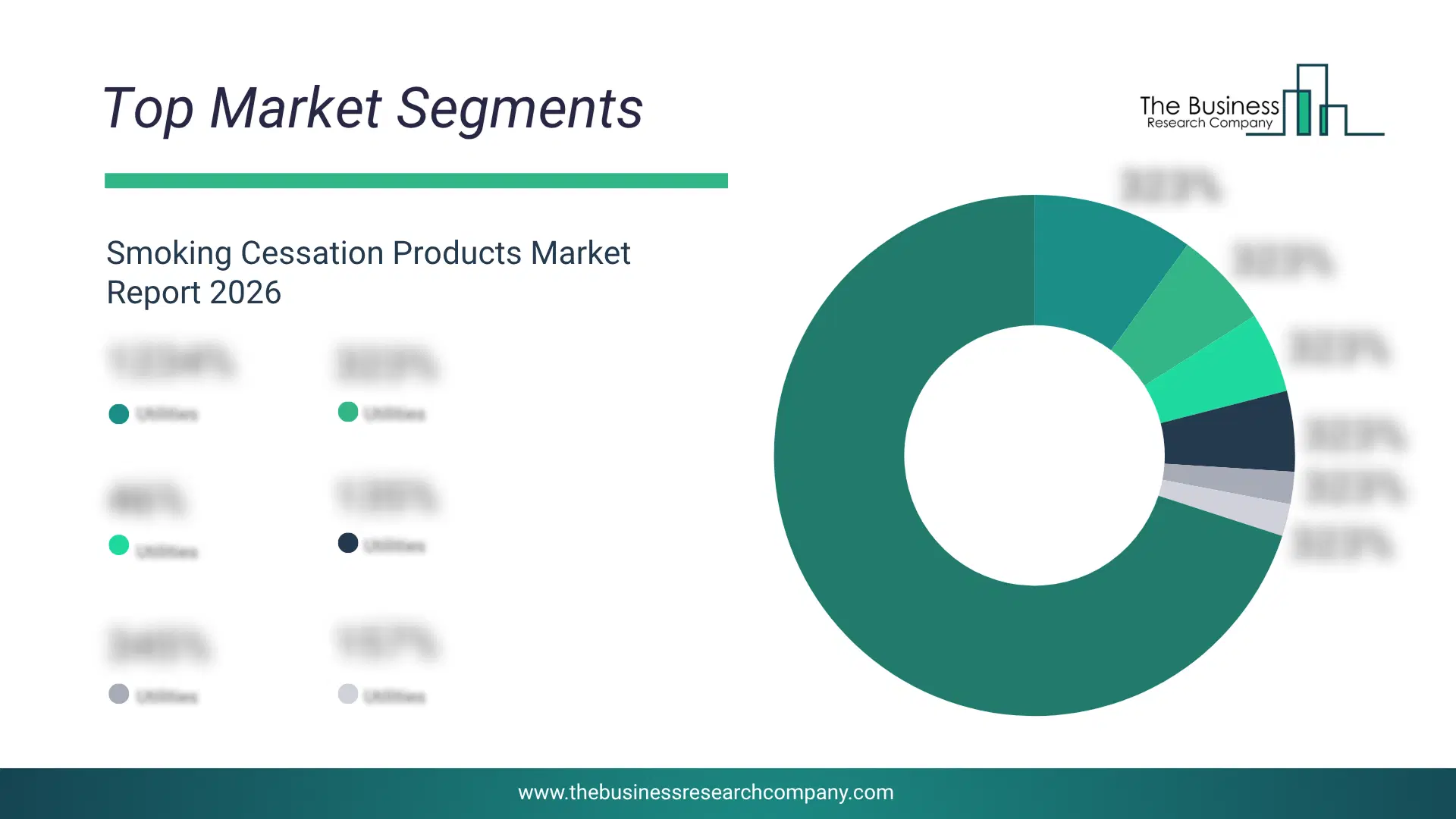
1) By Product Type: Nicotine Replacement Therapy, Prescription Drugs, Over-The-Counter Drugs, Electronic Cigarettes 2) By Formulation Type: Gums, Lozenges, Patches, Inhalers, Nasal Sprays 3) By Distribution Channel: Pharmacies, Online Retail, Supermarkets, Health Care Providers 4) By End-User: Adults, Teenagers, Pregnant Women Subsegments: 1) By Nicotine Replacement Therapy: Gum, Patch, Lozenge, Inhaler, Nasal Spray 2) By Prescription Drugs: Varenicline, Bupropion, Nortriptyline, Clonidine 3) By Over-The-Counter Drugs: Nicotine Gum, Nicotine Lozenges, Herbal Lozenges, Non-nicotine Tablets 4) By Electronic Cigarettes: Disposable E-cigarettes, Rechargeable E-cigarettes, Modular E-cigarettes, Pod-Based E-cigarettesWhat Is The Driver Of The Smoking Cessation Products Market?
The rising burden of smoking-related diseases is anticipated to fuel the growth of the smoking cessation products market in the coming years. Smoking-related diseases are health conditions that arise as a direct or indirect result of tobacco use, affecting various organs and bodily systems. Smoking-related diseases are rising due to the continued prevalence of tobacco use, which prolongs exposure to harmful chemicals that damage vital organs and increase the risk of chronic illnesses over time. The rise in smoking-related diseases drives demand for smoking cessation products as growing health awareness and medical diagnoses prompt more individuals to seek effective solutions to quit smoking and reduce their risk of serious illness. For instance, in January 2025, according to the American Cancer Society, a US-based non-profit organization, for the year 2025 in the United States, it is estimated that there will be roughly 226,650 new lung cancer diagnoses, with about 110,680 cases in males and 115,970 in females. Lung cancer-related deaths are expected to total around 124,730, comprising approximately 64,190 men and 60,540 women. Therefore, the rising burden of smoking-related diseases will drive the growth of the smoking cessation products industry.Key Players In The Global Smoking Cessation Products Market
Major companies operating in the smoking cessation products market are Pfizer Inc., Johnson & Johnson, Novartis AG, Imperial Brands PLC, GlaxoSmithKline (GSK), British American Tobacco PLC, Philip Morris International Inc., Haleon Group of Companies, Perrigo Company, Dr. Reddy's Laboratories, Cipla Ltd., Fertin Pharma, Lucy, Euro-Pharm International Canada Inc., Alkalon A/S, Enorama Pharma AB, Niconovum AB, Sparsha Pharma International Pvt Ltd, The Harvard Drug Group, Revolymer.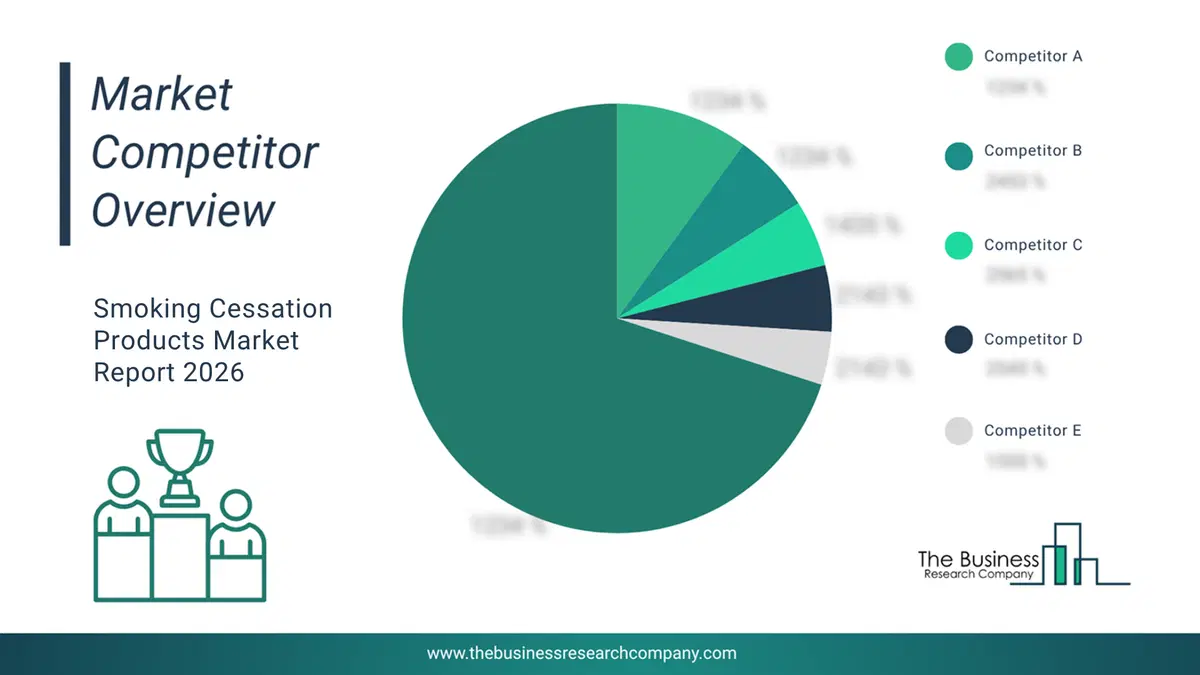
This chart is for illustrative purposes; the full report includes a detailed competitor analysis and comprehensive overview of the top 10 companies in the market.
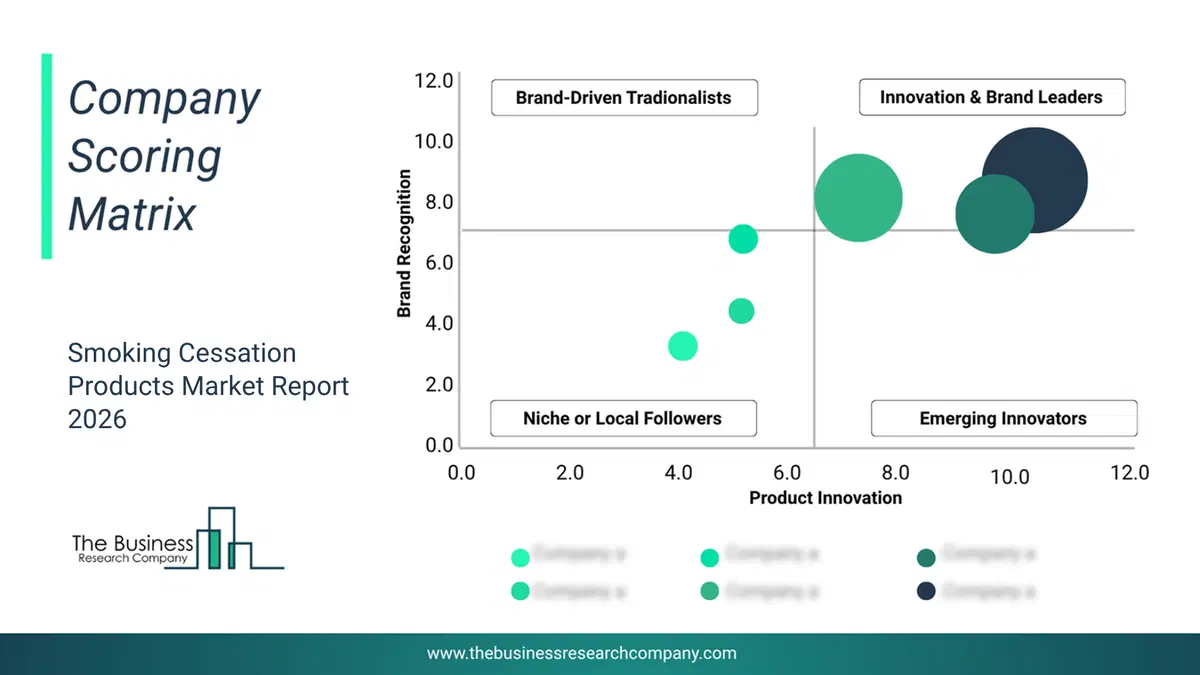
This chart maps companies by product innovation and brand strength, with bubble size indicating relative revenue, helping identify market leaders, challengers, and niche players. This is an illustrative chart; the full report provides a complete and accurate competitive analysis.
Global Smoking Cessation Products Market Trends and Insights
Major companies operating in the smoking cessation products market are focusing on developing de-addiction campaigns to create community support networks that enhance recovery success and prevent relapse. De-addiction campaigns are organized efforts aimed at raising awareness and providing support to help individuals overcome substance dependence and promote healthier lifestyles. For instance, in April 2023, Rusan Pharma, an India-based pharmaceutical company, launched a campaign to promote tobacco de-addiction with the brand 2baconil, a 24-hour nicotine transdermal patch. The #NoReasonIsGoodEnough campaign by 2baconil is based on the insight that individuals often justify their smoking habits with various reasons. It emphasizes how 2baconil nicotine patches help reduce both the physical and mental dependence on nicotine. The brand offers its products in nicotine patch and gum formats to assist users in quitting smoking.What Are Latest Mergers And Acquisitions In The Smoking Cessation Products Market?
In April 2024, Dr. Reddy’s Laboratories Ltd., an India-based pharmaceutical company, acquired the global Nicotine Replacement Therapy (NRT) business of Haleon Plc for $619 million. Following the acquisition, the portfolio expanded to include Nicotinell, a prominent global leader in nicotine replacement therapy with a wide reach across more than 30 countries in Europe, Asia, and Latin America, and notable regional brands such as Nicabate, Thrive, and Habitrol. The range covers various formats such as lozenges, patches, and gums, as well as upcoming products, across all major international markets, excluding the United States. Haleon Plc is a UK-based manufacturer of smoking cessation products.
Regional Insights
North America was the largest region in the smoking cessation products market in 2025. Asia-Pacific is expected to be the fastest-growing region in the forecast period. The regions covered in this market report are Asia-Pacific, South East Asia, Western Europe, Eastern Europe, North America, South America, Middle East, Africa. The countries covered in this market report are Australia, Brazil, China, France, Germany, India, Indonesia, Japan, Taiwan, Russia, South Korea, UK, USA, Canada, Italy, Spain.What Defines the Smoking Cessation Products Market?
The smoking cessation products market consists of sales of non-nicotine prescription medications, quit smoking supplements, and detox and recovery aids. Values in this market are ‘factory gate’ values, that is the value of goods sold by the manufacturers or creators of the goods, whether to other entities (including downstream manufacturers, wholesalers, distributors and retailers) or directly to end customers. The value of goods in this market includes related services sold by the creators of the goods.How is Market Value Defined and Measured?
The market value is defined as the revenues that enterprises gain from the sale of goods and/or services within the specified market and geography through sales, grants, or donations in terms of the currency (in USD unless otherwise specified). The revenues for a specified geography are consumption values that are revenues generated by organizations in the specified geography within the market, irrespective of where they are produced. It does not include revenues from resales along the supply chain, either further along the supply chain or as part of other products.
This chart presents market attractiveness based on a quantitative evaluation of growth, competition, strategic alignment, and risk, offering a clear view of opportunity areas for decision-making. This chart is for illustrative purposes; the full report contains the complete analysis.

This chart highlights the Total Addressable Market (TAM) by estimating the maximum revenue opportunity using an assumption-driven approach, supporting strategic planning and opportunity sizing across markets. The chart is illustrative; the full report provides a more comprehensive analysis.
What Key Data and Analysis Are Included in the Smoking Cessation Products Market Report 2026?
The smoking cessation products market research report is one of a series of new reports from The Business Research Company that provides market statistics, including industry global market size, regional shares, competitors with the market share, detailed market segments, market trends and opportunities, and any further data you may need to thrive in the smoking cessation products industry. The market research report delivers a complete perspective of everything you need, with an in-depth analysis of the current and future state of the industry.Smoking Cessation Products Market Report Forecast Analysis
| Report Attribute | Details |
|---|---|
| Market Size Value In 2026 | $26.14 billion |
| Revenue Forecast In 2030 | $35.59 billion |
| Growth Rate | CAGR of 8.3% from 2026 to 2030 |
| Base Year For Estimation | 2025 |
| Actual Estimates/Historical Data | 2020-2025 |
| Forecast Period | 2026 - 2030 |
| Market Representation | Revenue in USD Billion and CAGR from 2026 to 2030 |
| Segments Covered | Product Type, Formulation Type, Distribution Channel, End-User |
| Regional Scope | Asia-Pacific, Western Europe, Eastern Europe, North America, South America, Middle East, Africa |
| Country Scope | The countries covered in the report are Australia, Brazil, China, France, Germany, India, Indonesia, Japan, Taiwan, Russia, South Korea, UK, USA, Canada, Italy, Spain. |
| Key Companies Profiled | Pfizer Inc., Johnson & Johnson, Novartis AG, Imperial Brands PLC, GlaxoSmithKline (GSK), British American Tobacco PLC, Philip Morris International Inc., Haleon Group of Companies, Perrigo Company, Dr. Reddy's Laboratories, Cipla Ltd., Fertin Pharma, Lucy, Euro-Pharm International Canada Inc., Alkalon A/S, Enorama Pharma AB, Niconovum AB, Sparsha Pharma International Pvt Ltd, The Harvard Drug Group, Revolymer. |
| Customization Scope | Request for Customization |
| Pricing And Purchase Options | Explore Purchase Options |