
Smoothies Market Report 2026
Global Outlook – By Product Type (Fruit-Based, Vegetable-Based, Dairy-Based, Other Product Types), By Packaging Material (Plastic, Paper, Glass, Other Packaging Materials), By Distribution Channel (Supermarkets And Hypermarkets, Smoothie Bars, Convenience Stores, Other Distribution Channels) – Market Size, Trends, Strategies, and Forecast to 2030
Smoothies Market Overview
• Smoothies market size has reached to $19.8 billion in 2025 • Expected to grow to $30.1 billion in 2030 at a compound annual growth rate (CAGR) of 9% • Growth Driver: Organic Food Demand Shapes the Future of Smoothies • Market Trend: Exploring Kind's Innovative Breakfast Smoothie • North America was the largest region in 2025 and Asia-Pacific is the fastest growing region.Market Gains By 2030 – Top Opportunities By Segment
Market Gain identifies the most promising market opportunities by highlighting the segments or products expected to generate the highest incremental revenue growth over the next five years.
What Is Covered Under Smoothies Market?
A smoothie is a blended beverage typically made from a combination of fruits, vegetables, liquids such as juice or milk, and additional ingredients like yogurt, ice cream, or sweeteners. The ingredients are blended until smooth, resulting in a thick, creamy, and often refreshing drink. The main product types of smoothies are fruit-based, vegetable-based, dairy-based, and others. Fruit-based smoothies are primarily made with various fruits as the main ingredients. These are packed through various packaging materials such as plastic, paper, glass, and others and are distributed through various distribution channels such as supermarkets and hypermarkets, smoothie bars, convenience stores, and others.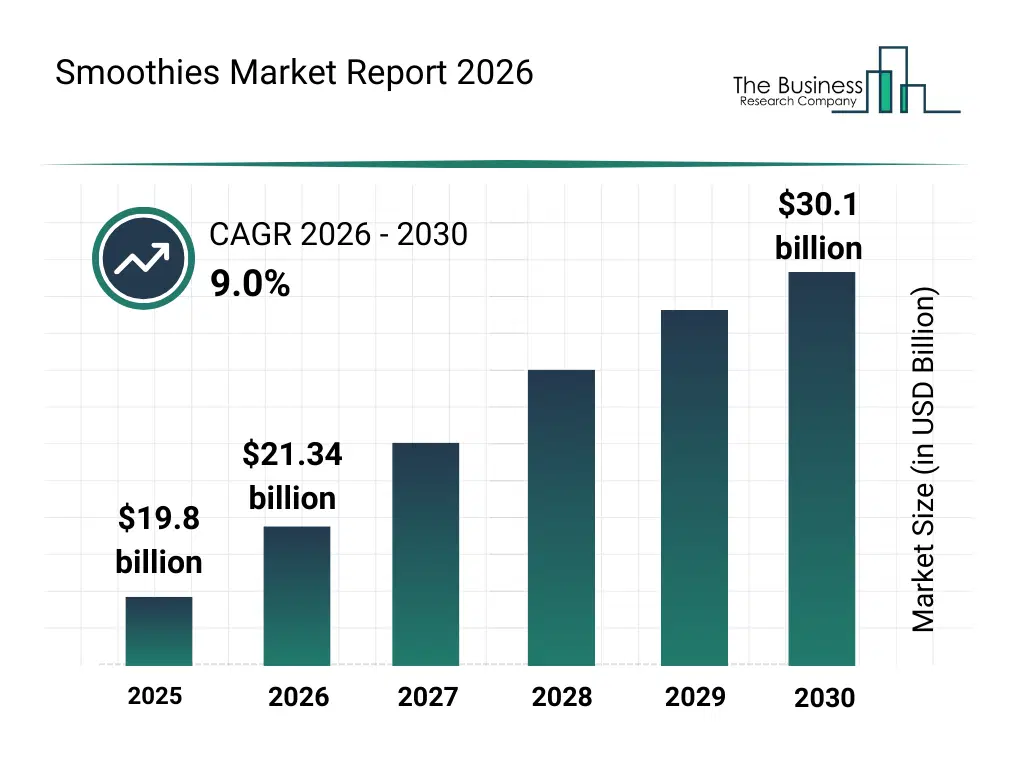
What Is The Smoothies Market Size and Share 2026?
The smoothies market size has grown strongly in recent years. It will grow from $19.8 billion in 2025 to $21.34 billion in 2026 at a compound annual growth rate (CAGR) of 7.7%. The growth in the historic period can be attributed to growth of health-conscious consumer behavior, expansion of urban foodservice outlets, rising consumption of fruit-based beverages, increasing demand for convenient nutrition, development of cold-chain distribution.What Is The Smoothies Market Growth Forecast?
The smoothies market size is expected to see strong growth in the next few years. It will grow to $30.1 billion in 2030 at a compound annual growth rate (CAGR) of 9.0%. The growth in the forecast period can be attributed to increasing demand for protein and superfood smoothies, rising adoption of personalized nutrition trends, expansion of on-the-go beverage consumption, growing focus on sugar reduction, increasing innovation in smoothie formulations. Major trends in the forecast period include increasing demand for functional and nutrient-rich smoothies, rising popularity of plant-based smoothie options, growing use of natural and clean ingredients, expansion of ready-to-drink smoothie formats, enhanced focus on customizable flavor profiles.
Global Smoothies Market Segmentation
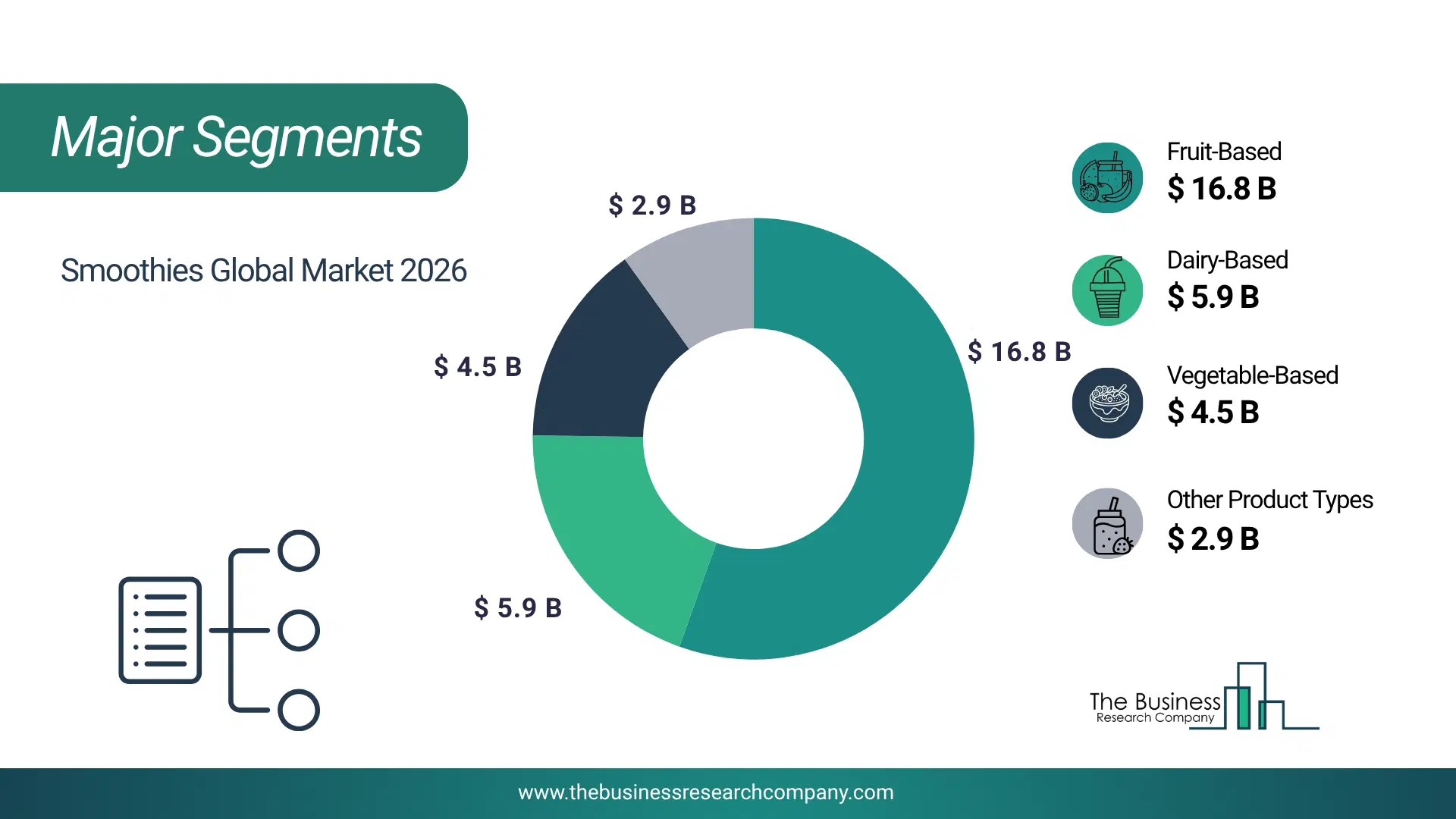
1) By Product Type: Fruit-Based, Vegetable-Based, Dairy-Based, Other Product Types 2) By Packaging Material: Plastic, Paper, Glass, Other Packaging Materials 3) By Distribution Channel: Supermarkets And Hypermarkets, Smoothie Bars, Convenience Stores, Other Distribution Channels Subsegments: 1) By Fruit-Based: Pure Fruit Smoothies, Fruit And Yogurt Smoothies, Fruit And Juice Smoothies 2) By Vegetable-Based: Green Vegetable Smoothies, Vegetable And Fruit Smoothies 3) By Dairy-Based: Milk Smoothies, Yogurt Smoothies 4) By Other Product Types: Protein Smoothies, Nut-Based Smoothies, Superfood Smoothies The top segments in the smoothies market will be: • Fruit-Based will reach $16.82 billion by 2030. • Dairy-Based will reach $5.89 billion by 2030. • Vegetable-Based will reach $4.5 billion by 2030. • Other Product Types will reach $2.89 billion by 2030.What Is The Driver Of The Smoothies Market?
Increasing demand for organic food is expected to propel the growth of the smoothie market going forward. Organic food refers to agricultural products that are grown, processed, and produced without the use of synthetic pesticides, fertilizers, genetically modified organisms (GMOs), irradiation, or sewage sludge. Smoothies with organic ingredients offer a nutrient-rich and environmentally sustainable option, supporting health-conscious choices and avoiding synthetic additives associated with conventional farming. For instance, in February 2024, according to the IFOAM (International Federation of Organic Agriculture Movements), a Germany-based an international organization, the global area under organic farming expanded by 2.5 million hectares in 2023, bringing the total to nearly 99 million hectares. Meanwhile, global sales of organic food rose to approximately 136 billion euros that same year. Therefore, increasing demand for organic food is driving the growth of the smoothie industry.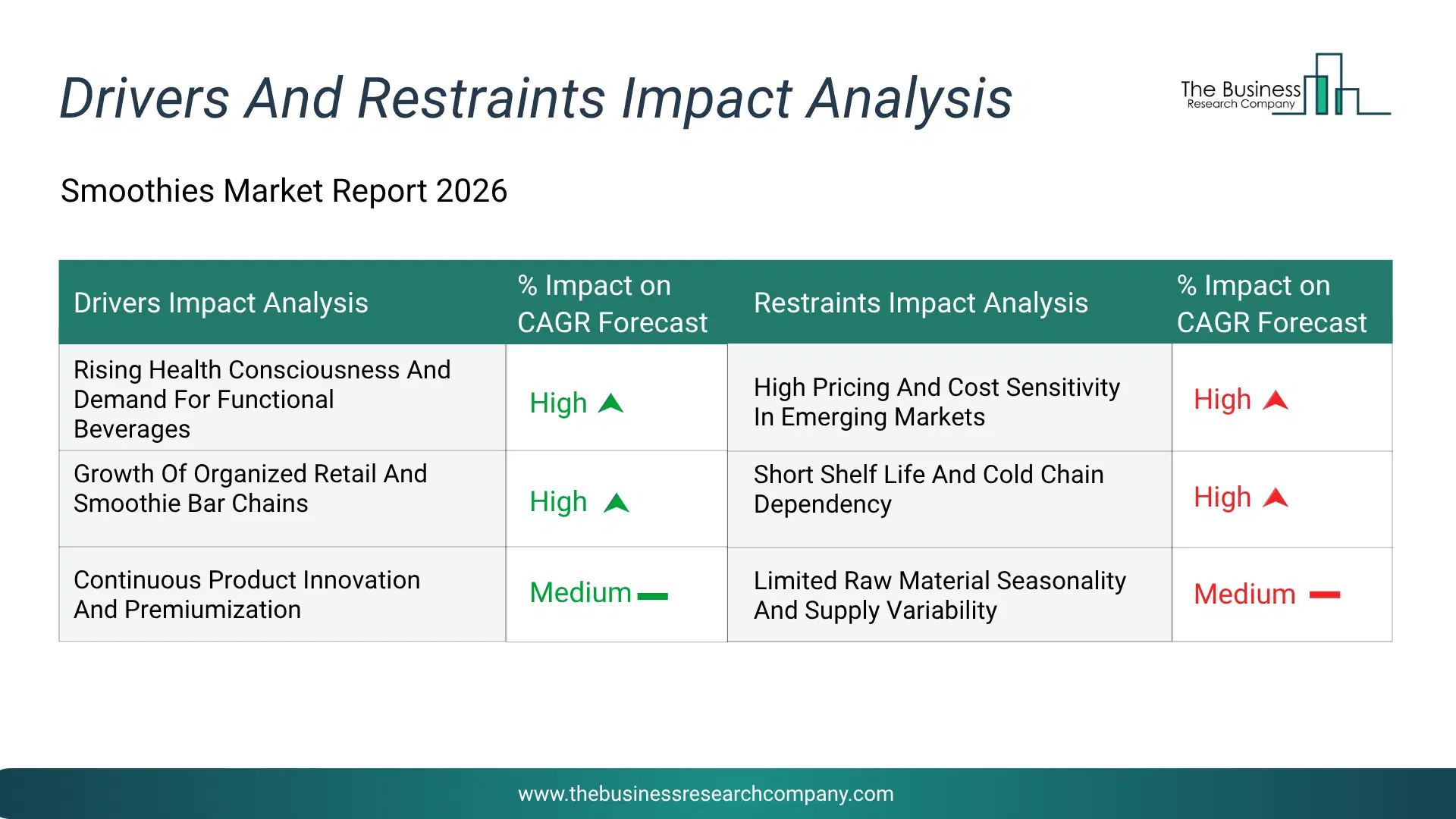
Infographic Chart Showing Key Market Drivers Analysis And Restraints For Smoothies Market
The chart presents an impact analysis of key drivers and restraints, quantifying their relative influence on the market's growth rate and helping assess the balance between growth enablers and limiting factors. This chart offers a high-level perspective; the full report contains more detailed insights.
How Will The Drivers Impact Growth In The Global Smoothies Market?
• Rising Health Consciousness And Demand For Functional Beverages (High) – During the forecast period, the rising health consciousness and demand for functional beverages is expected to become a key growth driver for the smoothies market by 2030. The rising consumer focus on health, wellness, and functional nutrition is a primary growth driver for the smoothies market. Increasing awareness regarding immunity, digestive health, weight management, and clean -label products is encouraging demand for fruit -based, vegetable -based, and protein -enriched smoothies. Consumers are shifting away from carbonated beverages toward nutrient -dense, natural drink options. The growing popularity of plant -based and dairy -free formulations further expands the addressable consumer base across developed and emerging economies. • Growth Of Organized Retail And Smoothie Bar Chains (High) – During the forecast period, the growth of organized retail and smoothie bar chains is expected to emerge as a major factor driving the expansion of the smoothies market by 2030. Expansion of organized retail, smoothie bars, and online grocery platforms significantly drives the smoothies market. Supermarkets and hypermarkets offer wide product assortments with attractive packaging and promotional pricing, improving visibility and accessibility. The rapid growth of smoothie chains and health cafés in urban areas supports impulse purchases and premium product positioning. Additionally, e-commerce penetration enables direct-to-consumer distribution, subscription models, and innovative flavor launches. • Continuous Product Innovation And Premiumization (Medium) – During the forecast period, the continuous product innovation and premiumization are expected to act as a key growth catalyst for the smoothies market by 2030. Product innovation and diversification in flavors, ingredients, and packaging formats further stimulate market growth. Companies are introducing high-protein, probiotic, organic, and superfood-infused smoothies to attract niche consumer segments. Sustainable and convenient packaging solutions such as recyclable bottles and on-the-go pouches enhance consumer appeal. Continuous innovation helps brands differentiate in a competitive beverage landscape, supporting long-term market expansion.How Will The Restraints Impact Growth In The Global Smoothies Market?
• High Pricing And Cost Sensitivity In Emerging Markets (High) – During the forecast period, the high product pricing compared to traditional juices and carbonated beverages acts as a key restraint for the smoothies market. Premium ingredients, cold-chain requirements, and shorter shelf life increase production and distribution costs. Price-sensitive consumers in emerging markets may limit frequent purchases due to affordability concerns. This cost barrier can slow penetration beyond urban and higher-income consumer segments. • Short Shelf Life And Cold Chain Dependency (High) – During the forecast period, the limited shelf life and cold chain dependency also restrain broader distribution, particularly in regions with underdeveloped refrigeration infrastructure. Smoothies require controlled storage to maintain freshness, taste, and nutritional value. Any disruption in the cold supply chain can result in spoilage and financial losses. These logistical constraints may restrict expansion into rural or remote markets. • Limited Raw Material Seasonality And Supply Variability (Medium) – During the forecast period, the limited raw material seasonality and supply variability act as a restraint for the smoothies market by affecting the consistent availability of fresh fruits and vegetables required for production. Seasonal fluctuations can lead to price volatility and increased procurement costs for manufacturers. Dependence on imported or non-local produce further exposes the supply chain to disruptions and transportation delays. These challenges make it difficult to maintain consistent product quality and stable pricing throughout the year. As a result, supply uncertainty can limit large-scale production and market expansion.Key Players In The Global Smoothies Market
Major companies operating in the smoothies market are PepsiCo Inc., The Coca-Cola Company, Danone S.A., The Hain Celestial Group Inc., Tropical Smoothie Café, MTY Food Group, Smoothie King Franchises Inc., Innocent Drinks, Bolthouse Farms, Daily Harvest Inc., Odwalla, Ella's Kitchen Brands Ltd., Jamba Juice Company, Boost Juice Bars, Suja Juice, Naked Juice, Planet Smoothie, Dr.Smoothie, Barfresh Food Group Inc., Surf City Squeeze, Revive Superfoods, Happy Planet Foods, Ceres Fruit Juices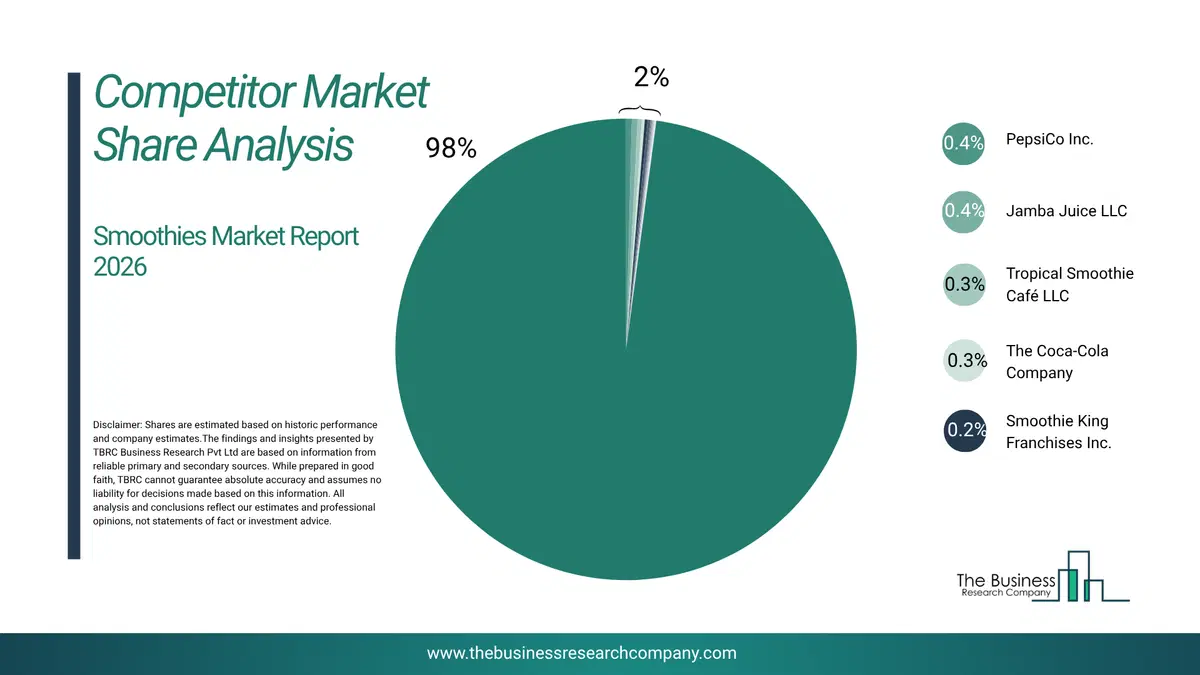
This chart is for illustrative purposes; the full report includes a detailed competitor analysis and comprehensive overview of the top 10 companies in the market.
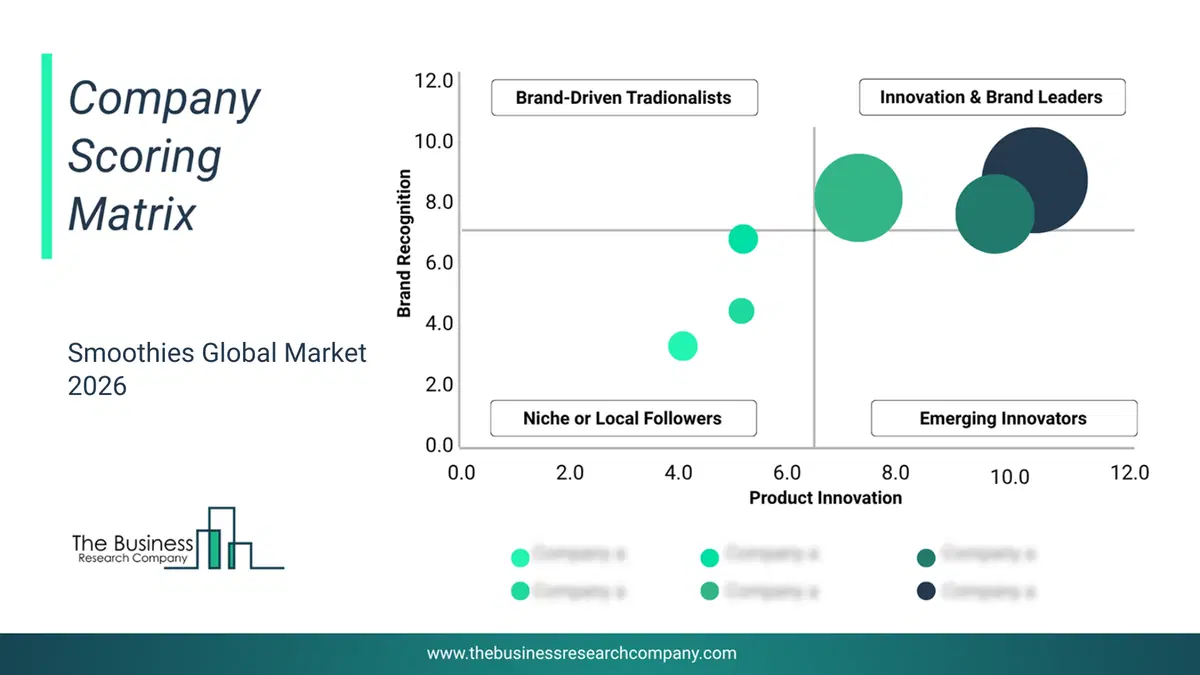
This chart maps companies by product innovation and brand strength, with bubble size indicating relative revenue, helping identify market leaders, challengers, and niche players. This is an illustrative chart; the full report provides a complete and accurate competitive analysis.
Global Smoothies Market Trends and Insights
Major companies operating in the smoothie market are emphasizing innovative product formulations, such as nutrient-dense and functional smoothies, to meet consumer demand for convenient, healthy options that promote wellness and cater to diverse dietary preferences. Gatorade Hydration Booster is an electrolyte powder crafted to enhance daily hydration, combining electrolytes from natural sources like watermelon juice and sea salt with essential vitamins to support an active lifestyle without artificial additives. For instance, in September 2024, the Gatorade Company, a US-based commercial company, launched the Gatorade Hydration Booster, an electrolyte powder designed for everyday hydration, with 100% daily value of essential vitamins A, B3, B5, B6, and C, free of artificial flavours, sweeteners, or colours.What Are Latest Mergers And Acquisitions In The Smoothies Market?
In May 2023, Main Squeeze Juice Co., a US-based nutrition company, acquired I Love Juice Bar LLC for an undisclosed amount. With this acquisition, Main Squeeze Juice Co. aims to expand its business and make health easier, serving more customers, accelerating growth, and increasing value for its franchisees. I Love Juice Bar LLC is a US-based food and beverage company producing juices and smoothies.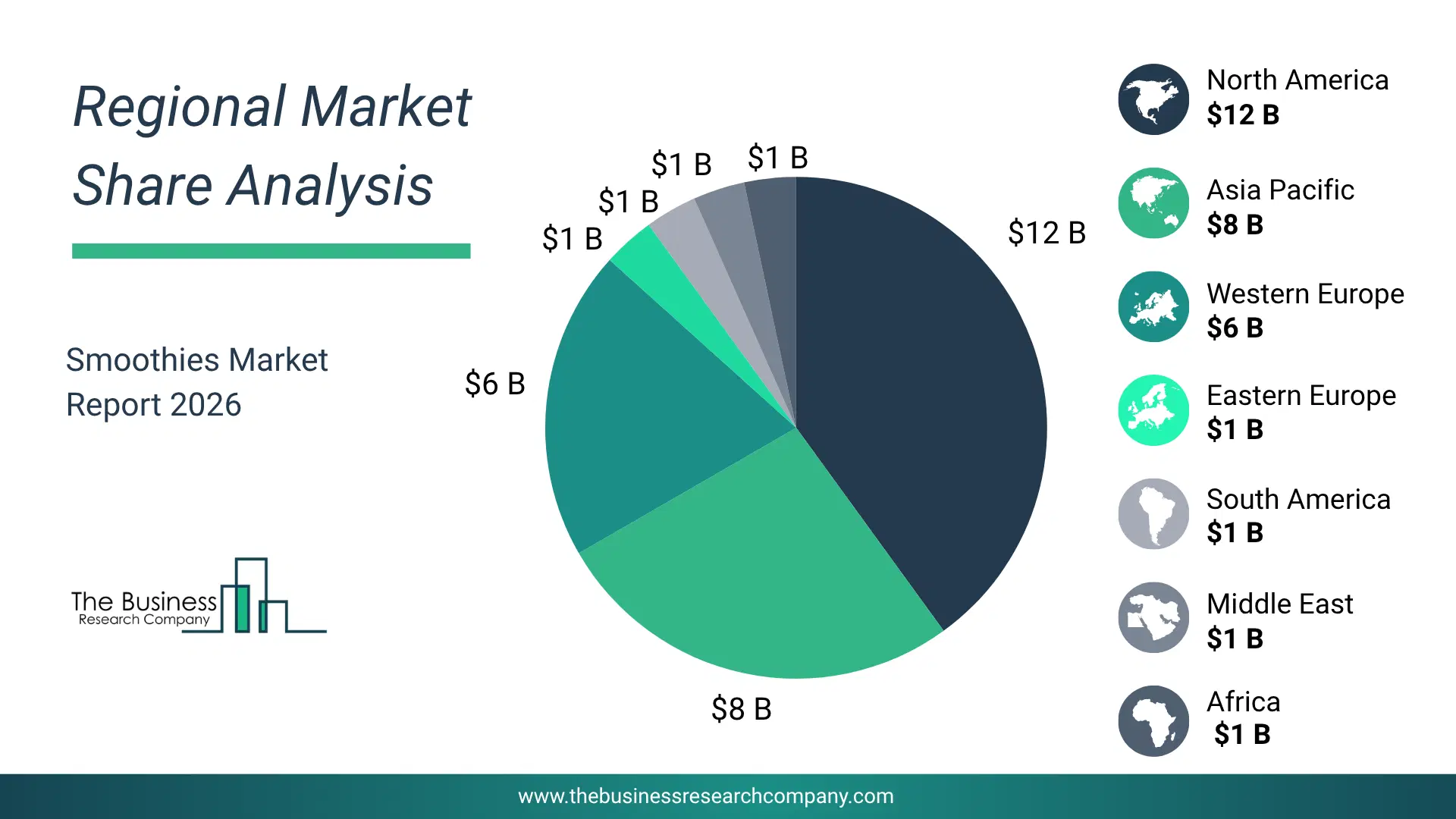
Regional Outlook
North America was the largest region in the smoothies market in 2025. Asia-Pacific is expected to be the fastest-growing region in the forecast period. The regions covered in this market report are Asia-Pacific, South East Asia, Western Europe, Eastern Europe, North America, South America, Middle East and Africa. The countries covered in this market report are Australia, Brazil, China, France, Germany, India, Indonesia, Japan, Taiwan, Russia, South Korea, UK, USA, Italy, Spain, CanadaWhat Defines the Smoothies Market?
The smoothies market consists of sales of body-slimmer smoothies, aloha smoothies, double-flavored smoothies, and bottled smoothies. Values in this market are ‘factory gate’ values, that is the value of goods sold by the manufacturers or creators of the goods, whether to other entities (including downstream manufacturers, wholesalers, distributors and retailers) or directly to end customers. The value of goods in this market includes related services sold by the creators of the goods.How is Market Value Defined and Measured?
The market value is defined as the revenues that enterprises gain from the sale of goods and/or services within the specified market and geography through sales, grants, or donations in terms of the currency (in USD unless otherwise specified). The revenues for a specified geography are consumption values that are revenues generated by organizations in the specified geography within the market, irrespective of where they are produced. It does not include revenues from resales along the supply chain, either further along the supply chain or as part of other products.
This chart presents market attractiveness based on a quantitative evaluation of growth, competition, strategic alignment, and risk, offering a clear view of opportunity areas for decision-making. This chart is for illustrative purposes; the full report contains the complete analysis.

This chart highlights the Total Addressable Market (TAM) by estimating the maximum revenue opportunity using an assumption-driven approach, supporting strategic planning and opportunity sizing across markets. The chart is illustrative; the full report provides a more comprehensive analysis.
What Key Data and Analysis Are Included in the Smoothies Market Report 2026?
The smoothies market research report is one of a series of new reports from The Business Research Company that provides market statistics, including industry global market size, regional shares, competitors with the market share, detailed market segments, market trends and opportunities, and any further data you may need to thrive in the smoothies industry. The market research report delivers a complete perspective of everything you need, with an in-depth analysis of the current and future state of the industry.Smoothies Market Report Forecast Analysis
| Report Attribute | Details |
|---|---|
| Market Size Value In 2026 | $21.34 billion |
| Revenue Forecast In 2030 | $30.1 billion |
| Growth Rate | CAGR of 7.7% from 2026 to 2030 |
| Base Year For Estimation | 2025 |
| Actual Estimates/Historical Data | 2020-2025 |
| Forecast Period | 2026 - 2030 |
| Market Representation | Revenue in USD Billion and CAGR from 2026 to 2030 |
| Segments Covered | Product Type, Packaging Material, Distribution Channel |
| Regional Scope | Asia-Pacific, Western Europe, Eastern Europe, North America, South America, Middle East, Africa |
| Country Scope | The countries covered in the report are Australia, Brazil, China, France, Germany, India, Indonesia, Japan, Taiwan, Russia, South Korea, UK, USA, Canada, Italy, Spain. |
| Key Companies Profiled | PepsiCo Inc., The Coca-Cola Company, Danone S.A., The Hain Celestial Group Inc., Tropical Smoothie Café, MTY Food Group, Smoothie King Franchises Inc., Innocent Drinks, Bolthouse Farms, Daily Harvest Inc., Odwalla, Ella's Kitchen Brands Ltd., Jamba Juice Company, Boost Juice Bars, Suja Juice, Naked Juice, Planet Smoothie, Dr.Smoothie, Barfresh Food Group Inc., Surf City Squeeze, Revive Superfoods, Happy Planet Foods, Ceres Fruit Juices |
| Customization Scope | Request for Customization |
| Pricing And Purchase Options | Explore Purchase Options |