
Sodium-Ion Battery Global Market Opportunities And Strategies To 2035
By Type (Carbon-Based Sodium-Ion Batteries, Transition Metal Oxide Sodium-Ion Batteries, Graphite Anode Sodium-Ion Batteries, Layered Oxide Cathode Sodium-Ion Batteries, Polyanionic Sodium-Ion Batteries), By Technology (Aqueous, Non-Aqueous), By Application (Energy Storage And Grid Integration, Electric Vehicles (EVs), Residential Energy Storage, Emergency Backup And Ups, Other Applications), And By Region, Opportunities And Strategies – Global Forecast To 2035
Sodium-Ion Battery Market Definition
A sodium-ion battery (Na-ion battery) is a rechargeable energy storage device that uses sodium ions (Na⁺) as charge carriers between the cathode and anode during charging and discharging cycles. It operates on a similar electrochemical principle as lithium-ion batteries but uses sodium, which is more abundant and less expensive than lithium, as the primary active material. The primary purpose of sodium-ion batteries is to provide cost-effective, safe and sustainable energy storage solutions, particularly for large-scale applications. The sodium-ion battery market consists of sales by entities (organizations, sole traders and partnerships) of products that store and supply electrical energy using sodium ions as the primary charge carriers between electrodes during electrochemical reactions. These batteries are designed as a cost-effective alternative to lithium-ion battery systems and are used in grid energy storage, renewable energy integration, electric mobility and backup power applications due to their lower raw material cost, improved safety profile and reliance on widely available sodium resources.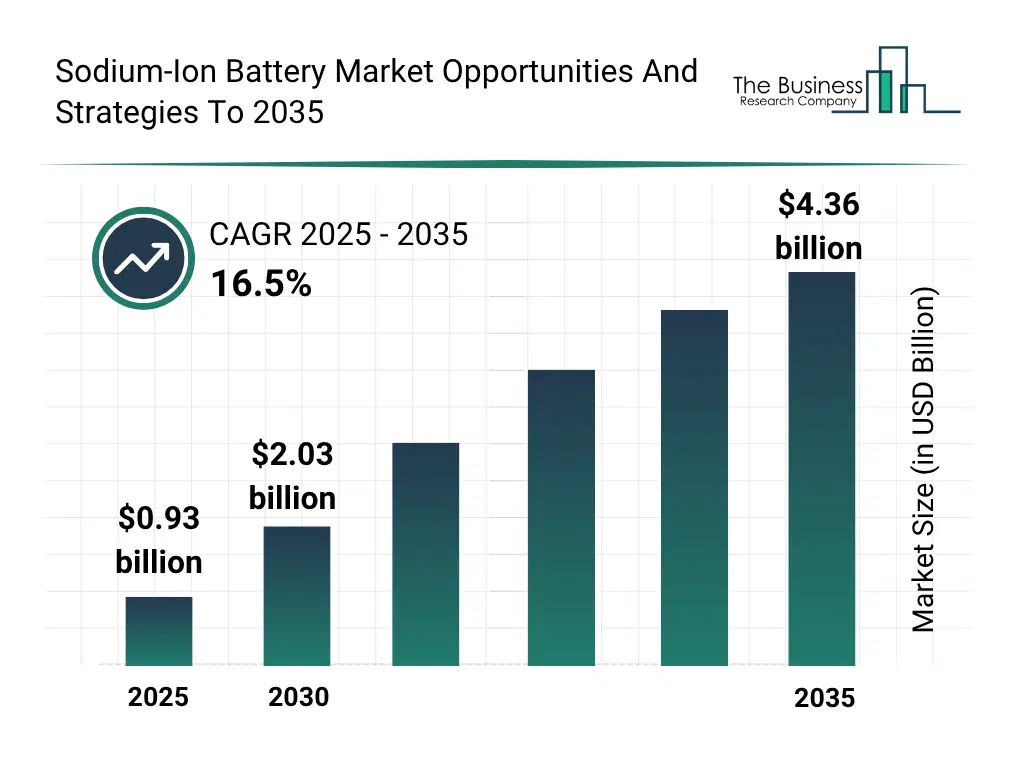
Sodium-Ion Battery Market Size
The global sodium-ion battery market reached a value of nearly $930.9 million in 2025, having grown at a compound annual growth rate (CAGR) of 15.4% since 2020. The market is expected to grow from $930.9 million in 2025 to $2,034.0 million in 2030 at a rate of 16.9%. The market is then expected to grow at a CAGR of 16.5% from 2030 and reach $4,359.2 million in 2035. Growth in the historic period resulted from growing renewable energy integration, growth of electric two- and three-wheelers, rising investments in battery technology R&D and increasing focus on energy security. Factors that negatively affected growth in the historic period were competition from established battery technologies and performance degradation concerns. Going forward, increasing demand for cost-effective energy storage, expansion of smart grid infrastructure, government policies and climate targets and expansion of rural electrification and microgrids will drive the growth. Factors that could hinder the growth of the sodium-ion battery market in the future include lower energy density, limited commercial manufacturing infrastructure and impact of trade wars and tariffs.
Sodium-Ion Battery Market Segmentation
The sodium-ion battery market is segmented by type, by technology, by application.
By Type –
The sodium-ion battery market is segmented by type into:
By Technology –
The sodium-ion battery market is segmented by technology into:
By Application –
The sodium-ion battery market is segmented by application into:
By Geography - The sodium-ion battery market is segmented by geography into:
By Type –
The sodium-ion battery market is segmented by type into:
- a) Carbon-Based Sodium-Ion Batteries
- b) Transition Metal Oxide Sodium-Ion Batteries
- a) Graphite Anode Sodium-Ion Batteries
- d) Layered Oxide Cathode Sodium-Ion Batteries
- c) Polyanionic Sodium-Ion Batteries
By Technology –
The sodium-ion battery market is segmented by technology into:
- a) Aqueous
- b) Non-Aqueous
By Application –
The sodium-ion battery market is segmented by application into:
- a) Energy Storage And Grid Integration
- b) Electric Vehicles (EVs)
- c) Residential Energy Storage
- d) Emergency Backup And Ups
- c) Other Applications
By Geography - The sodium-ion battery market is segmented by geography into:
- China
- India
- Japan
- Australia
- Indonesia
- South Korea
- USA
- Canada
- Brazil
- France
- Germany
- UK
- Italy
- Spain
- Russia
-
o Asia Pacific
o Africa