
Software-Defined Satellite Market Report 2026
Global Outlook – By Component (Hardware, Software, Services), By Orbit Type (Low Earth Orbit (LEO), Medium Earth Orbit (MEO), Geostationary Orbit (GEO)), By Technology (Software-Defined Radio, Artificial Intelligence (AI), Cloud Computation, Reconfigurable Payload), By Application (Communication, Earth Observation, Navigation, Scientific Research, Other Applications), By End-User (Commercial, Government, Defense, Other End-Users) – Market Size, Trends, Strategies, and Forecast to 2030
Software-Defined Satellite Market Overview
• Software-Defined Satellite market size has reached to $3.52 billion in 2025 • Expected to grow to $6.64 billion in 2030 at a compound annual growth rate (CAGR) of 13.5% • Growth Driver: Expansion Of Telecommunication Networks Fueling The Growth Of The Market Due To 5G-Enabled High-Speed Connectivity And Massive Device Support • Market Trend: Advancing Flexible And Efficient Satellite Communications With Software-Defined Radios • North America was the largest region in 2025 and Asia-Pacific is the fastest growing region.What Is Covered Under Software-Defined Satellite Market?
Software-defined satellites refer to next-generation satellites equipped with reprogrammable software-based systems that replace traditional fixed hardware, allowing them to dynamically manage functions such as communication protocols, frequency allocation, and coverage areas. This capability enables operators to remotely update, reconfigure, or optimize satellite performance even after deployment in orbit, ensuring greater flexibility, adaptability to evolving mission requirements, and extended operational value. The main components of software-defined satellite are hardware, software, and services. Hardware refers to the physical components and equipment integrated into software-defined satellites, including payload systems, antennas, processors, and reconfigurable modules that support satellite operations. It includes various orbit types, such as low earth orbit (LEO), medium earth orbit (MEO), and geostationary orbit (GEO), and utilizes various technologies, including software-defined radio, artificial intelligence (AI), cloud computation, and reconfigurable payload. It finds applications in communication, earth observation, navigation, scientific research, and others, serving end users such as commercial, government, defense, and others.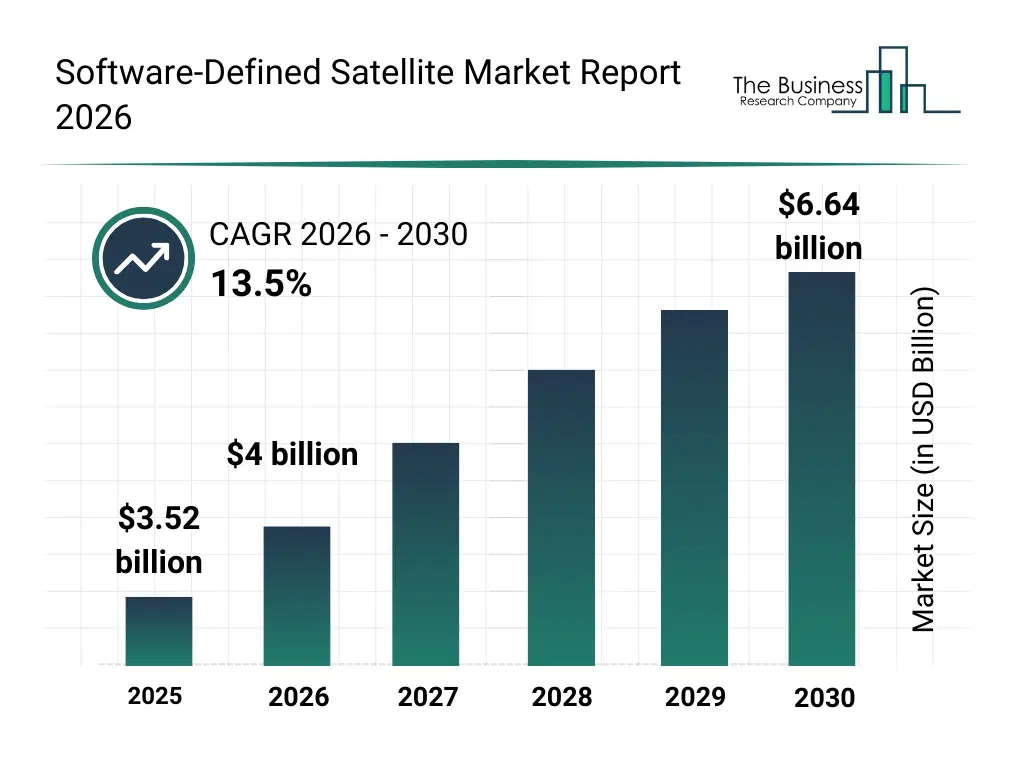
What Is The Software-Defined Satellite Market Size and Share 2026?
The software-defined satellite market size has grown rapidly in recent years. It will grow from $3.52 billion in 2025 to $4 billion in 2026 at a compound annual growth rate (CAGR) of 13.6%. The growth in the historic period can be attributed to adoption of flexible payload satellites, early implementation of onboard software reconfiguration, demand for dynamic frequency allocation in communication satellites, integration of software-defined radios in satellite systems, use of mission optimization tools for existing satellites.What Is The Software-Defined Satellite Market Growth Forecast?
The software-defined satellite market size is expected to see rapid growth in the next few years. It will grow to $6.64 billion in 2030 at a compound annual growth rate (CAGR) of 13.5%. The growth in the forecast period can be attributed to expansion of AI-driven in-orbit reconfiguration, rising deployment of multi-mission software-defined satellites, development of ground control integration platforms, increasing reliance on remote software updates and reprogramming, growth in commercial and defense satellite software services. Major trends in the forecast period include dynamic in-orbit reconfiguration, rising demand for flexible payload architectures, growth of sdr-based satellite platforms, expansion of real-time beam steering capabilities, increasing adoption of cloud-controlled satellite operations.
Global Software-Defined Satellite Market Segmentation
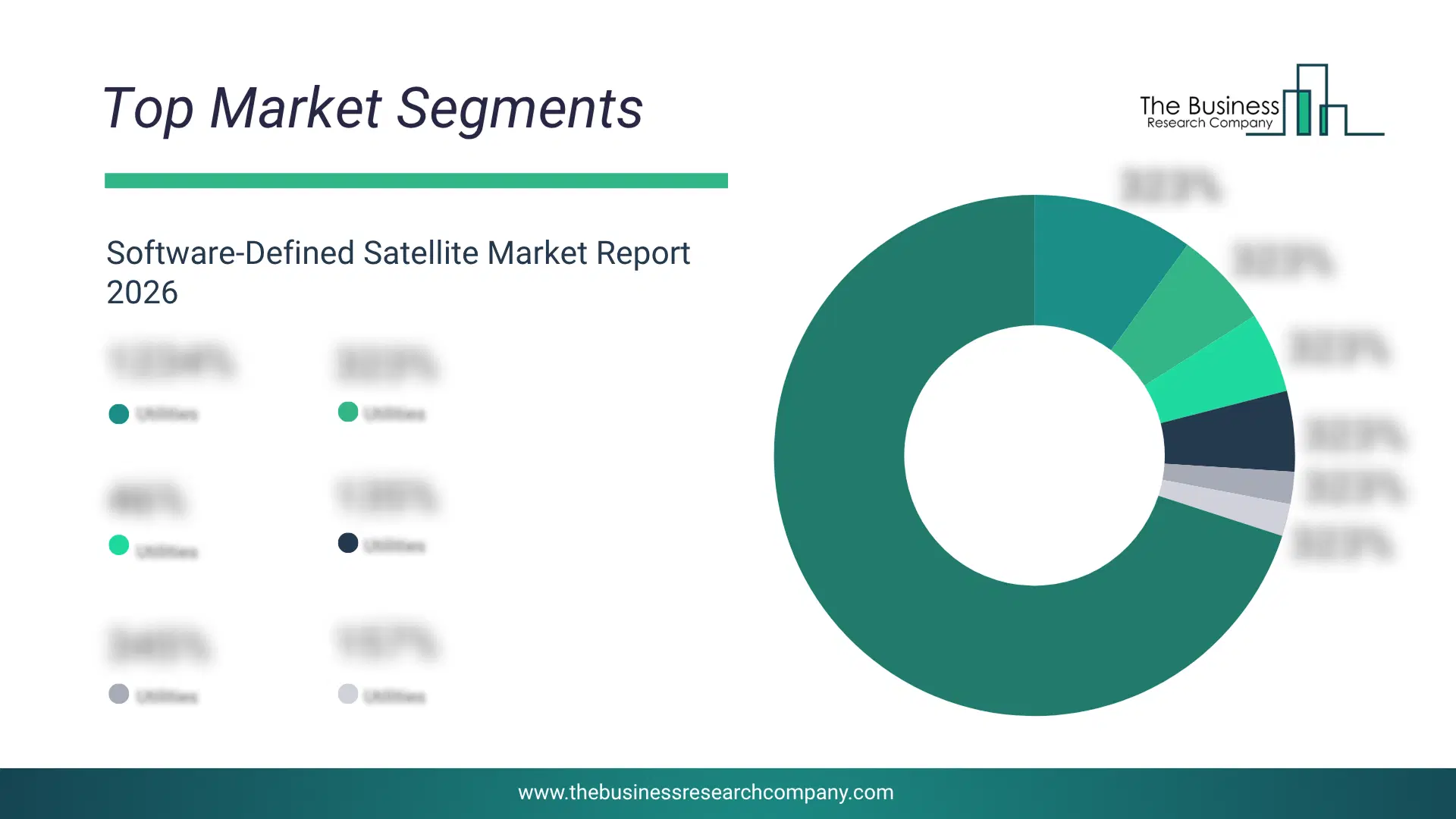
1) By Component: Hardware, Software, Services 2) By Orbit Type: Low Earth Orbit (LEO), Medium Earth Orbit (MEO), Geostationary Orbit (GEO) 3) By Technology: Software-Defined Radio, Artificial Intelligence (AI), Cloud Computation, Reconfigurable Payload 4) By Application: Communication, Earth Observation, Navigation, Scientific Research, Other Applications 5) By End-User: Commercial, Government, Defense, Other End-Users Subsegments: 1) By Hardware: Antennas, Transponders, Power Amplifiers, Receivers, Onboard Processors 2) By Software: Network Management Software, Signal Processing Software, Payload Management Software, Ground Control Software, Data Analytics Software 3) By Services: Integration And Deployment Services, Consulting Services, Maintenance And Support Services, Managed Services, Training And Education ServicesWhat Is Driver Of The Software-Defined Satellite Market?
The expansion of telecommunication networks is expected to propel the growth of the software-defined satellite market going forward. Telecommunication networks refer to interconnected systems that allow the transmission of voice, data, and video between people and devices over long or short distances. The expansion of telecommunication networks is due to the rollout of 5G technology as it enables faster data speeds, low latency, and supports massive device connectivity. Software-defined satellites enhance telecommunication networks by offering reconfigurable payloads, making them ideal for adapting to changing bandwidth and coverage demands. They improve network efficiency by enabling dynamic service adjustments, boosting connectivity, and operational flexibility. For instance, in April 2025, according to the Office of Communications (Ofcom), a UK-based government department, the number of fixed broadband lines reached 29.2 million by the end of the fourth quarter of 2024, marking a year-on-year increase of 691,000 (2.4%). Therefore, the expansion of telecommunication networks is driving the growth of the software-defined satellite industry.Key Players In The Global Software-Defined Satellite Market
Major companies operating in the software-defined satellite market are The Boeing Company, Lockheed Martin Corporation, Airbus S.A.S., General Dynamics Mission Systems Inc., Northrop Grumman Corporation, Thales S.A., L3Harris Technologies Inc., SES S.A., Hughes Network Systems LLC, Eutelsat Communications S.A., Iridium Communications Inc., Inmarsat Global Limited, Spire Global Inc., Innoflight Inc., Vector Launch Inc., Muon Space Inc., Antwerp Space N.V., XDLINX Space Labs Inc., SatixFy Communications Ltd., ReOrbit Inc.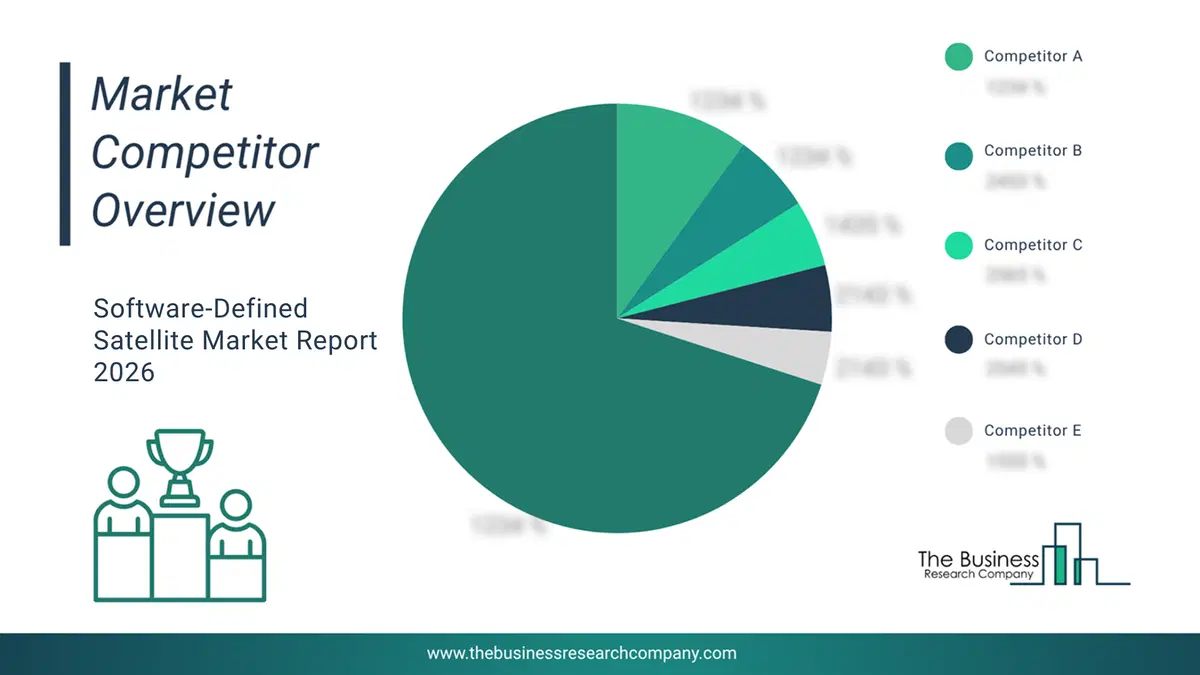
This chart is for illustrative purposes; the full report includes a detailed competitor analysis and comprehensive overview of the top 10 companies in the market.
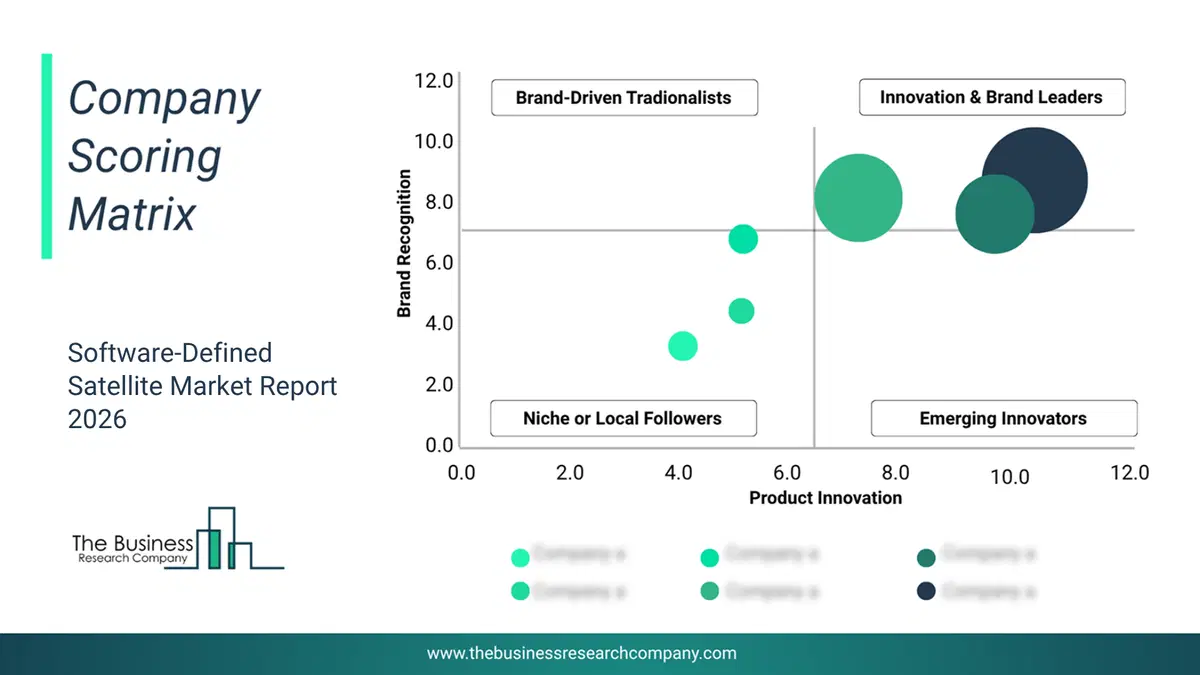
This chart maps companies by product innovation and brand strength, with bubble size indicating relative revenue, helping identify market leaders, challengers, and niche players. This is an illustrative chart; the full report provides a complete and accurate competitive analysis.
Global Software-Defined Satellite Market Trends and Insights
Major companies operating in the software-defined satellite market are focusing on developing innovative solutions, such as software-defined radios (SDRs), to enable flexible, reconfigurable, and high-performance satellite communications. Software-defined radios (SDRs) are communication systems where signal processing is done through software rather than fixed hardware, allowing satellites to switch frequencies, protocols, and functions dynamically, which helps enable flexible, multi-standard communications, improve efficiency, and extend satellite lifespan compared to traditional fixed radios. For instance, in May 2025, Alén Space, a Spain-based aerospace company, launched the SATMAR nanosatellite, a 6U CubeSat designed to advance the digital transformation of the maritime sector. The satellite, scheduled for deployment aboard a SpaceX Falcon 9 as part of the Transporter-14 mission from Vandenberg Space Force Base in California, aims to test the new VHF Data Exchange System (VDES) standard in real operational scenarios, which is intended to enhance maritime communications by replacing the current Automatic Identification System (AIS). SATMAR will enable bidirectional data transmission via satellite in the VHF band, helping to reduce network congestion and improve efficiency, safety, and sustainability across global maritime traffic.What Are Latest Mergers And Acquisitions In The Software-Defined Satellite Market? SES Acquires Intelsat To Strengthen Multi-Orbit Satellite Connectivity Services
In July 2025, SES S.A., a Luxembourg-based provider of global satellite communications services, acquired Intelsat S.A. for an undisclosed amount. With this acquisition, SES aims to establish a global multi-orbit satellite connectivity powerhouse by combining its and Intelsat’s fleets and technology, enhancing capacity, market reach, and ability to deliver integrated, next-generation satellite solutions worldwide. Intelsat S.A. is a US-based satellite services provider that offers software-defined satellites to support 5G connectivity and other services.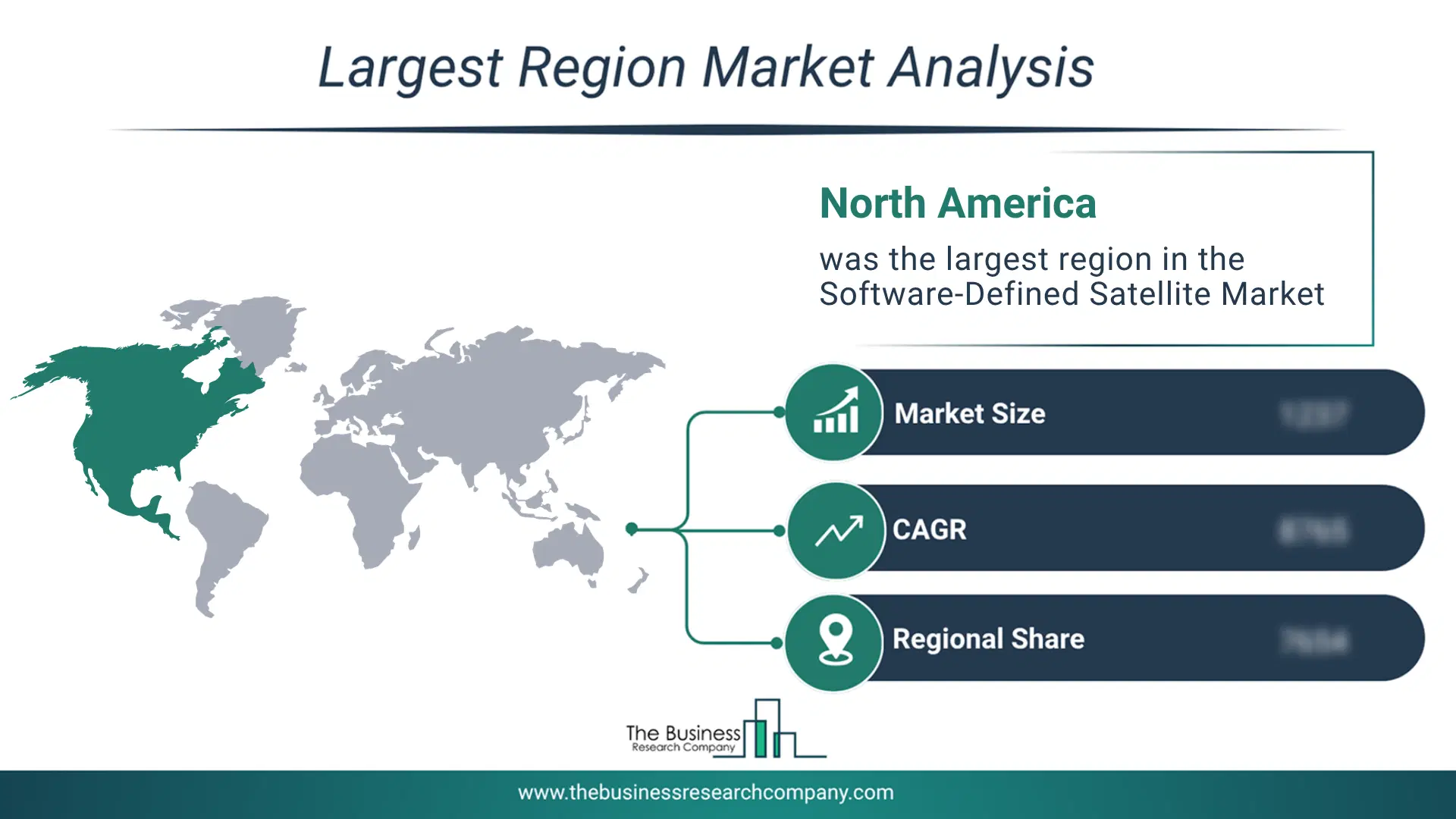
Regional Insights
North America was the largest region in the software-defined satellite market in 2025. Asia-Pacific is expected to be the fastest-growing region in the forecast period. The regions covered in this market report are Asia-Pacific, South East Asia, Western Europe, Eastern Europe, North America, South America, Middle East, Africa. The countries covered in this market report are Australia, Brazil, China, France, Germany, India, Indonesia, Japan, Taiwan, Russia, South Korea, UK, USA, Canada, Italy, SpainWhat Defines the Software-Defined Satellite Market?
The software-defined satellite market consists of revenues earned by entities by providing services such as satellite software development, satellite communication, beam steering and shaping, mission optimization, and in-orbit reconfiguration capabilities. The market value includes the value of related hardware and software sold by the service provider or included within the service offering. The software-defined satellite market also includes sales of onboard software platforms, communication modules, flexible payloads, software-defined radio (SDR) modules, and ground control integration solutions. Values in this market are ‘factory gate’ values, that is, the value of goods and software sold by the manufacturers or creators of the goods, whether to other entities (including downstream manufacturers, wholesalers, distributors, and retailers) or directly to end customers. The value of goods and software in this market includes related services sold by the creators of the goods.How is Market Value Defined and Measured?
The market value is defined as the revenues that enterprises gain from the sale of goods and/or services within the specified market and geography through sales, grants, or donations in terms of the currency (in USD unless otherwise specified). The revenues for a specified geography are consumption values that are revenues generated by organizations in the specified geography within the market, irrespective of where they are produced. It does not include revenues from resales along the supply chain, either further along the supply chain or as part of other products.
This chart presents market attractiveness based on a quantitative evaluation of growth, competition, strategic alignment, and risk, offering a clear view of opportunity areas for decision-making. This chart is for illustrative purposes; the full report contains the complete analysis.

This chart highlights the Total Addressable Market (TAM) by estimating the maximum revenue opportunity using an assumption-driven approach, supporting strategic planning and opportunity sizing across markets. The chart is illustrative; the full report provides a more comprehensive analysis.
What Key Data and Analysis Are Included in the Software-Defined Satellite Market Report 2026?
The software-defined satellite market research report is one of a series of new reports from The Business Research Company that provides market statistics, including industry global market size, regional shares, competitors with the market share, detailed market segments, market trends and opportunities, and any further data you may need to thrive in the software-defined satellite industry. The market research report delivers a complete perspective of everything you need, with an in-depth analysis of the current and future state of the industry.Software-Defined Satellite Market Report Forecast Analysis
| Report Attribute | Details |
|---|---|
| Market Size Value In 2026 | $4 billion |
| Revenue Forecast In 2030 | $6.64 billion |
| Growth Rate | CAGR of 13.5% from 2026 to 2030 |
| Base Year For Estimation | 2025 |
| Actual Estimates/Historical Data | 2020-2025 |
| Forecast Period | 2026 - 2030 |
| Market Representation | Revenue in USD Billion and CAGR from 2026 to 2030 |
| Segments Covered | Component, Orbit Type, Technology, Application, End-User |
| Regional Scope | Asia-Pacific, Western Europe, Eastern Europe, North America, South America, Middle East, Africa |
| Country Scope | The countries covered in the software-defined satellite market report are Australia, Brazil, China, France, Germany, India, Indonesia, Japan, Taiwan, Russia, South Korea, UK, USA, Canada, Italy, Spain |
| Key Companies Profiled | The Boeing Company, Lockheed Martin Corporation, Airbus S.A.S., General Dynamics Mission Systems Inc., Northrop Grumman Corporation, Thales S.A., L3Harris Technologies Inc., SES S.A., Hughes Network Systems LLC, Eutelsat Communications S.A., Iridium Communications Inc., Inmarsat Global Limited, Spire Global Inc., Innoflight Inc., Vector Launch Inc., Muon Space Inc., Antwerp Space N.V., XDLINX Space Labs Inc., SatixFy Communications Ltd., ReOrbit Inc. |
| Customization Scope | Request for Customization |
| Pricing And Purchase Options | Explore Purchase Options |