

Software-Defined Wide Area Network (SD-WAN) Market Report 2026
Global Outlook – By Component Type (Solutions, Services), By Deployment Mode (Premise, Cloud, Hybrid), By Organization Size (Large Enterprises, Small-Medium Enterprises), By End-User Industry (Healthcare, Banking And Financial Services, Retail And Consumer Services, Manufacturing, Transport And Logistics, Information Technology (IT) And Telecommunication (Telecom), Other End-User Industries) – Market Size, Trends, Strategies, and Forecast to 2030
Software-Defined Wide Area Network (SD-WAN) Market Overview
• Software-Defined Wide Area Network (SD-WAN) market size has reached to $9.17 billion in 2025 • Expected to grow to $35.39 billion in 2030 at a compound annual growth rate (CAGR) of 31% • Growth Driver: The Increasing Adoption Of Cloud-Based Solutions Fueling The Growth Of The Market Due To Rising Enterprise Cloud Migration Needs • Market Trend: Next-Generation Quantum‑Safe Platforms Set To Revolutionize Network Security And Performance • North America was the largest region in 2025 and Asia-Pacific is the fastest growing region.Market Gains By 2030 – Top Opportunities By Segment
Market Gain identifies the most promising market opportunities by highlighting the segments or products expected to generate the highest incremental revenue growth over the next five years.
What Is Covered Under Software-Defined Wide Area Network (SD-WAN) Market?
A software-defined wide area network (SD-WAN) is a technology that simplifies the management and operation of a wide area network (WAN) by separating the networking hardware from its control mechanism. It leverages software-defined networking (SDN) principles to dynamically manage and optimize the distribution of network traffic across multiple connection types, including broadband internet, MPLS (multiprotocol label switching), LTE, and others. The main components of software-defined wide area network (SD-WAN) are solutions and services. SD-WAN solutions involve the hardware and software components that enable a software-defined approach to managing wide area networks. They are deployed based on premise, cloud, and hybrid modes in large enterprises and small-medium enterprises of various end-user industries, including healthcare, banking and financial services, retail and consumer services, manufacturing, transport and logistics, information technology (IT) and telecommunication (Telecom), and others.
What Is The Software-Defined Wide Area Network (SD-WAN) Market Size and Share 2026?
The software-defined wide area network (sd-wan) market size has grown exponentially in recent years. It will grow from $9.17 billion in 2025 to $12.03 billion in 2026 at a compound annual growth rate (CAGR) of 31.2%. The growth in the historic period can be attributed to increasing enterprise network complexity, rising adoption of cloud applications, expansion of distributed workforce models, growing demand for reliable network connectivity, increasing limitations of traditional wan architectures.What Is The Software-Defined Wide Area Network (SD-WAN) Market Growth Forecast?
The software-defined wide area network (sd-wan) market size is expected to see exponential growth in the next few years. It will grow to $35.39 billion in 2030 at a compound annual growth rate (CAGR) of 31.0%. The growth in the forecast period can be attributed to increasing investments in secure access service edge solutions, rising adoption of multi-cloud networking, expansion of edge computing deployments, growing focus on zero-trust networking models, increasing demand for scalable software-defined networks. Major trends in the forecast period include increasing adoption of cloud-managed wan solutions, rising demand for secure network virtualization, growing integration of AI-based traffic optimization, expansion of hybrid wan deployments, enhanced focus on application-aware networking.
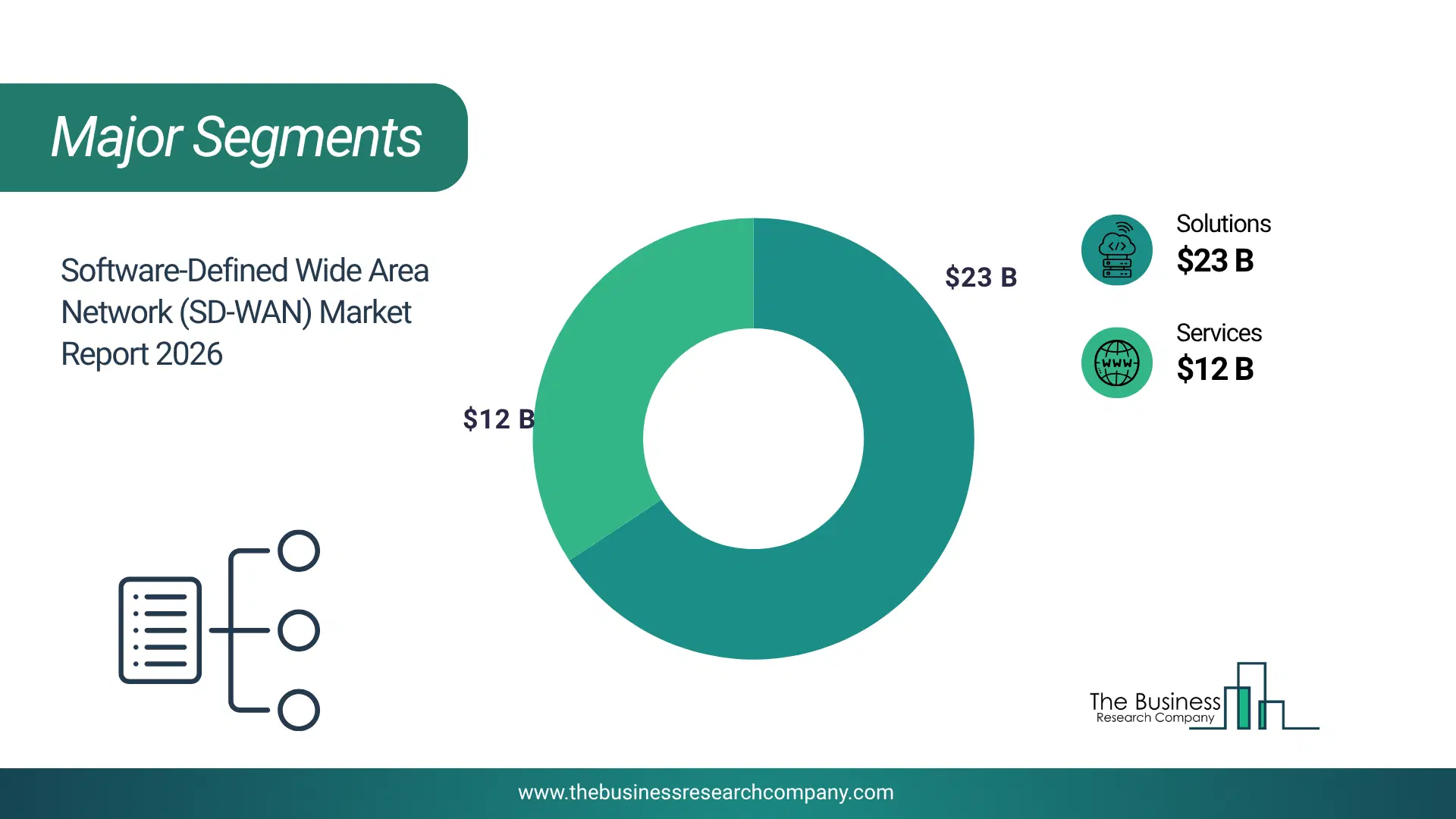
Global Software-Defined Wide Area Network (SD-WAN) Market Segmentation
1) By Component Type: Solutions, Services 2) By Deployment Mode: Premise, Cloud, Hybrid 3) By Organization Size: Large Enterprises, Small-Medium Enterprises 4) By End-User Industry: Healthcare, Banking And Financial Services, Retail And Consumer Services, Manufacturing, Transport And Logistics, Information Technology (IT) And Telecommunication (Telecom), Other End-User Industries Subsegments: 1) By Solutions: SD-WAN Software, SD-WAN Appliances, SD-WAN Controllers, Security Solutions, Orchestration Solutions, Traffic Management And Optimization Solutions 2) By Services: Professional Services, Managed Services, Cloud Connectivity Services, Technical Support And Maintenance Services, Integration Services The top segments in the software-defined wide area network (sd-wan) market will be: • Large Enterprises will reach $16542.29 Million by 2030. • Solutions will reach $16092.4 Million by 2030. • Premise will reach $13350.4 Million by 2030. • Services will reach $9698.77 Million by 2030. • Cloud will reach $9643.2 Million by 2030.What Is The Driver Of The Software-Defined Wide Area Network (SD-WAN) Market?
The increasing adoption of cloud-based solutions is expected to propel the growth of the software-defined wide area network (SD-WAN) market going forward. Cloud-based solutions refer to any service or application that relies on cloud computing technologies. The adoption of cloud-based services is driven by their scalability, cost efficiency, global accessibility, security enhancements, and continuous innovation. Software-defined wide area network (SD-WAN) enhances cloud-based solutions by optimizing traffic routing for improved performance, integrating security features, reducing costs through efficient use of multiple connection types, simplifying centralized management, enabling scalability, and ensuring reliable connectivity with failover and load balancing capabilities. For instance, in April 2025, according to the American Bar Association, a U.S.-based professional organization, approximately 75% of attorneys reported using cloud computing for work-related tasks, up from 69% in 2023 and about 70% in 2022. Therefore, the increasing adoption of cloud-based solutions is driving the growth of the software-defined wide area network (SD-WAN) industry.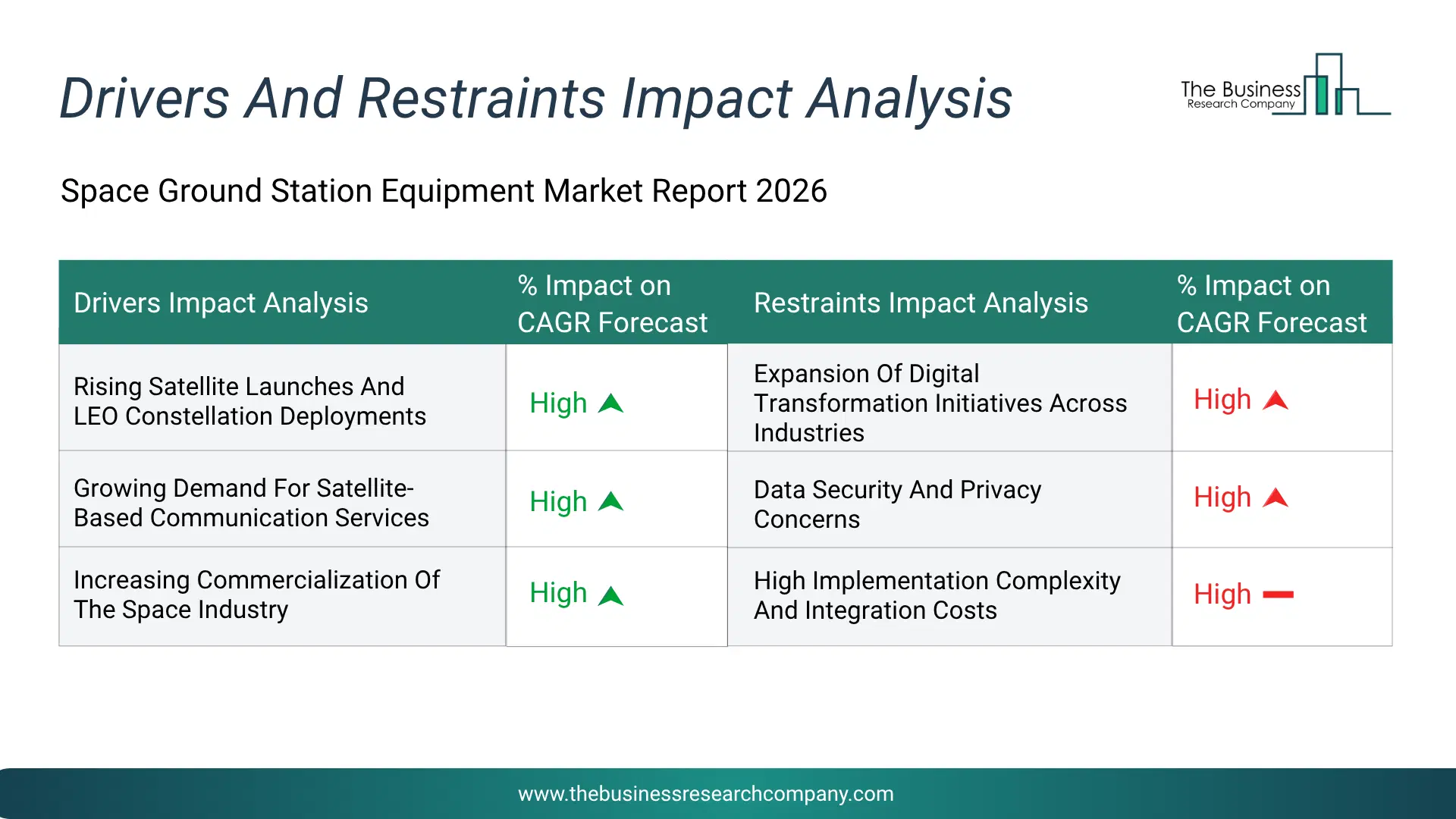
Infographic Chart Showing Key Market Drivers Analysis And Restraints For Software-Defined Wide Area Network (Sd-Wan) Market
The chart presents an impact analysis of key drivers and restraints, quantifying their relative influence on the market's growth rate and helping assess the balance between growth enablers and limiting factors. This chart offers a high-level perspective; the full report contains more detailed insights.
How Will The Drivers Impact Growth In The Global Software-Defined Wide Area Network (SD-WAN) Market?
• 5G And Broadband Proliferation (Medium) – During the forecast period, the 5g and broadband proliferation will become a key driver of growth in the software-defined wide area network (sd-wan) market by 2030. as enterprises increasingly leverage 5g networks and enhance broadband infrastructure, wan architecture is becoming more dynamic and multi-transport in nature. unlike traditional wan models that relied heavily on dedicated mpls circuits, modern enterprise networks incorporate multiple connectivity types, including fiber broadband, fixed wireless access and 5g links, to ensure redundancy and performance optimization. sd-wan plays a critical role in orchestrating and intelligently managing these heterogeneous connections by dynamically steering traffic based on application priority, latency and real-time network conditions. the integration of 5g into enterprise networking environments will enable faster branch deployments, temporary site connectivity, mobile workforce enablement and edge computing expansion. as a result, 5g and broadband proliferation is anticipated to contributing to a 1.3% annual growth in the market. • Rising Frequency And Sophistication Of Cyberattacks (Low) – During the forecast period, the rising frequency and sophistication of cyberattacks will emerge as a major factor driving the expansion of the software-defined wide area network (sd-wan) market by 2030. modern cyber threats increasingly target distributed networks, cloud workloads, remote endpoints and branch environments, exposing weaknesses in traditional perimeter-based security models. as enterprises face more advanced ransomware, phishing campaigns, supply chain attacks and network intrusions, there is a heightened demand for integrated security within wan infrastructure. sd-wan solutions are evolving to embed advanced encryption, traffic segmentation, intrusion prevention and real-time threat intelligence capabilities directly into network architecture. this convergence of networking and security allows enterprises to enforce consistent security policies across all locations, regardless of physical boundaries. consequently, the rising frequency and sophistication of cyberattacks is projected to contributing to a 1.0% annual growth in the market. • Proliferation Of Internet Of Things (IoT) Devices (Low) – During the forecast period, the proliferation of internet of things (iot) devices will serve as a key growth catalyst for the software-defined wide area network (sd-wan) market by 2030. iot deployments generate continuous streams of data across geographically dispersed networks, including manufacturing facilities, retail branches, transportation systems, healthcare institutions and smart infrastructure. managing this vast volume of device-generated traffic requires wan solutions capable of prioritizing critical data, segmenting network traffic and ensuring secure communication between endpoints and centralized or cloud-based systems. traditional wan infrastructures lack the flexibility and granular visibility necessary to efficiently manage large-scale iot ecosystems. sd-wan addresses these challenges by providing centralized orchestration, dynamic bandwidth allocation, application-aware routing and secure segmentation of iot traffic from core enterprise systems. therefore, proliferation of internet of things (iot) devices is projected to supporting to a 0.8% annual growth in the market. • Expansion Of Remote And Hybrid Work Models (Low) – During the forecast period, the growth in expansion of remote and hybrid work models is expected to be a key driver propelling growth in the software-defined wide area network (SD-WAN) market. This shift requires secure, reliable and high-performance connectivity that extends beyond traditional corporate network perimeters. SD-WAN enables centralized management of distributed endpoints while optimizing application performance for cloud-based collaboration tools, virtual desktops and SaaS platforms. By dynamically routing traffic through optimal paths and integrating security controls such as encryption and identity-based access policies, SD-WAN supports consistent user experiences regardless of location. Additionally, hybrid work models increase reliance on cloud-managed networking solutions that provide real-time visibility and simplified orchestration. therefore, growth in expansion of remote and hybrid work models is projected to supporting to a 0.5% annual growth in the market.How Will The Restraints Impact Growth In The Global Software-Defined Wide Area Network (SD-WAN) Market?
• Complexity In Integration (Medium) – During the forecast period, complexity in integration is restricting the growth of the software-defined wide area network (SD-WAN) market. Many organizations operate hybrid infrastructures that combine legacy networking hardware, traditional WAN architecture, on-premises data centers and multi-cloud deployments. Integrating SD-WAN into such environments requires careful alignment of routing policies, security frameworks, performance monitoring tools and application delivery mechanisms. The coexistence of MPLS, broadband, LTE and emerging 5G connectivity further increases architectural complexity. Enterprises must ensure seamless interoperability between SD-WAN controllers, firewalls, identity management systems and cloud gateways. growth affected by the complexity in integration during the forecast period in 2025 is -3.0%. • Regulatory And Data Sovereignty Challenges (Low) – During the forecast period, regulatory and data sovereignty challenges is restricting the growth of the software-defined wide area network (SD-WAN) market. As data protection laws and cybersecurity regulations become more stringent, organizations must ensure that network traffic routing, data storage and cloud connectivity comply with regional requirements. SD-WAN architecture often involves dynamic routing of traffic across geographically dispersed networks and cloud providers, which may inadvertently transfer sensitive data across borders. Compliance with evolving data localization mandates, encryption standards and sector-specific regulations can complicate WAN design and deployment strategies. Government agencies, financial institutions and healthcare organizations must carefully evaluate how SD-WAN configurations align with regulatory obligations. growth affected by the regulatory and data sovereignty challenges during the forecast period in 2025 is -2.3%. • Impact Of Trade Wars And Tariffs (Low) – During the forecast period, the impact of trade wars and tariffs is restricting the growth of the software-defined wide area network (SD-WAN) market. SD-WAN deployments often rely on hardware appliances, edge devices, routers and security components that may be manufactured or assembled across global supply chains. Trade tensions and tariff impositions can increase procurement costs, disrupt supply timelines and create uncertainty in vendor pricing strategies. Enterprises may face higher capital expenditure when sourcing networking hardware, reducing the financial attractiveness of large-scale SD-WAN rollouts. Furthermore, geopolitical tensions can restrict cross-border technology transfers and influence vendor selection decisions, particularly in government and critical infrastructure sectors. growth affected by the impact of trade wars and tariffs during the forecast period in 2025 is -0.3%.Key Players In The Global Software-Defined Wide Area Network (SD-WAN) Market
Major companies operating in the software-defined wide area network (sd-wan) market are Dell Technologies Inc., Huawei Technologies Co. Ltd., Cisco Systems Inc., Hewlett Packard Enterprise Development LP, Ericsson, Nokia Corporation, NEC Corporation, VMware Inc., Palo Alto Networks, Juniper Networks Inc., Fortinet Inc., Citrix Systems Inc., Tata Communications, Forcepoint, Riverbed Technology, Cato Networks Ltd., Versa Networks Inc., Aryaka Networks Inc., FatPipe Networks Inc., Adaptiv Networks Inc., Silver Peak Systems Inc.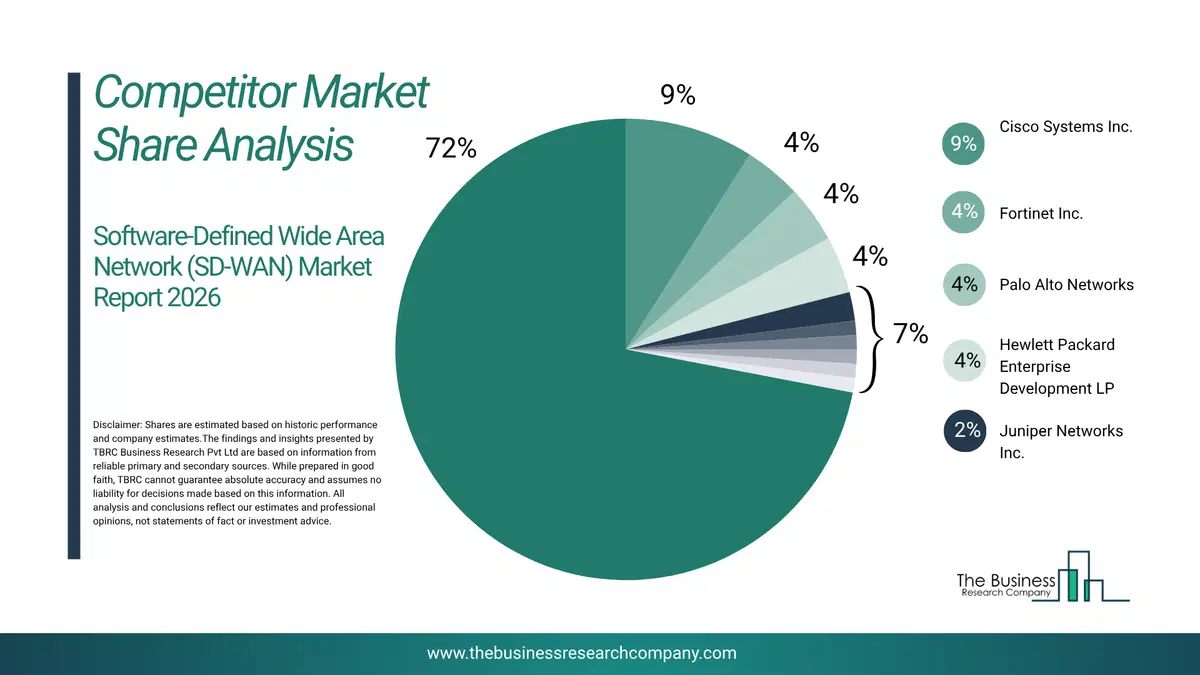
This chart is for illustrative purposes; the full report includes a detailed competitor analysis and comprehensive overview of the top 10 companies in the market.
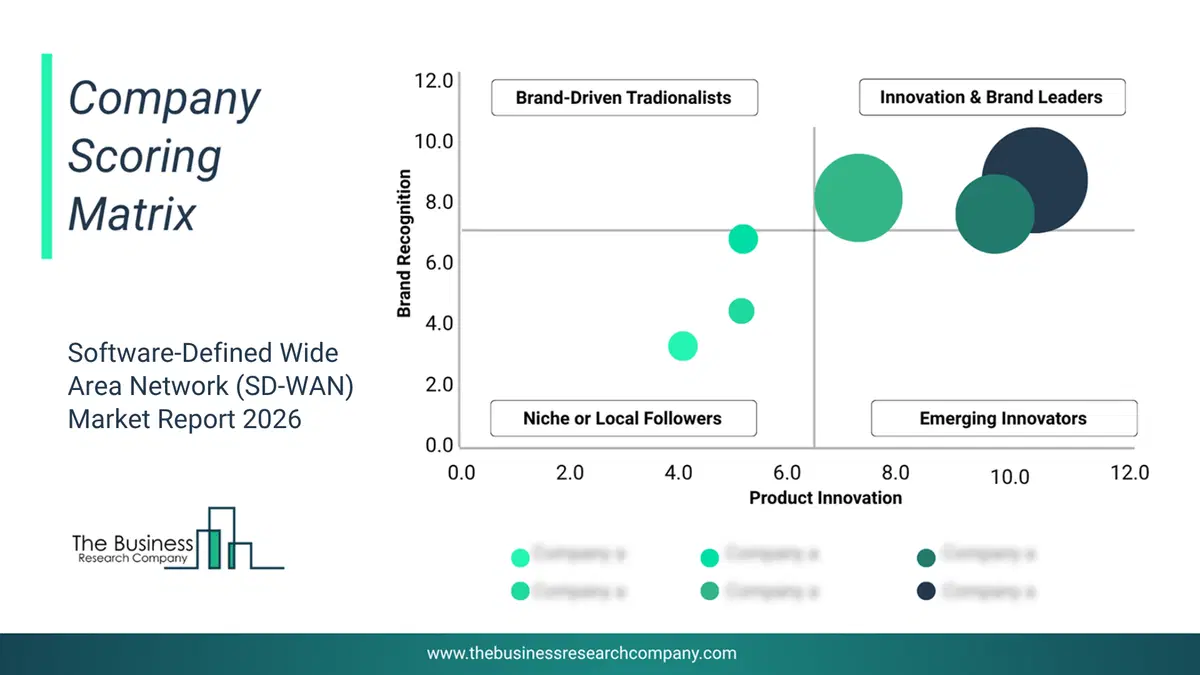
This chart maps companies by product innovation and brand strength, with bubble size indicating relative revenue, helping identify market leaders, challengers, and niche players. This is an illustrative chart; the full report provides a complete and accurate competitive analysis.
Global Software-Defined Wide Area Network (SD-WAN) Market Trends and Insights
Major companies operating in the SD‑WAN (Software‑Defined Wide Area Network) market are focusing on developing innovative solutions such as quantum‑safe platforms to enhance network security and performance. Quantum‑safe platforms are security systems designed to protect data and communications from being compromised by quantum computers. For instance, in October 2025, Gorilla Technology Group Inc., a US-based technology company, launched its Gorilla Intelligent Network Director, the industry’s first SD‑WAN platform built with post‑quantum cryptography. This product uses a hybrid key-exchange mechanism combining Elliptic‑Curve Diffie‑Hellman (ECDH) with the NIST‑approved CRYSTALS‑Kyber algorithm for key exchange and employs CRYSTALS‑Dilithium digital signatures for node authentication and control‑plane integrity. The architecture ensures crypto-agility, long-term confidentiality, and quantum resistance across orchestration, control, and data channels, making it ideal for applications in hybrid, multi‑cloud, sovereign network environments, especially in national AI and digital infrastructure. Gorilla is also setting up Quantum‑Safe Readiness Labs in Taiwan and India to help governments and enterprises simulate quantum migration strategies and validate secure network deployments.What Are Latest Mergers And Acquisitions In The Software-Defined Wide Area Network (SD-WAN) Market?
In November 2023, Etisalat by e&, a UAE-based telecommunications company, collaborated with Versa Networks, VeloCloud Networks Inc., and Fortinet to expand its portfolio and unveil a new era in managed SD-WAN (software-defined wide area network) services. This partnership places Etisalat by e& at the leading edge of network connectivity, providing businesses with greater operational efficiency, more robust security measures, and a scalable network infrastructure. Versa Networks is a US-based SD-WAN and SASE (Secure Access Service Edge) solutions provider. VeloCloud Networks, Inc. is a US-based company known for adopting cloud-delivered SD-WAN architecture. Fortinet is a US-based company that provides software-defined networking (SDN).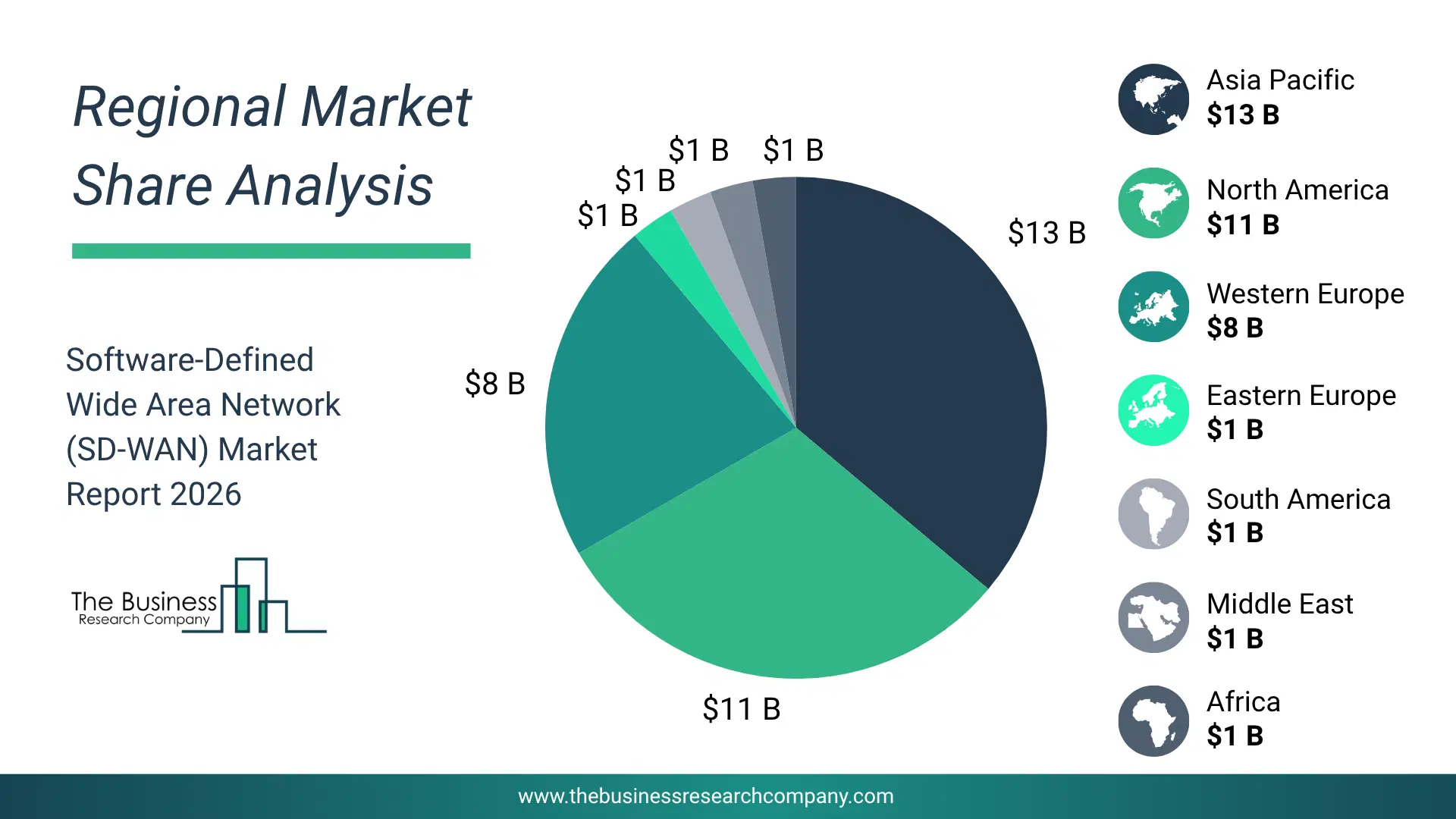
Regional Insights
North America was the largest region in the software-defined wide area network (SD-WAN) market in 2025. Asia-Pacific is expected to be the fastest-growing region in the forecast period. The regions covered in this market report are Asia-Pacific, South East Asia, Western Europe, Eastern Europe, North America, South America, Middle East, Africa. The countries covered in this market report are Australia, Brazil, China, France, Germany, India, Indonesia, Japan, Taiwan, Russia, South Korea, UK, USA, Canada, Italy, Spain.What Defines the Software-Defined Wide Area Network (SD-WAN) Market?
The software-defined wide area network (SD-WAN) market consist of revenues earned by entities by providing on-premises SD-WAN, cloud-managed SD-WAN, hybrid SD-WAN, managed SD-WAN Services, and virtual SD-WAN. The market value includes the value of related goods sold by the service provider or included within the service offering. Only goods and services traded between entities or sold to end consumers are included. The software-defined wide area network (SD-WAN) market also includes consists of sales of edge devices, routers, gateways, switches, and network interface cards (NICs). Values in this market are ‘factory gate’ values, that is the value of goods sold by the manufacturers or creators of the goods, whether to other entities (including downstream manufacturers, wholesalers, distributors and retailers) or directly to end customers. The value of goods in this market includes related services sold by the creators of the goods.How is Market Value Defined and Measured?
The market value is defined as the revenues that enterprises gain from the sale of goods and/or services within the specified market and geography through sales, grants, or donations in terms of the currency (in USD unless otherwise specified). The revenues for a specified geography are consumption values that are revenues generated by organizations in the specified geography within the market, irrespective of where they are produced. It does not include revenues from resales along the supply chain, either further along the supply chain or as part of other products.
This chart presents market attractiveness based on a quantitative evaluation of growth, competition, strategic alignment, and risk, offering a clear view of opportunity areas for decision-making. This chart is for illustrative purposes; the full report contains the complete analysis.

This chart highlights the Total Addressable Market (TAM) by estimating the maximum revenue opportunity using an assumption-driven approach, supporting strategic planning and opportunity sizing across markets. The chart is illustrative; the full report provides a more comprehensive analysis.
What Key Data and Analysis Are Included in the Software-Defined Wide Area Network (SD-WAN) Market Report 2026?
The software-defined wide area network (sd-wan) market research report is one of a series of new reports from The Business Research Company that provides market statistics, including industry global market size, regional shares, competitors with the market share, detailed market segments, market trends and opportunities, and any further data you may need to thrive in the software-defined wide area network (sd-wan) industry. The market research report delivers a complete perspective of everything you need, with an in-depth analysis of the current and future state of the industry.Software-Defined Wide Area Network (SD-WAN) Market Report Forecast Analysis
| Report Attribute | Details |
|---|---|
| Market Size Value In 2026 | $12.03 billion |
| Revenue Forecast In 2030 | $35.39 billion |
| Growth Rate | CAGR of 31.2% from 2026 to 2030 |
| Base Year For Estimation | 2025 |
| Actual Estimates/Historical Data | 2020-2025 |
| Forecast Period | 2026 - 2030 - 2035 |
| Market Representation | Revenue in USD Billion and CAGR from 2026 to 2030 |
| Segments Covered | Component Type, Deployment Mode, Organization Size, End-User Industry |
| Regional Scope | Asia-Pacific, Western Europe, Eastern Europe, North America, South America, Middle East, Africa |
| Country Scope | The countries covered in the report are Australia, Brazil, China, France, Germany, India, Indonesia, Japan, Taiwan, Russia, South Korea, UK, USA, Canada, Italy, Spain. |
| Key Companies Profiled | Dell Technologies Inc., Huawei Technologies Co. Ltd., Cisco Systems Inc., Hewlett Packard Enterprise Development LP, Ericsson, Nokia Corporation, NEC Corporation, VMware Inc., Palo Alto Networks, Juniper Networks Inc., Fortinet Inc., Citrix Systems Inc., Tata Communications, Forcepoint, Riverbed Technology, Cato Networks Ltd., Versa Networks Inc., Aryaka Networks Inc., FatPipe Networks Inc., Adaptiv Networks Inc., Silver Peak Systems Inc. |
| Customization Scope | Request for Customization |
| Pricing And Purchase Options | Explore Purchase Options |