

Software-Defined Wide Area Network (SD-WAN) Global Market Opportunities And Strategies To 2035
By Component Type (Solutions, Services), By Deployment Mode (Premise, Cloud, Hybrid), By Organization Size (Large Enterprises, Small-Medium Enterprises), By End-User Industry (Healthcare, Banking And Financial Services, Retail And Consumer Services, Manufacturing, Transport And Logistics, Information Technology (IT) And Telecommunication (Telecom), Other End-User Industries), And By Region, Opportunities And Strategies – Global Forecast To 2035
Software-Defined Wide Area Network (SD-WAN) Market Definition
Software-defined wide area network (SD-WAN) is a modern networking technology that uses software-based controls to manage and optimize wide-area network connections across multiple locations. It separates the network control layer from the hardware layer, enabling centralized management, intelligent traffic routing and secure connectivity over various transport links. The primary purpose of SD-WAN is to improve network performance, reliability and cost efficiency for enterprises with distributed operations. The SD-WAN market consists of sales by entities (organizations, sole traders and partnerships) of SD-WAN that is a software-based networking architecture that virtualizes the management and operation of a wide area network (WAN), enabling organizations to centrally control connectivity across geographically dispersed sites using intelligent, application-aware routing. SD-WAN abstracts the underlying transport layer, such as broadband internet, multiprotocol label switching (MPLS) and LTE/5G and dynamically directs traffic based on performance requirements, security policies and business priorities.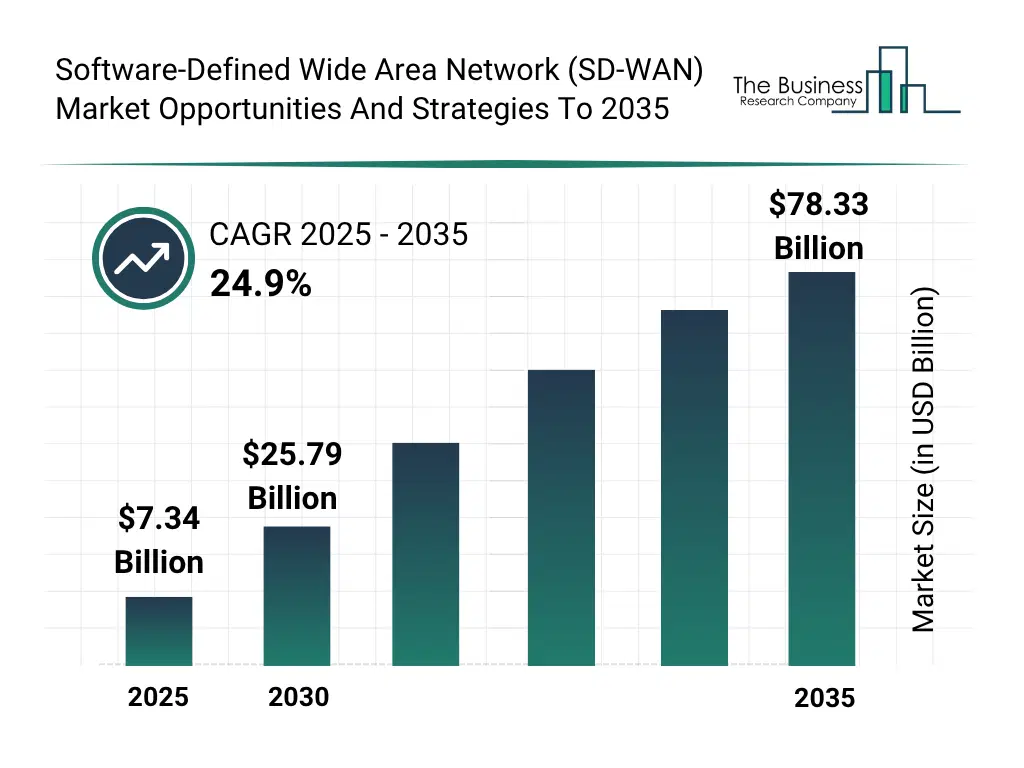
Software-Defined Wide Area Network (SD-WAN) Market Size
The global software-defined wide area network (SD-WAN) market reached a value of nearly $7,335.5 million in 2025, having grown at a compound annual growth rate (CAGR) of 31.0% since 2020. The market is expected to grow from $7,335.5 million in 2025 to $25,791.2 million in 2030 at a rate of 28.6%. The market is then expected to grow at a CAGR of 24.9% from 2030 and reach $78,333.5 million in 2035. Growth in the historic period resulted from growing adoption of SaaS applications, rapid adoption of cloud solutions, government initiatives for digital transformation and rise in demand for zero trust network access (ZTNA). Factors that negatively affected growth in the historic period were shortage of skilled professionals and high initial deployment and migration costs. Going forward, 5G and broadband proliferation, rising frequency and sophistication of cyberattacks, proliferation of internet of things (IoT) devices and expansion of remote and hybrid work models will drive the growth. Factors that could hinder the growth of the software-defined wide area network (SD-WAN) market in the future include complexity in integration, regulatory and data sovereignty challenges and impact of trade war and tariffs.
Software-Defined Wide Area Network (SD-WAN) Market Segmentation
The software-defined wide area network (SD-WAN) market is segmented by component type, by deployment mode, by organization size, and by end-user industry.By Component Type–
The software-defined wide area network (SD-WAN) market is segmented by component type into:
- a) Solutions
- b) Services
By Deployment Mode–
The software-defined wide area network (SD-WAN) market is segmented by deployment mode into:
- a) Premise
- b) Cloud
- b) Hybrid
By Organization Size–
The software-defined wide area network (SD-WAN) market is segmented by organization size into:
- a) Large Enterprises
- b) Small-Medium Enterprises
By End-User Industry–
The software-defined wide area network (SD-WAN) market is segmented by end-user industry into:
- a) Healthcare
- b) Banking And Financial Services
- c) Retail And Consumer Services
- d) Manufacturing
- e) Transport And Logistics
- f) Information Technology (IT) And Telecommunication (Telecom)
- g) Other End-User Industries
By Geography - The software-defined wide area network (SD-WAN) market is segmented by geography into:
- China
- India
- Japan
- Australia
- Indonesia
- South Korea
- USA
- Canada
- Brazil
- France
- Germany
- UK
- Italy
- Spain
- Russia
-
o Asia Pacific
o Africa