
Soil Conditioners Market Report 2026
Global Outlook – By Product Type (Organic, In-Organic), By Formulation (Dry, Liquid), By Soil Type (Sand, Silt, Clay, Loam, Other Soil Types), By Crop Type (Cereals And Grains, Oilseeds And Pulses, Fruits And Vegetables, Other Crop Types) – Market Size, Trends, Strategies, and Forecast to 2030
Soil Conditioners Market Overview
• Soil Conditioners market size has reached to $6.68 billion in 2025 • Expected to grow to $9.35 billion in 2030 at a compound annual growth rate (CAGR) of 6.8% • Growth Driver: Organic Food Demand Energizes Growth In Soil Conditioners Market • Market Trend: Agromin Launches Online Retail Store For Eco-Friendly Soil Products • Asia-Pacific was the largest region and fastest growing region.What Is Covered Under Soil Conditioners Market?
Soil conditioners refer to soil additives that strengthen the soil's structure. It helps improve the soil condition by boosting aeration, water holding capacity, oxygen penetration, nutrient absorption in the soil, and maintaining the pH level. Soil conditioners unlock nutrients that have been trapped in soil surface and clay soils. Organic or inorganic materials, as well as mixtures of synthetic and natural materials, can be used as soil conditioners. Organic soil conditioners contain various components, such as animal waste, compost leftover from cover crops, waste sludge, and others., whereas inorganic soil conditioners include pulverized limestone, slate, gypsum, glauconite, and others. The main types of soil conditioners are organic and inorganic. Organic soil conditioner refers to any natural or organic material that is added to soil to improve its physical structure, fertility, and overall health. These soil conditioners are used to enhance the soil's ability to retain water, promote aeration, and provide essential nutrients to plants. The dry and liquid soil conditioners are used on sand, silt, clay, loam soil types, and others. The various crops that it supports include cereals and grains, oilseeds and pulses, fruits and vegetables, and others.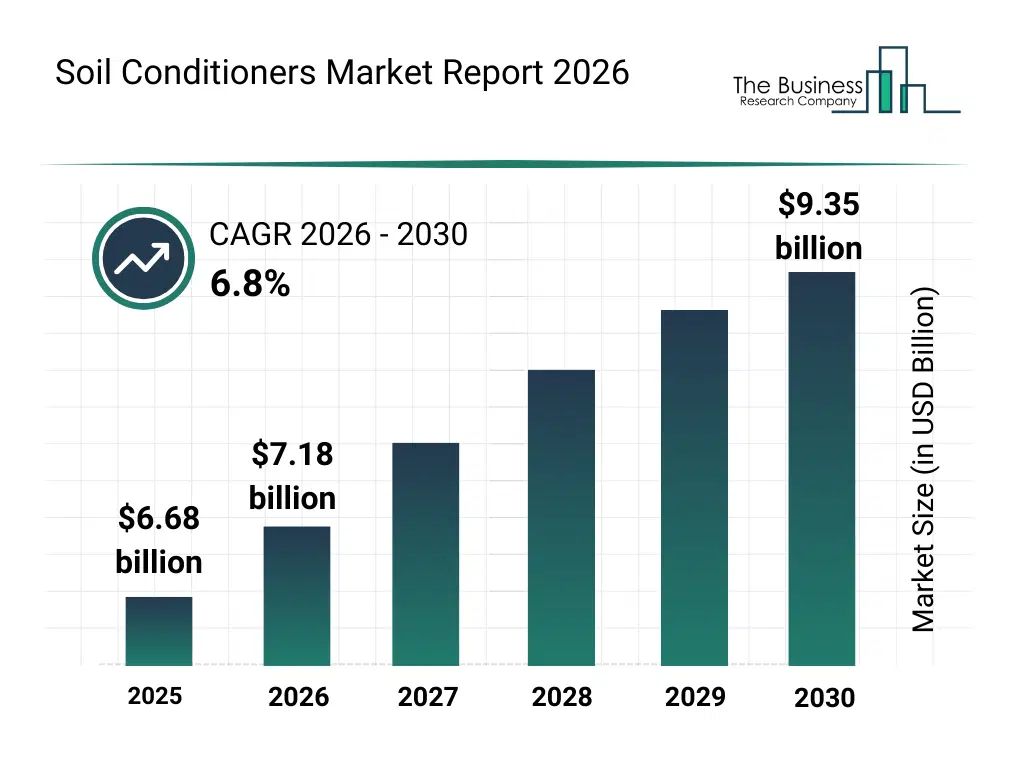
What Is The Soil Conditioners Market Size and Share 2026?
The soil conditioners market size has grown strongly in recent years. It will grow from $6.68 billion in 2025 to $7.18 billion in 2026 at a compound annual growth rate (CAGR) of 7.5%. The growth in the historic period can be attributed to soil degradation issues, expansion of agriculture, need for yield improvement, availability of organic waste, government soil programs.What Is The Soil Conditioners Market Growth Forecast?
The soil conditioners market size is expected to see strong growth in the next few years. It will grow to $9.35 billion in 2030 at a compound annual growth rate (CAGR) of 6.8%. The growth in the forecast period can be attributed to growth in sustainable farming, rising demand for organic crops, climate change impacts on soil, precision agriculture adoption, expansion of horticulture. Major trends in the forecast period include rising adoption of organic soil amendments, growing demand for soil health improvement, expansion of biochar usage, increasing focus on water retention solutions, use of conditioners for ph stabilization.
Global Soil Conditioners Market Segmentation
1) By Product Type: Organic, In-Organic 2) By Formulation: Dry, Liquid 3) By Soil Type: Sand, Silt, Clay, Loam, Other Soil Types 4) By Crop Type: Cereals And Grains, Oilseeds And Pulses, Fruits And Vegetables, Other Crop Types Subsegments: 1) By Organic Soil Conditioners: Compost, Manure, Peat Moss, Green Manure, Biochar, Seaweed Extracts 2) By Inorganic Soil Conditioners: Gypsum, Lime, Sulfur, Synthetic Soil AmendmentsWhat Is The Driver Of The Soil Conditioners Market?
The Increasing demand for organic food products is expected to propel the growth of the soil conditioners market. Soil conditioners can improve poor soils by adding organic material among soil particles. Soil conditioners improve soil structure through increasing water retention, increasing aeration and adding plant nutrients. Such soil is useful to grow organic food products. Organic food products can be beneficial for soil conditioning through the principles and practices associated with organic farming. For instance, in February 2024, according to the IFOAM (International Federation of Organic Agriculture Movements), a Germany-based an international organization, the global area under organic farming expanded by 2.5 million hectares in 2023, bringing the total to nearly 99 million hectares. Meanwhile, global sales of organic food rose to approximately 136 billion euros that same year. Therefore, the increased demand for organic food products is driving the growth of the soil conditioners industry.Key Players In The Global Soil Conditioners Market
Major companies operating in the soil conditioners market are BASF SE, Evonik Industries AG, UPL Limited, Saint-Gobain Group, Solvay S.A., Omnia Holdings Limited, Mangalore Chemicals & Fertilizers Limited, Nufarm, Novozymes A/S, Southern Petrochemical Industries Corporation Ltd (SPIC), Weifang Hanhe Fertilizer Co. Ltd, Qingdao Haidelong Biotechnology Co. Ltd, Changsha Richfield Agri Tech Co. Ltd, Eco Sustainable Solutions, Halcyon Environmental, RMB Hydroseeding, Advance Grass Solutions, Amenity Land Solutions, Angus Horticulture, Boughton Loam Ltd, Edagum Sm Rus LLC, Norofert Group, AGRO CS, VitaFer.pl, Intermag, PhosAgro, Acron Group, Bioera-Moscow LLC, Lignohumatate, Nutrien Ltd, Mosaic Co, Rooted Leaf Agritech, Polyorganic Technologies Corporation, North American Kelp, CoastBio, Cargill Inc, ExcelAg Corp, Monty's Plant Food, Technes Agrícola Ltda, Brazilian Agricultural Research Corporation, Tradecorp Brazil, Wasit General Trading LLC, Agrotar, Haifa Group, GrowGroup Israel, ICL Israel Chemicals Ltd, Nutri-Crop Agro, TerraCottem, Kamasol Aqua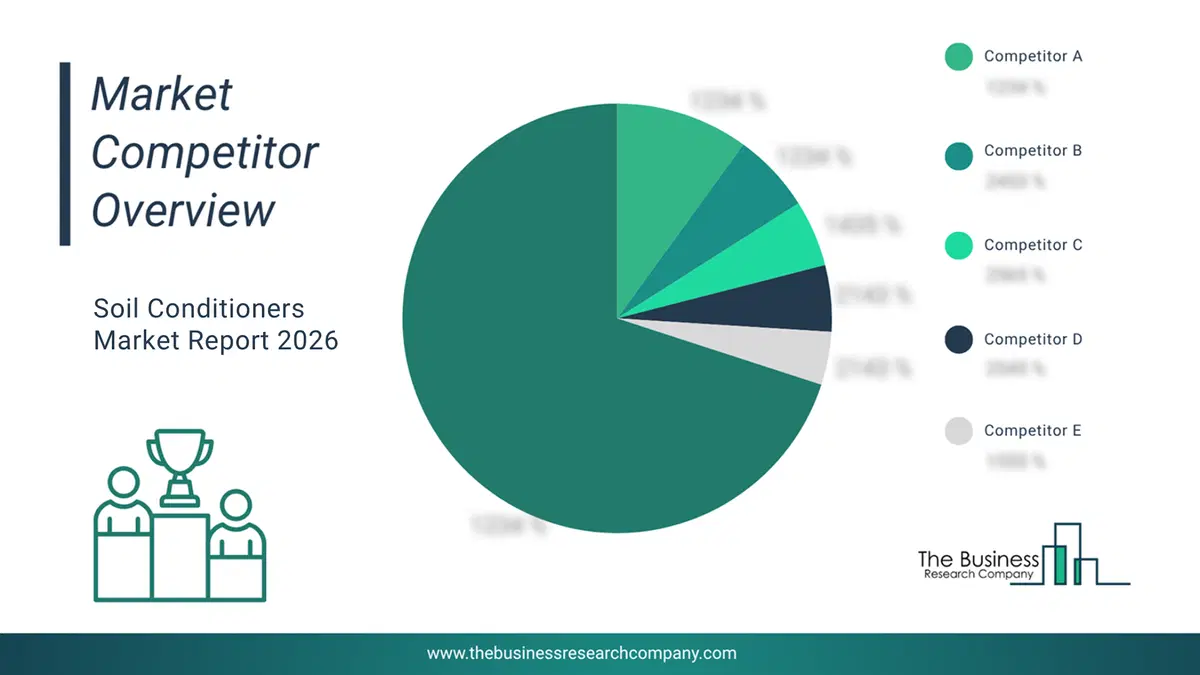
This chart is for illustrative purposes; the full report includes a detailed competitor analysis and comprehensive overview of the top 10 companies in the market.
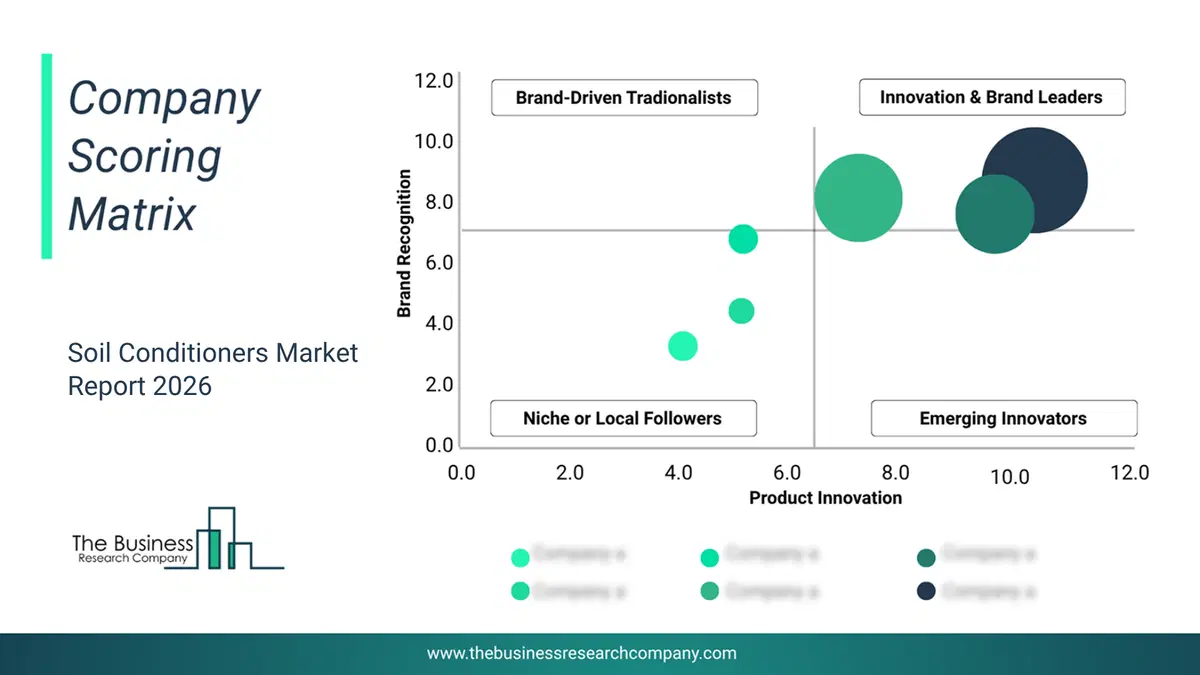
This chart maps companies by product innovation and brand strength, with bubble size indicating relative revenue, helping identify market leaders, challengers, and niche players. This is an illustrative chart; the full report provides a complete and accurate competitive analysis.
Global Soil Conditioners Market Trends and Insights
Major companies operating in the soil conditioner market are focusing on integrating online retail technologies, such as dedicated e-commerce platforms, to improve customer accessibility, simplify ordering, and expand direct-to-consumer availability of soil products. Online retail refers to the digital selling of goods through internet-based storefronts that allow customers to browse, compare, and purchase products conveniently from computers or mobile devices. For instance, in July 2023, Agromin, a US-based manufacturer of earth-friendly soil products, launched an online retail store offering a wide range of compost, mulch, and soil amendments made from locally recycled organic waste, providing customers with easier access to sustainable soil-conditioning solutions and supporting broader adoption of digital purchasing channels within the soil conditioner market.What Are Latest Mergers And Acquisitions In The Soil Conditioners Market?
In February 2024, Huma, Inc., a US-based healthcare technology company, acquired Gro-Power, Inc., a US-based manufacturer of organic fertilizers, for an undisclosed amount. With this acquisition, Huma aims to expand its business scope, combining its technological capabilities with Gro-Power’s fertilizer manufacturing operations thereby extending its market reach into agricultural/organic-fertilizer segments.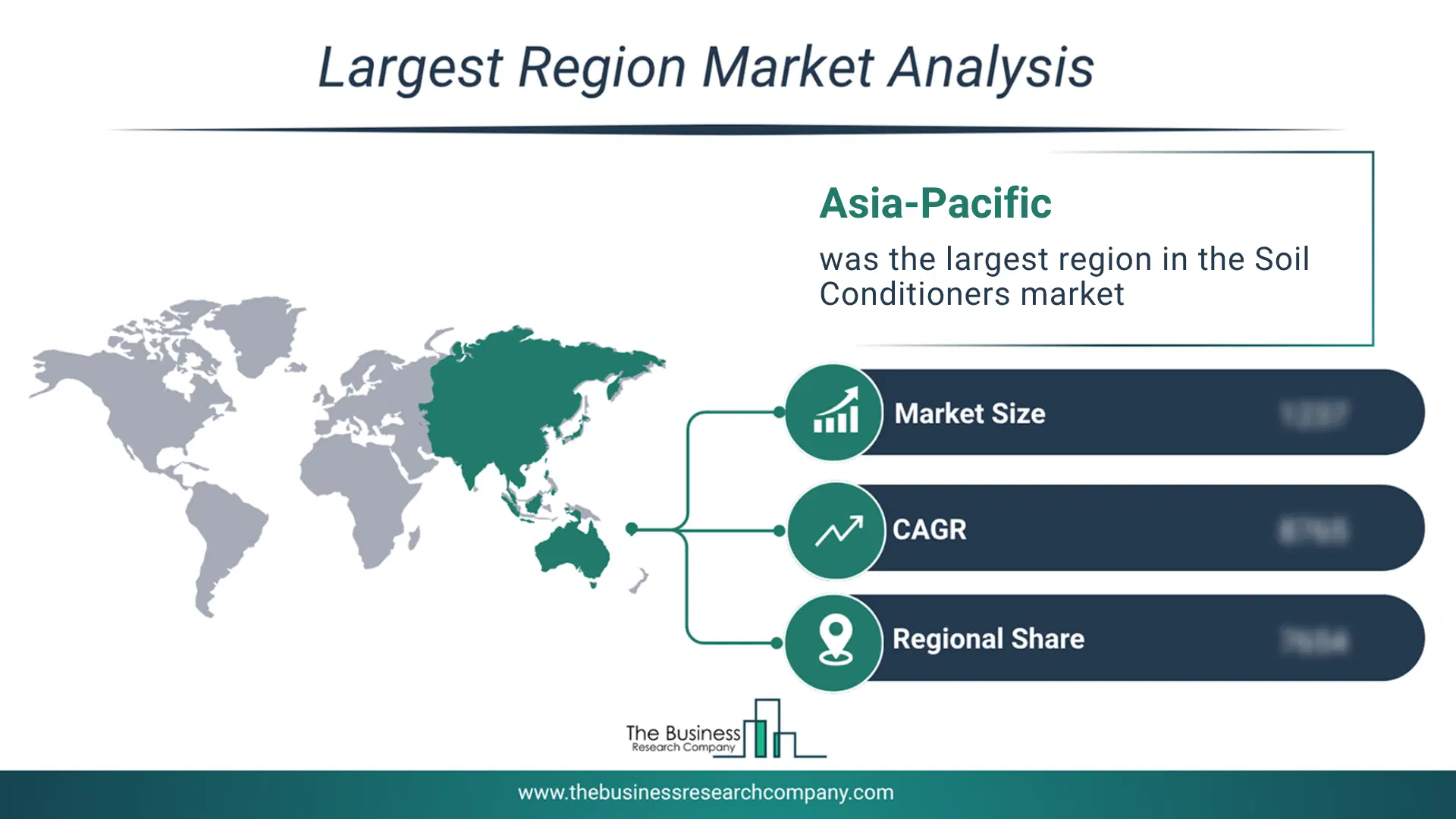
Regional Insights
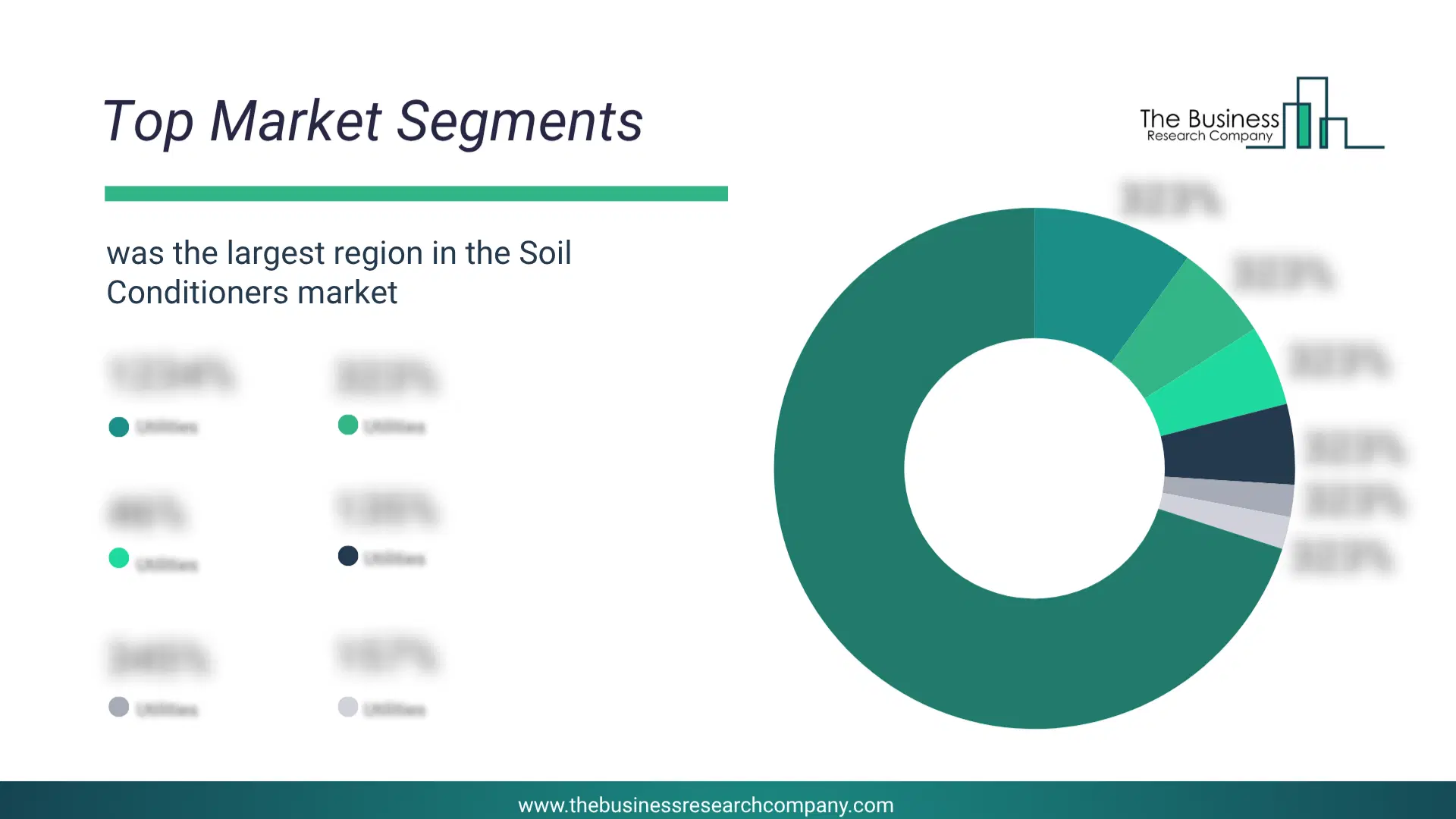
Asia-Pacific was the largest region in the soil conditioner market in 2025. Asia-Pacific is expected to be the fastest-growing region in the forecast period. The regions covered in this market report are Asia-Pacific, South East Asia, Western Europe, Eastern Europe, North America, South America, Middle East, Africa The countries covered in this market report are Australia, Brazil, China, France, Germany, India, Indonesia, Japan, Taiwan, Russia, South Korea, UK, USA, Canada, Italy, SpainWhat Defines the Soil Conditioners Market?
The soil conditioners market consists of sales of organic and inorganic soil conditioners. Values in this market are ‘factory gate’ values, that is the value of goods sold by the manufacturers or creators of the goods, whether to other entities (including downstream manufacturers, wholesalers, distributors, and retailers) or directly to end customers. The value of goods in this market includes related services sold by the creators of the goods.How is Market Value Defined and Measured?
The market value is defined as the revenues that enterprises gain from the sale of goods and/or services within the specified market and geography through sales, grants, or donations in terms of the currency (in USD unless otherwise specified). The revenues for a specified geography are consumption values that are revenues generated by organizations in the specified geography within the market, irrespective of where they are produced. It does not include revenues from resales along the supply chain, either further along the supply chain or as part of other products.
This chart presents market attractiveness based on a quantitative evaluation of growth, competition, strategic alignment, and risk, offering a clear view of opportunity areas for decision-making. This chart is for illustrative purposes; the full report contains the complete analysis.

This chart highlights the Total Addressable Market (TAM) by estimating the maximum revenue opportunity using an assumption-driven approach, supporting strategic planning and opportunity sizing across markets. The chart is illustrative; the full report provides a more comprehensive analysis.
What Key Data and Analysis Are Included in the Soil Conditioners Market Report 2026?
The soil conditioners market research report is one of a series of new reports from The Business Research Company that provides market statistics, including industry global market size, regional shares, competitors with the market share, detailed market segments, market trends and opportunities, and any further data you may need to thrive in the soil conditioners industry. The market research report delivers a complete perspective of everything you need, with an in-depth analysis of the current and future state of the industry.Soil Conditioners Market Report Forecast Analysis
| Report Attribute | Details |
|---|---|
| Market Size Value In 2026 | $7.18 billion |
| Revenue Forecast In 2030 | $9.35 billion |
| Growth Rate | CAGR of 7.5% from 2026 to 2030 |
| Base Year For Estimation | 2025 |
| Actual Estimates/Historical Data | 2020-2025 |
| Forecast Period | 2026 - 2030 |
| Market Representation | Revenue in USD Billion and CAGR from 2026 to 2030 |
| Segments Covered | Product Type, Formulation, Soil Type, Crop Type |
| Regional Scope | Asia-Pacific, Western Europe, Eastern Europe, North America, South America, Middle East, Africa |
| Country Scope | The countries covered in this market report are Australia, Brazil, China, France, Germany, India, Indonesia, Japan, Taiwan, Russia, South Korea, UK, USA, Canada, Italy, Spain |
| Key Companies Profiled | BASF SE, Evonik Industries AG, UPL Limited, Saint-Gobain Group, Solvay S.A., Omnia Holdings Limited, Mangalore Chemicals & Fertilizers Limited, Nufarm, Novozymes A/S, Southern Petrochemical Industries Corporation Ltd (SPIC), Weifang Hanhe Fertilizer Co. Ltd, Qingdao Haidelong Biotechnology Co. Ltd, Changsha Richfield Agri Tech Co. Ltd, Eco Sustainable Solutions, Halcyon Environmental, RMB Hydroseeding, Advance Grass Solutions, Amenity Land Solutions, Angus Horticulture, Boughton Loam Ltd, Edagum Sm Rus LLC, Norofert Group, AGRO CS, VitaFer.pl, Intermag, PhosAgro, Acron Group, Bioera-Moscow LLC, Lignohumatate, Nutrien Ltd, Mosaic Co, Rooted Leaf Agritech, Polyorganic Technologies Corporation, North American Kelp, CoastBio, Cargill Inc, ExcelAg Corp, Monty's Plant Food, Technes Agrícola Ltda, Brazilian Agricultural Research Corporation, Tradecorp Brazil, Wasit General Trading LLC, Agrotar, Haifa Group, GrowGroup Israel, ICL Israel Chemicals Ltd, Nutri-Crop Agro, TerraCottem, Kamasol Aqua |
| Customization Scope | Request for Customization |
| Pricing And Purchase Options | Explore Purchase Options |