
Contact Us
  Search
The Business Research Company Logo
Solar Electricity Global Market Opportunities And Strategies To 2035
Published :July 2026
Pages :386
Format :PDF
Delivery Time :2-3 Business Days
Why 2-3 days? We update the report with the latest data and news before delivery. Let us know if you need us to expedite.
Report Price :$4,490.00

Solar Electricity Global Market Opportunities And Strategies To 2035

By Technology (Photovoltaic Systems, Concentrated Solar Power Systems), By Solar Module (Monocrystalline, Polycrystalline, Cadmium Telluride, Amorphous Silicon Cells, Other Solar Modules), By End User (Residential, Commercial, Utilities), And By Region, Opportunities And Strategies – Global Forecast To 2035

Solar Electricity Market Definition

Solar electricity refers to the generation of electrical power from sunlight using technologies that convert solar radiation into usable energy. It is a key segment of the broader renewable energy industry and is widely used by residential households, commercial establishments, utilities, and industrial users seeking sustainable and cost-effective power solutions. Solar electricity is utilized during daylight hours and, when paired with storage systems, can also provide power during non-sunlight hours. The solar electricity market consists of sales of solar electricity by entities (organizations, sole traders and partnerships) that produce and supply electricity using solar energy technologies, as well as those providing related installation, integration, and maintenance services. This market includes both distributed generation systems and utility-scale solar power projects designed to supply electricity to end users or national grids.
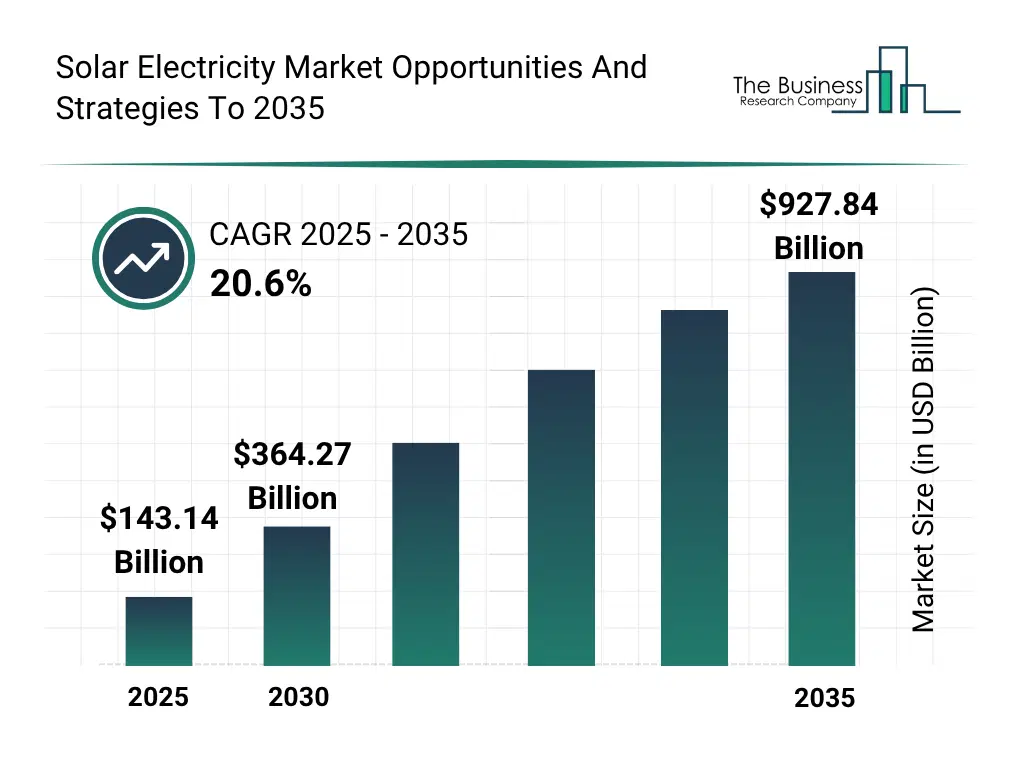
Solar Electricity Global Market Opportunities And Strategies To 2035 Market Size and growth rate 2026 to 2030: Graph

Solar Electricity Market Size

The global solar electricity market reached a value of nearly $143,141.3 million in 2025, having grown at a compound annual growth rate (CAGR) of 16.5% since 2020. The market is expected to grow from $143,141.3 million in 2025 to $364,265.8 million in 2030 at a rate of 20.5%. The market is then expected to grow at a CAGR of 20.6% from 2030 and reach $927,839.9 million in 2035. Growth in the historic period resulted from growing adoption rate of solar PV installation, Strong government subsidies, tax credits, and incentive schemes for solar photovoltaic (PV), declining levelized cost of electricity (LCOE) for solar compared to fossil fuels and increasing consumer awareness and preference for clean energy solutions. Factors that negatively affected growth in the historic period were high upfront capital investment and limited access to financing. Going forward, decarbonization policies and climate commitments and targets, national and regional renewable energy targets, advancements in energy storage systems and expansion of decentralized and off-grid solar solutions will drive the growth. Factors that could hinder the growth of the solar electricity market in the future include grid congestion and curtailment, low-capacity utilization factors and impact of trade war and tariffs.
Research Expert

Book your 30 minutes free consultation with our research experts

Solar Electricity Market Segmentation

The solar electricity market is segmented by technology, by solar module, and by end user.

By Technology –
The solar electricity market is segmented by technology into:
    • a) Photovoltaic Systems
    • b) Concentrated Solar Power Systems
The photovoltaic systems market was the largest segment of the solar electricity market segmented by technology, accounting for 99.3% or $142,205.1 million of the total in 2025. Going forward, the concentrated solar power systems segment is expected to be the fastest growing segment in the solar electricity market segmented by technology, at a CAGR of 25.4% during 2025-2030.

By Solar Module –
The solar electricity market is segmented by solar module into:
    • a) Monocrystalline
    • b) Polycrystalline
    • c) Cadmium Telluride
    • d) Amorphous Silicon Cells
    • e) Other Solar Modules
The monocrystalline market was the largest segment of the solar electricity market segmented by solar module, accounting for 81.2% or $116,257.0 million of the total in 2025. Going forward, the cadmium telluride segment is expected to be the fastest growing segment in the solar electricity market segmented by solar module, at a CAGR of 33.4% during 2025-2030.

By End User –
The solar electricity market is segmented by end user into:
    • a) Residential
    • b) Commercial
    • c) Utilities
The utilities market was the largest segment of the solar electricity market segmented by end user, accounting for 46.2% or $66,068.2 million of the total in 2025. Going forward, the commercial segment is expected to be the fastest growing segment in the solar electricity market segmented by end user, at a CAGR of 23.0% during 2025-2030.

By Geography - The solar electricity market is segmented by geography into:
      o Asia Pacific
      • China
      • India
      • Japan
      • Australia
      • Indonesia
      • South Korea
      o North America
      • USA
      • Canada
      o South America
      • Brazil
      o Western Europe
      • France
      • Germany
      • UK
      • Italy
      • Spain
      o Eastern Europe
      • Russia
      o Middle East
      o Africa
Asia Pacific was the largest region in the solar electricity market, accounting for 55.0% or $78,766.9 million of the total in 2025. It was followed by Western Europe, North America and then the other regions. Going forward, the fastest-growing regions in the solar electricity market will be Africa and Middle East where growth will be at CAGRs of 25.1% and 24.5% respectively. These will be followed by Asia Pacific and Western Europe where the markets are expected to grow at CAGRs of 22.4% and 18.5% respectively.

Solar Electricity Market Drivers

The key drivers of the solar electricity market include: Decarbonization Policies And Climate Commitments And Targets During the forecast period, decarbonization policies and climate commitments and targets are expected to drive growth in the solar electricity market, as governments and international bodies intensify efforts to reduce greenhouse gas emissions and transition toward low-carbon energy systems. Increasing enforcement of net-zero targets, carbon neutrality goals, and emission reduction mandates is expected to accelerate large-scale solar deployment across both developed and emerging economies. These policy frameworks will significantly boost demand for solar photovoltaic installations as a primary clean electricity source, encouraging investments and long-term project pipelines globally. The decarbonization policies and climate commitments growth contribution during the forecast period. The decarbonization policies and climate commitments and targets growth contribution during the forecast period in 2026 is 1.5%.

Solar Electricity Market Restraints

The key restraints on the solar electricity market include: Low-Capacity Utilization Factors Low-capacity utilization factors limit the growth of the solar electricity market by reducing the actual electricity output generated relative to installed capacity. This occurs due to variability in solar irradiation, weather conditions, and seasonal fluctuations that prevent plants from operating at optimal efficiency throughout the year. It leads to lower revenue generation per installed MW, thereby impacting project profitability and investor returns. As a result, developers face challenges in achieving expected payback periods, which can slow down new project investments. Additionally, underutilization of existing infrastructure increases the levelized cost of electricity, making solar less competitive in certain regions compared to other energy sources. Therefore, low-capacity utilization factors hinder the growth of the solar electricity market going forward. Growth affected by the low-capacity utilization factors during the forecast period in 2026 is -2.0%.

Solar Electricity Market Competitive Landscape

Major Competitors are:

  • JinkoSolar Holding Co. Ltd.
  • LONGi Green Energy Technology Co. Ltd.
  • Trina Solar Co. Ltd.
  • JA Solar Holdings Co. Ltd.
  • Canadian Solar Inc.
  • Other Competitors Include:

  • NextEra Energy Inc.
  • Iberdrola SA
  • First Solar Inc.
  • Tongwei Solar
  • Engie SA
  • Motech Industries, Inc.
  • TSEC Corporation
  • DelSolar Co., Ltd.
  • Tainergy Tech Co., Ltd
  • Giga Solar
  • Yangzhou Autex Solar Technology Co., Ltd.
  • RatedPower
  • Hanwha Group
  • Skygreen Energy
  • Adani Green Energy Limited
  • Datang International Power Generation Co., Ltd.
  • Huaneng Power International, Inc.
  • Waaree Group
  • Tata Power Solar Systems Limited
  • Urja Global Limited
  • Wuxi Suntech Power Co. Ltd
  • Azure Power
  • Vivaan Solar
  • Aiko Solar
  • China Three Gorges Corporation
  • Xinyi Solar Holdings Ltd
  • Shunfeng International Clean Energy Ltd
  • China Datang Corporation Ltd.
  • Risen Energy
  • Sungrow
  • RENOVA, Inc.
  • Vena Energy
  • Gigasolar Co., Ltd.
  • Virya Energy
  • Kyocera Corporation
  • Grace Solar
  • OCI Company Ltd
  • HD Hyundai Energy Solutions
  • S-Energy Co., Ltd.
  • SolarPark Korea Co., Ltd
  • Yingli Energy Development Co., Ltd
  • Clean Energy Connect, Inc.
  • Shinsung E&G Co., Ltd.
  • Enel X Korea
  • New Green Power
  • Acmepoint Energy Services Co., Ltd
  • United Renewable Energy Co., Ltd
  • Solarvest Holdings
  • Plus Xnergy
  • TNB Engineering Corporation
  • ERS Energy Sdn. Bhd.
  • SOLS Energy
  • Solar Philippines
  • ACEN Corporation
  • First Gen
  • Nextnorth Energy
  • Solaric Corporation
  • PHILERGY German Solar
  • Cleantech Solar
  • ENGIE Southeast Asia
  • Eigen Energy
  • Sinenergy Pte Ltd
  • Energy Absolute
  • Gunkul Engineering
  • Super Energy Corporation
  • SchneiTec Group
  • JTC Corporation
  • Mitsubishi Electric Corporation
  • Siemens US
  • Fuji Electric Global
  • General Electric Company
  • Hitachi Energy
  • Peak Power Inc. (Toronto)
  • Enwave Energy Corporation
  • TransAlta Corporation
  • Northland Power Inc.
  • TERIC Power
  • American Electric Power (AEP)
  • NRG Energy
  • Terabase Energy
  • Sunrun
  • EDF Renewables North America
  • Invenergy
  • SunPower Corporation
  • Enphase Energy
  • JinkoSolar
  • ENGIE North America
  • Nextracker
  • Energea
  • Canadian Solar Inc.
  • Brookfield Renewable Partners
  • Innergex
  • Silfab Solar
  • Heliene
  • Voltec Solar (Alsace)
  • DualSun
  • Photowatt
  • Solarwatt
  • IBC Solar
  • AxSun Solar
  • SolarWorld
  • 3Sun
  • Solsonica
  • ATERSA
  • TAMESOL
  • Lightsource bp
  • Hive Energy
  • Ecotricity
  • Genneia SA.
  • 360 Energy SA.
  • YPF Luz.
  • Neoenergia
  • Elera Renováveis
  • Engie Brasil Energia
  • Enel Green Power Brasil
  • Solek Chile
  • AES Andes
  • Orygen Perú
  • Kallpa Generación
  • CEZ Group
  • Solartec Holding a.s.
  • Energeticky a Prumyslovy Holding (EPH)
  • Polenergia
  • Monsson Group
  • Photon Energy Group
  • Rezolv Energy
  • Hevel Solar (Hevel LLC)
  • Unigreen Energy
  • RusHydro
  • MAPNA Group
  • Ghadir Solar
  • Kirchner Solar Group Iranian (KSGI)
  • Sunir Co
  • Doral Renewable Energy Resources Group
  • ACWA Power
  • Masdar
  • Alfanar
  • KarmSolar
  • Infinity Power
  • Elsewedy Electric
  • Arnergy
  • GVE Projects
  • Vesselnet Solar
  • Solaris GreenTech Hub
  • ARTsolar
  • Need data on a specific region in this market?

    Opportunities And Recommendations In The Solar Electricity Market

    Opportunities – The top opportunities in the solar electricity market segmented by technology will arise in the photovoltaic systems segment, which will gain $219,157.9 million of global annual sales by 2030. The top opportunities in the solar electricity market segmented by solar module will arise in the monocrystalline segment, which will gain $180,287.1 million of global annual sales by 2030. The top opportunities in the solar electricity market segmented by end user will arise in the utilities segment, which will gain $99,647.4 million of global annual sales by 2030. The solar electricity market size will gain the most in China at $59,089.6 million. Recommendations- To take advantage of the opportunities, The Business Research Company recommends the solar electricity companies to focus on integrated solar power electronics and smart energy management, focus on perovskite photovoltaic technologies for low-light applications, focus on low-light optimized perovskite solar modules, focus on artificial intelligence-driven solar manufacturing, focus on concentrated solar power systems for dispatchable renewable energy, focus on cadmium telluride solar modules for utility-scale deployment, expand in emerging markets, continue to focus on developed markets, focus on flexible and value-based solar pricing models, focus on data-driven digital promotion and customer education, focus on corporate sustainability partnerships and commercial brand positioning, focus on commercial solar installations and corporate energy partnerships.
    Chat with us