
Solar Photovoltaic (PV) Backsheet Market Report 2026
Global Outlook – By Product (Tedlar-PET-Tedlar (Primed), Tedlar-Polyester-Ethylene, Polyethylene Terephthalate, Polyvinylidene Fluoride, Polyethylene Naphthalate, Other Products), By Material Type (Fluoropolymer, Non-Fluoropolymer), By Technology (Crystalline, Thin Film, Ultra-Thin Film), By Installation (Roof Mounted, Ground, Floating), By End-User (Residential, Industrial, Utility) – Market Size, Trends, Strategies, and Forecast to 2030
Solar Photovoltaic (PV) Backsheet Market Overview
• Solar Photovoltaic (PV) Backsheet market size has reached to $4.28 billion in 2025 • Expected to grow to $6.28 billion in 2030 at a compound annual growth rate (CAGR) of 7.9% • Growth Driver: Increasing Use Of Renewable Energy Fueling The Growth Of The Market Due To Rising Energy Demand, Government Incentives, And Carbon Emission Reduction Efforts • Market Trend: Advancements In Conductive Backsheet Technology For Enhanced Solar Panel Efficiency • Asia-Pacific was the largest region in 2025 and North America is the fastest growing region.What Is Covered Under Solar Photovoltaic (PV) Backsheet Market?
Solar photovoltaic (PV) backsheet refer to the outermost protective layer of a solar panel, specifically designed to provide insulation, durability, and resistance against environmental factors such as UV radiation, moisture, and mechanical stress. They enhance solar modules' longevity and overall efficiency by preventing electrical leakage and degradation. Solar photovoltaic (PV) backsheet plays a crucial role in ensuring the long-term reliability of solar panels by acting as a barrier against harsh weather conditions, chemical exposure, and physical damage. The main product types of solar photovoltaic (PV) backsheets are tedlar-pet-tedlar (Primed), tedlar-polyester-ethylene, polyethylene terephthalate, polyvinylidene fluoride, polyethylene naphthalate, and others. Tedlar-PET-Tedlar (Primed) is a photovoltaic backsheet with a PET core laminated between two Tedlar (PVF) layers, ensuring superior durability and weather resistance. It is made up of several material types, such as fluoropolymer and non-fluoropolymer, with various technologies, including crystalline, thin film, and ultra-thin film. It is installed on several installation types, such as roof-mounted, ground, and floating, and used by various end users, including residential, industrial, and utility.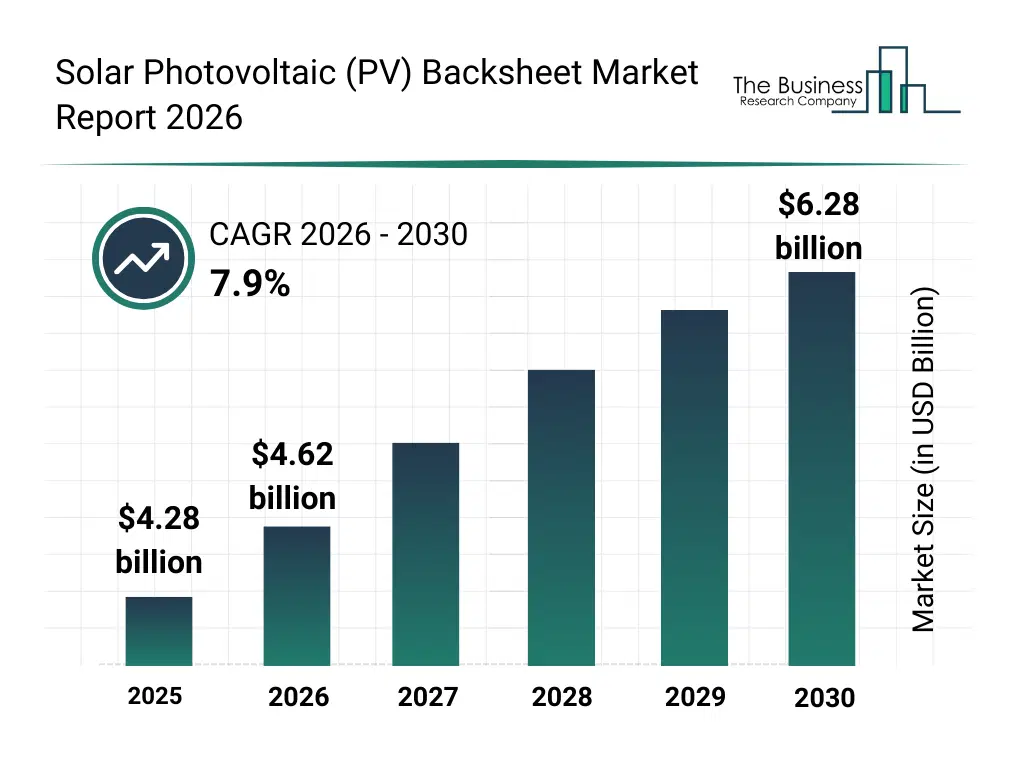
What Is The Solar Photovoltaic (PV) Backsheet Market Size and Share 2026?
The solar photovoltaic (pv) backsheet market size has grown strongly in recent years. It will grow from $4.28 billion in 2025 to $4.62 billion in 2026 at a compound annual growth rate (CAGR) of 8.1%. The growth in the historic period can be attributed to expansion of global solar module manufacturing, increasing demand for long-lasting solar panels, advancements in polymer material technologies, rising quality standards for pv modules, growth of utility-scale solar projects.What Is The Solar Photovoltaic (PV) Backsheet Market Growth Forecast?
The solar photovoltaic (pv) backsheet market size is expected to see strong growth in the next few years. It will grow to $6.28 billion in 2030 at a compound annual growth rate (CAGR) of 7.9%. The growth in the forecast period can be attributed to increasing focus on recyclable backsheet materials, rising adoption of lightweight solar modules, expansion of ultra-thin film technologies, growing investments in advanced polymer research, increasing demand for extended module warranties. Major trends in the forecast period include increasing demand for high-durability backsheet materials, rising adoption of non-fluoropolymer backsheets, growing use of uv-resistant and moisture-barrier films, expansion of ultra-thin and lightweight backsheet designs, enhanced focus on module longevity.
Global Solar Photovoltaic (PV) Backsheet Market Segmentation
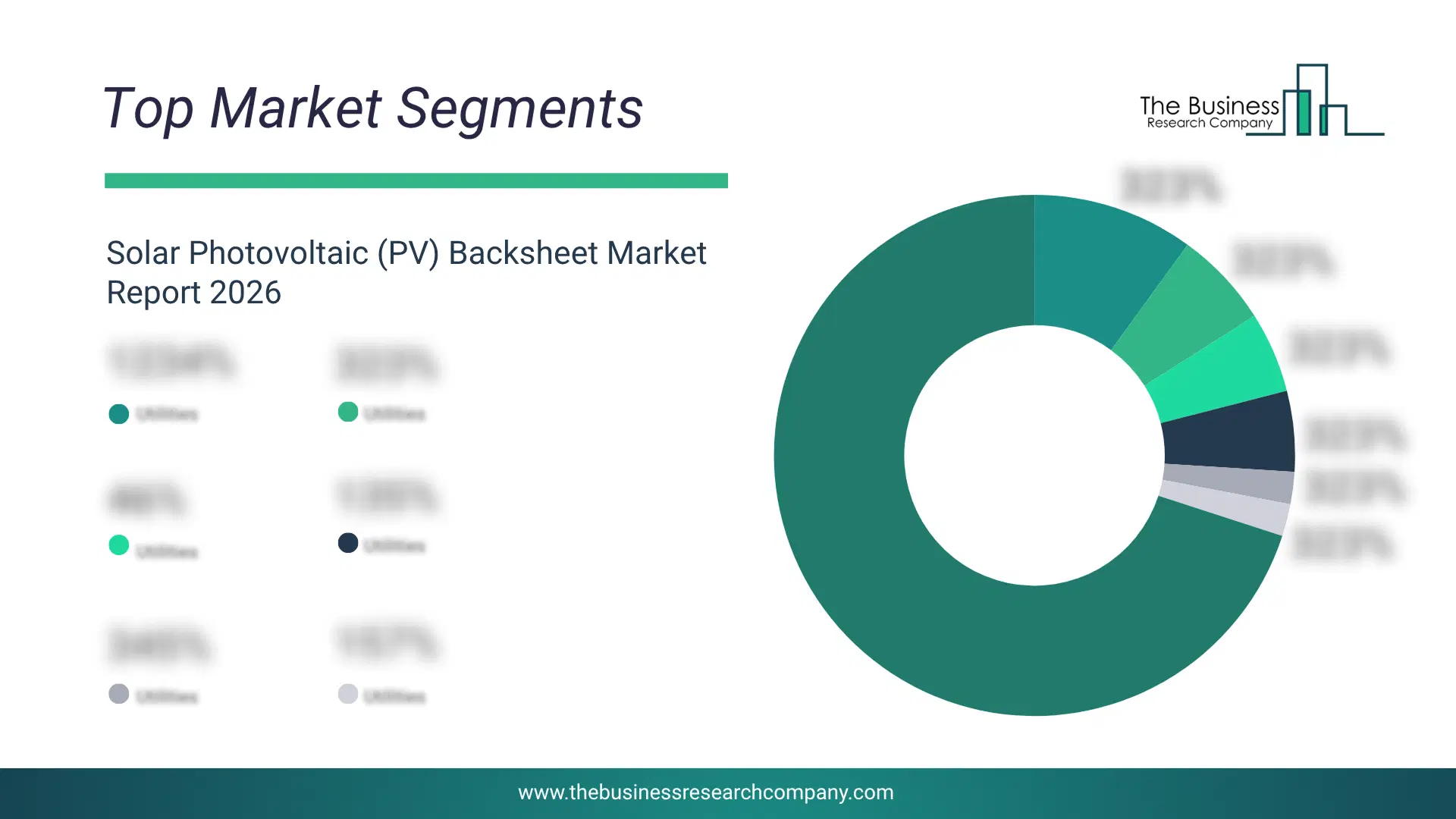
1) By Product: Tedlar-PET-Tedlar (Primed), Tedlar-Polyester-Ethylene, Polyethylene Terephthalate, Polyvinylidene Fluoride, Polyethylene Naphthalate, Other Products 2) By Material Type: Fluoropolymer, Non-Fluoropolymer 3) By Technology: Crystalline, Thin Film, Ultra-Thin Film 4) By Installation: Roof Mounted, Ground, Floating 5) By End-User: Residential, Industrial, Utility Subsegments: 1) By Tedlar-PET-Tedlar (Primed): Fluoropolymer-Based, Non-Fluoropolymer-Based 2) By Tedlar-Polyester-Ethylene: Single-Sided Fluoropolymer, Double-Sided Fluoropolymer 3) By Polyethylene Terephthalate (PET): Ultraviolet (UV)-Stabilized Polyethylene Terephthalate (PET), Non-Ultraviolet-Stabilized Polyethylene Terephthalate (PET) 4) By Polyvinylidene Fluoride (PVDF): Co-Extruded Polyvinylidene Fluoride (PVDF), Laminated Polyvinylidene Fluoride (PVDF) 5) By Polyethylene Naphthalate (PEN): High-Temperature Resistant Polyethylene Naphthalate (PEN), Standard Polyethylene Naphthalate (PEN) 6) By Other Products: Polyamide-Based Backsheet, Polyolefin-Based BacksheetWhat Are The Drivers Of The Solar Photovoltaic (PV) Backsheet Market?
The increasing use of renewable energy is expected to propel the growth of the solar photovoltaic (PV) backsheet market going forward. Renewable energy refers to energy derived from naturally replenishing sources such as sunlight, wind, water, and biomass. The increasing use of renewable energy is due to the rising energy demand and the need to reduce carbon emissions due to climate change. Solar photovoltaic backsheets enhance renewable energy adoption by protecting solar panels and extending their lifespan, ensuring sustainable power generation. For instance, in October 2024, according to the International Energy Agency, a France-based autonomous intergovernmental organization, global renewable electricity generation is projected to exceed 17,000 TWh (60 EJ) by 2030, representing an almost 90% increase from 2023. Therefore, the increasing use of renewable energy is driving the growth of the solar photovoltaic (PV) backsheet industry. The increasing investment in solar energy farms is expected to propel the growth of the solar photovoltaic (PV) backsheet market going forward. A solar energy farm refers to a large-scale installation of solar panels designed to generate electricity for commercial or utility purposes. The increasing investment in solar energy is due to rising energy demand, declining solar panel costs, and government incentives for renewable energy. Solar photovoltaic backsheets enhance the durability and efficiency of solar panels, reducing maintenance costs and improving long-term returns, making solar energy farms more attractive for investment. For instance, in June 2024, according to the International Energy Agency, a France-based intergovernmental organization, the total investments in solar PV increased from $480 billion in 2023 to $500 billion in 2024. Therefore, the increasing investment in solar energy farms is driving the growth of the solar photovoltaic (PV) backsheet industry.Key Players In The Global Solar Photovoltaic (PV) Backsheet Market
Major companies operating in the solar photovoltaic (pv) backsheet market are Dow Inc., 3M Company, DuPont de Nemours Inc., Arkema SA, RenewSys India Pvt. Ltd., Dunmore Corp., Krempel GmbH, TEKRA LLC, Coveme S.P.A., Endurans Inc., Toyo Aluminium K.K., Neoflex Industries, Jolywood (Taizhou) Co. Ltd., Hanwha Q CELLS Materials, Wacker Chemie AG, Solvay SA, Toray Industries Inc., Mitsubishi Chemical Corporation, SKC Solmate, Celanese Corporation, Shenzhen Sun Materials Technology Co. Ltd., GSE Advanced Materials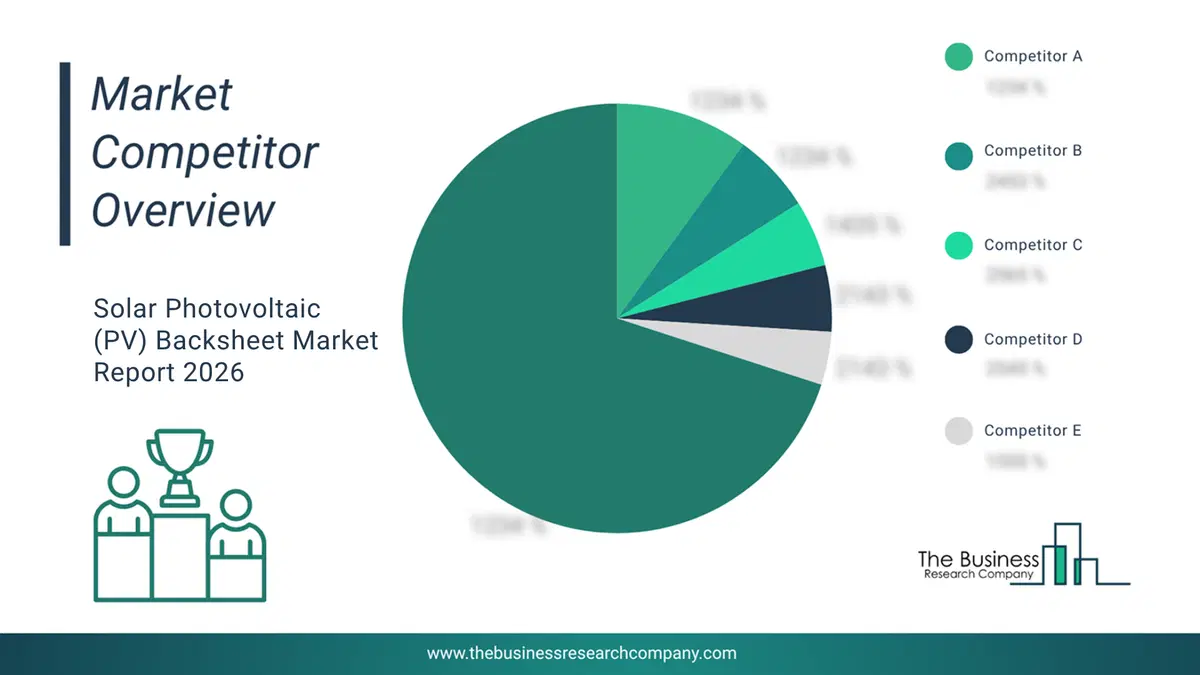
This chart is for illustrative purposes; the full report includes a detailed competitor analysis and comprehensive overview of the top 10 companies in the market.
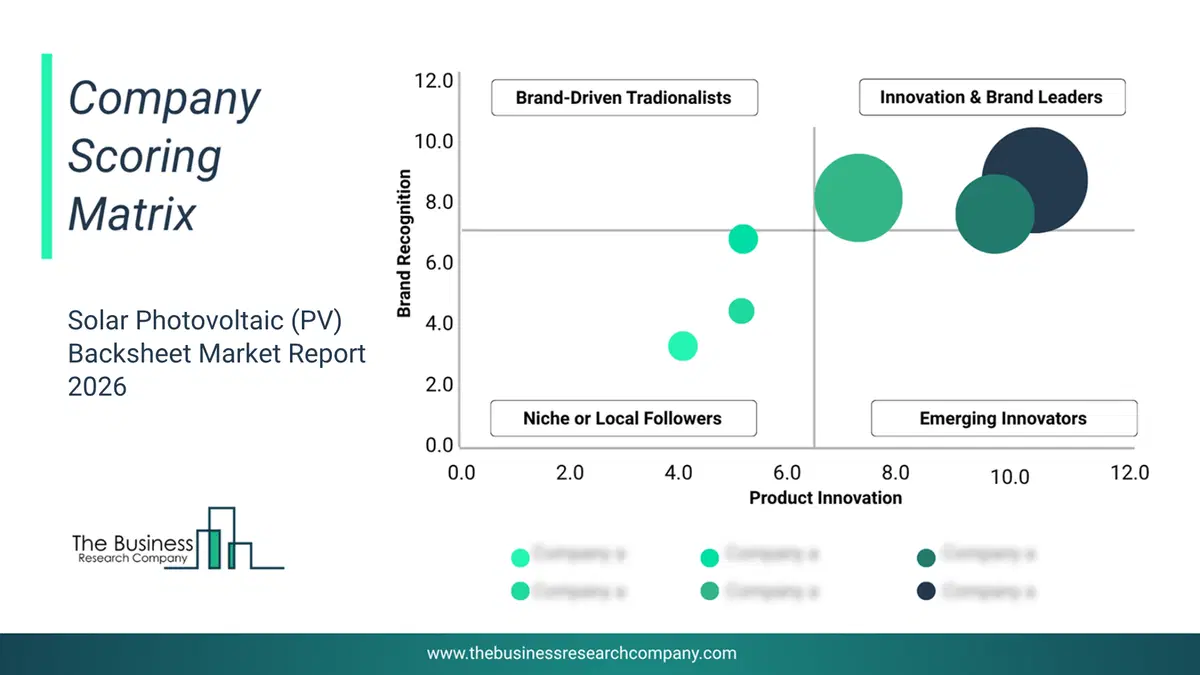
This chart maps companies by product innovation and brand strength, with bubble size indicating relative revenue, helping identify market leaders, challengers, and niche players. This is an illustrative chart; the full report provides a complete and accurate competitive analysis.
Global Solar Photovoltaic (PV) Backsheet Market Trends and Insights
Major companies operating in the solar photovoltaic (PV) backsheet market are focusing on developing advanced products, such as conductive backsheet, to enhance module efficiency and performance. Conductive backsheets refer to specialized photovoltaic backsheets that incorporate conductive materials to enhance electrical performance and improve module efficiency in solar panels. For instance, in February 2023, Silfab Solar Inc., a Canada-based photovoltaic module manufacturer, introduced the next generation of the Silfab ELITE series, a premium line of solar panels exclusively manufactured in the United States featuring its proprietary X-pattern technology with an innovative conductive backsheet. This design enhances power generation by producing 410 watts with a 21.4% efficiency rating. With its all-black, sleek look, ELITE enhances the aesthetics of the module.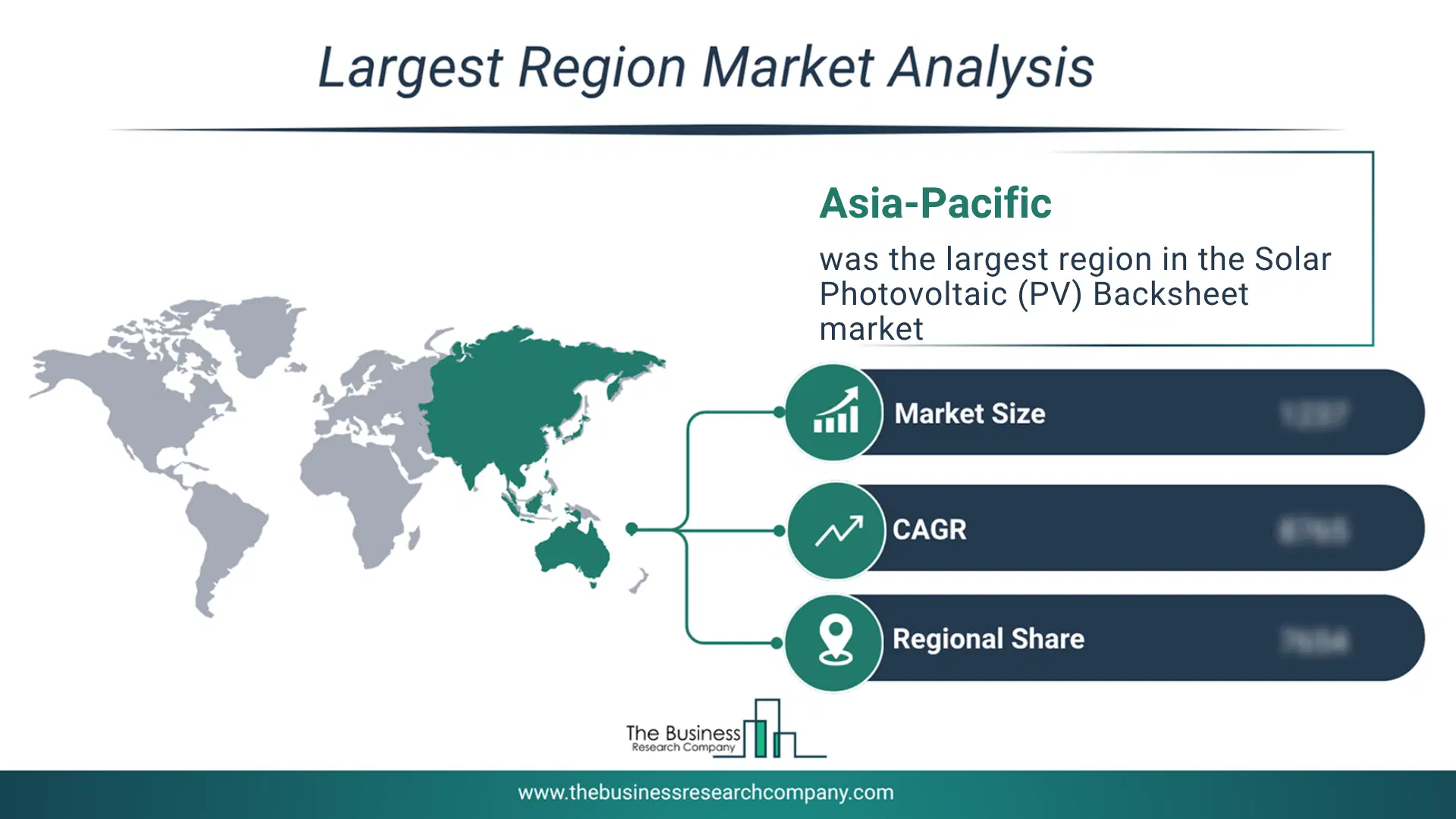
Regional Outlook
Asia-Pacific was the largest region in the solar photovoltaic (PV) backsheet market in 2025. North America is expected to be the fastest-growing region in the forecast period. The regions covered in this market report are Asia-Pacific, South East Asia, Western Europe, Eastern Europe, North America, South America, Middle East, Africa. The countries covered in this market report are Australia, Brazil, China, France, Germany, India, Indonesia, Japan, Taiwan, Russia, South Korea, UK, USA, Canada, Italy, SpainWhat Defines the Solar Photovoltaic (PV) Backsheet Market?
The solar photovoltaic (PV) backsheet market consists of sales of polyamide backsheets, polyolefin backsheets, co-extruded backsheets, polycarbonate backsheets, and thermoplastic backsheets. Values in this market are ‘factory gate’ values, that is the value of goods sold by the manufacturers or creators of the goods, whether to other entities (including downstream manufacturers, wholesalers, distributors and retailers) or directly to end customers. The value of goods in this market includes related services sold by the creators of the goods.How is Market Value Defined and Measured?
The market value is defined as the revenues that enterprises gain from the sale of goods and/or services within the specified market and geography through sales, grants, or donations in terms of the currency (in USD unless otherwise specified). The revenues for a specified geography are consumption values that are revenues generated by organizations in the specified geography within the market, irrespective of where they are produced. It does not include revenues from resales along the supply chain, either further along the supply chain or as part of other products.
This chart presents market attractiveness based on a quantitative evaluation of growth, competition, strategic alignment, and risk, offering a clear view of opportunity areas for decision-making. This chart is for illustrative purposes; the full report contains the complete analysis.

This chart highlights the Total Addressable Market (TAM) by estimating the maximum revenue opportunity using an assumption-driven approach, supporting strategic planning and opportunity sizing across markets. The chart is illustrative; the full report provides a more comprehensive analysis.
What Key Data and Analysis Are Included in the Solar Photovoltaic (PV) Backsheet Market Report 2026?
The solar photovoltaic (pv) backsheet market research report is one of a series of new reports from The Business Research Company that provides market statistics, including Market Report 2026?global market size, regional shares, competitors with the market share, detailed market segments, market trends and opportunities, and any further data you may need to thrive in the solar photovoltaic (pv) backsheet Market Report 2026? The market research report delivers a complete perspective of everything you need, with an in-depth analysis of the current and future state of the Market Report 2026?Solar Photovoltaic (PV) Backsheet Market Report Forecast Analysis
| Report Attribute | Details |
|---|---|
| Market Size Value In 2026 | $4.62 billion |
| Revenue Forecast In 2030 | $6.28 billion |
| Growth Rate | CAGR of 8.1% from 2026 to 2030 |
| Base Year For Estimation | 2025 |
| Actual Estimates/Historical Data | 2020-2025 |
| Forecast Period | 2026 - 2030 - 2030 |
| Market Representation | Revenue in USD Billion and CAGR from 2026 to 2030 |
| Segments Covered | Product, Material Type, Technology, Installation, End-User |
| Regional Scope | Asia-Pacific, Western Europe, Eastern Europe, North America, South America, Middle East, Africa |
| Country Scope | The countries covered in the report are Australia, Brazil, China, France, Germany, India, Indonesia, Japan, Taiwan, Russia, South Korea, UK, USA, Canada, Italy, Spain. |
| Key Companies Profiled | Dow Inc., 3M Company, DuPont de Nemours Inc., Arkema SA, RenewSys India Pvt. Ltd., Dunmore Corp., Krempel GmbH, TEKRA LLC, Coveme S.P.A., Endurans Inc., Toyo Aluminium K.K., Neoflex Industries, Jolywood (Taizhou) Co. Ltd., Hanwha Q CELLS Materials, Wacker Chemie AG, Solvay SA, Toray Industries Inc., Mitsubishi Chemical Corporation, SKC Solmate, Celanese Corporation, Shenzhen Sun Materials Technology Co. Ltd., GSE Advanced Materials |
| Customization Scope | Request for Customization |
| Pricing And Purchase Options | Explore Purchase Options |