
Solar Shading Systems Market Report 2026
Global Outlook – By Product Type ( Blinds, Shades, Louvers, Textiles ), By Material ( Metal, Glass, Wood, Other Materials), By Technology ( Battery Powered, Manual, Smart Power Source), By Mechanism ( Fixed, Manual, Motorized), By Application ( Residential, Commercial, Industrial) – Market Size, Trends, Strategies, and Forecast to 2030
Solar Shading Systems Market Overview
• Solar Shading Systems market size has reached to $15.79 billion in 2025 • Expected to grow to $19.28 billion in 2030 at a compound annual growth rate (CAGR) of 4.1% • Growth Driver: Rapid Urbanization Driving Demand In The Solar Shading Market • Market Trend: Technological Advancements in Solar Shading Systems: TNO’s Rollable Shade Screen with Integrated Solar Foil • North America was the largest region in 2025.What Is Covered Under Solar Shading Systems Market?
The solar shading system is a method used to mitigate solar radiation in the form of heat and light in a building. Solar shading systems offer strong architectural features and solutions for intensive solar radiation and enable shading. The main types of products in solar shading systems are blinds, shades, louvers, and textiles. The blinds help protect flooring, furniture, and interior decor from fading and can reduce the room temperature. The material involved are metal, glass, wood, and others that are backed with technologies such as battery-powered, manual, and smart power source and uses fixed, manual, and motorized mechanism for residential, commercial, and industrial applications.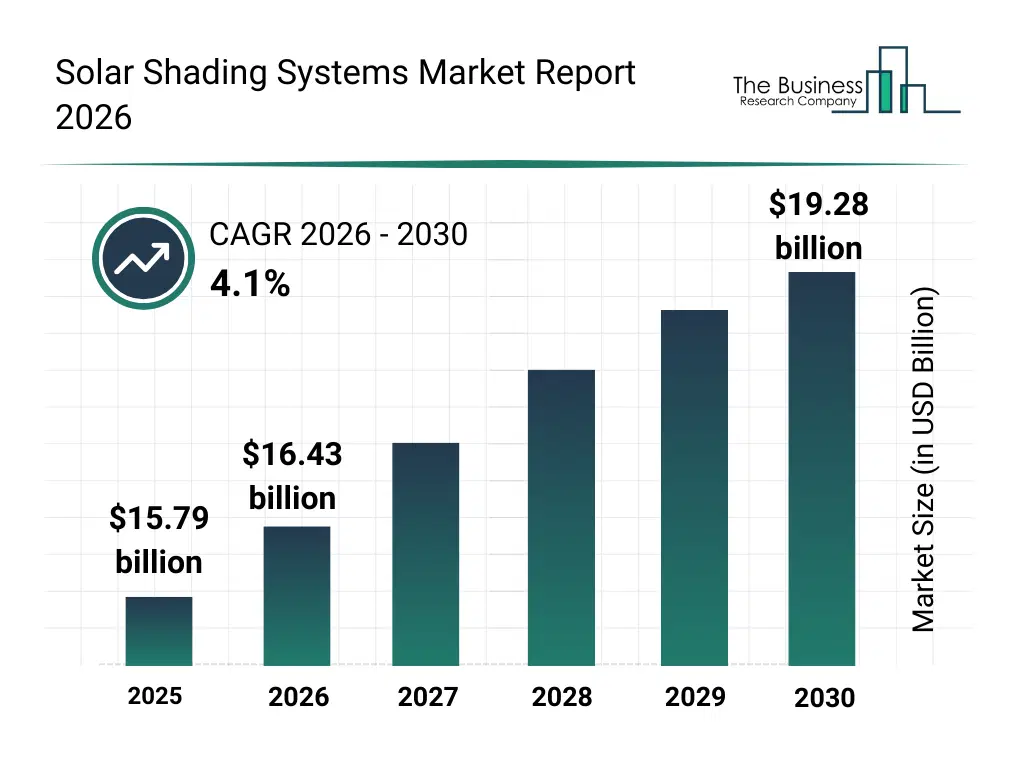
What Is The Solar Shading Systems Market Size 2026 And Growth Rate?
The solar shading systems market size has grown steadily in recent years. It will grow from $15.79 billion in 2025 to $16.43 billion in 2026 at a compound annual growth rate (CAGR) of 4.0%. The growth in the historic period can be attributed to growth in traditional shading installations, expansion of commercial building construction, reliance on manual shading mechanisms, early use of architectural louvers, development of textile-based shading materials.What Is The Solar Shading Systems Market Growth Forecast?
The solar shading systems market size is expected to see steady growth in the next few years. It will grow to $19.28 billion in 2030 at a compound annual growth rate (CAGR) of 4.1%. The growth in the forecast period can be attributed to increasing adoption of automated shading systems, rising demand for sustainable building solutions, expansion of smart home and commercial automation, development of high-performance shading materials, increasing focus on indoor energy efficiency. Major trends in the forecast period include adoption of energy-efficient solar shading solutions, integration of IoT-connected automated shading systems, expansion of smart building optimization platforms, development of advanced digital shading controls, enhancement of AI-based thermal and lighting regulation systems.
Global Solar Shading Systems Market Segmentation
1) By Product Type: Blinds, Shades, Louvers, Textiles 2) By Material: Metal, Glass, Wood, Other Materials 3) By Technology: Battery Powered, Manual, Smart Power Source 4) By Mechanism: Fixed, Manual, Motorized 5) By Application: Residential, Commercial, Industrial Subsegments: 1) By Blinds: Horizontal Blinds, Vertical Blinds, Cellular Or Honeycomb Blinds 2) By Shades: Roller Shades, Roman Shades, Pleated Shades 3) By Louvers: Fixed Louvers, Adjustable Louvers, Operable Louvers 4) By Textiles: Sheer Fabrics, Blackout Fabrics, Technical TextilesWhat Is The Driver Of The Solar Shading Systems Market?
Rapid urbanization is expected to propel the growth of the solar shading market. Urbanization refers to the process of increasing population concentration in urban areas, specifically cities and towns. Urban areas often experience higher building density, with taller and more closely spaced structures. This can lead to increased solar exposure and heat gain in buildings, making solar shading systems essential to control sunlight and maintain comfortable indoor temperatures. For instance, in April 2023, according to the World Bank, a US-based international financial institution, around 4.4 billion people, or 56% of the world's population, presently reside in cities. By 2050, approximately 7 out of 10 people will live in cities, with the urban population predicted to more than double from its current level. By 2030, the world is predicted to have 1.2 million km² more of urban built-up area because urban land consumption is expected to continue to expand at a rate that is up to 50% faster than population growth. The rapid growth in urbanization is expected to generate high demand for the solar shading market.Key Players In The Global Solar Shading Systems Market
Major companies operating in the solar shading systems market are Hunter Douglas, Lutron Electronics, QMotion, Insolroll, Mecho, Draper Inc., Levolor, Gable Screens, Solar Screen, Phifer, Rollac Shutters, ODL, The Shade Store, IKEA, Sunesta, Coolaroo, Sun Control Products, Zebra Blinds, Blinds.com, Graber, Soltis, Eclipse Shading Systems, A. H. Harris, TerraShade, SolarGuard, Aluvision, Awnings by Munch, Screen Innovations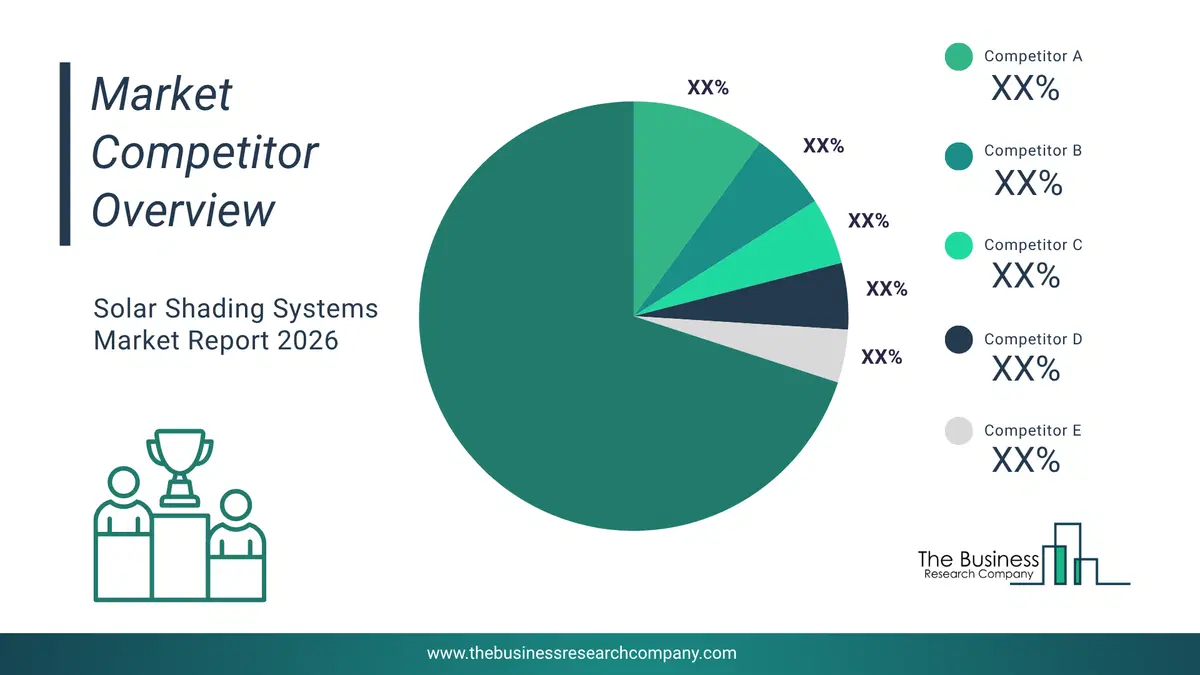
This chart is for illustrative purposes; the full report includes a detailed competitor analysis and comprehensive overview of the top 10 companies in the market.
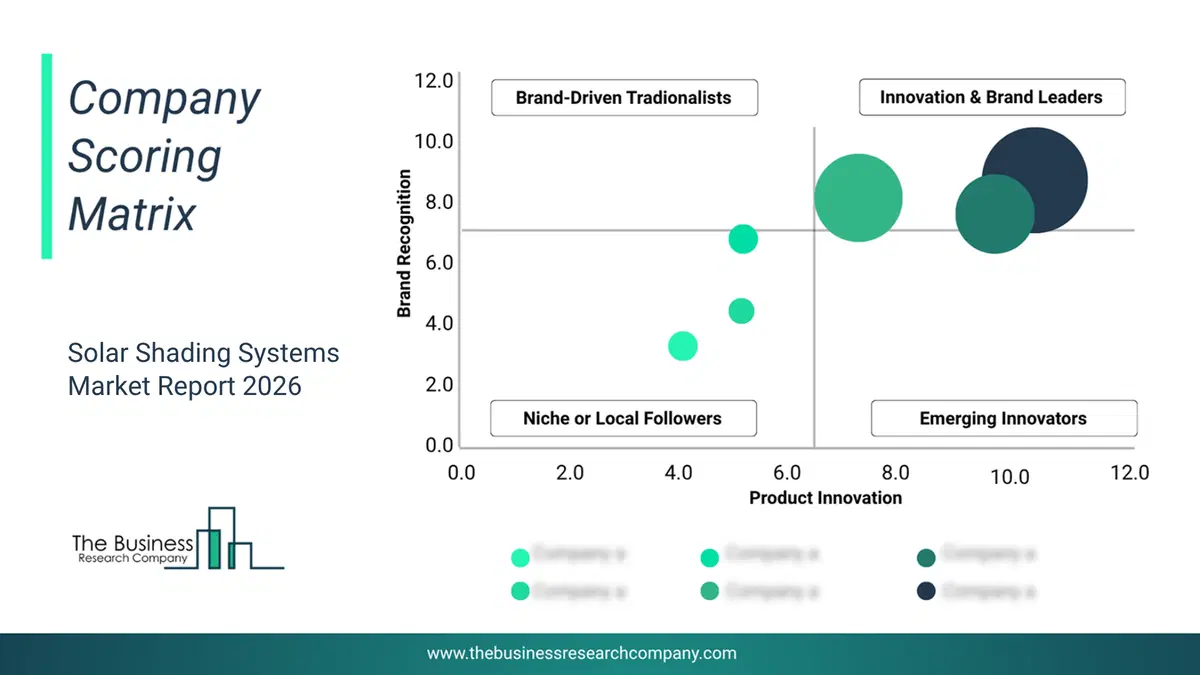
This chart maps companies by product innovation and brand strength, with bubble size indicating relative revenue, helping identify market leaders, challengers, and niche players. This is an illustrative chart; the full report provides a complete and accurate competitive analysis.
Global Solar Shading Systems Market Trends and Insights
Major companies operating in the field of solar shading systems are focusing on technological advancements such as radiant heat barrier technology to sustain their market position. Radiant heat barrier technology refers to methods and materials designed to reduce the transfer of radiant heat. For instance, in March 2025, the TNO, Netherlands‑based research institute introduced a rollable shade screen with integrated solar foil. The system features adjustable shading from 0 % to 100 %, flexible solar‑foil panels embedded in the screen enabling energy generation, and ventilated design that allows air circulation while reducing solar heat gain.What Are Latest Mergers And Acquisitions In The Solar Shading Systems Market?
In January 2025, MHT Technologies, a US‑based provider of Power‑over‑Ethernet smart‑building sensors and lighting systems, partnered with Somfyfor the introduction of the Inspextor Pro Shade Automation + Sonesse 40 PoE motor system. With this partnership, MHT Technologies aimed to enhance its building‑automation technology portfolio by integrating artificial‑intelligence‑driven shade control capabilities into motorised solar‑shading systems. Somfy is a France‑based manufacturer specializing in motors and control systems for window coverings and solar‑protection products.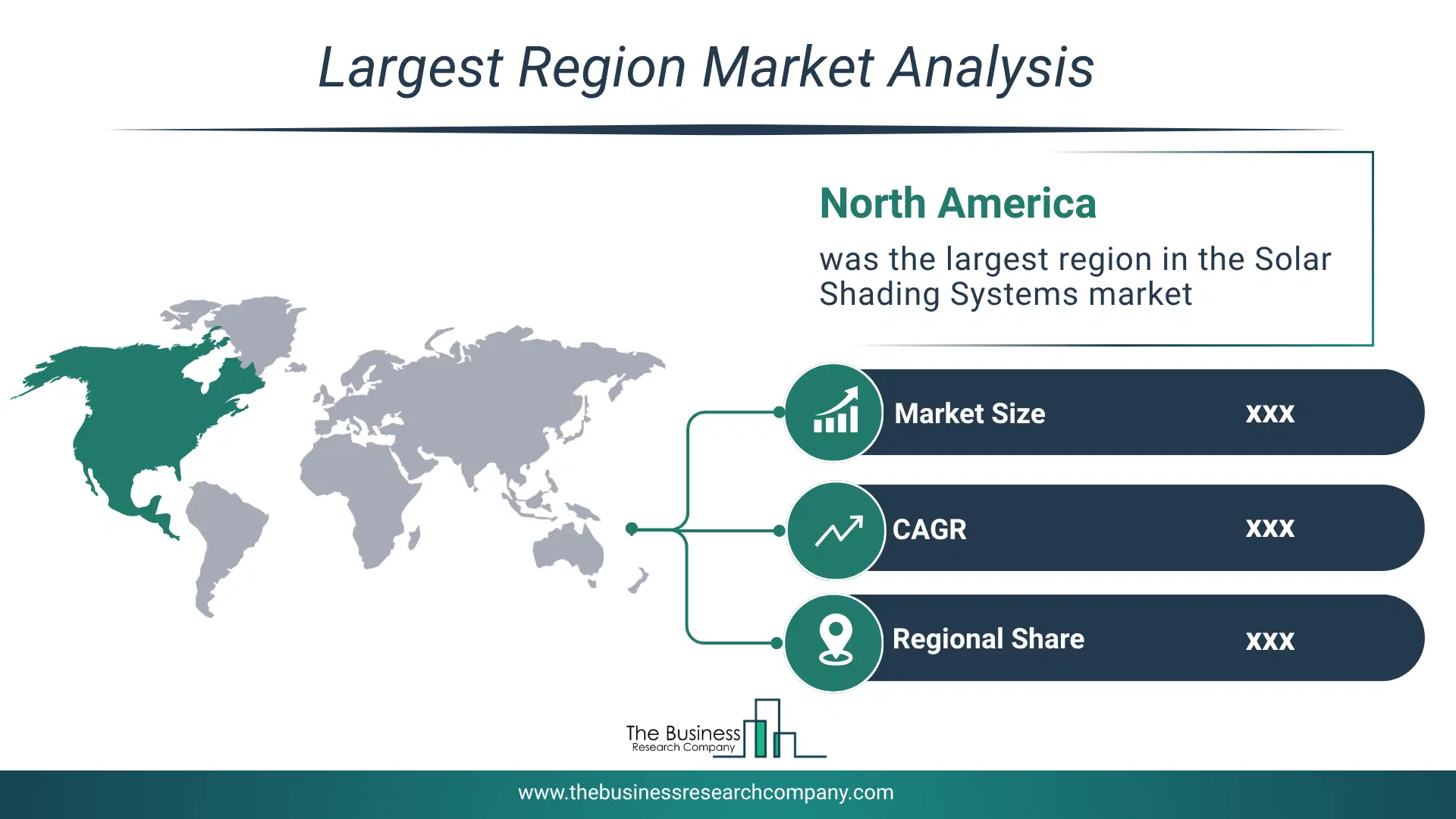
Regional Outlook
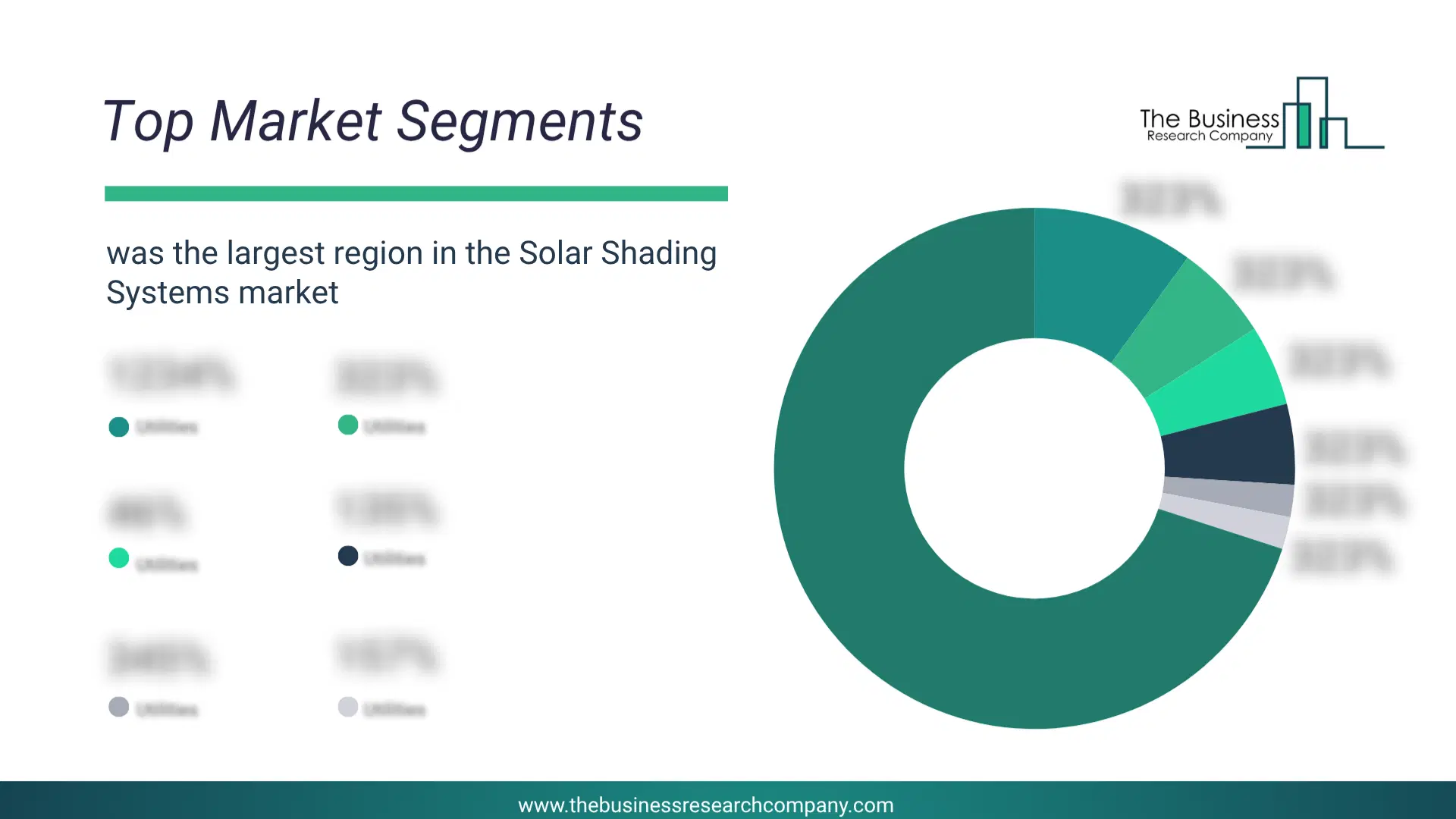
North America was the largest region in the solar shading systems market share in 2025. The regions covered in this market report are Asia-Pacific, South East Asia, Western Europe, Eastern Europe, North America, South America, Middle East, Africa. The countries covered in this market report are Australia, Brazil, China, France, Germany, India, Indonesia, Japan, Taiwan, Russia, South Korea, UK, USA, Canada, Italy, Spain.What Defines the Solar Shading Systems Market?
The solar shading system market consists of sales of solar shading systems that are used to limit solar radiation in buildings. Values in this market are ‘factory gate’ values, that is the value of goods sold by the manufacturers or creators of the goods, whether to other entities (including downstream manufacturers, wholesalers, distributors and retailers) or directly to end customers. The value of goods in this market includes related services sold by the creators of the goods.How is Market Value Defined and Measured?
The market value is defined as the revenues that enterprises gain from the sale of goods and/or services within the specified market and geography through sales, grants, or donations in terms of the currency (in USD unless otherwise specified). The revenues for a specified geography are consumption values that are revenues generated by organizations in the specified geography within the market, irrespective of where they are produced. It does not include revenues from resales along the supply chain, either further along the supply chain or as part of other products.
This chart presents market attractiveness based on a quantitative evaluation of growth, competition, strategic alignment, and risk, offering a clear view of opportunity areas for decision-making. This chart is for illustrative purposes; the full report contains the complete analysis.

This chart highlights the Total Addressable Market (TAM) by estimating the maximum revenue opportunity using an assumption-driven approach, supporting strategic planning and opportunity sizing across markets. The chart is illustrative; the full report provides a more comprehensive analysis.
What Key Data and Analysis Are Included in the Solar Shading Systems Market Report 2026?
The solar shading systems market research report is one of a series of new reports from The Business Research Company that provides market statistics, including industry global market size, regional shares, competitors with the market share, detailed market segments, market trends and opportunities, and any further data you may need to thrive in the solar shading systems industry. The market research report delivers a complete perspective of everything you need, with an in-depth analysis of the current and future state of the industry.Solar Shading Systems Market Report Forecast Analysis
| Report Attribute | Details |
|---|---|
| Market Size Value In 2026 | $16.43 billion |
| Revenue Forecast In 2030 | $19.28 billion |
| Growth Rate | CAGR of 4.1% from 2026 to 2030 |
| Base Year For Estimation | 2025 |
| Actual Estimates/Historical Data | 2020-2025 |
| Forecast Period | 2026 - 2030 |
| Market Representation | Revenue in USD Billion and CAGR from 2026 to 2030 |
| Segments Covered | Product Type, Material, Technology, Mechanism, Application |
| Regional Scope | Asia-Pacific, Western Europe, Eastern Europe, North America, South America, Middle East, Africa |
| Country Scope | The countries covered in the report are Australia, Brazil, China, France, Germany, India, Indonesia, Japan, Taiwan, Russia, South Korea, UK, USA, Canada, Italy, Spain. |
| Key Companies Profiled | Hunter Douglas, Lutron Electronics, QMotion, Insolroll, Mecho, Draper Inc., Levolor, Gable Screens, Solar Screen, Phifer, Rollac Shutters, ODL, The Shade Store, IKEA, Sunesta, Coolaroo, Sun Control Products, Zebra Blinds, Blinds.com, Graber, Soltis, Eclipse Shading Systems, A. H. Harris, TerraShade, SolarGuard, Aluvision, Awnings by Munch, Screen Innovations |
| Customization Scope | Request for Customization |
| Pricing And Purchase Options | Explore Purchase Options |