
Solar Vehicle Market Report 2026
Global Outlook – By Type (Battery Electric Vehicle (BEV), Hybrid Electric Vehicle (HEV)), By Battery Type (Lithium Ion, Lead Acid, Other Battery Types), By Solar Panel Type (Mono-Crystalline, Poly-Crystalline), By Application (Passenger Car, Commercial Vehicle ) – Market Size, Trends, Strategies, and Forecast to 2030
Solar Vehicle Market Overview
• Solar Vehicle market size has reached to $0.44 billion in 2025 • Expected to grow to $1.08 billion in 2030 at a compound annual growth rate (CAGR) of 19.4% • Growth Driver: Impact of Electric Vehicle Demand on the Solar Vehicle Market • Market Trend: Integrated Solar Technology Redefines The Future Of Zero-Emission Transportation • North America was the largest region in 2025 and Asia-Pacific is the fastest growing region.What Is Covered Under Solar Vehicle Market?
A solar vehicle is an electric vehicle (EV) powered primarily or entirely by solar energy from solar panels mounted on the vehicle's surface. These vehicles use photovoltaic (PV) cells to convert sunlight directly into electricity, which is then stored in batteries or used to power the vehicle's motors. The main types of solar vehicles are battery electric vehicles (BEV), and hybrid electric vehicles (HEV). A battery electric vehicle (BEV) is a type of electric vehicle that runs entirely on electricity stored in rechargeable batteries. These vehicles do not have an internal combustion engine and produce zero tailpipe emissions, making them environmentally friendly. The various battery types include lithium ion, lead acid, and others. The various solar panel types include mono-crystalline and poly-crystalline used for various applications such as passenger cars and commercial vehicles.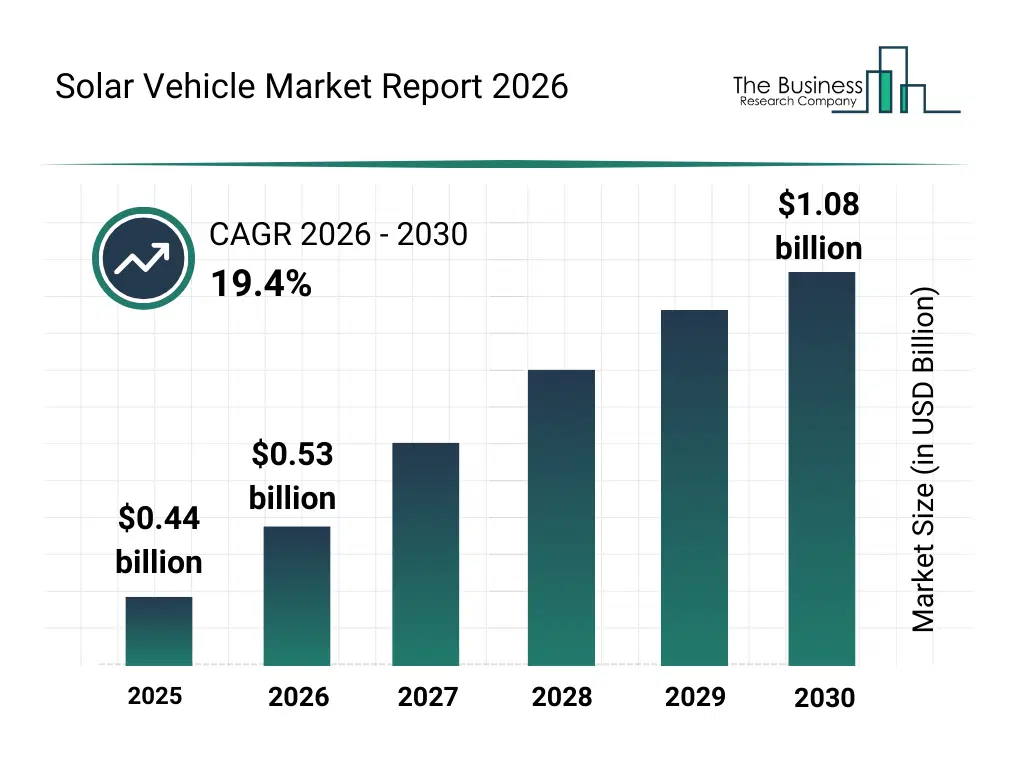
What Is The Solar Vehicle Market Size and Share 2026?
The solar vehicle market size has grown exponentially in recent years. It will grow from $0.44 billion in 2025 to $0.53 billion in 2026 at a compound annual growth rate (CAGR) of 21.5%. The growth in the historic period can be attributed to advancements in electric vehicle technology, increasing environmental awareness, growth of solar energy adoption, rising demand for fuel-efficient vehicles, pilot deployment of solar vehicle models.What Is The Solar Vehicle Market Growth Forecast?
The solar vehicle market size is expected to see rapid growth in the next few years. It will grow to $1.08 billion in 2030 at a compound annual growth rate (CAGR) of 19.4%. The growth in the forecast period can be attributed to increasing efficiency of photovoltaic cells, expansion of charging infrastructure integration, rising investments in solar mobility startups, growing adoption in commercial transportation, increasing regulatory support for zero-emission vehicles. Major trends in the forecast period include increasing adoption of solar-integrated electric vehicles, rising demand for extended driving range solutions, growing use of advanced pv materials, expansion of solar vehicles in commercial fleets, enhanced focus on energy self-sufficiency.
Global Solar Vehicle Market Segmentation
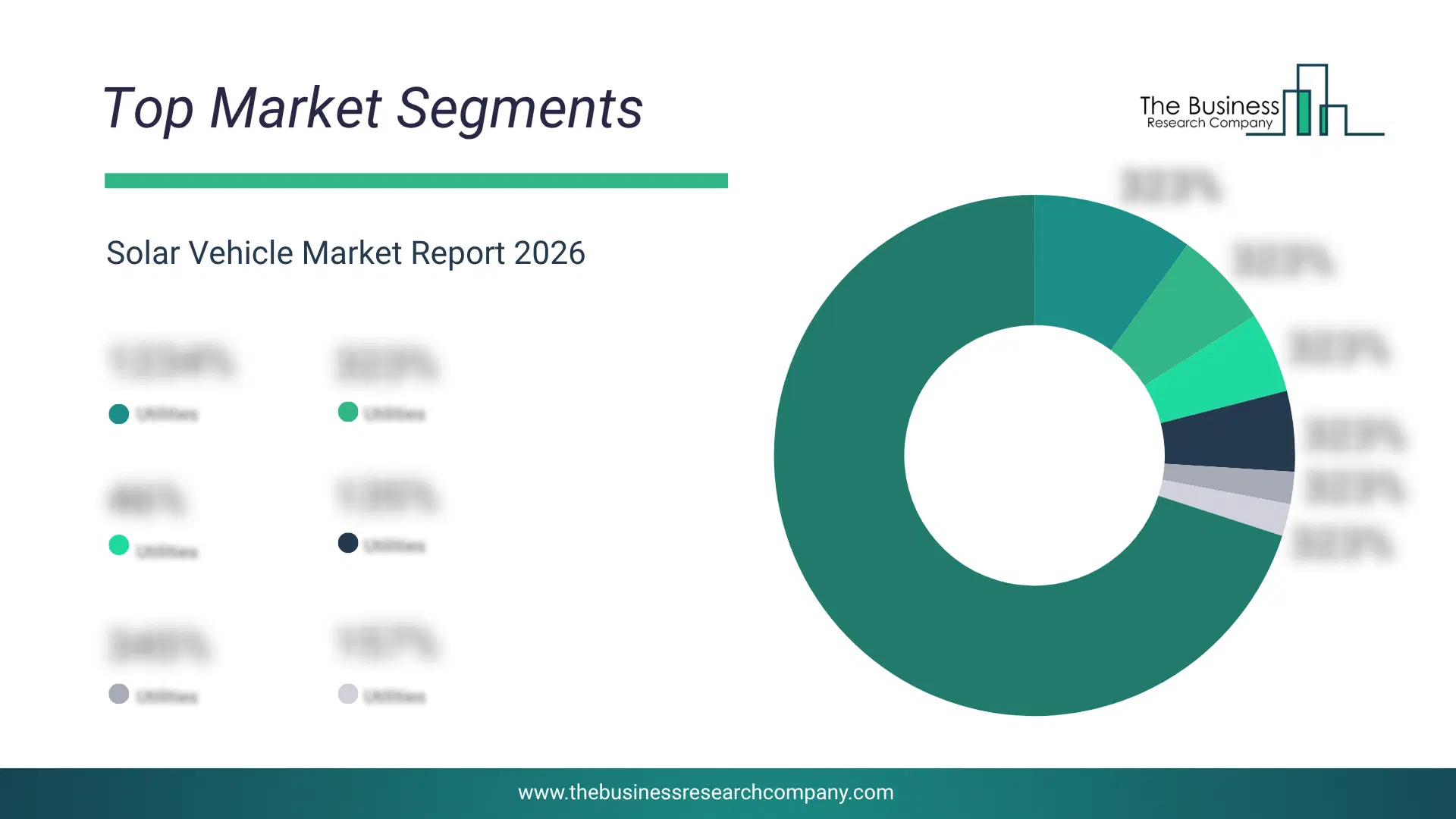
1) By Type: Battery Electric Vehicle (BEV), Hybrid Electric Vehicle (HEV) 2) By Battery Type: Lithium Ion, Lead Acid, Other Battery Types 3) By Solar Panel Type: Mono-Crystalline, Poly-Crystalline 4) By Application: Passenger Car, Commercial Vehicle Subsegments: 1) By Battery Electric Vehicle (BEV): Passenger BEVs, Commercial BEVs, Two-Wheelers (BEV) 2) By Hybrid Electric Vehicle (HEV): Plug-in Hybrid Electric Vehicles (PHEV), Non-plug-in Hybrid Electric Vehicles (HEV), Mild Hybrid Electric Vehicles (MHEV)What Is The Driver Of The Solar Vehicle Market?
The growing demand for electric vehicles is expected to propel the growth of the solar vehicle market going forward. Electric vehicles (EVs) are vehicles that are powered by one or more electric motors, using electrical energy stored in rechargeable batteries or other energy storage devices. The demand for electric vehicles is due to environmental benefits, cost savings, technological advancements, energy security considerations, regulatory support, and evolving consumer preferences. Solar technology in electric vehicles currently serves as a supplemental energy source, and ongoing advancements in solar efficiency and vehicle integration may expand its role in future automotive applications, potentially offering greater energy autonomy and reducing dependency on traditional charging infrastructure. For instance, in April 2024, according to the International Energy Agency, a France-based intergovernmental organization, sales of electric vehicles increased by 3.5 million in 2023 compared to 2022, a 35% annual rise. Therefore, the growing demand for electric vehicles is driving the growth of the solar vehicle industry.Key Players In The Global Solar Vehicle Market
Major companies operating in the solar vehicle market report include Sono Motors GmbH, Aptera Motors Corp., Lightyear, Hanergy Holding Group, Sunswift Solar Racing Team, Venturi Automobiles, Cruise Car Inc., Squad Mobility B.V., Solar Electric Vehicle Company, Daymak Inc., Nimbus Vehicles, ElectraMeccanica, Astrolab, EdisonFuture, Mahindra and Mahindra Ltd., Toyota Motor Corporation, Hyundai Motor Company, Fisker Inc., Bollore Group, Solaris Bus and Coach SA, Suzhou Eagle Electric Vehicle Manufacturing Co. Ltd., Karma Automotive LLC, GreenPower Motor Company, Solar Team Eindhoven, EVX Ventures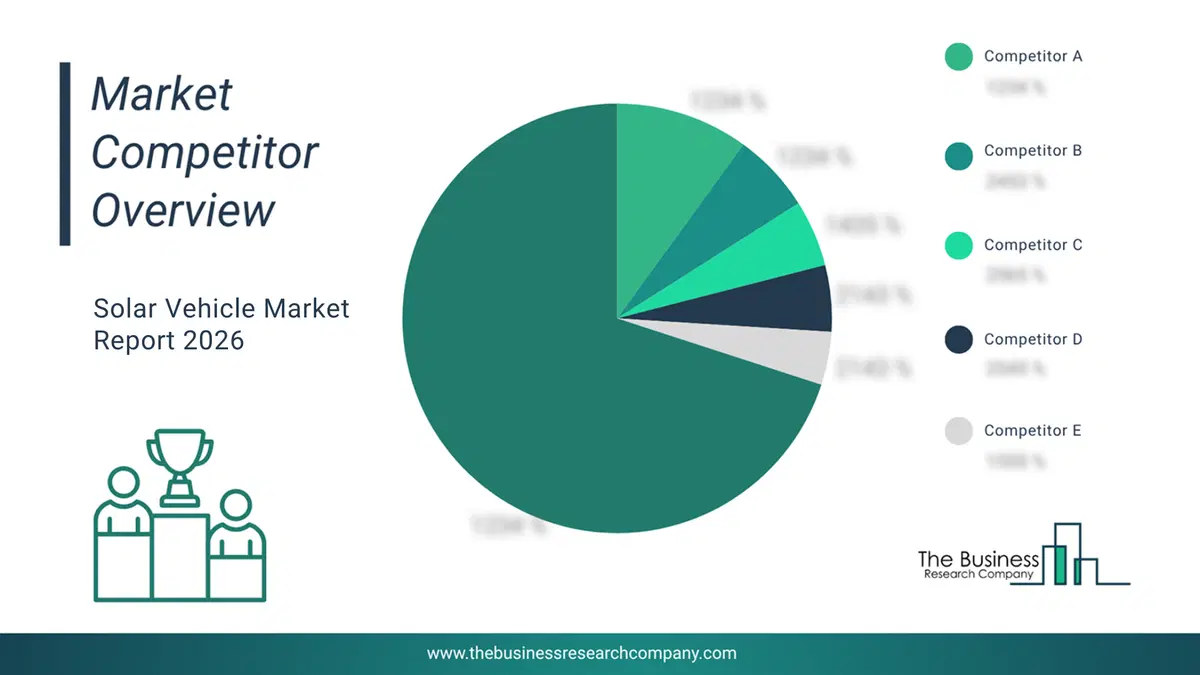
This chart is for illustrative purposes; the full report includes a detailed competitor analysis and comprehensive overview of the top 10 companies in the market.
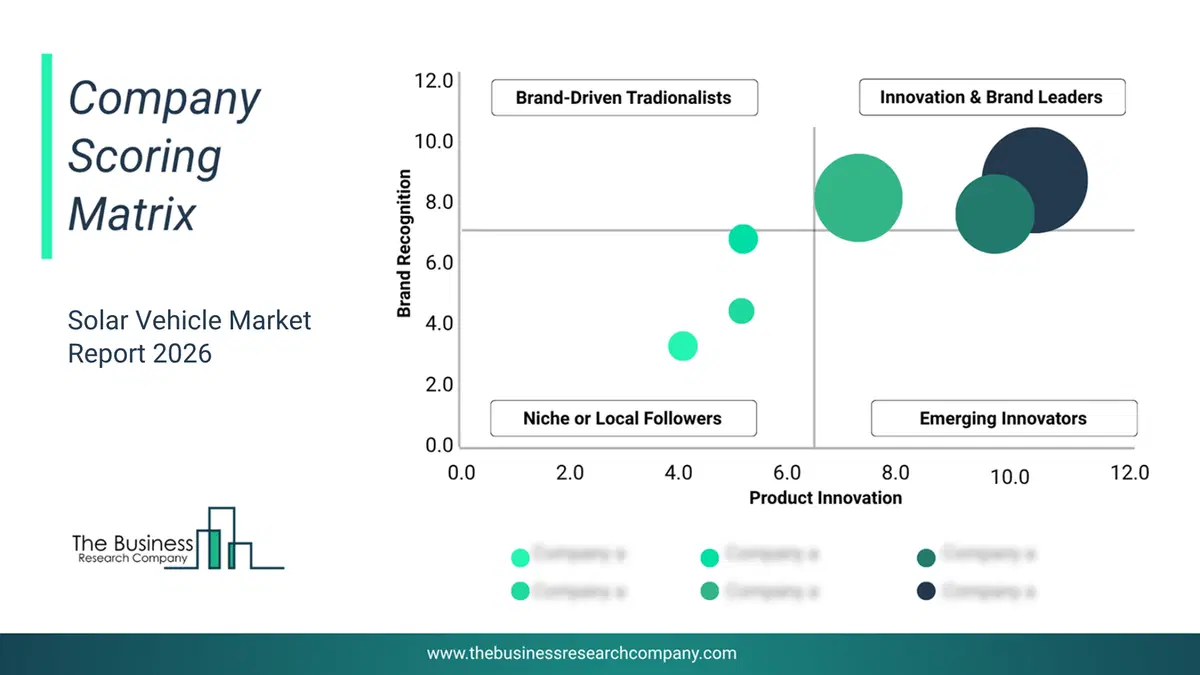
This chart maps companies by product innovation and brand strength, with bubble size indicating relative revenue, helping identify market leaders, challengers, and niche players. This is an illustrative chart; the full report provides a complete and accurate competitive analysis.
Global Solar Vehicle Market Trends and Insights
Major companies operating in the solar vehicle market are focusing on developing innovative solutions, such as complete vehicle-integrated solar arrays, to enable continuous on-board energy generation, extend daily driving range without external charging, and accelerate the shift toward truly self-powered, zero-emission mobility. Complete vehicle-integrated solar arrays help solar vehicles by continuously generating electricity directly on the vehicle surface, reducing dependence on external charging and extending the driving range using clean, renewable solar energy. For instance, in January 2025, Aptera Motors, a US-based automotive company, launched its production-ready solar electric vehicle (SEV) at CES 2025, marking its transition from prototype to validation-ready vehicle. The sEV features a fully integrated four-panel solar array mounted on the hood, dash, roof, and hatch, enabling up to 40 miles of free solar-powered driving per day and a total range of up to 400 miles per charge. Built using a carbon-fiber sheet molding compound (CF-SMC) body, the vehicle is ultra-lightweight and highly energy efficient. Designed to minimize dependence on grid charging.What Are Latest Mergers And Acquisitions In The Solar Vehicle Market?
In March 2024, Nissan Motor Corporation, a Japan-based automobile manufacturer, acquired Nissan shares from Renault Group for €358 million ($383.58 million). This move allows Nissan to integrate operations further, streamline decision-making processes, and potentially enhance synergies in technology development, manufacturing efficiencies, and global market strategies. Renault Group is a France-based automobile manufacturer that manufactures solar vehicles.
Regional Outlook
North America was the largest region in the solar vehicle market in 2025. Asia-Pacific is expected to be the fastest-growing region in the forecast period. The regions covered in this market report include Asia-Pacific, South East Asia, Western Europe, Eastern Europe, North America, South America, Middle East, Africa. The countries covered in this market report include Australia, Brazil, China, France, Germany, India, Indonesia, Japan, Taiwan, Russia, South Korea, UK, USA, Canada, Italy, SpainWhat Defines the Solar Vehicle Market?
The solar vehicle market consists of sales of solar electric buses, solar-powered boats, solar-powered UAVs, solar-powered scooters, and solar-powered charging stations. Values in this market are ‘factory gate’ values, that is the value of goods sold by the manufacturers or creators of the goods, whether to other entities (including downstream manufacturers, wholesalers, distributors and retailers) or directly to end customers. The value of goods in this market includes related services sold by the creators of the goods.How is Market Value Defined and Measured?
The market value is defined as the revenues that enterprises gain from the sale of goods and/or services within the specified market and geography through sales, grants, or donations in terms of the currency (in USD unless otherwise specified). The revenues for a specified geography are consumption values that are revenues generated by organizations in the specified geography within the market, irrespective of where they are produced. It does not include revenues from resales along the supply chain, either further along the supply chain or as part of other products.
This chart presents market attractiveness based on a quantitative evaluation of growth, competition, strategic alignment, and risk, offering a clear view of opportunity areas for decision-making. This chart is for illustrative purposes; the full report contains the complete analysis.

This chart highlights the Total Addressable Market (TAM) by estimating the maximum revenue opportunity using an assumption-driven approach, supporting strategic planning and opportunity sizing across markets. The chart is illustrative; the full report provides a more comprehensive analysis.
What Key Data and Analysis Are Included in the Solar Vehicle Market Report 2026?
The solar vehicle market research report is one of a series of new reports from The Business Research Company that provides market statistics, including industry global market size, regional shares, competitors with the market share, detailed market segments, market trends and opportunities, and any further data you may need to thrive in the solar vehicle industry. The market research report delivers a complete perspective of everything you need, with an in-depth analysis of the current and future state of the industry.Solar Vehicle Market Report Forecast Analysis
| Report Attribute | Details |
|---|---|
| Market Size Value In 2026 | $0.53 billion |
| Revenue Forecast In 2030 | $1.08 billion |
| Growth Rate | CAGR of 21.5% from 2026 to 2030 |
| Base Year For Estimation | 2025 |
| Actual Estimates/Historical Data | 2020-2025 |
| Forecast Period | 2026 - 2030 - 2030 |
| Market Representation | Revenue in USD Billion and CAGR from 2026 to 2030 |
| Segments Covered | Type, Battery Type, Solar Panel Type, Application |
| Regional Scope | Asia-Pacific, Western Europe, Eastern Europe, North America, South America, Middle East, Africa |
| Country Scope | The countries covered in the report are Australia, Brazil, China, France, Germany, India, Indonesia, Japan, Taiwan, Russia, South Korea, UK, USA, Canada, Italy, Spain. |
| Key Companies Profiled | Sono Motors GmbH, Aptera Motors Corp., Lightyear, Hanergy Holding Group, Sunswift Solar Racing Team, Venturi Automobiles, Cruise Car Inc., Squad Mobility B.V., Solar Electric Vehicle Company, Daymak Inc., Nimbus Vehicles, ElectraMeccanica, Astrolab, EdisonFuture, Mahindra and Mahindra Ltd., Toyota Motor Corporation, Hyundai Motor Company, Fisker Inc., Bollore Group, Solaris Bus and Coach SA, Suzhou Eagle Electric Vehicle Manufacturing Co. Ltd., Karma Automotive LLC, GreenPower Motor Company, Solar Team Eindhoven, EVX Ventures |
| Customization Scope | Request for Customization |
| Pricing And Purchase Options | Explore Purchase Options |