
Space Augmented Reality Market Report 2026
Global Outlook – By Component (Hardware, Software, Services), By Deployment Model (On-Premises Deployment, Cloud-Based Deployment, Hybrid Deployment), By Application (Astronaut Training, Satellite Navigation, Space Exploration, Space Tourism, Other Applications), By End-User (Government And Defense Agencies, Aerospace Manufacturers, Research Institutions, Space Tourism Companies) – Market Size, Trends, Strategies, and Forecast to 2030
Space Augmented Reality Market Overview
• Space Augmented Reality market size has reached to $1.4 billion in 2025 • Expected to grow to $3.73 billion in 2030 at a compound annual growth rate (CAGR) of 21.7% • Growth Driver: Surge In Investments In Space Exploration Driving Growth Of The Market Due To Enhanced Visualization, Training, And Collaboration Capabilities • North America was the largest region in 2025 and Asia-Pacific is the fastest growing region.What Is Covered Under Space Augmented Reality Market?
Space augmented reality is the application of augmented reality within spatial settings, where digital elements are seamlessly layered over real-world environments. It emphasizes the enhancement of spatial perception by aligning virtual visuals with physical surroundings in real time. This approach creates a more immersive and interactive experience, as it allows digital content to coexist naturally with the physical space, thereby improving awareness and engagement with the environment. The main components of space augmented reality include hardware, software, and services. Space augmented reality hardware refers to physical devices and equipment designed to enable the integration of digital information with real-world spatial environments for immersive visualization and interaction. It offers various deployment models, including on-premises deployment, cloud-based deployment, and hybrid deployment, and is applied for astronaut training, satellite navigation, space exploration, space tourism, and others. It is used by several end-users, including government and defense agencies, aerospace manufacturers, research institutions, and space tourism companies.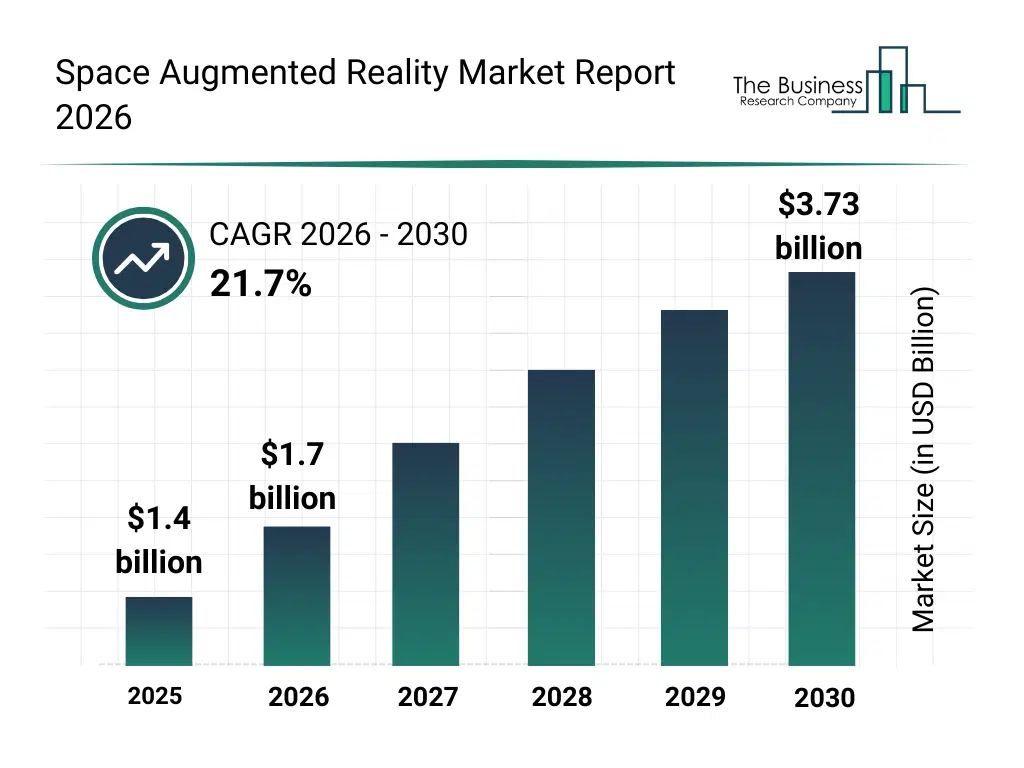
What Is The Space Augmented Reality Market Size and Share 2026?
The space augmented reality market size has grown exponentially in recent years. It will grow from $1.4 billion in 2025 to $1.7 billion in 2026 at a compound annual growth rate (CAGR) of 21.4%. The growth in the historic period can be attributed to initial adoption of spatial mapping technologies, integration of immersive simulation in training programs, deployment of early head-mounted displays for spatial visualization, use of spatial sensors for real-time interaction, development of software for spatial data overlay.What Is The Space Augmented Reality Market Growth Forecast?
The space augmented reality market size is expected to see exponential growth in the next few years. It will grow to $3.73 billion in 2030 at a compound annual growth rate (CAGR) of 21.7%. The growth in the forecast period can be attributed to growth in real-time spatial data integration applications, adoption of advanced motion tracking and smart glasses, expansion of AR in space training and mission simulations, rising demand for interactive spatial experience services, integration with satellite-derived spatial datasets. Major trends in the forecast period include growing adoption of spatially aware ar tools for astronaut and mission training, rising demand for real-time spatial mapping for satellite navigation and exploration, expansion of ar-enabled payload visualization and operational planning, increased integration of ar for remote satellite diagnostics and maintenance, advancement of spatial interaction interfaces for mission control environments.
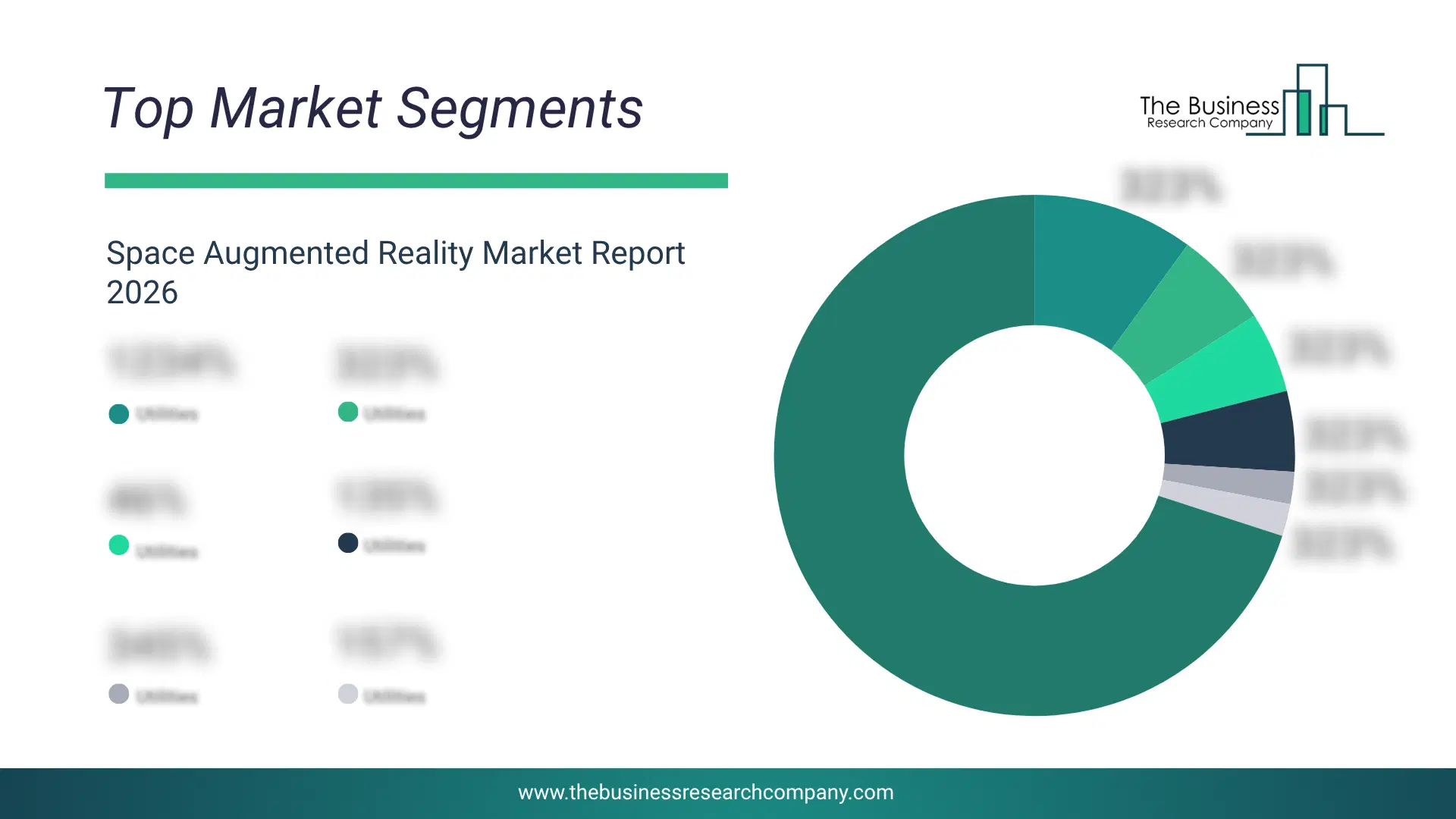
Global Space Augmented Reality Market Segmentation
1) By Component: Hardware, Software, Services 2) By Deployment Model: On-Premises Deployment, Cloud-Based Deployment, Hybrid Deployment 3) By Application: Astronaut Training, Satellite Navigation, Space Exploration, Space Tourism, Other Applications 4) By End-User: Government And Defense Agencies, Aerospace Manufacturers, Research Institutions, Space Tourism Companies Subsegments: 1) By Hardware: Head Mounted Displays, Sensors, Processors, Cameras 2) By Software: Simulation Software, Visualization Software, Tracking Software, Augmentation Software 3) By Services: Training Services, Maintenance Services, Consulting Services, Integration ServicesWhat Is Driver Of The Space Augmented Reality Market?
The growing number of satellite launches is expected to propel the growth of the space augmented reality market going forward. A satellite is a man-made or natural body that travels in a consistent path around a planet or celestial object. Satellite launches are rising due to the growing demand for global internet coverage, as companies and governments are increasingly deploying satellites to provide high-speed connectivity in remote and underserved regions. Satellite launches create demand for space augmented reality as they rely on advanced visualization and monitoring tools to ensure accurate deployment, tracking, and operational efficiency. For instance, in January 2025, according to the Space Foundation, a US-based non-profit organization, a total of 259 launches took place in 2024, averaging one launch every 34 hours, occurring five hours sooner on average than in 2023. Therefore, the growing number of satellite launches is driving the growth of the space augmented reality industry.Key Players In The Global Space Augmented Reality Market
Major companies operating in the space augmented reality market are Google LLC, Microsoft Corporation, Siemens AG, The Boeing Co., Airbus Defence and Space GmbH, Raytheon Technologies Corporation, Lockheed Martin Corporation, Northrop Grumman Corporation, National Aeronautics and Space Administration (NASA), Thales Group S.A., Leonardo S.p.A., Ball Aerospace & Technologies Corp., SpaceX Corp., Trimble Inc., PTC Inc., Unity Technologies, Epic Games Inc., Environmental Systems Research Institute Inc. (Esri), MDA Ltd., Varjo Technologies Oy, Red 6 Inc.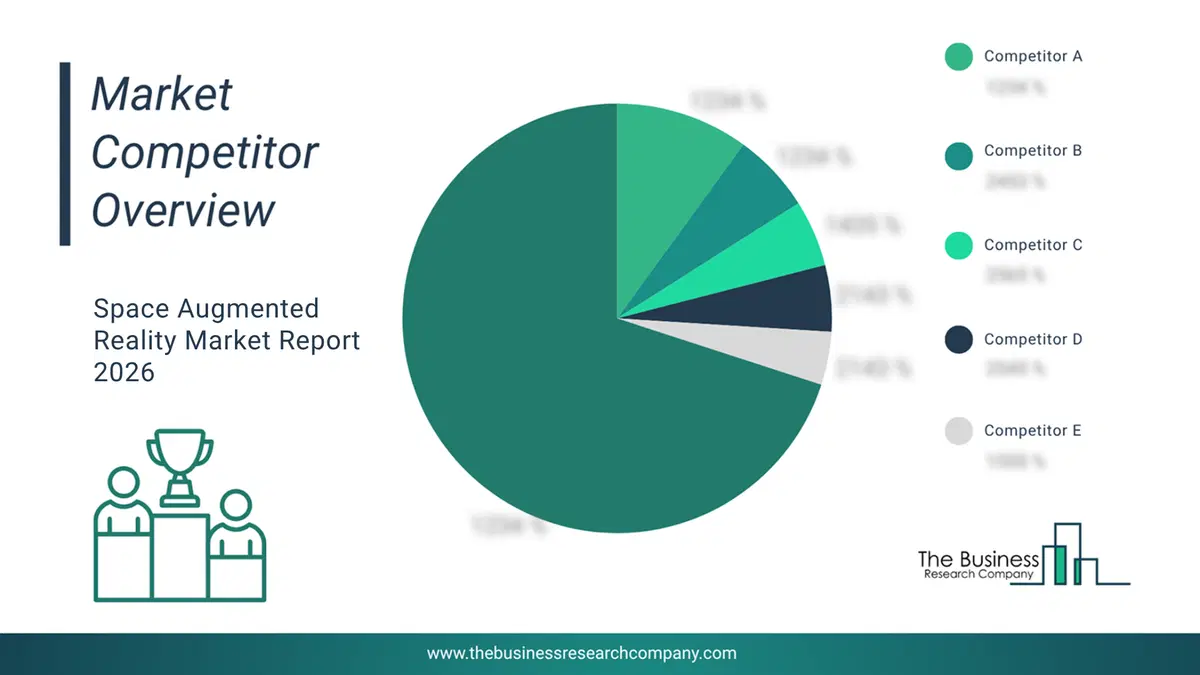
This chart is for illustrative purposes; the full report includes a detailed competitor analysis and comprehensive overview of the top 10 companies in the market.
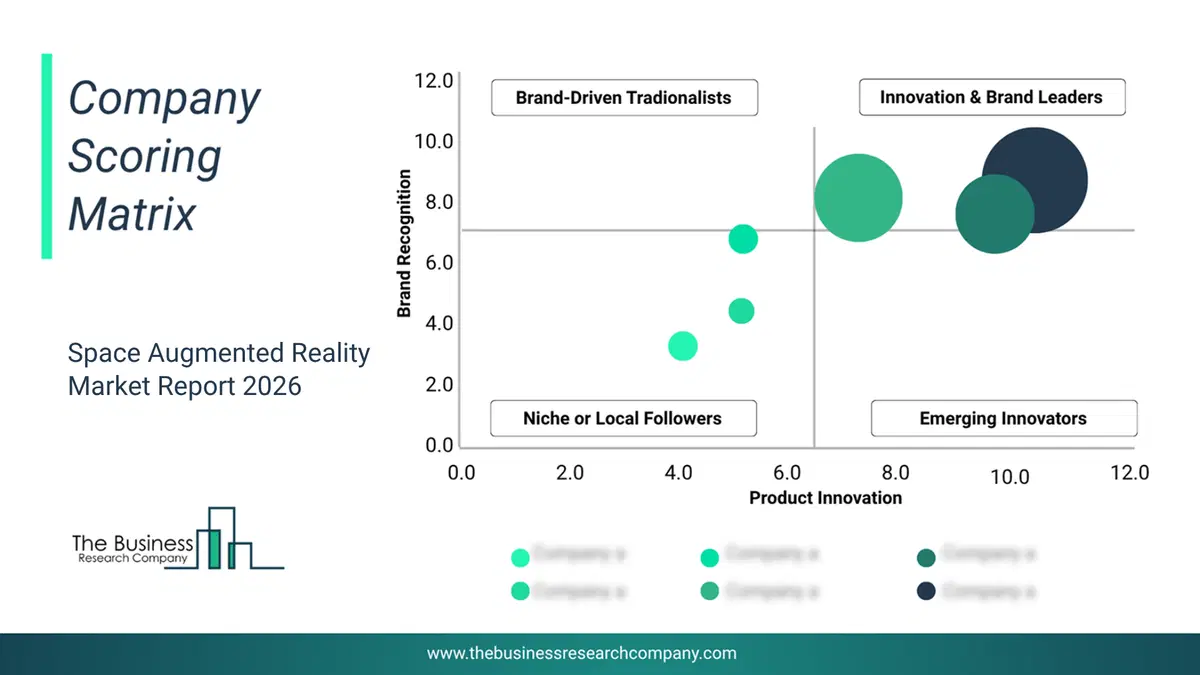
This chart maps companies by product innovation and brand strength, with bubble size indicating relative revenue, helping identify market leaders, challengers, and niche players. This is an illustrative chart; the full report provides a complete and accurate competitive analysis.
What Are Latest Mergers And Acquisitions In The Space Augmented Reality Market? IIT Madras And ISRO Collaborate To Advance Extended Reality In India’s Human Spaceflight Program
In February 2023, the Indian Institute of Technology Madras, an India-based public research university and technical institute, collaborated with the Indian Space Research Organization (ISRO) for the application of extended reality in India’s human spaceflight program. Through this collaboration, the Indian Institute of Technology Madras will create a training module for the Indian spaceflight programme leveraging Augmented Reality (AR), Virtual Reality (VR), and Mixed Reality (MR). ISRO will use the technologies developed at the newly established eXperiential Technology Innovation Centre (XTIC) to support research and innovation in the field of Extended Reality (XR). Indian Space Research Organization (ISRO) is an India-based national space agency.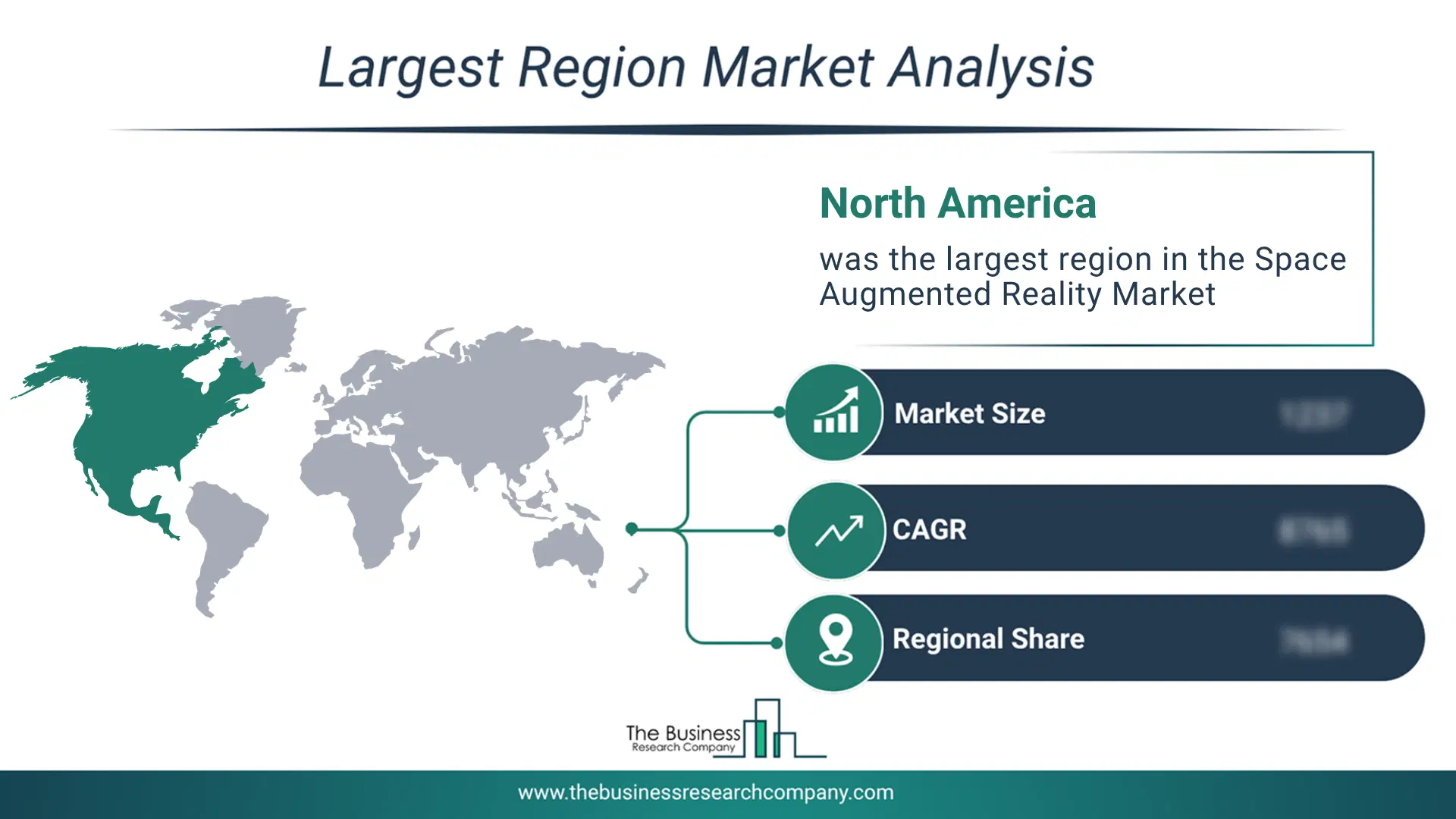
Regional Insights
North America was the largest region in the space augmented reality market in 2025. Asia-Pacific is expected to be the fastest-growing region in the forecast period. The regions covered in this market report are Asia-Pacific, South East Asia, Western Europe, Eastern Europe, North America, South America, Middle East, Africa. The countries covered in this market report are Australia, Brazil, China, France, Germany, India, Indonesia, Japan, Taiwan, Russia, South Korea, UK, USA, Canada, Italy, SpainWhat Defines the Space Augmented Reality Market?
The space augmented reality market consists of revenues earned by entities by providing services such as spatial mapping, immersive simulation services, real-time spatial data integration, and spatial interaction design. The market value includes the value of related goods sold by the service provider or included within the service offering. The space augmented reality market also includes sales of head-mounted displays, spatial sensors, smart glasses, and motion tracking devices. Values in this market are ‘factory gate’ values, that is the value of goods sold by the manufacturers or creators of the goods, whether to other entities (including downstream manufacturers, wholesalers, distributors and retailers) or directly to end customers. The value of goods in this market includes related services sold by the creators of the goods.How is Market Value Defined and Measured?
The market value is defined as the revenues that enterprises gain from the sale of goods and/or services within the specified market and geography through sales, grants, or donations in terms of the currency (in USD unless otherwise specified). The revenues for a specified geography are consumption values that are revenues generated by organizations in the specified geography within the market, irrespective of where they are produced. It does not include revenues from resales along the supply chain, either further along the supply chain or as part of other products.
This chart presents market attractiveness based on a quantitative evaluation of growth, competition, strategic alignment, and risk, offering a clear view of opportunity areas for decision-making. This chart is for illustrative purposes; the full report contains the complete analysis.

This chart highlights the Total Addressable Market (TAM) by estimating the maximum revenue opportunity using an assumption-driven approach, supporting strategic planning and opportunity sizing across markets. The chart is illustrative; the full report provides a more comprehensive analysis.
What Key Data and Analysis Are Included in the Space Augmented Reality Market Report 2026?
The space augmented reality market research report is one of a series of new reports from The Business Research Company that provides market statistics, including industry global market size, regional shares, competitors with the market share, detailed market segments, market trends and opportunities, and any further data you may need to thrive in the space augmented reality industry. The market research report delivers a complete perspective of everything you need, with an in-depth analysis of the current and future state of the industry.Space Augmented Reality Market Report Forecast Analysis
| Report Attribute | Details |
|---|---|
| Market Size Value In 2026 | $1.7 billion |
| Revenue Forecast In 2030 | $3.73 billion |
| Growth Rate | CAGR of 21.7% from 2026 to 2030 |
| Base Year For Estimation | 2025 |
| Actual Estimates/Historical Data | 2020-2025 |
| Forecast Period | 2026 - 2030 |
| Market Representation | Revenue in USD Billion and CAGR from 2026 to 2030 |
| Segments Covered | Component, Deployment Model, Application, End-User |
| Regional Scope | Asia-Pacific, Western Europe, Eastern Europe, North America, South America, Middle East, Africa |
| Country Scope | The countries covered in the space augmented reality market report are Australia, Brazil, China, France, Germany, India, Indonesia, Japan, Taiwan, Russia, South Korea, UK, USA, Canada, Italy, Spain |
| Key Companies Profiled | Google LLC, Microsoft Corporation, Siemens AG, The Boeing Co., Airbus Defence and Space GmbH, Raytheon Technologies Corporation, Lockheed Martin Corporation, Northrop Grumman Corporation, National Aeronautics and Space Administration (NASA), Thales Group S.A., Leonardo S.p.A., Ball Aerospace & Technologies Corp., SpaceX Corp., Trimble Inc., PTC Inc., Unity Technologies, Epic Games Inc., Environmental Systems Research Institute Inc. (Esri), MDA Ltd., Varjo Technologies Oy, Red 6 Inc. |
| Customization Scope | Request for Customization |
| Pricing And Purchase Options | Explore Purchase Options |