
Space-Based Artificial Intelligence Assistants Market Report 2026
Global Outlook – By Component (Hardware, Software, Services), By Application (Satellite Operations, Space Exploration, Spacecraft Navigation, Communications, Other Applications), By End-User (Government, Commercial, Defense, Research Organizations, Other End-Users) – Market Size, Trends, Strategies, and Forecast to 2030
Space-Based Artificial Intelligence Assistants Market Overview
• Space-Based Artificial Intelligence Assistants market size has reached to $1.3 billion in 2025 • Expected to grow to $2.67 billion in 2030 at a compound annual growth rate (CAGR) of 15.3% • Growth Driver: The Growing Investment In The Space Exploration Is Fueling The Growth Of The Market Due To Rising Demand For Advanced AI-Enabled Space Technologies And Infrastructure • Market Trend: AI-Powered Onboard Processors Enhance Autonomy And Efficiency In Space Missions • North America was the largest region in 2025 and Asia-Pacific is the fastest growing region.What Is Covered Under Space-Based Artificial Intelligence Assistants Market?
Space-based artificial intelligence assistants are advanced AI systems deployed on orbital platforms or spacecraft. They actively analyze space data, manage onboard systems, and support real-time decision-making in extraterrestrial environments using machine learning and adaptive algorithms. These assistants optimize satellite operations, enhance the autonomy of deep-space missions, assist astronauts with diagnostics and navigation, and process large volumes of astronomical data to drive scientific discoveries. The main component types of space-based artificial intelligence assistants are hardware, software, and services. The hardware comprises robust, space-resistant physical components that enable AI assistants to operate autonomously in space. It is applicable in various applications, such as satellite operations, space exploration, spacecraft navigation, communications, and others, and is used by several end-users, including government, commercial, defense, research organizations, and others.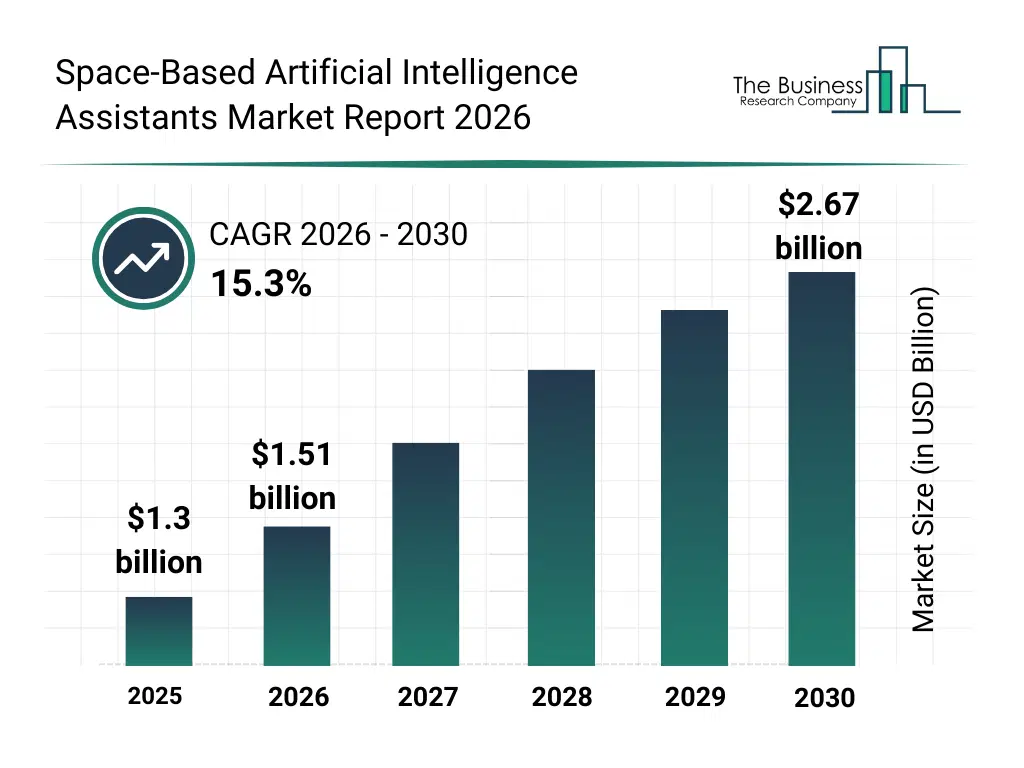
What Is The Space-Based Artificial Intelligence Assistants Market Size and Share 2026?
The space-based artificial intelligence assistants market size has grown rapidly in recent years. It will grow from $1.3 billion in 2025 to $1.51 billion in 2026 at a compound annual growth rate (CAGR) of 16.2%. The growth in the historic period can be attributed to development of early spaceborne computing systems, advancements in machine learning for autonomous spacecraft operations, increasing deployment of AI in satellite data analysis, government funding for AI-driven space missions, integration of AI for astronaut support in low-earth orbit missions.What Is The Space-Based Artificial Intelligence Assistants Market Growth Forecast?
The space-based artificial intelligence assistants market size is expected to see rapid growth in the next few years. It will grow to $2.67 billion in 2030 at a compound annual growth rate (CAGR) of 15.3%. The growth in the forecast period can be attributed to rising adoption of AI assistants for deep-space exploration, deployment of radiation-hardened AI processors and edge computing modules, increased demand for autonomous mission planning and navigation, growth in AI-driven environmental monitoring and system diagnostics, collaboration between aerospace and AI technology firms for advanced space operations. Major trends in the forecast period include expansion of radiation-hardened ai hardware for orbital reliability, growth in autonomous mission planning and spacecraft navigation systems, rising demand for onboard real-time data analytics for scientific missions, increased integration of astronaut assistance systems using nlp and diagnostics, adoption of edge-processing modules to reduce reliance on ground-station communication.
Global Space-Based Artificial Intelligence Assistants Market Segmentation
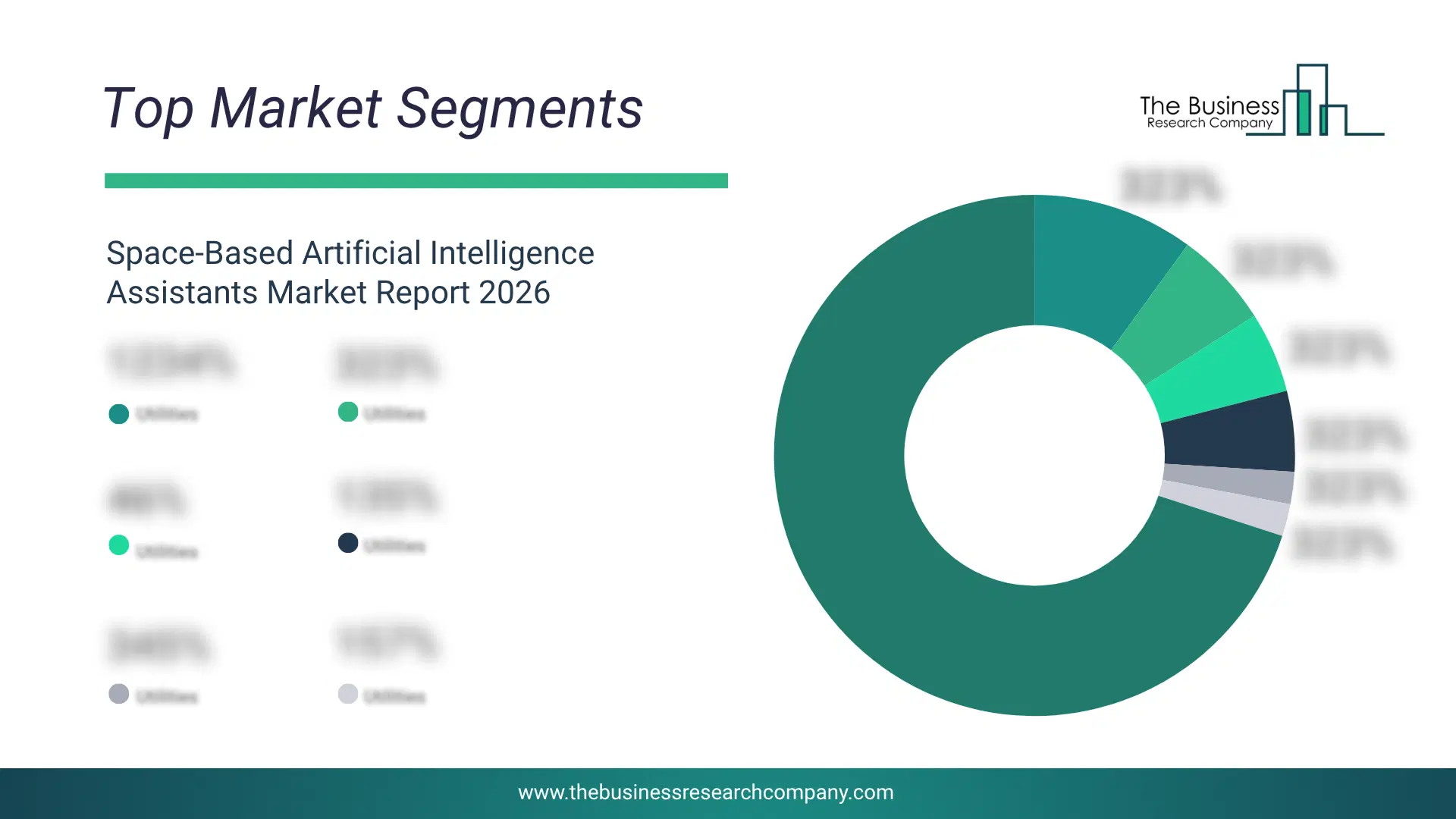
1) By Component: Hardware, Software, Services 2) By Application: Satellite Operations, Space Exploration, Spacecraft Navigation, Communications, Other Applications 3) By End-User: Government, Commercial, Defense, Research Organizations, Other End-Users Subsegments: 1) By Hardware: Onboard Processors, Artificial Intelligence (AI) Accelerators, Edge Computing Devices, Sensor Suites, Communication Modules, Power Systems 2) By Software: Machine Learning Algorithms, Natural Language Processing (NLP) Engines, Predictive Analytics Software, Computer Vision Systems, Autonomous Navigation And Control Systems, Data Fusion And Decision-Making Platforms 3) By Services: Artificial Intelligence (AI) Training And Simulation Services, System Integration And Testing, Data Analysis And Interpretation, Predictive Maintenance Services, Mission Support And Operational Monitoring, Custom Software Development And UpgradesWhat Is Driver Of The Space-Based Artificial Intelligence Assistants Market?
The increasing investments in space exploration are expected to propel the growth of the space-based artificial intelligence assistants market going forward. Space exploration investments are funding efforts by the public and private sectors aimed at advancing technologies, missions, and infrastructure for space discovery and development. Rising investments in space exploration are driven by increasing demand for satellite services that enable communication, navigation, and Earth monitoring, making them vital to today’s global economy. Investments in space exploration accelerate the growth of space-based AI assistants by supporting AI technologies and onboard computing advancements. This enhances spacecraft autonomy, real-time analysis, and efficient mission execution in space. For instance, in July 2024, according to the Space Foundation, a US-based nonprofit organization supporting the global space community, in 2023, the global space economy reached $570 billion, marking a 7.4% increase from the revised 2022 total of $531 billion. Therefore, the increasing investments in space exploration are driving the growth of the space-based artificial intelligence assistants industry.Key Players In The Global Space-Based Artificial Intelligence Assistants Market
Major companies operating in the space-based artificial intelligence assistants market are Airbus, International Business Machines Corporation, Mitsubishi Heavy Industries Ltd., National Aeronautics and Space Administration, Safran S.A., Thales Group, L3Harris Technologies Inc., SpaceX, Blue Origin LLC, German Aerospace Centre (DLR), Sierra Nevada Corporation, Axiom Space Inc., Sidus Space Inc., Klepsydra Technologies AG, KP Labs Inc., Cognitive Space, EdgeCortix Inc., Nebula AI, Planetary Systems AI, Aistrospace Limited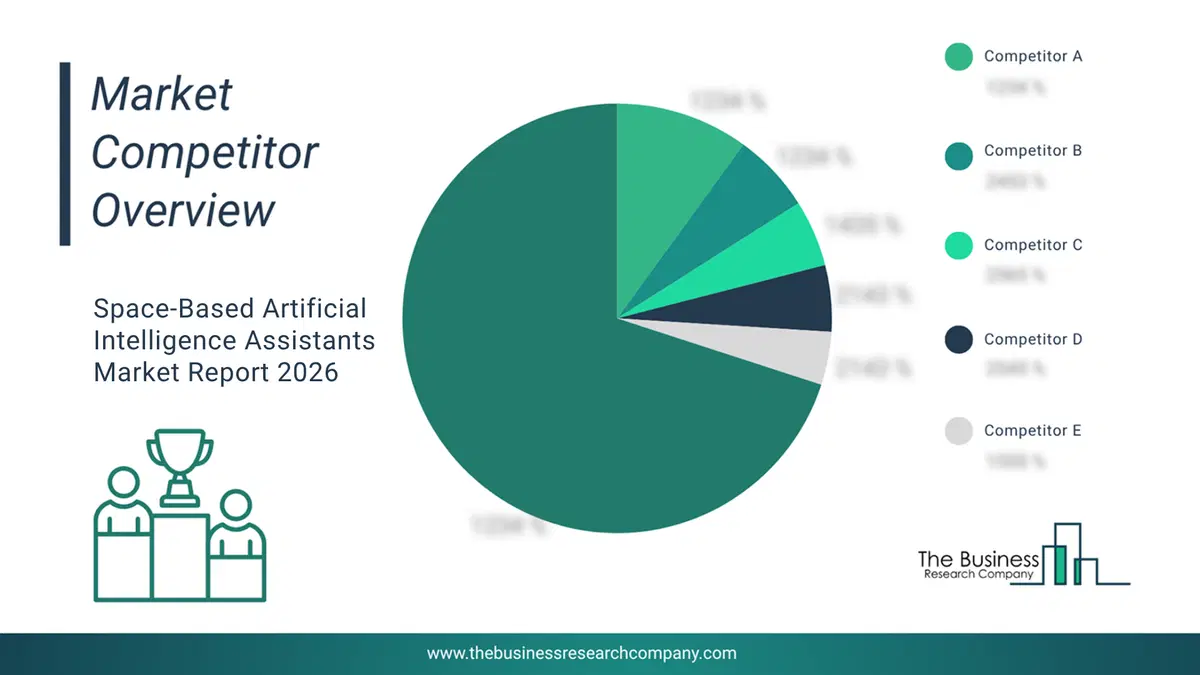
This chart is for illustrative purposes; the full report includes a detailed competitor analysis and comprehensive overview of the top 10 companies in the market.
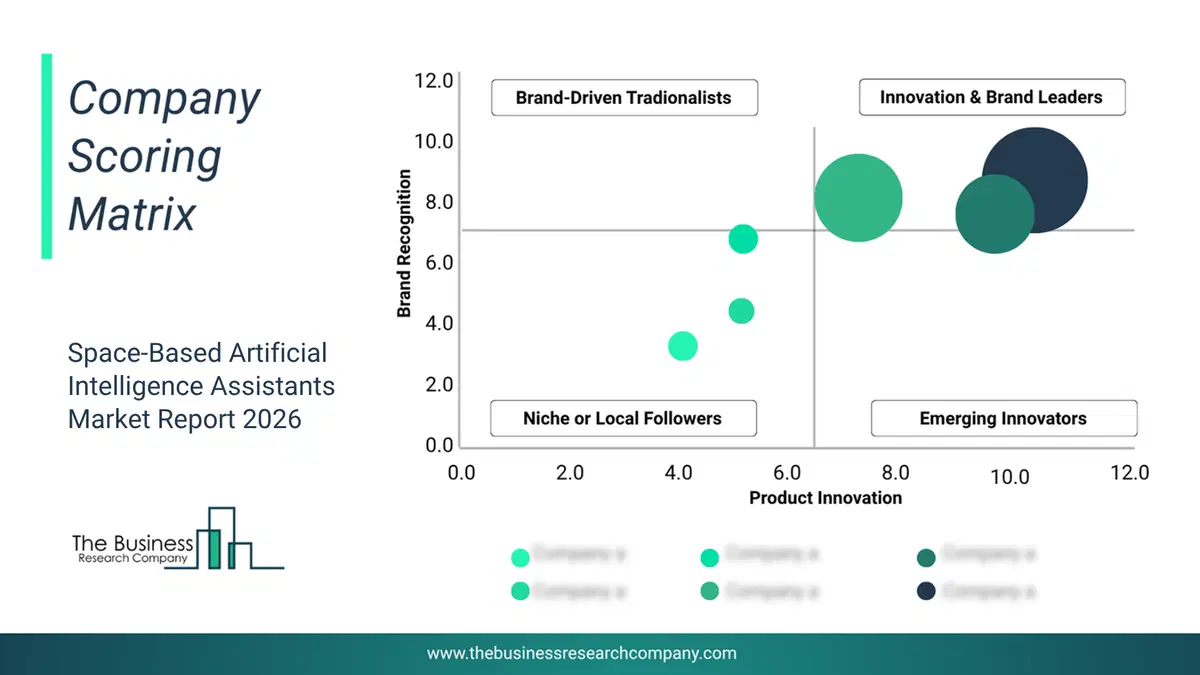
This chart maps companies by product innovation and brand strength, with bubble size indicating relative revenue, helping identify market leaders, challengers, and niche players. This is an illustrative chart; the full report provides a complete and accurate competitive analysis.
Global Space-Based Artificial Intelligence Assistants Market Trends and Insights
Major companies operating in the space-based artificial intelligence assistants market are focusing on developing advanced products such as AI-based onboard processors to reduce reliance on ground control systems during space missions. AI-based onboard processors are smart computing systems embedded in spacecraft or satellites that use AI to analyze data in real time. They support autonomous functions and reduce dependence on ground-based control by processing information locally. For instance, in March 2024, Mitsubishi Heavy Industries, a Japan-based electronics corporation, developed AIRIS, an onboard AI-based object detector. It utilizes the next-generation space-grade microprocessor ""SOISOC4"" for enhanced image processing and object detection in space. This system will be demonstrated in orbit as part of JAXA's Innovative Satellite Technology Demonstration-4 mission. The demonstration will involve using AI to identify vessels in satellite images, transmitting only relevant data to the ground, retraining the AI model based on new data, and updating the onboard AI accordingly, showcasing both advanced AI capabilities and the robust, low-power SOISOC4 processor in a real-space environment.What Are Latest Mergers And Acquisitions In The Space-Based Artificial Intelligence Assistants Market? Sidus Space Acquired Exo-Space To Bolster AI-Powered Satellite Capabilities
In August 2023, Sidus Space, a US-based satellite manufacturing and space services company, acquired Exo-Space for an undisclosed amount. This acquisition strengthens Sidus Space’s position in the AI-powered space technology market by enhancing its ability to deliver real-time, on-orbit AI data processing through advanced satellite capabilities. Exo-Space is a US-based company that specializes in edge artificial intelligence (AI) software and hardware for space applications.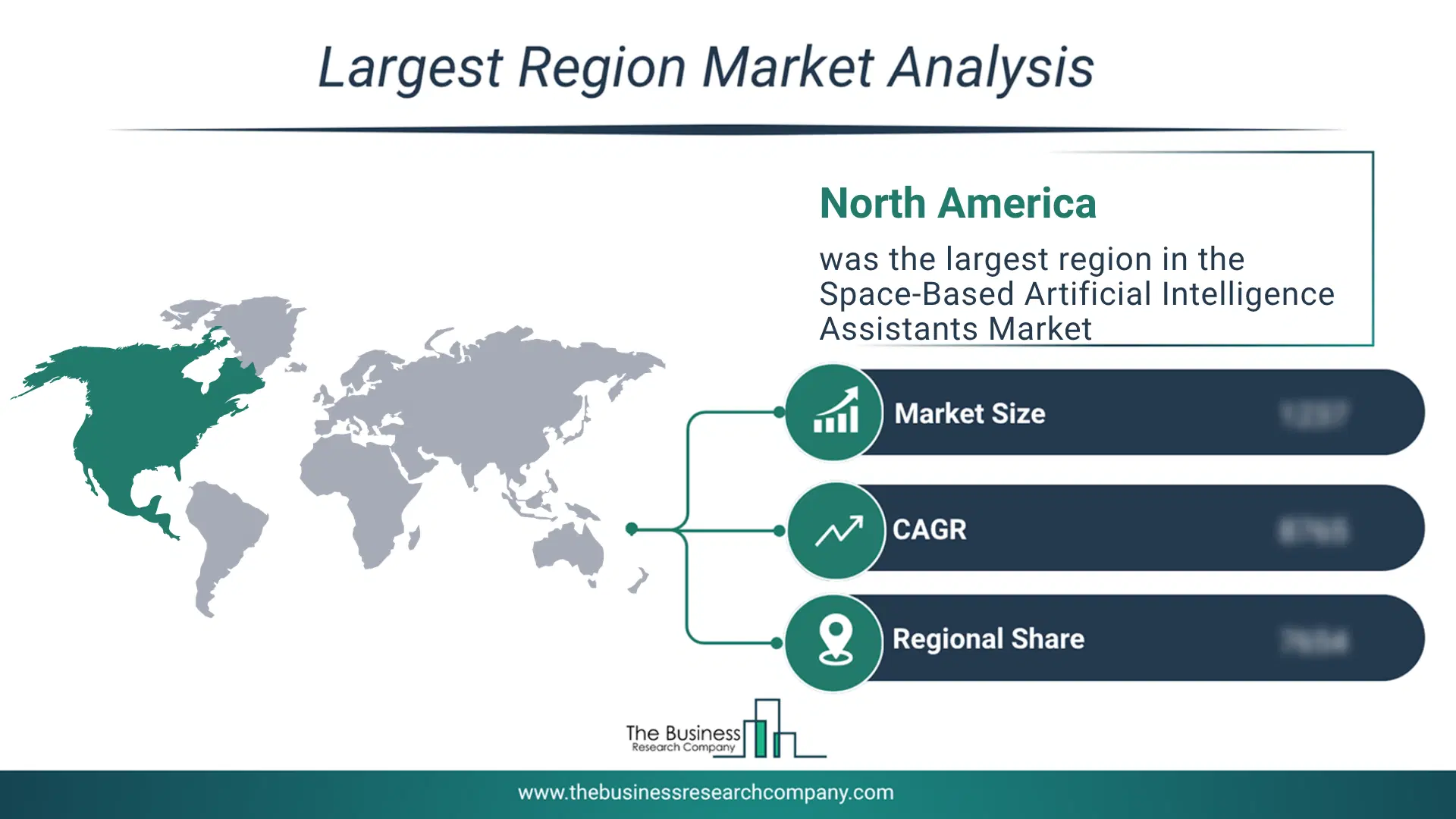
Regional Insights
North America was the largest region in the space-based artificial intelligence assistants market in 2025. Asia-Pacific is expected to be the fastest-growing region in the forecast period. The regions covered in this market report are Asia-Pacific, South East Asia, Western Europe, Eastern Europe, North America, South America, Middle East, Africa. The countries covered in this market report are Australia, Brazil, China, France, Germany, India, Indonesia, Japan, Taiwan, Russia, South Korea, UK, USA, Canada, Italy, SpainWhat Defines the Space-Based Artificial Intelligence Assistants Market?
The space-based artificial intelligence assistants market consists of revenues earned by entities by providing services such as autonomous system management, data processing and analysis, mission planning and navigation support, astronaut assistance, and environmental monitoring and response. The market value includes the value of related goods sold by the service provider or included within the service offering. The space-based artificial intelligence assistants market includes sales of radiation-hardened AI processors, edge computing modules, autonomous navigation units, and high-density storage devices. Values in this market are ‘factory gate’ values, that is, the value of goods sold by the manufacturers or creators of the goods, whether to other entities (including downstream manufacturers, wholesalers, distributors, and retailers) or directly to end customers. The value of goods in this market includes related services sold by the creators of the goods.How is Market Value Defined and Measured?
The market value is defined as the revenues that enterprises gain from the sale of goods and/or services within the specified market and geography through sales, grants, or donations in terms of the currency (in USD unless otherwise specified). The revenues for a specified geography are consumption values that are revenues generated by organizations in the specified geography within the market, irrespective of where they are produced. It does not include revenues from resales along the supply chain, either further along the supply chain or as part of other products.
This chart presents market attractiveness based on a quantitative evaluation of growth, competition, strategic alignment, and risk, offering a clear view of opportunity areas for decision-making. This chart is for illustrative purposes; the full report contains the complete analysis.

This chart highlights the Total Addressable Market (TAM) by estimating the maximum revenue opportunity using an assumption-driven approach, supporting strategic planning and opportunity sizing across markets. The chart is illustrative; the full report provides a more comprehensive analysis.
What Key Data and Analysis Are Included in the Space-Based Artificial Intelligence Assistants Market Report 2026?
The space-based artificial intelligence assistants market research report is one of a series of new reports from The Business Research Company that provides market statistics, including industry global market size, regional shares, competitors with the market share, detailed market segments, market trends and opportunities, and any further data you may need to thrive in the space-based artificial intelligence assistants industry. The market research report delivers a complete perspective of everything you need, with an in-depth analysis of the current and future state of the industry.Space-Based Artificial Intelligence Assistants Market Report Forecast Analysis
| Report Attribute | Details |
|---|---|
| Market Size Value In 2026 | $1.51 billion |
| Revenue Forecast In 2030 | $2.67 billion |
| Growth Rate | CAGR of 15.3% from 2026 to 2030 |
| Base Year For Estimation | 2025 |
| Actual Estimates/Historical Data | 2020-2025 |
| Forecast Period | 2026 - 2030 |
| Market Representation | Revenue in USD Billion and CAGR from 2026 to 2030 |
| Segments Covered | Component, Application, End-User |
| Regional Scope | Asia-Pacific, Western Europe, Eastern Europe, North America, South America, Middle East, Africa |
| Country Scope | The countries covered in the space-based artificial intelligence assistants market report are Australia, Brazil, China, France, Germany, India, Indonesia, Japan, Taiwan, Russia, South Korea, UK, USA, Canada, Italy, Spain |
| Key Companies Profiled | Airbus, International Business Machines Corporation, Mitsubishi Heavy Industries Ltd., National Aeronautics and Space Administration, Safran S.A., Thales Group, L3Harris Technologies Inc., SpaceX, Blue Origin LLC, German Aerospace Centre (DLR), Sierra Nevada Corporation, Axiom Space Inc., Sidus Space Inc., Klepsydra Technologies AG, KP Labs Inc., Cognitive Space, EdgeCortix Inc., Nebula AI, Planetary Systems AI, Aistrospace Limited |
| Customization Scope | Request for Customization |
| Pricing And Purchase Options | Explore Purchase Options |