
Space-Based Climate Engineering Market Report 2026
Global Outlook – By Technology (Solar Radiation Management, Carbon Dioxide Removal, Space Mirrors, Other Technologies), By Deployment (Satellites, Spacecraft, Other Deployments ), By Application (Climate Change Mitigation, Weather Modification, Other Applications), By End-User (Government, Private Sector, Research Institutions, Other End Users) – Market Size, Trends, Strategies, and Forecast to 2030
Space-Based Climate Engineering Market Overview
• Space-Based Climate Engineering market size has reached to $3.65 billion in 2025 • Expected to grow to $6.25 billion in 2030 at a compound annual growth rate (CAGR) of 11.3% • Growth Driver: Rise In Climate Change Fueling The Growth Of The Market Due To Increasing Global Warming And Need For Advanced Mitigation Technologies • Market Trend: Advancing Climate Predictions Through Satellite-Based Modeling Innovations • North America was the largest region in 2025.What Is Covered Under Space-Based Climate Engineering Market?
Space-based climate engineering refers to the use of space technologies and systems to deliberately modify the Earth's climate to counteract global warming. This can involve deploying satellites or space-based mirrors to reflect a portion of solar radiation away from Earth. It is a form of geoengineering aimed at large-scale environmental impact through space intervention. The main technologies of the space-based climate engineering include solar radiation management, carbon dioxide removal, space mirrors, and others. Solar radiation management refers to techniques designed to reflect a portion of the sun’s energy back into space to reduce global temperatures and mitigate the impacts of climate change. There are deployments such as satellites, spacecraft, and other deployments. The key applications include climate change mitigation, weather modification, and other applications, and they are used by several end-users such as government, private sector, research institutions, and others.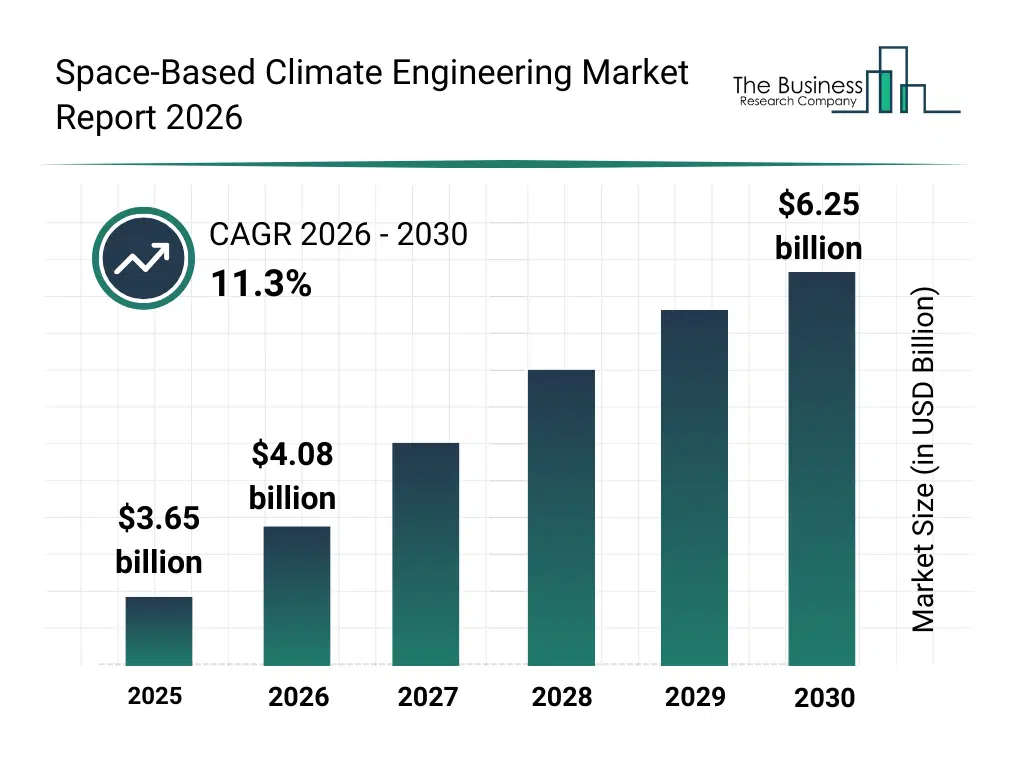
What Is The Space-Based Climate Engineering Market Size and Share 2026?
The space-based climate engineering market size has grown rapidly in recent years. It will grow from $3.65 billion in 2025 to $4.08 billion in 2026 at a compound annual growth rate (CAGR) of 11.8%. The growth in the historic period can be attributed to early research on solar radiation management technologies, development of prototype climate intervention satellites, increasing global awareness of climate change impacts, government and institutional funding for geoengineering projects, advancements in orbital deployment and reflective material technologies.What Is The Space-Based Climate Engineering Market Growth Forecast?
The space-based climate engineering market size is expected to see rapid growth in the next few years. It will grow to $6.25 billion in 2030 at a compound annual growth rate (CAGR) of 11.3%. The growth in the forecast period can be attributed to expansion of commercial and governmental space-based climate intervention programs, deployment of large-scale orbital sunshades and reflective systems, integration of real-time Earth monitoring and climate modeling, adoption of advanced thermal control and geoengineering mission hardware, rising collaboration between aerospace and environmental technology firms. Major trends in the forecast period include advancements in space-based solar reflectors, enhanced climate monitoring and modeling from orbit, increasing demand for carbon dioxide removal technologies, growth in private sector participation in geoengineering, development of modular and scalable orbital climate intervention hardware.
Global Space-Based Climate Engineering Market Segmentation
1) By Technology: Solar Radiation Management, Carbon Dioxide Removal, Space Mirrors, Other Technologies 2) By Deployment: Satellites, Spacecraft, Other Deployments 3) By Application: Climate Change Mitigation, Weather Modification, Other Applications 4) By End-User: Government, Private Sector, Research Institutions, Other End Users Subsegments: 1) By Solar Radiation Management: Stratospheric Aerosol Injection (SAI), Space-Based Reflectors, Surface Albedo Modification 2) By Carbon Dioxide Removal: Direct Air Capture and Storage (DACS), 3) By Space Mirrors: Large Deployable Mirrors, Thin Film Reflectors, Modular Mirror Arrays, Orbital Lens Systems 4) By Other Technologies: Space-Based Cloud Seeding, Atmospheric Shielding Systems, Hybrid Engineering SolutionsWhat Is Driver Of The Space-Based Climate Engineering Market?
The growing investment in space technologies is expected to propel the growth of the space-based climate engineering market going forward. Space technologies refer to the tools, systems, and innovations such as satellites, spacecraft, launch vehicles, sensors, and orbital platforms used for exploring, monitoring, and utilizing outer space. Investment in space technologies is rising due to the growing commercial opportunities in satellite services, space-based climate monitoring, and space exploration. Investment in space technologies in space-based climate engineering enables the development and deployment of satellites and orbital systems to monitor, model, and mitigate climate change on a global scale. For instance, in June 2025, according to the European Space Policy Institute (ESPI), an Austria-based think tank that provides strategic analysis and advice on space policy and its global implications, global investment in space ventures totaled $8.02 billion (€6.9 billion) across 265 funding rounds in 2025, reflecting a 6% year-on-year increase. Therefore, the growing investment in space technologies is driving the growth of the space-based climate engineering industry.Key Players In The Global Space-Based Climate Engineering Market
Major companies operating in the space-based climate engineering market are Raytheon Technologies Inc., Lockheed Martin Corporation, Airbus SE, Northrop Grumman Corporation, L3Harris Technologies, Thales Alenia Space, OHB SE, Aidash, Pixxel, Ororatech, Space Forge, Albedo Space, Kuva Space, Near Space Labs, SpaceSolar, Stratosolar, Planetary Sunshade Foundation, Airmo, Orbify, Solaren Corporation.
This chart is for illustrative purposes; the full report includes a detailed competitor analysis and comprehensive overview of the top 10 companies in the market.
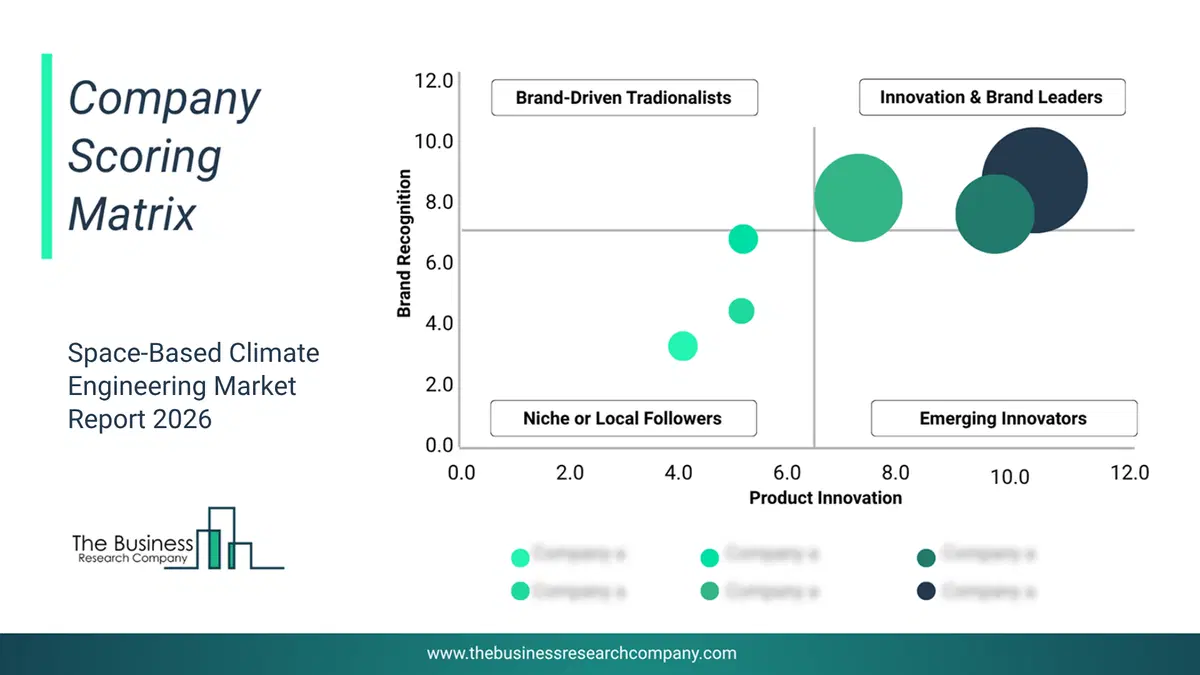
This chart maps companies by product innovation and brand strength, with bubble size indicating relative revenue, helping identify market leaders, challengers, and niche players. This is an illustrative chart; the full report provides a complete and accurate competitive analysis.
Global Space-Based Climate Engineering Market Trends and Insights
Major companies operating in the space-based climate engineering market are focusing on technological advancements, such as advanced climate modeling systems. Advanced climate modeling systems refer to sophisticated computer-based tools and simulations that use mathematical equations and vast datasets to replicate and predict the Earth’s climate systems. For instance, in May 2024, the National Aeronautics and Space Administration (NASA), a US-based government space agency, launched the first satellite of its PREFIRE mission aboard Rocket Lab’s Electron rocket from New Zealand. This CubeSat will measure heat radiated from the Arctic and Antarctica to better understand how Earth’s polar regions influence global energy balance. The data will improve climate models, aiding predictions of sea ice loss, ice sheet melt, and rising sea levels. These insights are vital for farmers, fishing fleets, and coastal communities adapting to the effects of climate change.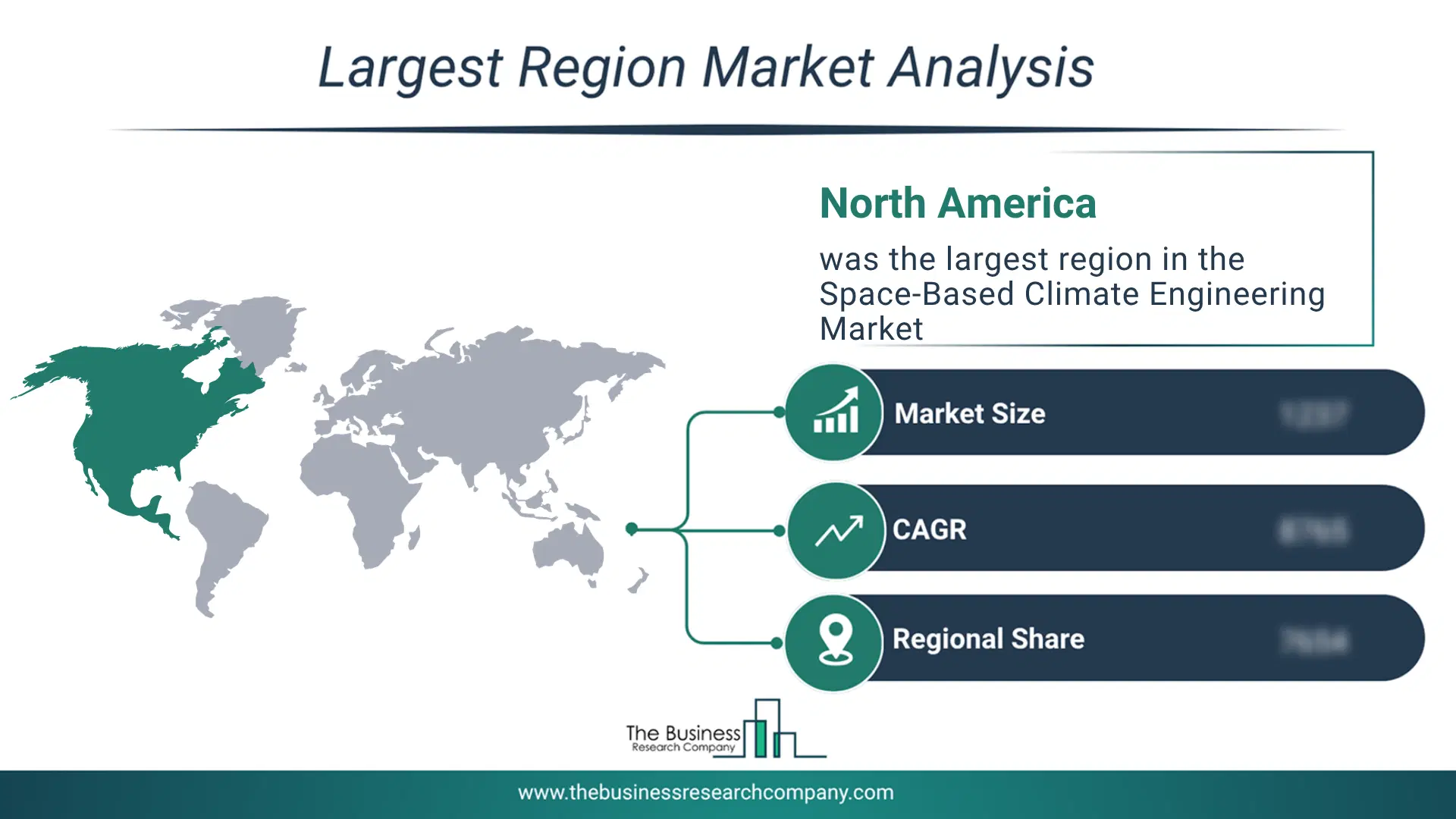
Regional Insights
North America was the largest region in the space-based climate engineering market in 2025. The regions covered in this market report are Asia-Pacific, South East Asia, Western Europe, Eastern Europe, North America, South America, Middle East, Africa. The countries covered in this market report are Australia, Brazil, China, France, Germany, India, Indonesia, Japan, Taiwan, Russia, South Korea, UK, USA, Canada, Italy, SpainWhat Defines the Space-Based Climate Engineering Market?
The space-based climate engineering market consists of revenues earned by entities by providing services such as deploying solar reflectors in orbit, launching satellites for climate intervention, and offering real-time Earth monitoring and climate modeling from space. The market value includes the value of related goods sold by the service provider or included within the service offering. The space-based climate engineering market also includes sales of orbital sunshades, reflective aerosol dispersal systems, climate intervention satellites, thermal control devices, and geoengineering mission hardware. Values in this market are ‘factory gate’ values, that is, the value of goods sold by the manufacturers or creators of the goods, whether to other entities (including downstream manufacturers, wholesalers, distributors, and retailers) or directly to end customers. The value of goods in this market includes related services sold by the creators of the goods.How is Market Value Defined and Measured?
The market value is defined as the revenues that enterprises gain from the sale of goods and/or services within the specified market and geography through sales, grants, or donations in terms of the currency (in USD unless otherwise specified). The revenues for a specified geography are consumption values that are revenues generated by organizations in the specified geography within the market, irrespective of where they are produced. It does not include revenues from resales along the supply chain, either further along the supply chain or as part of other products.
This chart presents market attractiveness based on a quantitative evaluation of growth, competition, strategic alignment, and risk, offering a clear view of opportunity areas for decision-making. This chart is for illustrative purposes; the full report contains the complete analysis.

This chart highlights the Total Addressable Market (TAM) by estimating the maximum revenue opportunity using an assumption-driven approach, supporting strategic planning and opportunity sizing across markets. The chart is illustrative; the full report provides a more comprehensive analysis.
What Key Data and Analysis Are Included in the Space-Based Climate Engineering Market Report 2026?
The space-based climate engineering market research report is one of a series of new reports from The Business Research Company that provides market statistics, including industry global market size, regional shares, competitors with the market share, detailed market segments, market trends and opportunities, and any further data you may need to thrive in the space-based climate engineering industry. The market research report delivers a complete perspective of everything you need, with an in-depth analysis of the current and future state of the industry.Space-Based Climate Engineering Market Report Forecast Analysis
| Report Attribute | Details |
|---|---|
| Market Size Value In 2026 | $4.08 billion |
| Revenue Forecast In 2030 | $6.25 billion |
| Growth Rate | CAGR of 11.3% from 2026 to 2030 |
| Base Year For Estimation | 2025 |
| Actual Estimates/Historical Data | 2020-2025 |
| Forecast Period | 2026 - 2030 |
| Market Representation | Revenue in USD Billion and CAGR from 2026 to 2030 |
| Segments Covered | Technology, Deployment, Application, End-User |
| Regional Scope | Asia-Pacific, Western Europe, Eastern Europe, North America, South America, Middle East, Africa |
| Country Scope | The countries covered in the space-based climate engineering market report are Australia, Brazil, China, France, Germany, India, Indonesia, Japan, Taiwan, Russia, South Korea, UK, USA, Canada, Italy, Spain |
| Key Companies Profiled | Raytheon Technologies Inc., Lockheed Martin Corporation, Airbus SE, Northrop Grumman Corporation, L3Harris Technologies, Thales Alenia Space, OHB SE, Aidash, Pixxel, Ororatech, Space Forge, Albedo Space, Kuva Space, Near Space Labs, SpaceSolar, Stratosolar, Planetary Sunshade Foundation, Airmo, Orbify, Solaren Corporation. |
| Customization Scope | Request for Customization |
| Pricing And Purchase Options | Explore Purchase Options |