
Contact Us
  Search
The Business Research Company Logo
Space-Based Fuel Cell Global Market Opportunities And Strategies To 2035
Published :June 2026
Pages :374
Format :PDF
Delivery Time :2-3 Business Days
Why 2-3 days? We update the report with the latest data and news before delivery. Let us know if you need us to expedite.
Report Price :$4,490.00

Space-Based Fuel Cell Global Market Opportunities And Strategies To 2035

By Type (Proton Exchange Membrane Fuel Cells, Alkaline Fuel Cells, Other Types), By Power Capacity (Low Power, Medium Power, High Power), By Application (Satellites, Spacecraft, Rovers, Other Applications), By End-User (Commercial, Scientific Research), And By Region, Opportunities And Strategies – Global Forecast To 2035

Space-Based Fuel Cell Market Definition

Space-based fuel cells refer to electrochemical energy conversion systems designed specifically for use in outer space environments to generate electricity through the reaction of a fuel, typically hydrogen, with an oxidant such as oxygen. These systems are used in satellites, spacecraft, planetary rovers and other extraterrestrial platforms where reliable, efficient and long-duration power supply is essential. Space-based fuel cells are typically deployed during missions that require continuous or high-density energy output, such as crewed space missions, deep-space exploration, and long-duration satellite operations. The space-based fuel cell market consists of sales of space-based fuel cells by entities (organizations, sole traders and partnerships) that involve the development, manufacturing and integration of fuel cell systems used in space missions. These fuel cells operate by converting chemical energy into electrical energy through controlled electrochemical reactions, producing water and heat as by-products, which can also be reused within spacecraft systems for thermal management or life support.
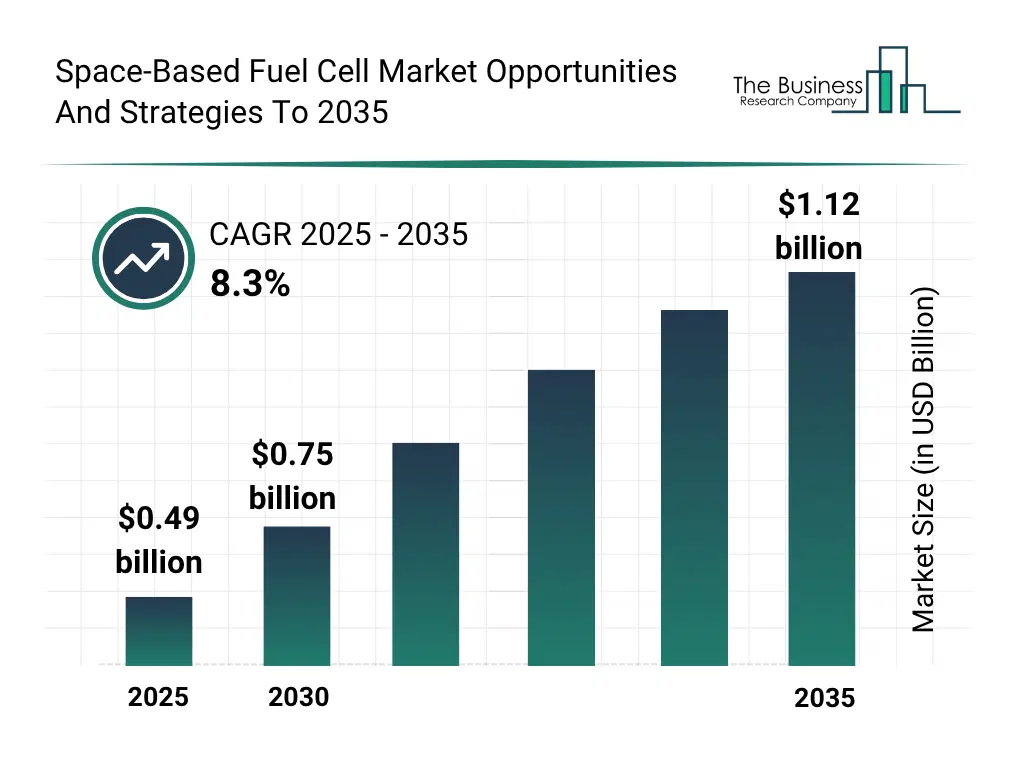
Space-Based Fuel Cell Global Market Opportunities And Strategies To 2035 Market Size and growth rate 2026 to 2030: Graph

Space-Based Fuel Cell Market Size

The global space-based fuel cell market reached a value of nearly $492.3 million in 2025, having grown at a compound annual growth rate (CAGR) of 9.6% since 2020. The market is expected to grow from $492.3 million in 2025 to $752.5 million in 2030 at a rate of 8.9%. The market is then expected to grow at a CAGR of 8.3% from 2029 and reach $1,123.4 million in 2035. Growth in the historic period resulted from growth in space infrastructure investments, increasing deployment of satellites and stations, growing focus on space exploration activities and rising investments in research and development in space. Factors that negatively affected growth in the historic period were high development and production costs and complex system integration. Going forward, global push for clean energy transitions extending to space, growing awareness of environmental concerns, increasing commercial space tourism activities and rising demand for reliable power will drive the growth. Factors that could hinder the growth of the space-based fuel cell market in the future include limited in space refueling and storage technologies, stringent safety and qualification requirements and impact of trade wars and tariffs.
Research Expert

Book your 30 minutes free consultation with our research experts

Space-Based Fuel Cell Market Segmentation The space-based fuel cell market is segmented by type, by power capacity, by application and by end-user.

By Type –
The space-based fuel cell market is segmented by type into:
    • a) Proton Exchange Membrane Fuel Cells
    • b) Alkaline Fuel Cells
    • c) Other Types
The proton exchange membrane fuel cells market was the largest segment of the space-based fuel cell market segmented by type, accounting for 47.7% or $234.6 million of the total in 2025. Going forward, the proton exchange membrane fuel cells segment is expected to be the fastest-growing segment in the space-based fuel cell market segmented by type, at a CAGR of 9.0% during 2025-2030.

By Power Capacity –
The space-based fuel cell market is segmented by power capacity into:
    • a) Low Power
    • b) Medium Power
    • c) High Power
The medium power was the largest segment of the space-based fuel cell market segmented by power capacity, accounting for 46.6% or $229.2 million of the total in 2025. Going forward, the high power segment is expected to be the fastest-growing segment in the space-based fuel cell market segmented by power capacity, at a CAGR of 12.2% during 2025-2030.

By Application –
The space-based fuel cell market is segmented by application into:
  1. a) Satellites
  2. b) Spacecraft
  3. c) Rovers
  4. d) Other Applications
The spacecraft market was the largest segment of the space-based fuel cell market segmented by industry, accounting for 42.3% or $208.2 million of the total in 2025. Going forward, the spacecraft segment is expected to be the fastest-growing segment in the space-based fuel cell market segmented by industry, at a CAGR of 9.3% during 2025-2030.

By End User –
The space-based fuel cell market is segmented by end user into:
    • a) Scientific Research
    • b) Commercial
The scientific research market was the largest segment of the space-based fuel cell market segmented by end-user, accounting for 52.7% or $259.3 million of the total in 2025. Going forward, the commercial segment is expected to be the fastest growing segment in the space-based fuel cell market segmented by end-user, at a CAGR of 10.3% during 2025-2030.

By Geography - The space-based fuel cell market is segmented by geography into:
      o Asia Pacific
      • China
      • India
      • Japan
      • Australia
      • Taiwan
      • South Korea
      o South East Asia
      • Indonesia
      o North America
      • USA
      • Canada
      o South America
      • Brazil
      o Western Europe
      • France
      • Germany
      • UK
      • Italy
      • Spain
      o Eastern Europe
      • Russia
      o Middle East
      o Africa
North America was the largest region in the space-based fuel cell market, accounting for 58.3% or $287.1 million of the total in 2025. It was followed by Asia Pacific, Eastern Europe and then the other regions. Going forward, the fastest-growing regions in the space-based fuel cell market will be Middle East and Western Europe where growth will be at CAGRs of 16.4% and 15.2% respectively. These will be followed by South America and Africa where the markets are expected to grow at CAGRs of 12.7% and 11.5% respectively.

Space-Based Fuel Cell Market Drivers

The key drivers of the space-based fuel cell market include: Global Push For Clean Energy Transitions Extending To Space The global push for clean energy transitions extending to space is driving increased demand for space-based fuel cell. The global emphasis on reducing carbon emissions and shifting toward renewable energy solutions is extending into aerospace, prompting adoption of hydrogen and fuel cell technologies for spacecraft and orbital platforms. Fuel cells provide clean, efficient, and compact energy solutions, aligning with sustainability goals for long-duration missions. Space agencies and private companies are increasingly integrating zero-emission power systems to minimize environmental impact beyond Earth. This green approach encourages the development and testing of high-performance fuel cells for propulsion and onboard energy needs, driving technology deployment in space. The global push for clean energy transitions extending to space growth contribution during the forecast period in 2025 is 2.0%.

Space-Based Fuel Cell Market Restraints

The key restraints on the space-based fuel cell market include: Stringent Safety And Qualification Requirements The stringent safety and qualification requirements remains a significant barrier to market expansion. As device performance continues to increase and die stacking becomes more complex, localized heat accumulation and high-power density in vertically integrated chips are creating significant thermal challenges. Inefficient heat spreading through multiple layers, interfaces, and materials can limit operating frequency, accelerate aging, and reduce overall reliability. The rising need for effective thermal design strategies, including optimized stack organization, interface materials, and cooling solutions, is driving demand for advanced space-based fuel cell solutions that ensure performance, yield, and system longevity. Growth affected by stringent safety and qualification requirements during the forecast period in 2025 is -2.0%.

Space-Based Fuel Cell Market Competitive Landscape

Major Competitors are:

  • Honeywell International Inc.
  • Northrop Grumman Corporation
  • Infinity Fuel Cell & Hydrogen Inc.
  • European Space Agency (ESA)
  • Japan Aerospace Exploration Agency (JAXA)
  • Other Competitors Include:

  • Blue Origin LLC
  • Mitsubishi Heavy Industries Ltd.
  • Safran S.A.
  • Ballard Power Systems
  • ElringKlinger AG
  • Horizon Fuel Cell Technologies Pte. Ltd.
  • Honda R&D Co., Ltd.
  • PowerCell Sweden AB
  • SFC Energy AG
  • Indian Space Research Organisation (ISRO)
  • SpaceX
  • National Aeronautics and Space Administration (NASA)
  • Nimbus Power Systems Inc.
  • Tec-Masters Inc.
  • Astrobotic Technology Inc.
  • Need data on a specific region in this market?

    Opportunities And Recommendations In The Space-Based Fuel Cell Market

    Opportunities – The top opportunities in the space-based fuel cell market segmented by type will arise in the proton exchange membrane fuel cells segment, which will gain $126.4 million of global annual sales by 2030. The top opportunities in the space-based fuel cell market segmented by power capacity will arise in the medium power segment, which will gain $101.0 million of global annual sales by 2030. The top opportunities in the space-based fuel cell market segmented by industry will arise in the spacecraft segment, which will gain $116.8 million of global annual sales by 2030. The top opportunities in the space-based fuel cell market segmented by application will arise in the commercial segment, which will gain $146.9 million of global annual sales by 2030. The space-based fuel cell market size will gain the most in the USA at $119.0 million. Recommendations- To take advantage of the opportunities, The Business Research Company recommends the space-based fuel cell companies to focus on qualification testing for space-based fuel cells, focus on advancing technology demonstration missions for space fuel cells, focus on integrated multi-functional fuel cell systems for sustained space missions, focus on integrated multi-functional fuel cell systems for sustained space missions, expand in emerging markets, continue to focus on developed markets, focus on expanding distribution through strategic space ecosystem partnerships, focus on value based pricing and contract discipline in space-based fuel cell market, focus on strategic institutional partnerships for promotion, focus on technical content leadership and demonstration-led promotion and focus on people capability alignment across scientific research and commercial space users.
    Chat with us