

Space-Based Genome Research Market Report 2026
Global Outlook – By Technology (Sequencing, Polymerase Chain Reaction, Microarray, Other Technologies), By Application (Disease Research, Drug Discovery, Personalized Medicine, Other Applications), By End-User (Research Institutes, Biotechnology Companies, Pharmaceutical Companies, Other End-Users) – Market Size, Trends, Strategies, and Forecast to 2030
Space-Based Genome Research Market Overview
• Space-Based Genome Research market size has reached to $1.28 billion in 2025 • Expected to grow to $2.37 billion in 2030 at a compound annual growth rate (CAGR) of 13.1% • Growth Driver: The Surge In Space Exploration Investment Is Fueling The Growth Of The Market Due To Enhanced Infrastructure And Opportunities For Genome Research Beyond Earth • Market Trend: Advancing Space-Based Genetic Research For Health And Scientific Innovation • North America was the largest region in 2025.What Is Covered Under Space-Based Genome Research Market?
Space-based genome research refers to the study of genetic material (DNA and RNA) in space or under spaceflight conditions to understand how microgravity, radiation, and other aspects of the space environment affect gene expression, genome stability, and biological processes. This field of research aims to uncover how space conditions impact living organisms at the molecular level, which is crucial for ensuring astronaut health, advancing space medicine, and supporting long-term space missions. The main types of space-based genome research technologies are sequencing, polymerase chain reaction, microarray, and others. Sequencing involves identifying the precise order of DNA or RNA nucleotides to decode the genetic information. Its primary applications encompass disease research, drug discovery, personalized medicine, and others, and key end-users include research institutes, biotechnology companies, pharmaceutical companies, and others.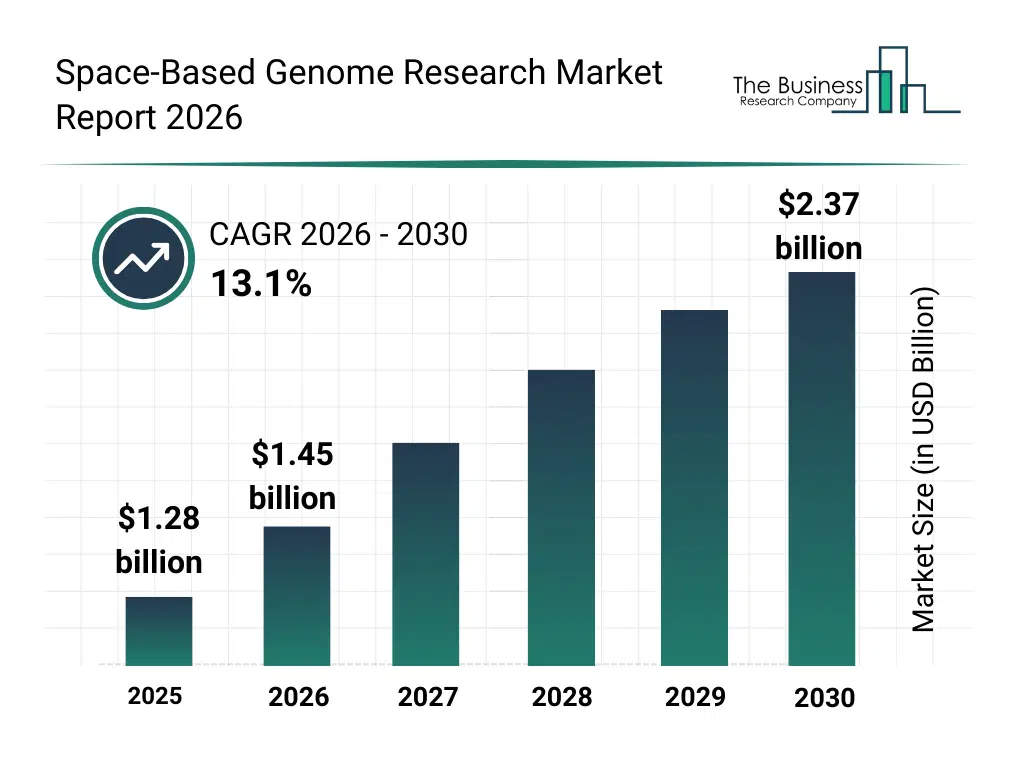
What Is The Space-Based Genome Research Market Size and Share 2026?
The space-based genome research market size has grown rapidly in recent years. It will grow from $1.28 billion in 2025 to $1.45 billion in 2026 at a compound annual growth rate (CAGR) of 13.3%. The growth in the historic period can be attributed to initial human spaceflight biological studies, development of space-compatible laboratory equipment, early genomic sequencing technologies, government-funded space research missions, collaboration between space agencies and research institutes.What Is The Space-Based Genome Research Market Growth Forecast?
The space-based genome research market size is expected to see rapid growth in the next few years. It will grow to $2.37 billion in 2030 at a compound annual growth rate (CAGR) of 13.1%. The growth in the forecast period can be attributed to increasing long-duration space missions, rising investments in space medicine research, expansion of commercial space laboratories, growing use of genomics in personalized medicine, advancements in miniaturized sequencing technologies. Major trends in the forecast period include increasing deployment of space-based genomic experiments, rising use of microgravity sequencing platforms, growing integration of ai in genomic analysis, expansion of space biology research missions, enhanced focus on astronaut health genomics.
Global Space-Based Genome Research Market Segmentation
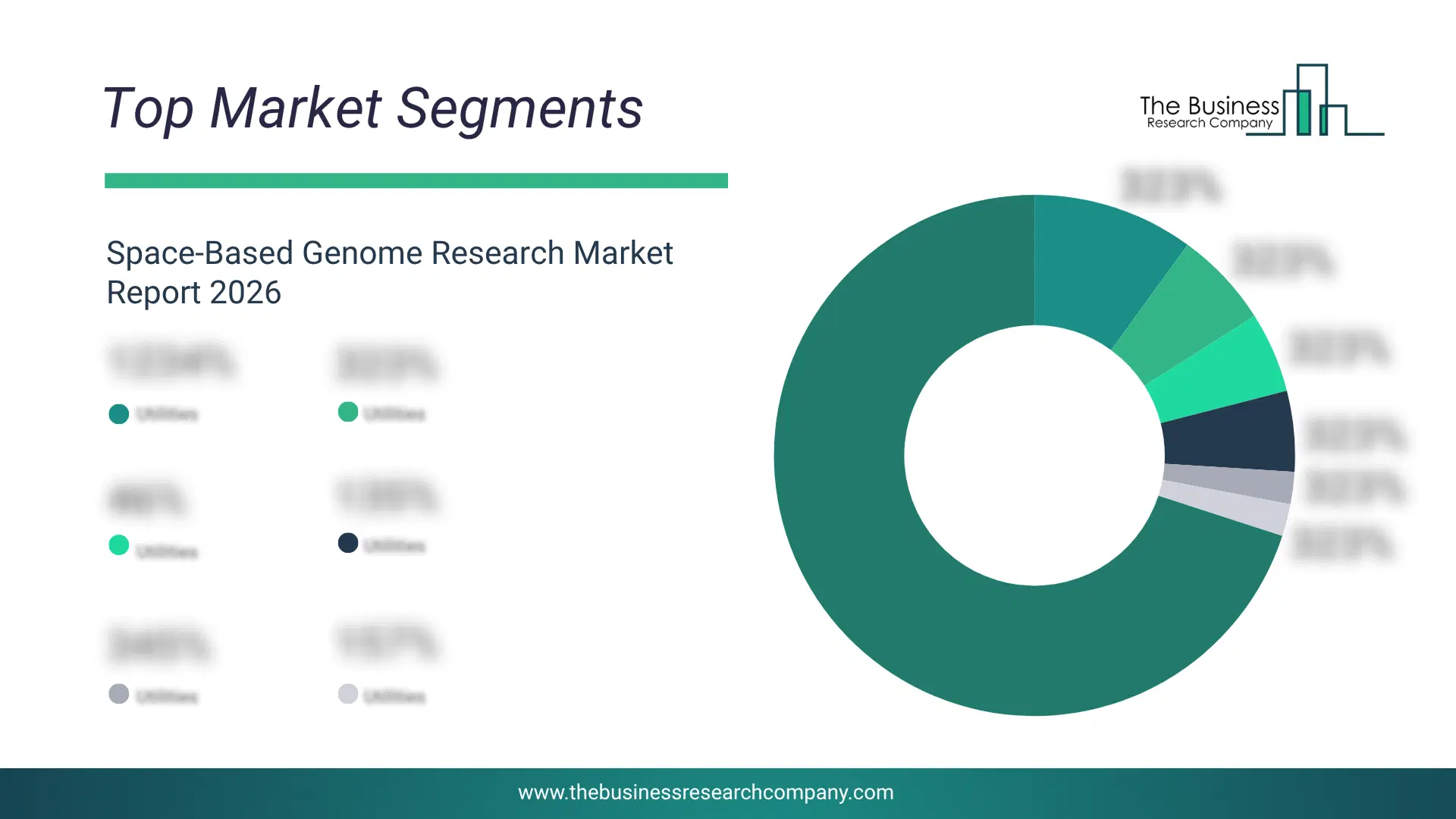
1) By Technology: Sequencing, Polymerase Chain Reaction, Microarray, Other Technologies 2) By Application: Disease Research, Drug Discovery, Personalized Medicine, Other Applications 3) By End-User: Research Institutes, Biotechnology Companies, Pharmaceutical Companies, Other End-Users Subsegments: 1) By Sequencing: Next-Generation Sequencing (NGS), Sanger Sequencing, Nanopore Sequencing, Whole Genome Sequencing, Whole Exome Sequencing, Ribonucleic Acid Sequencing 2) By Polymerase Chain Reaction (PCR): Real-Time Polymerase Chain Reaction (PCR), Digital Polymerase Chain Reaction (PCR), Reverse Transcription Polymerase Chain Reaction (PCR), Multiplex Polymerase Chain Reaction (PCR), Hot Start Polymerase Chain Reaction (PCR) 3) By Microarray: Deoxyribonucleic Acid Microarray, Protein Microarray, Single Nucleotide Polymorphism Microarray, Gene Expression Microarray, Tiling Microarray 4) By Other Technologies: Clustered Regularly Interspaced Short Palindromic Repeats-Based Genomic Tools, Epigenomics, Synthetic Biology Platforms, Biosensors, Lab-On-A-Chip TechnologiesWhat Is The Driver Of The Space-Based Genome Research Market?
The increasing investment in space exploration is expected to propel the growth of the space-based genome research market going forward. Space exploration investment is the financial support governments and private entities provide to advance missions, technologies, and infrastructure to explore and harness space. Space exploration investment is rising due to heightened interest in deep space missions and satellite deployments, which has prompted public and private sectors to increase their budgets for space programs. Investing in space exploration builds the necessary infrastructure and technology to support genome research beyond Earth. It facilitates genetic experiments in space, deepening insights into human biology and driving advancements in space healthcare. For instance, in July 2024, according to the Space Foundation, a US-based nonprofit organization supporting the global space community, in 2023, the global space economy reached $570 billion, marking a 7.4% increase from the revised 2022 total of $531 billion. Therefore, increasing investments in space exploration are driving the growth of the space-based genome research industry.Key Players In The Global Space-Based Genome Research Market
Major Companies operating in the space-based genome research market are The Boeing Company, Cedars-Sinai-Medical-Center, European Space Agency, Japan Aerospace Exploration Agency, Redwire Corporation, Axiom Space Inc., Fresh Gravity Inc., Nanoracks, ResearchSat, SpacePharma, Space Tango, LambdaVision, Orbit Genomics, GeneLab, BioServe, Yuri GmbH, Angiex Inc., Genes in Space, Celestial Immunity, SpaceOMIX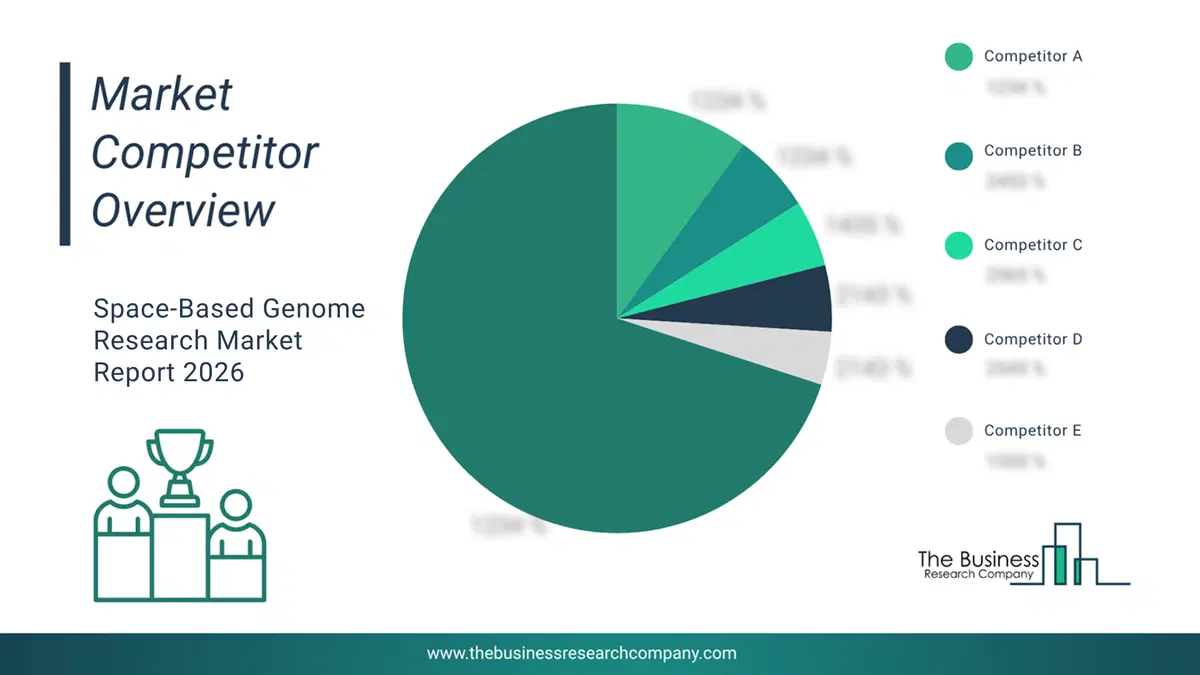
This chart is for illustrative purposes; the full report includes a detailed competitor analysis and comprehensive overview of the top 10 companies in the market.
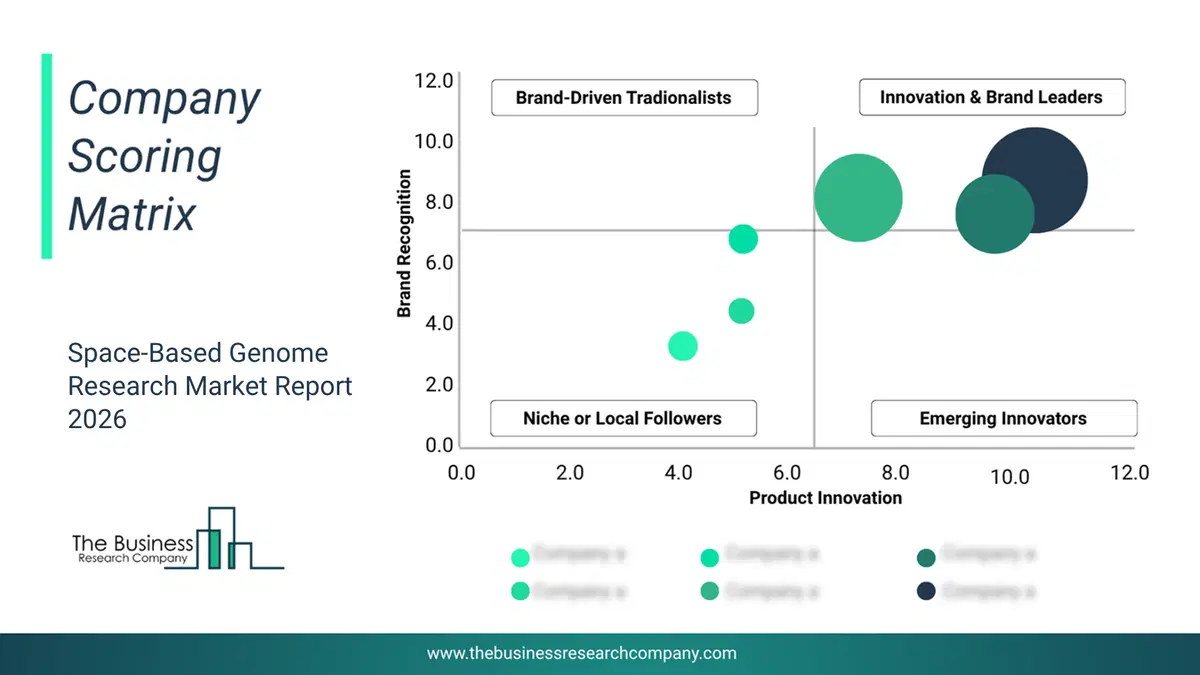
This chart maps companies by product innovation and brand strength, with bubble size indicating relative revenue, helping identify market leaders, challengers, and niche players. This is an illustrative chart; the full report provides a complete and accurate competitive analysis.
Global Space-Based Genome Research Market Trends and Insights
Major companies operating in the space-based genome research market are focusing on developing advanced solutions, such as the genetic research initiative, to enhance biomedical applications and support astronaut health during long-duration missions. A genetic research initiative aims to investigate DNA, genes, and their roles in biological functions and diseases. In space, it examines how conditions like microgravity and radiation impact gene behavior and stability. For instance, in September 2024, ISS National Laboratory, a US-based government-funded national laboratory, is sponsoring a five-month science mission to the orbiting outpost, supporting botanical, cardiac, and genetic research. This mission leverages the unique microgravity environment of the International Space Station to advance studies that could improve life on Earth, such as plant growth, heart health, and genetic analysis.What Are Latest Mergers And Acquisitions In The Space-Based Genome Research Market?
In December 2023, the State of the African Diaspora (SOAD), a Jamaica-based modern political entity, partnered with Spaceomix to pioneer genomics beyond Earth. The partnership aims to conduct the first DNA sequencing experiments beyond low Earth orbit on the Moon and deep space to advance space-based genetic research, unlock new medical insights, and position SOAD and Spaceomix as leaders in interstellar science and space biomedicine. Spaceomix is a Malta-based company specializing in space genomic science.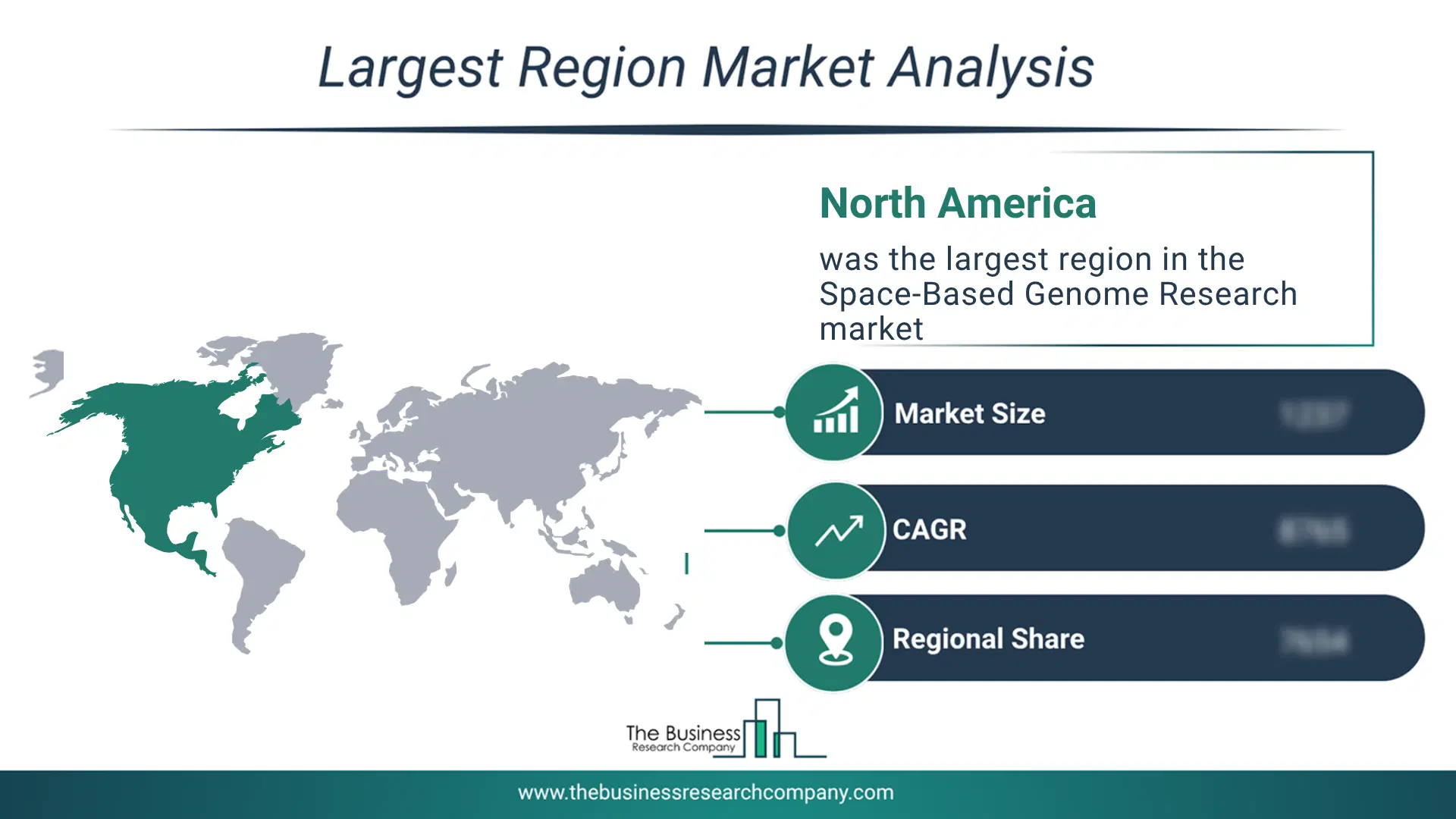
Regional Insights
North America was the largest region in the space-based genome research market in 2025. The regions covered in this market report are Asia-Pacific, South East Asia, Western Europe, Eastern Europe, North America, South America, Middle East, Africa. The countries covered in this market report are Australia, Brazil, China, France, Germany, India, Indonesia, Japan, Taiwan, Russia, South Korea, UK, USA, Canada, Italy, Spain.What Defines the Space-Based Genome Research Market?
The space-based genome research market consists of revenues earned by entities providing services such as gene expression analysis, bioinformatics, and molecular diagnostics. The market value includes the value of related goods sold by the service provider or included within the service offering. The space-based genome research market includes sales of portable DNA or RNA sequencers, space-compatible lab equipment, microfluidic devices, CRISPR-based gene-editing tools, and bioinformatics software. Values in this market are ‘factory gate’ values, that is, the value of goods sold by the manufacturers or creators of the goods, whether to other entities (including downstream manufacturers, wholesalers, distributors, and retailers) or directly to end customers. The value of goods in this market includes related services sold by the creators of the goods.How is Market Value Defined and Measured?
The market value is defined as the revenues that enterprises gain from the sale of goods and/or services within the specified market and geography through sales, grants, or donations in terms of the currency (in USD unless otherwise specified). The revenues for a specified geography are consumption values that are revenues generated by organizations in the specified geography within the market, irrespective of where they are produced. It does not include revenues from resales along the supply chain, either further along the supply chain or as part of other products.
This chart presents market attractiveness based on a quantitative evaluation of growth, competition, strategic alignment, and risk, offering a clear view of opportunity areas for decision-making. This chart is for illustrative purposes; the full report contains the complete analysis.

This chart highlights the Total Addressable Market (TAM) by estimating the maximum revenue opportunity using an assumption-driven approach, supporting strategic planning and opportunity sizing across markets. The chart is illustrative; the full report provides a more comprehensive analysis.
What Key Data and Analysis Are Included in the Space-Based Genome Research Market Report 2026?
The space-based genome research market research report is one of a series of new reports from The Business Research Company that provides market statistics, including industry global market size, regional shares, competitors with the market share, detailed market segments, market trends and opportunities, and any further data you may need to thrive in the space-based genome research industry. The market research report delivers a complete perspective of everything you need, with an in-depth analysis of the current and future state of the industry.Space-Based Genome Research Market Report Forecast Analysis
| Report Attribute | Details |
|---|---|
| Market Size Value In 2026 | $1.45 billion |
| Revenue Forecast In 2030 | $2.37 billion |
| Growth Rate | CAGR of 13.3% from 2026 to 2030 |
| Base Year For Estimation | 2025 |
| Actual Estimates/Historical Data | 2020-2025 |
| Forecast Period | 2026 - 2030 |
| Market Representation | Revenue in USD Billion and CAGR from 2026 to 2030 |
| Segments Covered | Technology, Application, End-User |
| Regional Scope | Asia-Pacific, Western Europe, Eastern Europe, North America, South America, Middle East, Africa |
| Country Scope | The countries covered in the report are Australia, Brazil, China, France, Germany, India, Indonesia, Japan, Taiwan, Russia, South Korea, UK, USA, Canada, Italy, Spain. |
| Key Companies Profiled | The Boeing Company, Cedars-Sinai-Medical-Center, European Space Agency, Japan Aerospace Exploration Agency, Redwire Corporation, Axiom Space Inc., Fresh Gravity Inc., Nanoracks, ResearchSat, SpacePharma, Space Tango, LambdaVision, Orbit Genomics, GeneLab, BioServe, Yuri GmbH, Angiex Inc., Genes in Space, Celestial Immunity, SpaceOMIX |
| Customization Scope | Request for Customization |
| Pricing And Purchase Options | Explore Purchase Options |