
Space-Based Manufacturing Material Market Report 2026
Global Outlook – By Material Type (Metals, Polymers, Ceramics, Composites, Other Material Types), By Manufacturing Process (Additive Manufacturing, Subtractive Manufacturing, Other Manufacturing Processes), By Application (Aerospace, Electronics, Medical, Construction, Other Applications), By End-User (Commercial, Government, Defense) – Market Size, Trends, Strategies, and Forecast to 2030
Space-Based Manufacturing Material Market Overview
• Space-Based Manufacturing Material market size has reached to $1.62 billion in 2025 • Expected to grow to $4.11 billion in 2030 at a compound annual growth rate (CAGR) of 20.3% • Growth Driver: Growing Interest In Space Exploration Fueling The Growth Of The Market Due To Rising Demand For Advanced Materials In Harsh Space Environments • Market Trend: Advancements In On Orbit Bioprinting And Microgravity Materials Processing • North America was the largest region in 2025.What Is Covered Under Space-Based Manufacturing Material Market?
Space-based manufacturing material refers to raw or engineered feedstock metals, ceramics, polymers, or crystals fabricated or processed in orbit using microgravity and vacuum to enable superior material properties or in-space construction. These materials are used to produce high-value products such as fiber optics, semiconductors, and bioengineered tissues that are difficult to manufacture on Earth. The main material types of space-based manufacturing materials include metals, polymers, ceramics, composites, and others. Metals refer to materials composed of elemental metals or metal alloys, known for their strength, durability, and heat resistance. The manufacturing process includes additive manufacturing, subtractive manufacturing, and others. Applications span across aerospace, electronics, medical, construction, and others and are utilized by end-users such as commercial, government, and defense.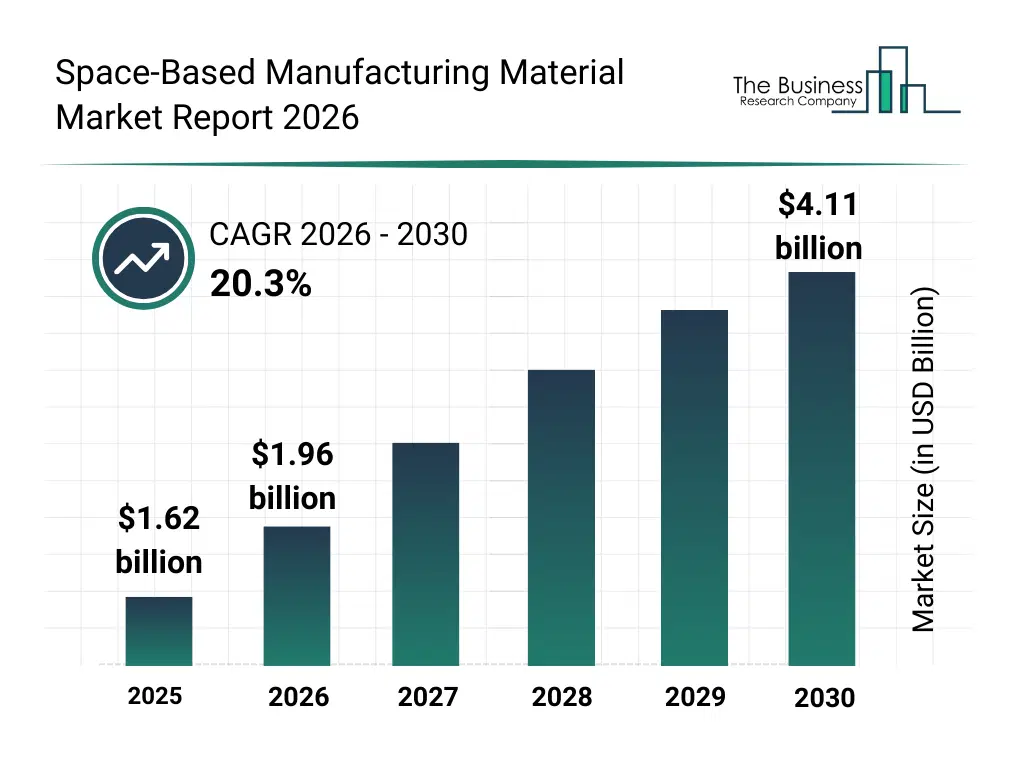
What Is The Space-Based Manufacturing Material Market Size and Share 2026?
The space-based manufacturing material market size has grown exponentially in recent years. It will grow from $1.62 billion in 2025 to $1.96 billion in 2026 at a compound annual growth rate (CAGR) of 21.0%. The growth in the historic period can be attributed to early experiments with microgravity material processing, development of orbital manufacturing prototypes, government and institutional funding for space manufacturing research, advancements in in-space bioprinting and crystal growth, deployment of materials processing payloads on space stations.What Is The Space-Based Manufacturing Material Market Growth Forecast?
The space-based manufacturing material market size is expected to see exponential growth in the next few years. It will grow to $4.11 billion in 2030 at a compound annual growth rate (CAGR) of 20.3%. The growth in the forecast period can be attributed to rising demand for high-value materials produced in microgravity, expansion of in-orbit manufacturing facilities, development of advanced metal alloys and semiconductors in space, growth in space-based bioprinting and tissue engineering, increased collaboration between aerospace companies and material science firms for orbital production. Major trends in the forecast period include in-space fabrication and assembly, microgravity-enhanced material properties, space resource utilization (in-situ resource utilization), advanced additive manufacturing techniques in orbit, high-value biofabrication in microgravity.
Global Space-Based Manufacturing Material Market Segmentation
1) By Material Type: Metals, Polymers, Ceramics, Composites, Other Material Types 2) By Manufacturing Process: Additive Manufacturing, Subtractive Manufacturing, Other Manufacturing Processes 3) By Application: Aerospace, Electronics, Medical, Construction, Other Applications 4) By End-User: Commercial, Government, Defense Subsegments: 1) By Metals: Titanium Alloys, Aluminum Alloys, Stainless Steel, Nickel-based Superalloys, Copper Alloys 2) By Polymers: Polyetheretherketone, Polyimide, Polytetrafluoroethylene, Polycarbonate, Acrylonitrile Butadiene Styrene 3) By Ceramics: Silicon Carbide, Aluminum Oxide, Zirconia, Boron Carbide, Ceramic Matrix Composites 4) By Composites: Carbon Fiber Reinforced Polymer, Glass Fiber Reinforced Polymer, Aramid Fiber Composites, Metal Matrix Composites, Ceramic Matrix Composites 5) By Other Material Types: Aerogels, Shape Memory Alloys, Additive Manufacturing Powders, Elastomers, Conductive InksWhat Is Driver Of The Space-Based Manufacturing Material Market?
The growing interest in space exploration is expected to propel the growth of the space-based manufacturing material market going forward. Space exploration is the discovery and study of outer space through spacecraft, satellites, and advanced technologies, both crewed and uncrewed. The rising interest in space exploration is primarily due to advancements in technology, which have made space missions more feasible and cost-effective. Space exploration uses space-based manufacturing materials to produce components such as satellite parts and structural elements directly in space, reducing launch weight and improving performance. For instance, in April 2025, according to the Space Foundation, a US-based nonprofit organization, the Federal Aviation Administration (FAA) licensed 157 commercial spaceflights in 2024 and projects up to 172 for 2025. Therefore, the growing interest in space exploration is driving the growth of the space-based manufacturing material industry.Key Players In The Global Space-Based Manufacturing Material Market
Major companies operating in the space-based manufacturing material market are Airbus SE, Northrop Grumman Corporation, Blue Origin LLC, Sierra Space Corporation, Redwire Corporation, Aegis Aerospace Inc., Varda Space Industries Inc., Space Forge Ltd., Interlune Corporation, Lidax Group SL, SAB Aerospace SRL, Tethers Unlimited Inc., Astral Materials Inc., L’Garde Inc., Space Tango Inc., SpacePharma SA, Space Cargo Unlimited SAS, Eascra Biotech GmbH, Apsidal SAS, G-Space.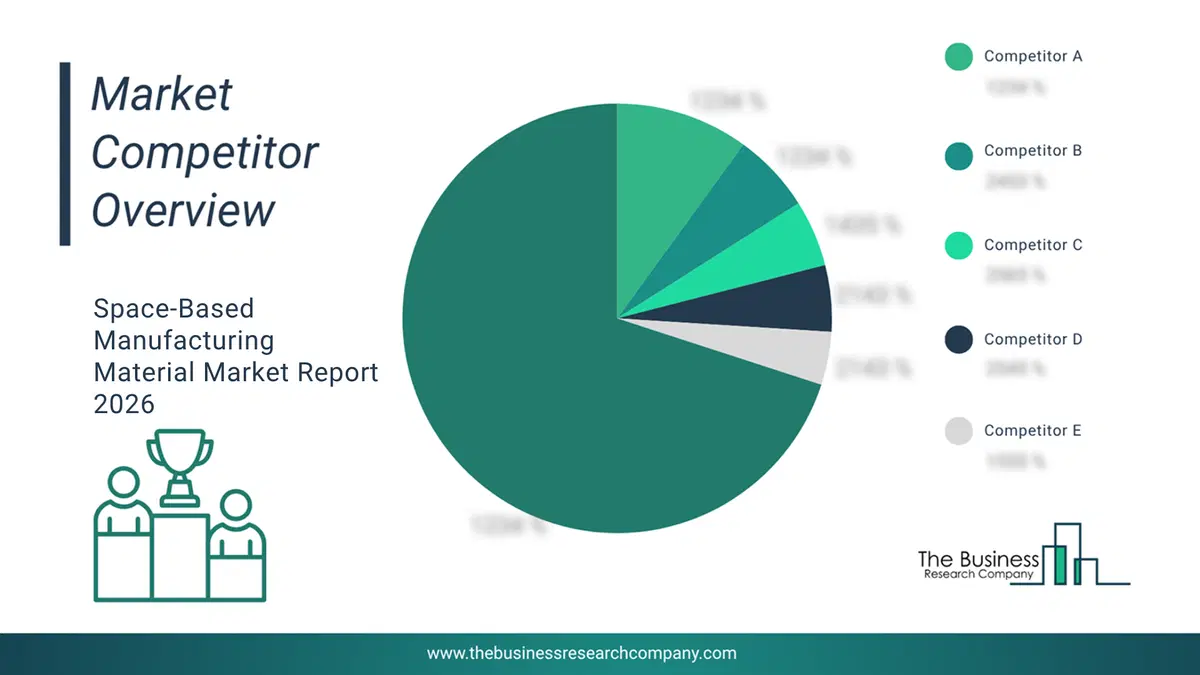
This chart is for illustrative purposes; the full report includes a detailed competitor analysis and comprehensive overview of the top 10 companies in the market.
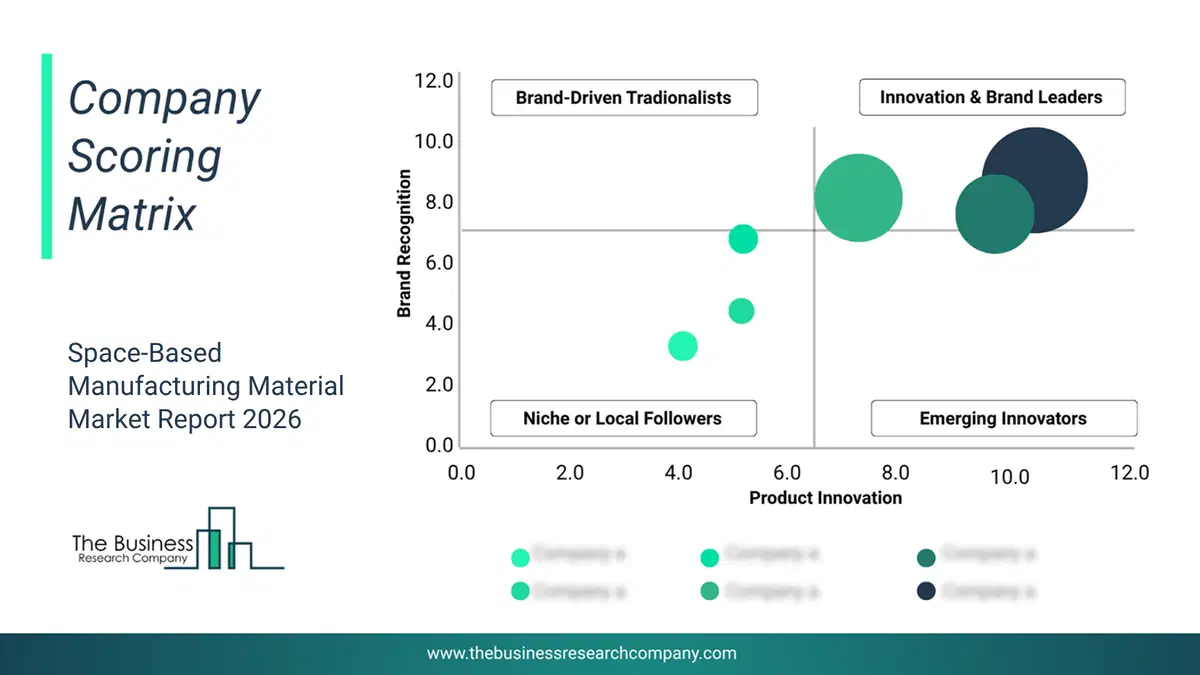
This chart maps companies by product innovation and brand strength, with bubble size indicating relative revenue, helping identify market leaders, challengers, and niche players. This is an illustrative chart; the full report provides a complete and accurate competitive analysis.
Global Space-Based Manufacturing Material Market Trends and Insights
Major companies operating in the space-based manufacturing material market are focusing on biofabrication facilities to develop complex biological tissues and organs in microgravity. A biofabrication facility is an onboard 3D bioprinting platform that uses live human or animal cells and multiple print heads to create complex tissue constructs in microgravity, which are then matured and cultured for return to Earth analysis. For instance, in March 2023, Redwire Corporation, a US-based space infrastructure company, launched an upgraded BioFabrication Facility (BFF) to the International Space Station. The BFF is a 3D bioprinter capable of printing human tissue from bioinks mixed with living cells. This ISS National Lab commercial facility is owned and operated by Redwire Space. The facility's first task was producing a full-sized, 3D printed human meniscus, utilizing live human cells to create complex tissue constructs in microgravity, which were then matured and cultured for return to Earth analysis.What Are Latest Mergers And Acquisitions In The Space-Based Manufacturing Material Market? Applied Aerospace Expands Capabilities With NeXolve Acquisition
In March 2025, Applied Aerospace, a US–based provider of advanced composite structures, metallic assemblies, and precision-engineered components for the aerospace and defense industries, acquired NeXolve for an undisclosed amount. With this acquisition, Applied Aerospace aimed to enhance its technological capabilities by integrating NeXolve’s expertise in deployable space structures and advanced polymer materials, thereby strengthening its position in the space systems market. NeXolve is a US–based provider of deployable space technologies and advanced polymer film materials used in spacecraft components such as sunshields, solar sails, and thin-film structures.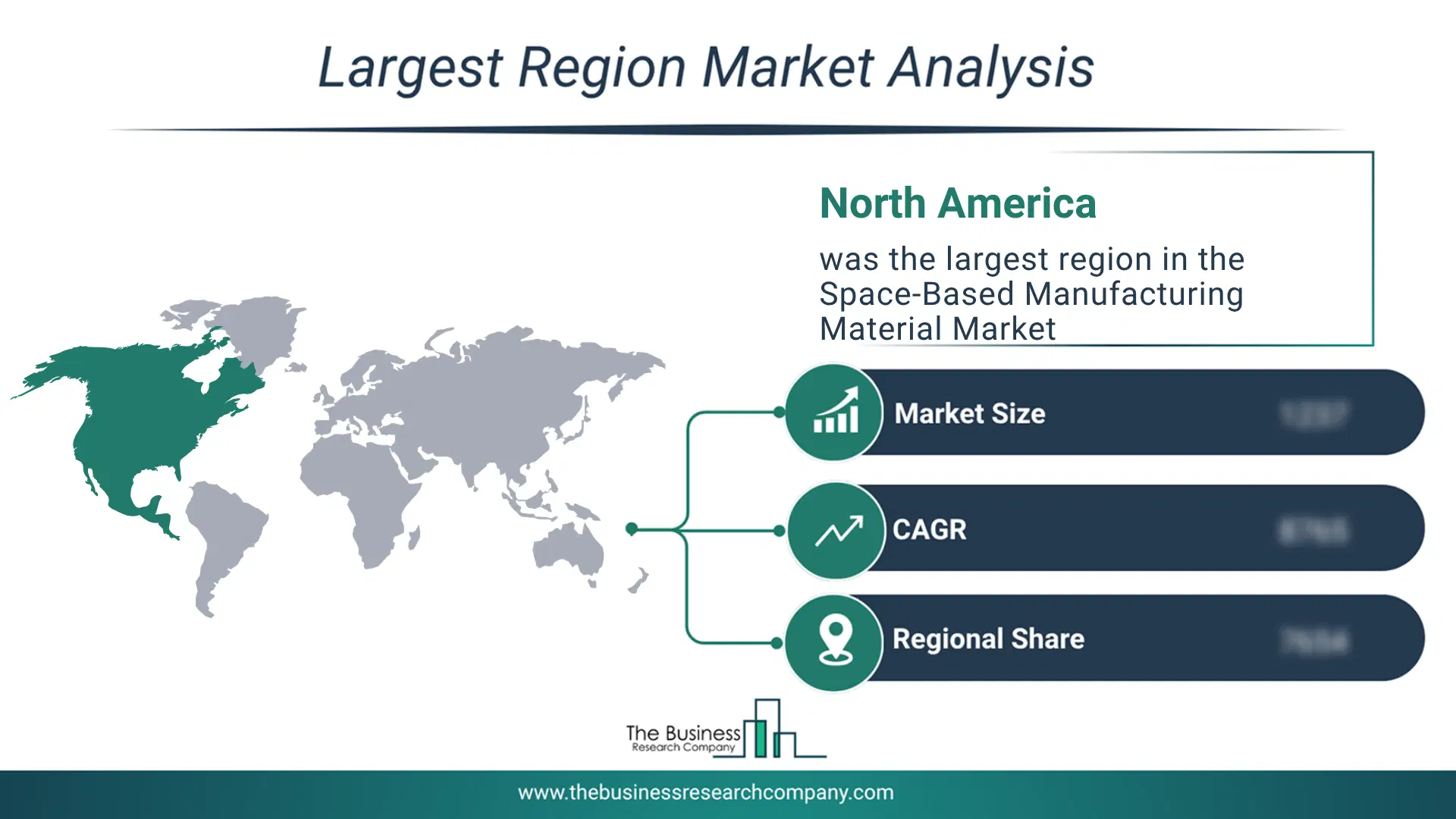
Regional Insights
North America was the largest region in the space-based manufacturing material market in 2025. The regions covered in this market report are Asia-Pacific, South East Asia, Western Europe, Eastern Europe, North America, South America, Middle East, Africa. The countries covered in this market report are Australia, Brazil, China, France, Germany, India, Indonesia, Japan, Taiwan, Russia, South Korea, UK, USA, Canada, Italy, SpainWhat Defines the Space-Based Manufacturing Material Market?
The space-based manufacturing material market also includes sales of bioprinted tissues, metal alloys, and semiconductors. Values in this market are ‘factory gate’ values, that is the value of goods sold by the manufacturers or creators of the goods, whether to other entities (including downstream manufacturers, wholesalers, distributors and retailers) or directly to end customers. The value of goods in this market includes related services sold by the creators of the goods.How is Market Value Defined and Measured?
The market value is defined as the revenues that enterprises gain from the sale of goods and/or services within the specified market and geography through sales, grants, or donations in terms of the currency (in USD unless otherwise specified). The revenues for a specified geography are consumption values that are revenues generated by organizations in the specified geography within the market, irrespective of where they are produced. It does not include revenues from resales along the supply chain, either further along the supply chain or as part of other products.
This chart presents market attractiveness based on a quantitative evaluation of growth, competition, strategic alignment, and risk, offering a clear view of opportunity areas for decision-making. This chart is for illustrative purposes; the full report contains the complete analysis.

This chart highlights the Total Addressable Market (TAM) by estimating the maximum revenue opportunity using an assumption-driven approach, supporting strategic planning and opportunity sizing across markets. The chart is illustrative; the full report provides a more comprehensive analysis.
What Key Data and Analysis Are Included in the Space-Based Manufacturing Material Market Report 2026?
The space-based manufacturing material market research report is one of a series of new reports from The Business Research Company that provides market statistics, including industry global market size, regional shares, competitors with the market share, detailed market segments, market trends and opportunities, and any further data you may need to thrive in the space-based manufacturing material industry. The market research report delivers a complete perspective of everything you need, with an in-depth analysis of the current and future state of the industry.Space-Based Manufacturing Material Market Report Forecast Analysis
| Report Attribute | Details |
|---|---|
| Market Size Value In 2026 | $1.96 billion |
| Revenue Forecast In 2030 | $4.11 billion |
| Growth Rate | CAGR of 20.3% from 2026 to 2030 |
| Base Year For Estimation | 2025 |
| Actual Estimates/Historical Data | 2020-2025 |
| Forecast Period | 2026 - 2030 |
| Market Representation | Revenue in USD Billion and CAGR from 2026 to 2030 |
| Segments Covered | Material Type, Manufacturing Process, Application, End-User |
| Regional Scope | Asia-Pacific, Western Europe, Eastern Europe, North America, South America, Middle East, Africa |
| Country Scope | The countries covered in the space-based manufacturing material market report are Australia, Brazil, China, France, Germany, India, Indonesia, Japan, Taiwan, Russia, South Korea, UK, USA, Canada, Italy, Spain |
| Key Companies Profiled | Airbus SE, Northrop Grumman Corporation, Blue Origin LLC, Sierra Space Corporation, Redwire Corporation, Aegis Aerospace Inc., Varda Space Industries Inc., Space Forge Ltd., Interlune Corporation, Lidax Group SL, SAB Aerospace SRL, Tethers Unlimited Inc., Astral Materials Inc., L’Garde Inc., Space Tango Inc., SpacePharma SA, Space Cargo Unlimited SAS, Eascra Biotech GmbH, Apsidal SAS, G-Space. |
| Customization Scope | Request for Customization |
| Pricing And Purchase Options | Explore Purchase Options |