

Space-Based Missile Defense Interceptor System Market Report 2026
Global Outlook – By Component (Interceptor Satellites, Sensor Payloads, Propulsion Systems, Guidance And Navigation Units), By Orbital Deployment Layer (Low Earth Orbit, Medium Earth Orbit, Geostationary Orbit), By Application (Ballistic Missile Interception, Hypersonic Glide Vehicle Interception, Early Warning And Tracking, Space Domain Defense Integration), By End User (Defense Agencies, Space Command Units, Aerospace And Defense Contractors, Government Research Organizations) – Market Size, Trends, Strategies, and Forecast to 2030
Space-Based Missile Defense Interceptor System Market Overview
• Space-Based Missile Defense Interceptor System market size has reached to $7.96 billion in 2025 • Expected to grow to $15.66 billion in 2030 at a compound annual growth rate (CAGR) of 14.5% • Growth Driver: Rising Defense Budgets And National Security Modernization Programs Fueling The Growth Of The Market Due To Increasing Investment In Advanced Missile Detection And Interception Technologies • Market Trend: Space-Based Interceptor Programs Enhancing Missile Defense Capabilities Through Advanced Orbital Threat Detection And Interception Technologies • North America was the largest region in 2025 and Asia-Pacific is the fastest growing region.What Is Covered Under Space-Based Missile Defense Interceptor System Market?
A space-based missile defense interceptor system refers to a defense platform deployed in space that is designed to detect, track, intercept, and destroy incoming ballistic missiles, hypersonic missiles, or other aerial threats before they reach their targets. These systems use space-based sensors, satellites, interceptor vehicles, and advanced command-and-control technologies to provide early warning, global surveillance, and rapid-response missile interception capabilities. The main components of space-based missile defense interceptor system include interceptor satellites, sensor payloads, propulsion systems, and guidance and navigation units. Interceptor satellites refer to space-based platforms designed to detect, track, and engage missile threats during various phases of flight. These systems are deployed across orbital layers including low earth orbit, medium earth orbit, and geostationary orbit. The key applications of ballistic missile interception, hypersonic glide vehicle interception, early warning and tracking, and space domain defense integration, while the end-users includes defense agencies, space command units, aerospace and defense contractors, and government research organizations.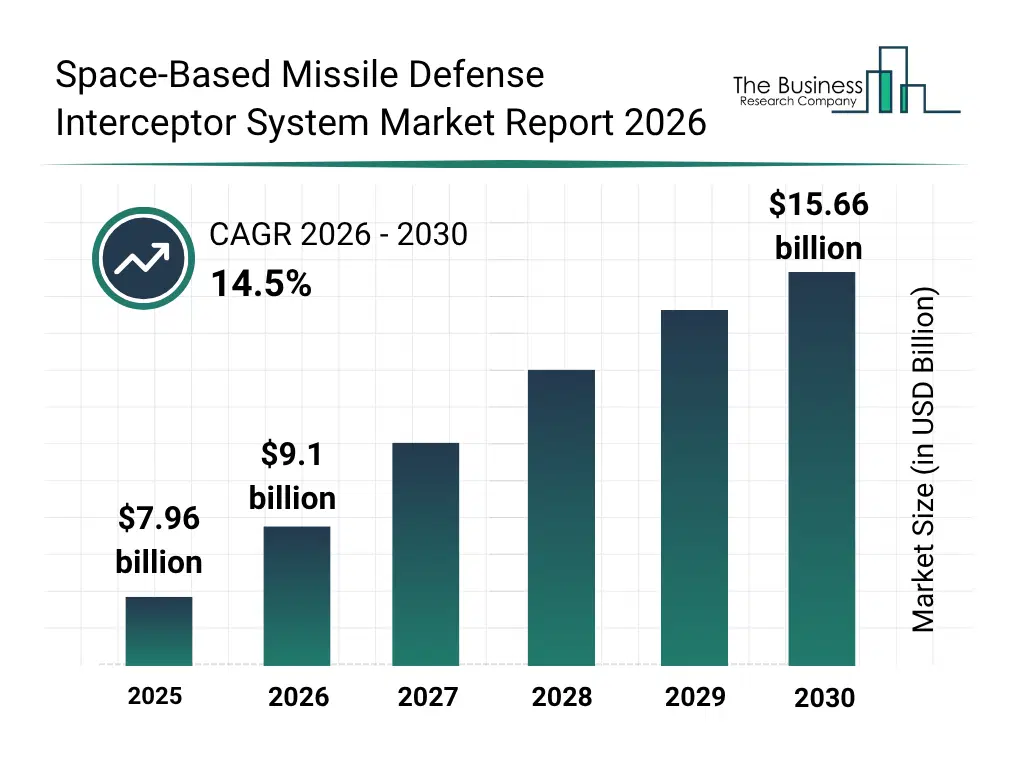
What Is The Space-Based Missile Defense Interceptor System Market Size and Share 2026?
The space-based missile defense interceptor system market size has grown rapidly in recent years. It will grow from $7.96 billion in 2025 to $9.1 billion in 2026 at a compound annual growth rate (CAGR) of 14.3%. The growth in the historic period can be attributed to cold war era missile defense modernization programs, development of early warning radar and satellite surveillance systems, increasing ballistic missile proliferation risks, defense investments in strategic deterrence systems, advancement in space sensor and tracking technologies.What Is The Space-Based Missile Defense Interceptor System Market Growth Forecast?
The space-based missile defense interceptor system market size is expected to see rapidly grown in the next few years. It will grow to $15.66 billion in 2030 at a compound annual growth rate (CAGR) of 14.5%. The growth in the forecast period can be attributed to rising hypersonic missile threats globally, expansion of space militarization programs, increasing adoption of autonomous defense systems, integration of ai-driven command and control systems, growth in multi-domain defense architecture investments. Major trends in the forecast period include ai-enabled autonomous missile interception and target classification systems, space-based hypersonic threat detection and tracking networks, integration of multi-layer satellite defense architectures for global missile shield coverage, development of real-time cloud-enabled command and control systems for missile defense, expansion of predictive threat analytics for ballistic missile trajectory modeling.
Global Space-Based Missile Defense Interceptor System Market Segmentation
1) By Component: Interceptor Satellites; Sensor Payloads; Propulsion Systems; Guidance And Navigation Units 2) By Orbital Deployment Layer: Low Earth Orbit; Medium Earth Orbit; Geostationary Orbit 3) By Application: Ballistic Missile Interception; Hypersonic Glide Vehicle Interception; Early Warning And Tracking; Space Domain Defense Integration 4) By End User: Defense Agencies; Space Command Units; Aerospace And Defense Contractors; Government Research Organizations Subsegments: 1) By Interceptor Satellites: Low Earth Orbit Interceptor Satellites; Medium Earth Orbit Interceptor Satellites; Geostationary Interceptor Satellites; Kinetic Kill Interceptor Satellites 2) By Sensor Payloads: Infrared Sensor Payloads; Radar Sensor Payloads; Electro Optical Sensor Payloads; Multi Sensor Payloads 3) By Propulsion Systems: Chemical Propulsion Systems; Electric Propulsion Systems; Hybrid Propulsion Systems 4) By Guidance And Navigation Units: Inertial Navigation Units; Global Navigation Satellite System Units; Artificial Intelligence Enabled Guidance Units; Autonomous Navigation UnitsWhat Are The Drivers Of The Space-Based Missile Defense Interceptor System Market?
The rising defense budgets and national security modernization programs are expected to propel the growth of the space-based missile defense interceptor system market going forward. Defense budgets and national security modernization programs refer to the planning, allocation, and spending of government funds to maintain and upgrade a country’s military and security capabilities. Defense budgets and national security modernization programs are rising due to increasing geopolitical tensions and evolving security threats, prompting governments to invest in advanced defense technologies and military readiness to strengthen national protection capabilities. Space-based missile defense interceptor systems strengthen national security by enabling early detection and interception of advanced missile threats, driving defense modernization investments, and enhancing strategic military preparedness. For instance, in April 2024, according to a report published by the Stockholm International Peace Research Institute (SIPRI), a Sweden-based international research institute, global military spending reached $2.443 trillion in 2023, marking a 6.8% increase in real terms compared to 2022. Therefore, the rising defense budgets and national security modernization programs are driving the growth of the space-based missile defense interceptor system industry. The increase in the number of satellite launches is expected to propel the growth of the space-based missile defense interceptor system market going forward. Satellite launches refer to the deployment of spacecraft into Earth's orbit or beyond, carried out by government agencies, defense organizations, and commercial entities for a range of strategic, communications, and surveillance purposes. The growing number of satellite launches is largely driven by the rapid expansion of national security space programs, as governments worldwide invest heavily in proliferated low Earth orbit (LEO) constellations to enhance real-time situational awareness and reduce vulnerability to missile threats. Space-based missile defense interceptor systems protect satellites and launch vehicles from missile threats during launch and orbital operations, improving the security and reliability of defense and communication satellite missions. For instance, in January 2024, according to the Space Foundation, a US-based nonprofit organization, global launch activity hit record levels for the third consecutive year, with 223 attempts and 212 successful launches, reflecting a significant rise. Commercial launches surged by 50% compared to 2022, while the United States saw a 33% increase in launch attempts. Therefore, an increase in the number of satellite launches is driving the growth of the space-based missile defense interceptor system industry.Key Players In The Global Space-Based Missile Defense Interceptor System Market
Major companies operating in the space-based missile defense interceptor system market are Lockheed Martin Corporation; RTX Corporation; Northrop Grumman Corporation; The Boeing Company; General Dynamics Corporation; L3Harris Technologies Inc.; Space Exploration Technologies Corp.; BAE Systems plc; Israel Aerospace Industries Ltd.; Kratos Defense & Security Solutions Inc.; Anduril Industries Inc.; Rocket Lab USA Inc.; Moog Inc.; Millennium Space Systems; Palantir Technologies Inc.; Sierra Space Corporation; York Space Systems LLC; Firefly Aerospace Inc.; SciTec Inc.; Aalyria Technologies Inc.; K2 Space Corporation; Impulse Space Inc.; Inversion Space Inc.; Voyager Technologies Inc.; L3Harris Missile SolutionsGlobal Space-Based Missile Defense Interceptor System Market Trends and Insights
Major companies operating in the space-based missile defense interceptor system market are focusing on developing advanced solutions, such as orbital missile interception platforms, to improve real-time threat detection, tracking accuracy, and hypersonic missile defense capabilities. Orbital missile interception platforms refer to space-based defense systems designed to detect, track, and neutralize ballistic and hypersonic missile threats during flight using satellite-enabled interception technologies. For instance, in April 2026, the United States Space Force, a US-based military space service, launched the Space-Based Interceptor program under the Golden Dome initiative to develop orbital interceptor technologies capable of countering advanced missile threats. The program focuses on integrating space-based tracking, targeting, and interception systems to strengthen the national missile defense architecture against rapidly evolving high-speed and maneuverable threats.Regional Outlook
North America was the largest region in the space-based missile defense interceptor system market in 2025. Asia-Pacific is expected to be the fastest-growing region in the forecast period. The regions covered in this market report are Asia-Pacific, South East Asia, Western Europe, Eastern Europe, North America, South America, Middle East, Africa. The countries covered in this market report are Australia, Brazil, China, France, Germany, India, Indonesia, Japan, Taiwan, Russia, South Korea, UK, USA, Canada, Italy, Spain.What Defines the Space-Based Missile Defense Interceptor System Market?
The space-based missile defense interceptor system market consists of sales of kinetic kill interceptors, directed-energy interceptors, hybrid interceptor systems, space-based tracking and targeting satellites, and command and control systems. Values in this market are ‘factory gate’ values, that is, the value of goods sold by the manufacturers or creators of the goods, whether to other entities (including downstream manufacturers, wholesalers, distributors and retailers) or directly to end customers. The value of goods in this market includes related services sold by the creators of the goods.How is Market Value Defined and Measured?
The market value is defined as the revenues that enterprises gain from the sale of goods and/or services within the specified market and geography through sales, grants, or donations in terms of the currency (in USD unless otherwise specified). The revenues for a specified geography are consumption values that are revenues generated by organizations in the specified geography within the market, irrespective of where they are produced. It does not include revenues from resales along the supply chain, either further along the supply chain or as part of other products.What Key Data and Analysis Are Included in the Space-Based Missile Defense Interceptor System Market Report 2026?
The space-based missile defense interceptor system market research report is one of a series of new reports from The Business Research Company that provides market statistics, including industry global market size, regional shares, competitors with the market share, detailed market segments, market trends and opportunities, and any further data you may need to thrive in the space-based missile defense interceptor system industry. The market research report delivers a complete perspective of everything you need, with an in-depth analysis of the current and future state of the industry.Space-Based Missile Defense Interceptor System Market Report Forecast Analysis
| Report Attribute | Details |
|---|---|
| Market Size Value In 2026 | $9.1 billion |
| Revenue Forecast In 2030 | $15.66 billion |
| Growth Rate | CAGR of 14.5% from 2026 to 2030 |
| Base Year For Estimation | 2025 |
| Actual Estimates/Historical Data | 2020-2025 |
| Forecast Period | 2026 - 2030 |
| Market Representation | Revenue in USD Billion and CAGR from 2026 to 2030 |
| Segments Covered | Component, Orbital Deployment Layer, Application, End User |
| Regional Scope | Asia-Pacific, Western Europe, Eastern Europe, North America, South America, Middle East, Africa |
| Country Scope | The countries covered in the report are Australia, Brazil, China, France, Germany, India, ... |
| Key Companies Profiled | Lockheed Martin Corporation; RTX Corporation; Northrop Grumman Corporation; The Boeing Company; General Dynamics Corporation; L3Harris Technologies Inc.; Space Exploration Technologies Corp.; BAE Systems plc; Israel Aerospace Industries Ltd.; Kratos Defense & Security Solutions Inc.; Anduril Industries Inc.; Rocket Lab USA Inc.; Moog Inc.; Millennium Space Systems; Palantir Technologies Inc.; Sierra Space Corporation; York Space Systems LLC; Firefly Aerospace Inc.; SciTec Inc.; Aalyria Technologies Inc.; K2 Space Corporation; Impulse Space Inc.; Inversion Space Inc.; Voyager Technologies Inc.; L3Harris Missile Solutions |
| Customization Scope | Request for Customization |
| Pricing And Purchase Options | Explore Purchase Options |