
Space-Based Nanotechnology Market Report 2026
Global Outlook – By Component (Materials, Devices, Tools, Other Components), By Application (Space Exploration, Satellite Communication, Spacecraft Manufacturing, Other Applications), By End-User (Government, Commercial, Defense, Other End-Users) – Market Size, Trends, Strategies, and Forecast to 2030
Space-Based Nanotechnology Market Overview
• Space-Based Nanotechnology market size has reached to $3.37 billion in 2025 • Expected to grow to $6.61 billion in 2030 at a compound annual growth rate (CAGR) of 14.3% • Growth Driver: The Growing Investment In The Space Industry Is Fueling The Growth Of The Market Due To Increasing Funding For Advanced Space Technologies And Nanomaterial Innovation • Market Trend: Advancing Material Purity and Structural Precision Through Space Manufacturing • North America was the largest region in 2025 and Asia-Pacific is the fastest growing region.What Is Covered Under Space-Based Nanotechnology Market?
Space-based nanotechnology involves the use of nanoscale materials and devices in space systems and missions. Its main goal is to minimize the size and weight of space equipment while enhancing performance, energy efficiency, and durability. This technology enables space missions to collect data more efficiently, explore more effectively, and maintain long-term sustainability in extreme environments. The main component types of space-based nanotechnology are materials, devices, tools, and others. Space-based nanotechnologies are nanoscale-engineered substances that enhance strength, reduce weight, and withstand extreme space conditions. It is applicable in various applications, such as space exploration, satellite communication, spacecraft manufacturing, and others, and is used by several end-users, including government, commercial, defense, and others.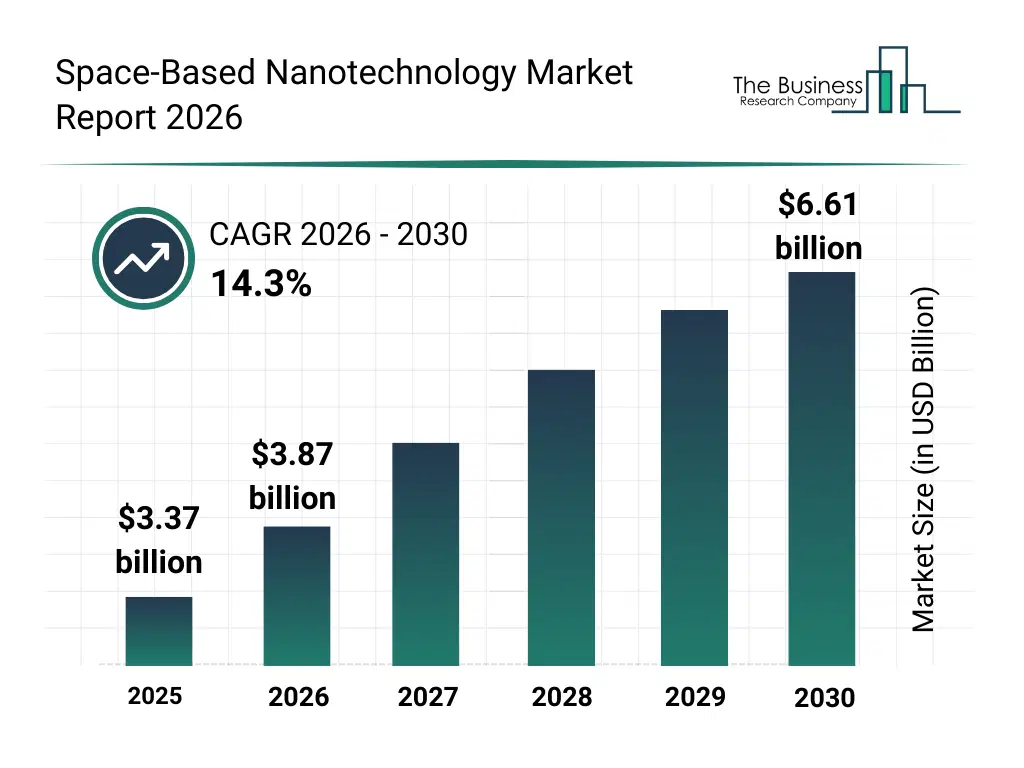
What Is The Space-Based Nanotechnology Market Size and Share 2026?
The space-based nanotechnology market size has grown rapidly in recent years. It will grow from $3.37 billion in 2025 to $3.87 billion in 2026 at a compound annual growth rate (CAGR) of 14.8%. The growth in the historic period can be attributed to early development of nanoscale materials for space applications, integration of nano-engineered sensors in spacecraft, advancements in miniaturized communication modules, government and institutional funding for space nanotechnology research, deployment of nano-optical devices and thermal protection systems in missions.What Is The Space-Based Nanotechnology Market Growth Forecast?
The space-based nanotechnology market size is expected to see rapid growth in the next few years. It will grow to $6.61 billion in 2030 at a compound annual growth rate (CAGR) of 14.3%. The growth in the forecast period can be attributed to rising adoption of nano-engineered batteries and propulsion optimization systems, expansion of autonomous maintenance solutions using nanotechnology, development of advanced nanosensors for real-time monitoring, increased use of miniaturized devices to reduce spacecraft weight and energy consumption, collaboration between aerospace firms and nanotech companies for next-generation space systems. Major trends in the forecast period include miniaturization of spacecraft components, advancement in nano-engineered thermal protection, growth in nano-enhanced propulsion materials, expansion of radiation-resistant nanostructures, increased adoption of nano-optical devices for deep-space sensing.
Global Space-Based Nanotechnology Market Segmentation
1) By Component: Materials, Devices, Tools, Other Components 2) By Application: Space Exploration, Satellite Communication, Spacecraft Manufacturing, Other Applications 3) By End-User: Government, Commercial, Defense, Other End-Users Subsegments: 1) By Materials: Nanocomposites, Nanotubes, Nanowires, Quantum Dots, Nanoparticles, Fullerenes, Aerogels 2) By Devices: Nanosensors, Nanoelectromechanical Systems (NEMS), Nano-Actuators, Nano-Antennas, Nanophotonic Devices 3) By Tools: Atomic Force Microscopes (AFM), Scanning Tunneling Microscopes (STM), Nanolithography Tools, Nanoimprint Equipment, Molecular Beam Epitaxy Systems 4) By Other Components: Coatings And Thin Films, Nano-Structured Insulators, Targeted Drug Delivery Module, Smart Materials For Thermal Regulation, Surface Modification AgentsWhat Is Driver Of The Space-Based Nanotechnology Market?
The growing investment in the space industry is expected to propel the growth of the space-based nanotechnology market going forward. Investment in the space industry refers to the financial commitment from governments and private entities toward space missions, infrastructure, and advanced space technologies. Space industry investment is rising due to the intensifying global competition for space dominance, pushing countries and corporations to boost funding to achieve strategic and technological leadership. Investment in the space industry drives the growth of space-based nanotechnology by supporting research and development and technological innovation. It facilitates the use of advanced nanomaterials in spacecraft, boosting efficiency, durability, and mission outcomes. For instance, in April 2024, according to the World Economic Forum, a Switzerland-based organization, reported that the space economy is projected to reach $1.8 trillion by 2035, up from $630 billion in 2023, driven by advancements in satellite and rocket technologies. Therefore, growing investment in the space industry is driving the growth of the space-based nanotechnology industry.Key Players In The Global Space-Based Nanotechnology Market
Major companies operating in the space-based nanotechnology market are Lockheed Martin, Boeing, Airbus, Northrop Grumman, Toray Industries, L3Harris Technologies, Thales Alenia Space, OHB SE, Blue Canyon Technologies, Pixxel, NanoAvionics, Surrey Satellite Technology Ltd., GomSpace, Nanocomp Technologies, NoPo Nanotechnologies, Exolaunch, LiftPort Group, General Nano, Nanoracks, Raytheon Technologies, Applied Materials, SpaceX, AIST Research Institutes, Quantum Space Systems, Solvay Specialty Polymers
This chart is for illustrative purposes; the full report includes a detailed competitor analysis and comprehensive overview of the top 10 companies in the market.
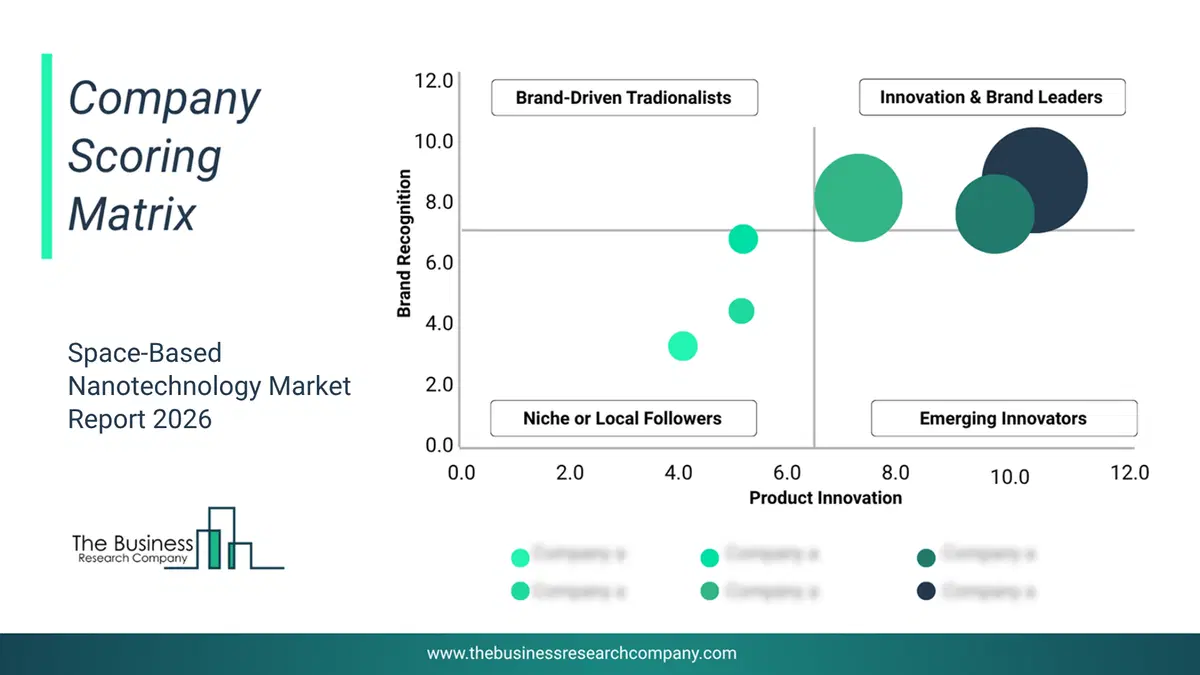
This chart maps companies by product innovation and brand strength, with bubble size indicating relative revenue, helping identify market leaders, challengers, and niche players. This is an illustrative chart; the full report provides a complete and accurate competitive analysis.
Global Space-Based Nanotechnology Market Trends and Insights
Major companies operating in the space-based nanotechnology market are focusing on developing advanced products, such as microgravity manufacturing module to enable the production of high-performance nanomaterials and semiconductors with superior purity and structural precision that are unattainable under Earth’s gravity. A microgravity manufacturing module refers to a specialized space-based platform designed to produce advanced materials and components in the weightless environment of space, where the absence of gravity enhances material purity and structural uniformity. For instance, in June 2025, Space Forge Ltd., a UK-based space technology company, launched ForgeStar-1, aboard SpaceX’s Transporter-14 mission from Vandenberg Space Force Base, is the UK’s first in-space manufacturing satellite, developed entirely in Wales. The mission marks a major milestone for British space innovation, aiming to produce high-performance materials for semiconductor and clean energy applications in microgravity while validating re-entry and recovery technologies for future reusable manufacturing missions.What Are Latest Mergers And Acquisitions In The Space-Based Nanotechnology Market? Carbice Partnered With Blue Canyon Technologies To Boost Thermal Management In Next-Gen Small Satellites
In January 2024, Carbice Corporation, a US-based provider of carbon nanomaterial-based thermal interface material, partnered with Blue Canyon Technologies to power sustainable innovation in space through advanced nanotechnology. The partnership aims to enhance satellite thermal management, reliability, and sustainability by integrating Carbice’s carbon nanotube-based thermal solutions into Blue Canyon’s satellite systems. Blue Canyon Technologies is a US-based aerospace and defense company that specializes in building small satellites.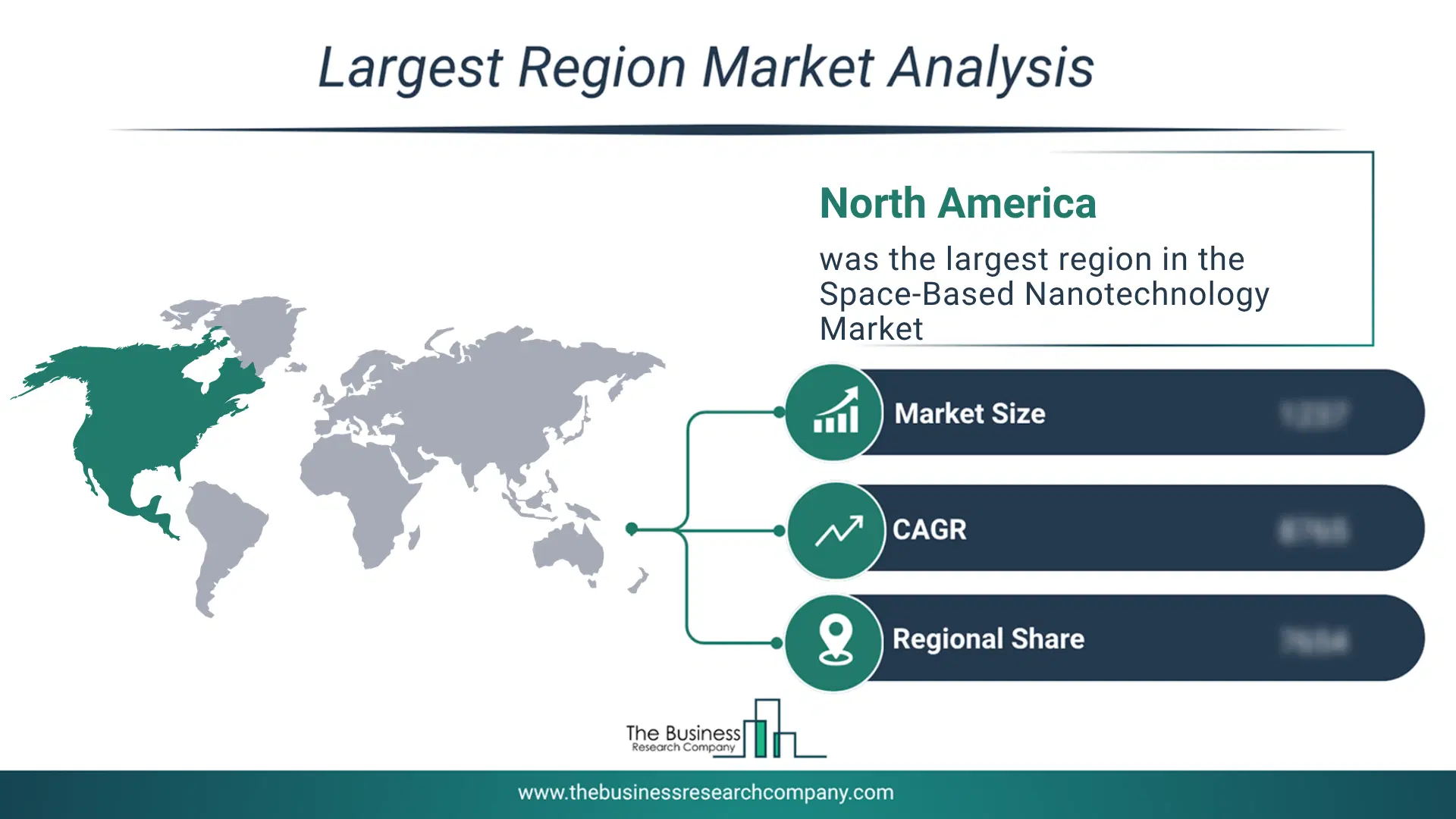
Regional Insights
North America was the largest region in the space-based nanotechnology market in 2025. Asia-Pacific is expected to be the fastest-growing region in the forecast period. The regions covered in this market report are Asia-Pacific, South East Asia, Western Europe, Eastern Europe, North America, South America, Middle East, Africa. The countries covered in this market report are Australia, Brazil, China, France, Germany, India, Indonesia, Japan, Taiwan, Russia, South Korea, UK, USA, Canada, Italy, SpainWhat Defines the Space-Based Nanotechnology Market?
The space-based nanotechnology market consists of revenues earned by entities by providing services such as autonomous maintenance, propulsion system optimization, advanced sensing and monitoring, and data transmission and processing. The market value includes the value of related goods sold by the service provider or included within the service offering. The space-based nanotechnology market also includes sales of sensors, structural materials, thermal protection systems, nano-optical devices, miniaturized communication modules, nano-engineered batteries. Values in this market are ‘factory gate’ values, that is, the value of goods sold by the manufacturers or creators of the goods, whether to other entities (including downstream manufacturers, wholesalers, distributors, and retailers) or directly to end customers. The value of goods in this market includes related services sold by the creators of the goods.How is Market Value Defined and Measured?
The market value is defined as the revenues that enterprises gain from the sale of goods and/or services within the specified market and geography through sales, grants, or donations in terms of the currency (in USD unless otherwise specified). The revenues for a specified geography are consumption values that are revenues generated by organizations in the specified geography within the market, irrespective of where they are produced. It does not include revenues from resales along the supply chain, either further along the supply chain or as part of other products.
This chart presents market attractiveness based on a quantitative evaluation of growth, competition, strategic alignment, and risk, offering a clear view of opportunity areas for decision-making. This chart is for illustrative purposes; the full report contains the complete analysis.

This chart highlights the Total Addressable Market (TAM) by estimating the maximum revenue opportunity using an assumption-driven approach, supporting strategic planning and opportunity sizing across markets. The chart is illustrative; the full report provides a more comprehensive analysis.
What Key Data and Analysis Are Included in the Space-Based Nanotechnology Market Report 2026?
The space-based nanotechnology market research report is one of a series of new reports from The Business Research Company that provides market statistics, including industry global market size, regional shares, competitors with the market share, detailed market segments, market trends and opportunities, and any further data you may need to thrive in the space-based nanotechnology industry. The market research report delivers a complete perspective of everything you need, with an in-depth analysis of the current and future state of the industry.Space-Based Nanotechnology Market Report Forecast Analysis
| Report Attribute | Details |
|---|---|
| Market Size Value In 2026 | $3.87 billion |
| Revenue Forecast In 2030 | $6.61 billion |
| Growth Rate | CAGR of 14.3% from 2026 to 2030 |
| Base Year For Estimation | 2025 |
| Actual Estimates/Historical Data | 2020-2025 |
| Forecast Period | 2026 - 2030 |
| Market Representation | Revenue in USD Billion and CAGR from 2026 to 2030 |
| Segments Covered | Component, Application, End-User |
| Regional Scope | Asia-Pacific, Western Europe, Eastern Europe, North America, South America, Middle East, Africa |
| Country Scope | The countries covered in the space-based nanotechnology market report are Australia, Brazil, China, France, Germany, India, Indonesia, Japan, Taiwan, Russia, South Korea, UK, USA, Canada, Italy, Spain |
| Key Companies Profiled | Lockheed Martin, Boeing, Airbus, Northrop Grumman, Toray Industries, L3Harris Technologies, Thales Alenia Space, OHB SE, Blue Canyon Technologies, Pixxel, NanoAvionics, Surrey Satellite Technology Ltd., GomSpace, Nanocomp Technologies, NoPo Nanotechnologies, Exolaunch, LiftPort Group, General Nano, Nanoracks, Raytheon Technologies, Applied Materials, SpaceX, AIST Research Institutes, Quantum Space Systems, Solvay Specialty Polymers |
| Customization Scope | Request for Customization |
| Pricing And Purchase Options | Explore Purchase Options |