
Space-Based Navigation Market Report 2026
Global Outlook – By Component (Hardware, Software, Services), By Application (Military And Defense, Commercial, Scientific Research, Other Applications), By End-User (Government, Private Sector, Other End Users) – Market Size, Trends, Strategies, and Forecast to 2030
Space-Based Navigation Market Overview
• Space-Based Navigation market size has reached to $16.12 billion in 2025 • Expected to grow to $27.76 billion in 2030 at a compound annual growth rate (CAGR) of 11.4% • Growth Driver: Increasing Number Of Satellite Launches Fueling The Growth Of The Market Due To Rising Demand For Global Connectivity • Market Trend: New Navigation Chip Supports Dual-Frequency For Greater Precision • North America was the largest region in 2025 and Asia-Pacific is the fastest growing region.Market Gains By 2030 – Top Opportunities By Segment
Market Gain identifies the most promising market opportunities by highlighting the segments or products expected to generate the highest incremental revenue growth over the next five years.
What Is Covered Under Space-Based Navigation Market?
Space-based navigation refers to the use of satellite systems to determine precise location, velocity, and timing information anywhere on Earth. It relies on global navigation satellite systems (GNSS) such as global positioning system (GPS), Galileo, GLONASS, and BeiDou. The primary purpose is to enable accurate and reliable positioning for applications in transportation, defense, telecommunications, and everyday navigation. The main components of space-based navigation are hardware, software, and services. Hardware refers to the physical components such as receivers, antennas, processors, transmitters, sensors, and integrated circuits (ICs) that enable the reception, processing, and transmission of satellite navigation signals. It finds applications in military and defense, commercial, scientific research, and others, serving end-users such as government, private sector, and others.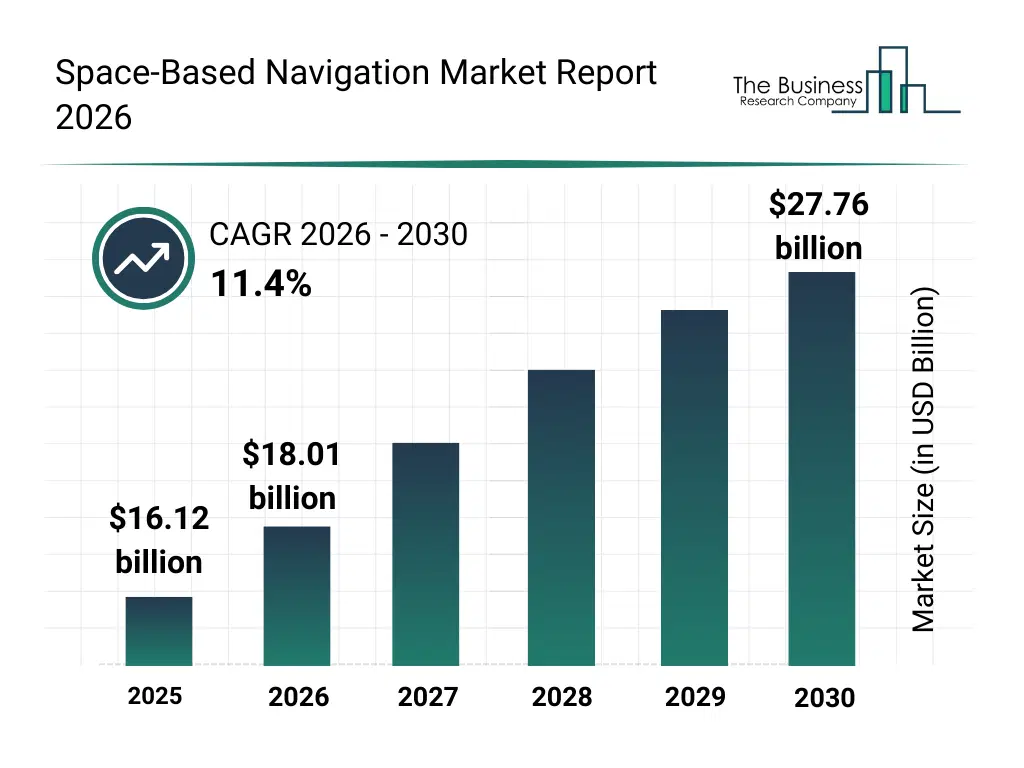
What Is The Space-Based Navigation Market Size and Share 2026?
The space-based navigation market size has grown rapidly in recent years. It will grow from $16.12 billion in 2025 to $18.01 billion in 2026 at a compound annual growth rate (CAGR) of 11.7%. The growth in the historic period can be attributed to deployment of early global navigation satellite systems (GNSS), advancements in satellite signal transmission and reception, government and military funding for space-based navigation programs, development of onboard navigation and timing systems, integration of signal augmentation equipment for improved accuracy.What Is The Space-Based Navigation Market Growth Forecast?
The space-based navigation market size is expected to see rapid growth in the next few years. It will grow to $27.76 billion in 2030 at a compound annual growth rate (CAGR) of 11.4%. The growth in the forecast period can be attributed to expansion of global navigation satellite constellations, rising demand for precise real-time positioning in commercial and defense sectors, adoption of advanced route optimization and geolocation tracking solutions, development of next-generation navigation antennas and onboard systems, increased collaboration between satellite manufacturers and navigation service providers. Major trends in the forecast period include signal augmentation and enhancement technologies, integration of multi-constellation gnss receivers, real-time navigation data analytics and processing, expansion of satellite-based timing synchronization, development of space-based navigation hardware miniaturization.
Global Space-Based Navigation Market Segmentation
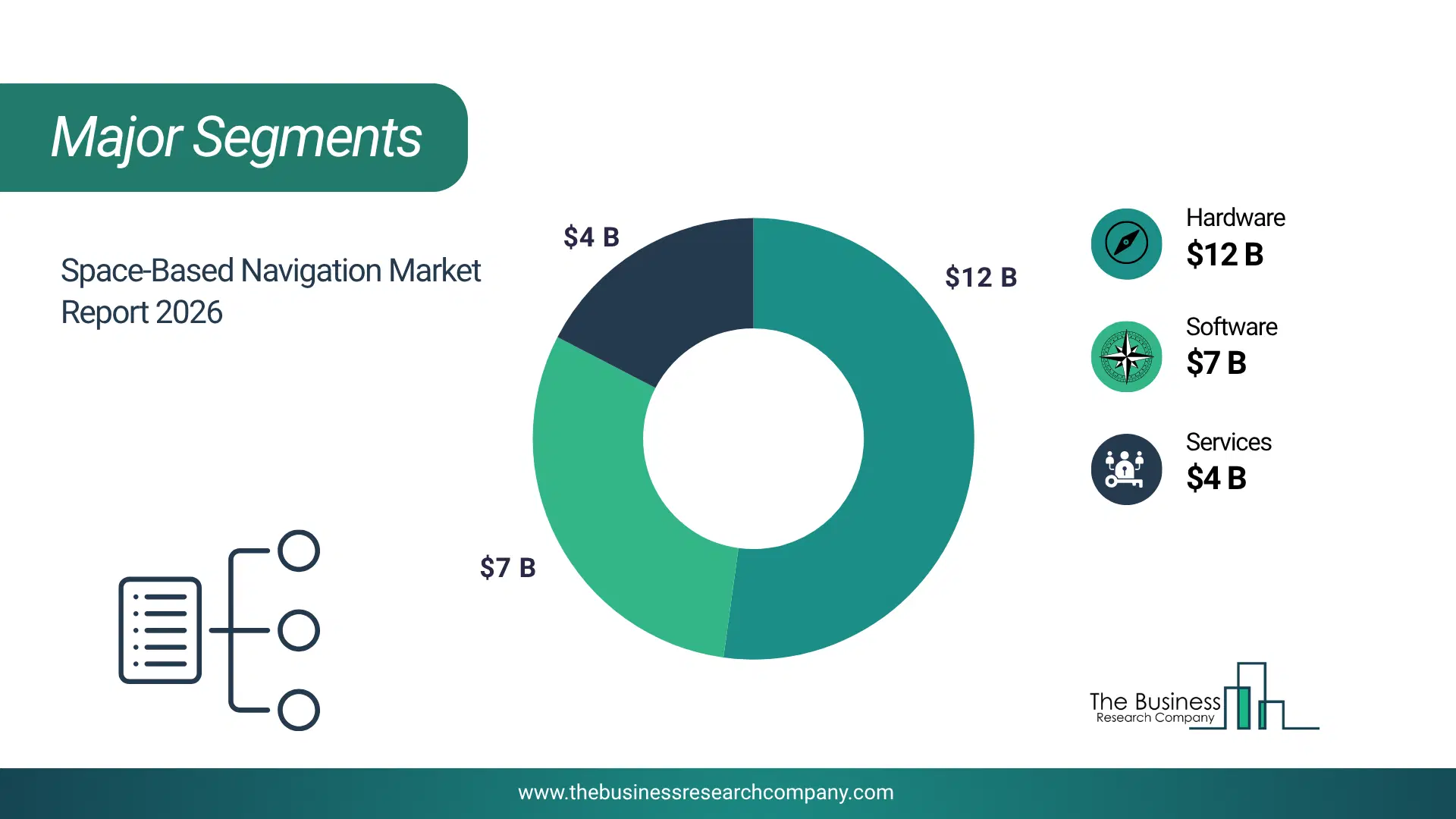
1) By Component: Hardware, Software, Services 2) By Application: Military And Defense, Commercial, Scientific Research, Other Applications 3) By End-User: Government, Private Sector, Other End Users Subsegments: 1) By Hardware: Receivers, Antennas, Processors, Transmitters, Sensors, Integrated Circuits (ICs) 2) By Software: Navigation Algorithms, Simulation And Modeling Software, Data Analytics And Processing Software, Mission Planning Software, User Interface Software, Security Software 3) By Services: System Integration, Consulting And Advisory, Maintenance And Support, Training And Education, Data Management Services, Upgradation And Modernization Services The top segments in the space-based navigation market will be: • Hardware will reach $12.35 Billion by 2030. • Software will reach $7.03 Billion by 2030. • Services will reach $4.43 Billion by 2030.What Is Driver Of The Space-Based Navigation Market?
The increasing number of satellite launches is expected to propel the growth of the space-based navigation market going forward. Satellite launches refer to the process of sending artificial satellites into space using launch vehicles or rockets. The increasing demand for satellite launches is due to the rising need for global connectivity as more regions seek reliable internet access through satellite-based broadband services. Space-based navigation supports satellite launches by enabling precise trajectory planning and in-orbit positioning, ensuring mission accuracy. It enhances launch efficiency by providing real-time tracking and timing, improving the overall reliability of space missions. For instance, in January 2024, according to the Space Foundation, a US-based nonprofit organization, global launch activity hit record levels for the third consecutive year, with 223 launch attempts and 212 successes in 2023, while commercial launches saw a 50% increase compared to 2022. Therefore, the increasing number of satellite launches is driving the growth of the space-based navigation industry.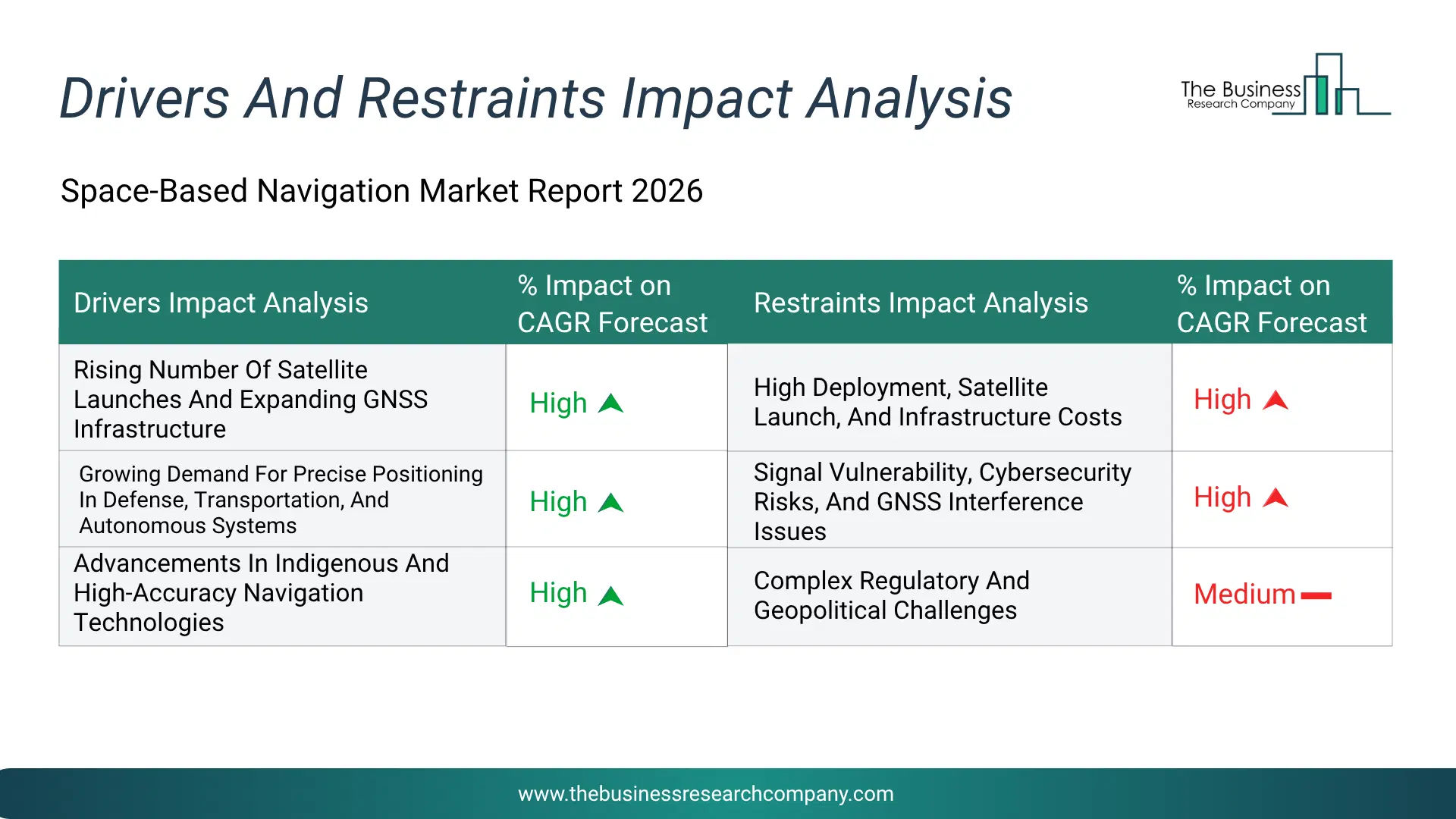
Infographic Chart Showing Key Market Drivers Analysis And Restraints For Space-Based Navigation Market
The chart presents an impact analysis of key drivers and restraints, quantifying their relative influence on the market's growth rate and helping assess the balance between growth enablers and limiting factors. This chart offers a high-level perspective; the full report contains more detailed insights.
How Will The Drivers Impact Growth In The Global Space-Based Navigation Market?
• Rising Number Of Satellite Launches And Expanding GNSS Infrastructure (High) – During the forecast period, the rising number of satellite launches and expanding GNSS infrastructure is expected to become a key growth driver for the space-based navigation market by 2030. Governments and space agencies are increasing investments in satellite constellation deployment to improve navigation coverage, signal reliability, and service availability. The expansion of ground control networks and augmentation systems is further enhancing positioning accuracy across diverse environments. In addition, the growing need for resilient navigation capabilities is encouraging continuous modernization of navigation infrastructure worldwide. • Growing Demand For Precise Positioning In Defense, Transportation, And Autonomous Systems (High) – During the forecast period, the growing demand for precise positioning in defense, transportation, and autonomous systems is expected to emerge as a major factor driving the expansion of the space-based navigation market by 2030. High-accuracy navigation solutions are becoming essential for mission-critical defense operations, intelligent transportation networks, and next-generation autonomous platforms. The increasing reliance on real-time location data for route optimization, operational efficiency, and situational awareness is strengthening demand for advanced navigation services. Furthermore, the adoption of precision navigation technologies across commercial and government sectors continues to accelerate market development. • Advancements In Indigenous And High-Accuracy Navigation Technologies (High) – During the forecast period, the advancements in indigenous and high-accuracy navigation technologies are expected to act as a key growth catalyst for the space-based navigation market by 2030. Countries are increasingly developing sovereign navigation capabilities to reduce dependence on foreign systems and strengthen strategic autonomy. Innovations in signal processing, satellite clock technology, and multi-frequency navigation services are improving accuracy, integrity, and reliability for end users. Additionally, the integration of advanced correction services and augmentation technologies is expanding the range of high-precision applications.How Will The Restraints Impact Growth In The Global Space-Based Navigation Market?
• High Deployment, Satellite Launch, And Infrastructure Costs (High) – During the forecast period, the high deployment, satellite launch, and infrastructure costs act as a major restraint for the space-based navigation market because developing, launching, and maintaining navigation satellites and associated ground infrastructure require substantial capital investment and long development timelines. The costs associated with satellite manufacturing, launch services, system integration, maintenance, and continuous technological upgrades create financial barriers for new entrants and emerging economies. These high expenditures can limit large-scale deployment and slow the adoption of advanced space-based navigation systems across certain regions and industries. • Signal Vulnerability, Cybersecurity Risks, And GNSS Interference Issues (High) – During the forecast period, the signal vulnerability, cybersecurity risks, and GNSS interference issues restrain the growth of the space-based navigation market because navigation systems are highly susceptible to signal jamming, spoofing, cyberattacks, and environmental disruptions that can compromise positioning accuracy and operational reliability. These risks are particularly critical in defense, aviation, maritime, and autonomous vehicle applications where uninterrupted navigation and timing services are essential. Increasing concerns regarding data security, system resilience, and protection against malicious interference are creating operational and regulatory challenges for market participants. • Complex Regulatory And Geopolitical Challenges (High) – During the forecast period, the complex regulatory and geopolitical challenges restrain the growth of the space-based navigation market due to varying international regulations, spectrum allocation policies, satellite coordination requirements, and national security restrictions across different countries. Geopolitical tensions and concerns related to navigation sovereignty, cross-border data control, and dependence on foreign satellite systems can create operational uncertainties and limit international collaboration. These challenges increase compliance complexity and may delay satellite deployment, technology sharing, and large-scale commercialization efforts in the global market.Key Players In The Global Space-Based Navigation Market
Major companies operating in the space-based navigation market are RTX Corporation, Airbus SE, Boeing Company, Lockheed Martin Corporation, Intel Corporation, China Aerospace Science and Technology Corporation, Qualcomm Technologies Inc., Northrop Grumman Corporation, Honeywell International Inc., Broadcom Inc., Thales Group, MediaTek Inc., L3Harris Technologies Inc., STMicroelectronics N.V., Infineon Technologies AG, NXP Semiconductors N.V., Roscosmos, SBG Systems, Indian Space Research Organisation, Aceinna.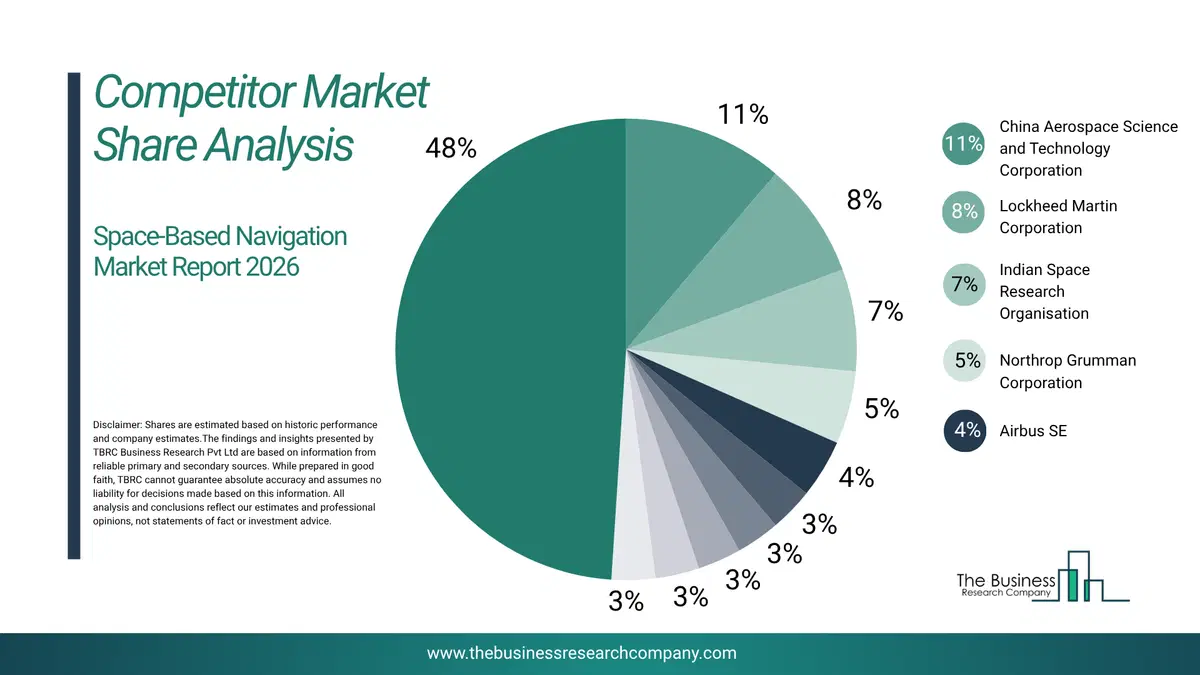
This chart is for illustrative purposes; the full report includes a detailed competitor analysis and comprehensive overview of the top 10 companies in the market.
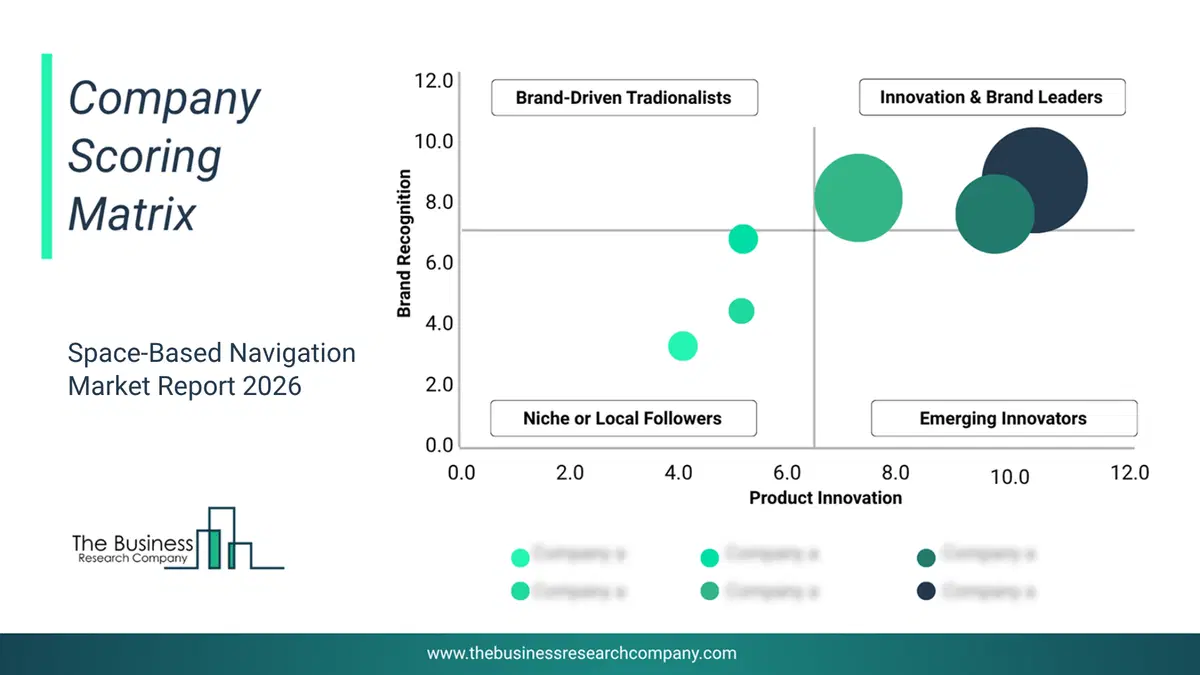
This chart maps companies by product innovation and brand strength, with bubble size indicating relative revenue, helping identify market leaders, challengers, and niche players. This is an illustrative chart; the full report provides a complete and accurate competitive analysis.
Global Space-Based Navigation Market Trends and Insights
Major companies operating in the space-based navigation market are focusing on developing advanced products, such as navigation with Indian constellation (NavIC) chipsets, to enhance accuracy, reduce dependence on foreign systems, and promote self-reliance in global positioning technology. Navigation with Indian constellation (NavIC) chipsets refers to advanced semiconductor components designed to receive and process signals from India's regional satellite navigation system, providing precise positioning and timing services. For instance, in April 2023, Elena Geo Systems, an India-based space technology company, launched the NavIC chip. This compact, multi-core, ultra-low-power chip utilizes India’s own navigation satellite system, NavIC (IRNSS), while also supporting signals from GPS (USA) and GLONASS (Russia). The chipset facilitates dual-frequency operation on both L5 and S bands, which significantly improves location accuracy even in challenging environments such as urban canyons or remote areas. By integrating NavIC into consumer and industrial applications such as smartphones, vehicle tracking systems, and precision agriculture, the chip enhances India's technological sovereignty and provides a competitive alternative to global navigation systems.What Are Latest Mergers And Acquisitions In The Space-Based Navigation Market? Hexagon Expands GNSS Capabilities With Strategic Acquisition Of Septentrio NV
In January 2025, Hexagon AB, a Sweden-based software company, acquired Septentrio NV for an undisclosed amount. With this acquisition, Hexagon’s aim is to drive innovation and expand the market reach of resilient, assured positioning solutions by combining Hexagon’s advanced positioning technologies with Septentrio’s pioneering GNSS platforms. Septentrio NV is a Belgium-based GNSS company specializing in high-precision receivers for space-based navigation.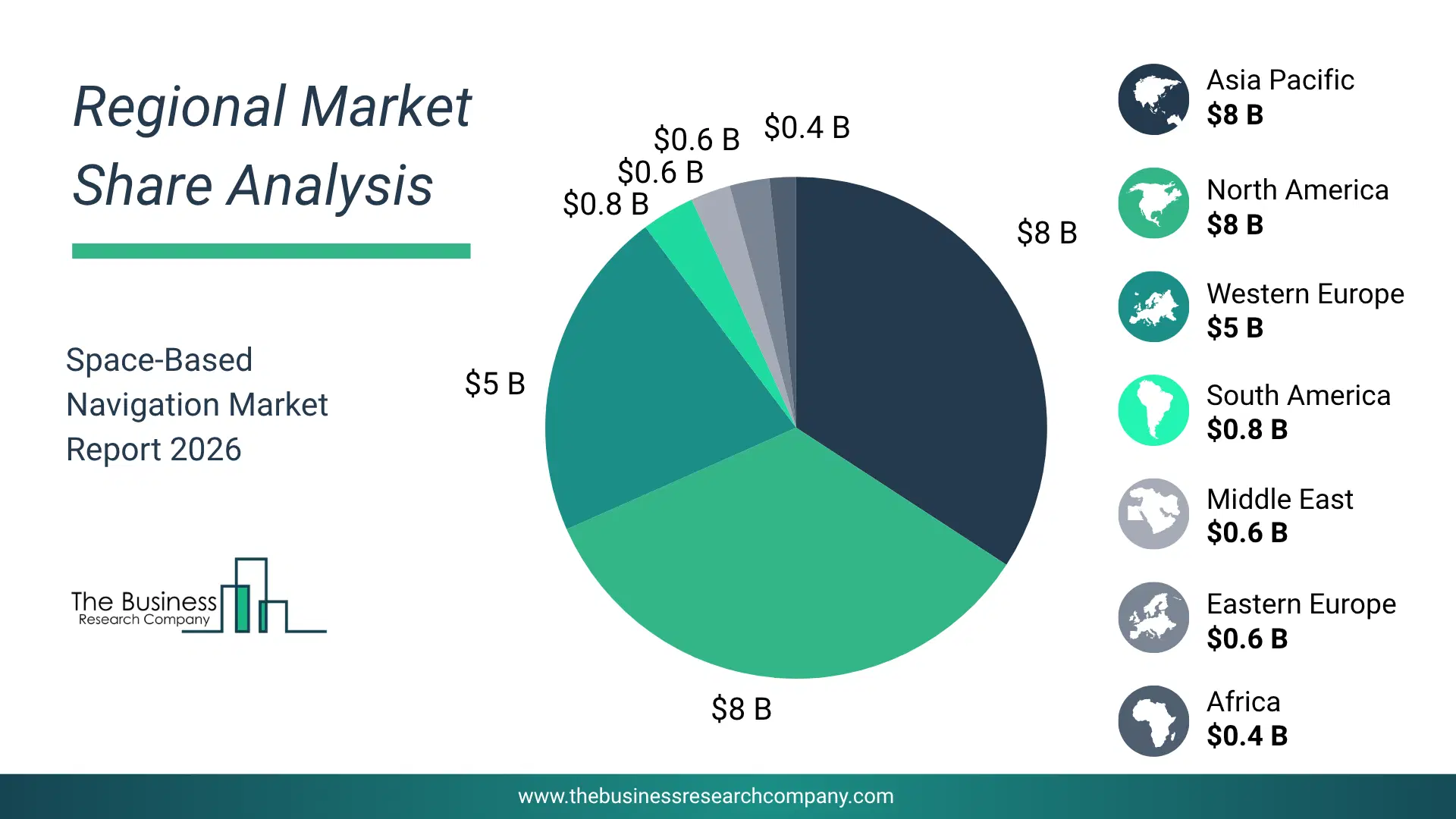
Regional Insights
North America was the largest region in the space-based navigation market in 2025. Asia-Pacific is expected to be the fastest-growing region in the forecast period. The regions covered in the space-based navigation market report are Asia-Pacific, South East Asia, Western Europe, Eastern Europe, North America, South America, Middle East, Africa. The countries covered in the space-based navigation market report are Australia, Brazil, China, France, Germany, India, Indonesia, Japan, Taiwan, Russia, South Korea, UK, USA, Canada, Italy, SpainWhat Defines the Space-Based Navigation Market?
The space-based navigation market consists of revenues earned by entities by providing services such as real-time positioning, navigation guidance, timing synchronization, geolocation tracking, and route optimization. The market value includes the value of related goods sold by the service provider or included within the service offering. The space-based navigation market also includes sales of navigation satellites, antennas, onboard navigation systems, antennas, signal augmentation equipment, and related hardware and software used for positioning, tracking, and timing applications. Values in this market are ‘factory gate’ values, that is, the value of goods sold by the manufacturers or creators of the goods, whether to other entities (including downstream manufacturers, wholesalers, distributors, and retailers) or directly to end customers. The value of goods in this market includes related services sold by the creators of the goods.How is Market Value Defined and Measured?
The market value is defined as the revenues that enterprises gain from the sale of goods and/or services within the specified market and geography through sales, grants, or donations in terms of the currency (in USD unless otherwise specified). The revenues for a specified geography are consumption values that are revenues generated by organizations in the specified geography within the market, irrespective of where they are produced. It does not include revenues from resales along the supply chain, either further along the supply chain or as part of other products.
This chart presents market attractiveness based on a quantitative evaluation of growth, competition, strategic alignment, and risk, offering a clear view of opportunity areas for decision-making. This chart is for illustrative purposes; the full report contains the complete analysis.

This chart highlights the Total Addressable Market (TAM) by estimating the maximum revenue opportunity using an assumption-driven approach, supporting strategic planning and opportunity sizing across markets. The chart is illustrative; the full report provides a more comprehensive analysis.
What Key Data and Analysis Are Included in the Space-Based Navigation Market Report 2026?
The space-based navigation market research report is one of a series of new reports from The Business Research Company that provides market statistics, including industry global market size, regional shares, competitors with the market share, detailed market segments, market trends and opportunities, and any further data you may need to thrive in the space-based navigation industry. The market research report delivers a complete perspective of everything you need, with an in-depth analysis of the current and future state of the industry.Space-Based Navigation Market Report Forecast Analysis
| Report Attribute | Details |
|---|---|
| Market Size Value In 2026 | $18.01 billion |
| Revenue Forecast In 2030 | $27.76 billion |
| Growth Rate | CAGR of 11.7% from 2026 to 2030 |
| Base Year For Estimation | 2025 |
| Actual Estimates/Historical Data | 2020-2025 |
| Forecast Period | 2026 - 2030 |
| Market Representation | Revenue in USD Billion and CAGR from 2026 to 2030 |
| Segments Covered | Component, Application, End-User |
| Regional Scope | Asia-Pacific, Western Europe, Eastern Europe, North America, South America, Middle East, Africa |
| Country Scope | The countries covered in the report are Australia, Brazil, China, France, Germany, India, Indonesia, Japan, Taiwan, Russia, South Korea, UK, USA, Canada, Italy, Spain. |
| Key Companies Profiled | RTX Corporation, Airbus SE, Boeing Company, Lockheed Martin Corporation, Intel Corporation, China Aerospace Science and Technology Corporation, Qualcomm Technologies Inc., Northrop Grumman Corporation, Honeywell International Inc., Broadcom Inc., Thales Group, MediaTek Inc., L3Harris Technologies Inc., STMicroelectronics N.V., Infineon Technologies AG, NXP Semiconductors N.V., Roscosmos, SBG Systems, Indian Space Research Organisation, Aceinna. |
| Customization Scope | Request for Customization |
| Pricing And Purchase Options | Explore Purchase Options |