
Space-Based Precision Agriculture Market Report 2026
Global Outlook – By Component (Hardware, Software, Services), By Technology (Remote Sensing, Global Positioning System (GPS), Geographic Information System (GIS), Satellite Imagery, Other Technologies), By Application (Crop Monitoring, Soil Health Monitoring, Yield Mapping, Irrigation Management, Other Applications), By End-User (Farmers, Agribusinesses, Research Institutions, Other End-Users) – Market Size, Trends, Strategies, and Forecast to 2030
Space-Based Precision Agriculture Market Overview
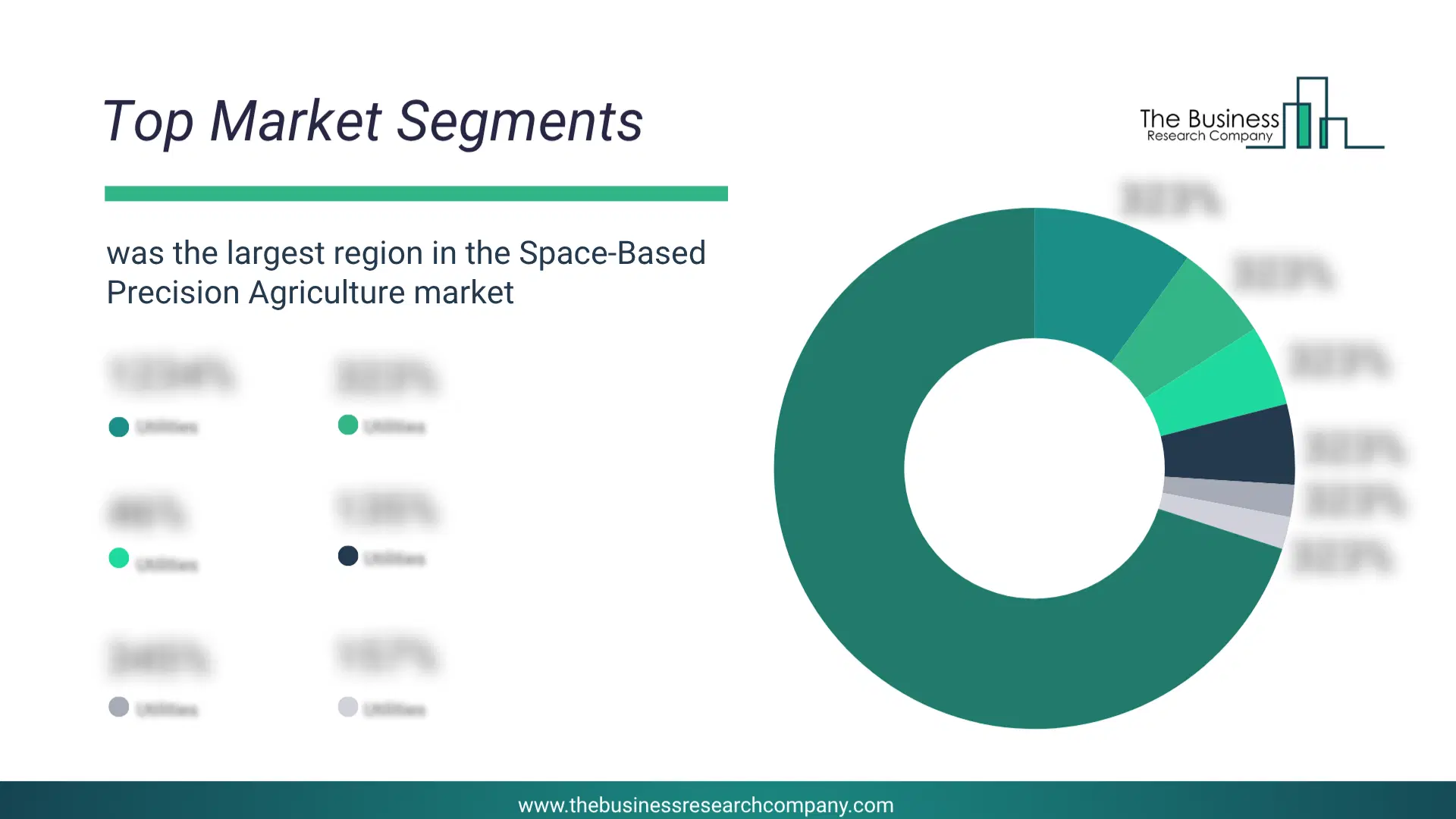
• Space-Based Precision Agriculture market size has reached to $5.55 billion in 2025 • Expected to grow to $9.16 billion in 2030 at a compound annual growth rate (CAGR) of 10.5% • Growth Driver: Increasing Focus On Sustainable Agriculture Is Fueling The Growth Of The Market Due To Its Role In Promoting Eco-Friendly Farming Practices • Market Trend: Advancement In Next-Generation GNSS Receivers Boost Precision And Performance In Agriculture Autoguidance Systems • North America was the largest region in 2025 and Asia-Pacific is the fastest growing region.What Is Covered Under Space-Based Precision Agriculture Market?
Space-based precision agriculture refers to using satellite technologies and space-derived data to enhance agricultural practices' efficiency, productivity, and sustainability. This approach involves the application of satellite imagery, remote sensing, GPS, and geospatial data to monitor crop health, soil conditions, weather patterns, and land usage in real-time. By leveraging this data, farmers and agribusinesses can make informed decisions about planting, irrigation, fertilization, and harvesting, leading to optimized resource use, reduced environmental impact, and increased crop yields. The main components of space-based precision agriculture are hardware, software, and services. Hardware refers to the tangible devices and equipment utilized on farms and satellites to gather and transmit data related to agriculture. It utilizes various technologies, including remote sensing, global positioning systems (GPS), geographic information systems (GIS), satellite imagery, and others for several applications, such as crop monitoring, soil health monitoring, yield mapping, irrigation management, and others. It is used by various end-users, including farmers, agribusinesses, research institutions, and others.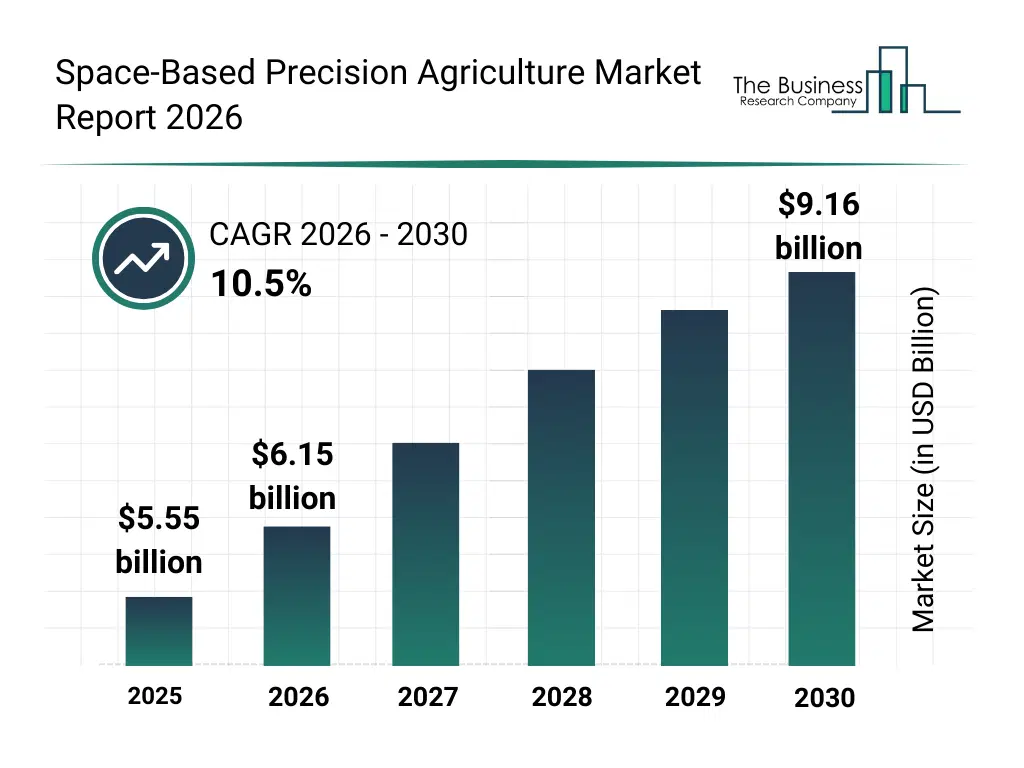
What Is The Space-Based Precision Agriculture Market Size and Share 2026?
The space-based precision agriculture market size has grown rapidly in recent years. It will grow from $5.55 billion in 2025 to $6.15 billion in 2026 at a compound annual growth rate (CAGR) of 10.8%. The growth in the historic period can be attributed to early adoption of remote sensing for agriculture, increasing need for large-scale land monitoring, growing awareness of climate variability impact, reliance on satellite-based mapping systems, rise in government-supported geospatial programs.What Is The Space-Based Precision Agriculture Market Growth Forecast?
The space-based precision agriculture market size is expected to see rapid growth in the next few years. It will grow to $9.16 billion in 2030 at a compound annual growth rate (CAGR) of 10.5%. The growth in the forecast period can be attributed to rising demand for precision agriculture optimization, increasing investment in satellite constellations, growing integration of AI-based geospatial analytics, expansion of global food security initiatives, increasing collaboration between space and agriculture sectors. Major trends in the forecast period include rising use of high-resolution satellite crop analytics, expansion of space-derived weather and soil insights, growing adoption of satellite-based variable rate applications, increased integration of satellite connectivity in farm equipment, growing focus on space-supported climate risk mitigation.
Global Space-Based Precision Agriculture Market Segmentation
1) By Component: Hardware, Software, Services 2) By Technology: Remote Sensing, Global Positioning System (GPS), Geographic Information System (GIS), Satellite Imagery, Other Technologies 3) By Application: Crop Monitoring, Soil Health Monitoring, Yield Mapping, Irrigation Management, Other Applications 4) By End-User: Farmers, Agribusinesses, Research Institutions, Other End-Users Subsegments: 1) By Hardware: Global Navigation Satellite System (GNSS) Or Global Positioning System (GPS) Devices, Satellite Sensors, Remote Sensing Equipment, Yield Monitors, Variable Rate Technology (VRT) Equipment, Control Systems, Display Devices, Drones With Satellite Connectivity, Soil And Weather Sensors 2) By Software: Data Management Software, Imaging And Mapping Software, Farm Management Software, Geospatial Analytics Tools, Variable Rate Application Software, Remote Monitoring And Diagnostic Tools, Artificial Intelligence (AI)-Based Predictive Analytics Platforms 3) By Services: Satellite Imagery And Mapping Services, Data Analytics And Advisory Services, Installation And Integration Services, Maintenance And Support Services, Consulting And Training Services, Data-As-A-Service (DaaS), Cloud-Based Crop Monitoring ServicesWhat Is Driver Of The Space-Based Precision Agriculture Market?
The increasing focus on sustainable agriculture is expected to propel the growth of the space-based precision agriculture market going forward. Sustainable agriculture is a method of farming that fulfills today’s food demands without compromising the health of natural resources and ecosystems for the future. The rise in sustainable agriculture is due to growing environmental concerns, as conventional farming contributes to soil degradation, water scarcity, and climate change, prompting a shift toward eco-friendly practices. Space-based precision agriculture leverages satellite imagery and remote sensing to precisely track crop health, soil, and water conditions. This helps farmers maximize resource efficiency, minimize waste, and boost yields for more sustainable farming. For instance, in December 2023, according to the World Bank Group, a US-based international financial institution, over the next five years, the initiative will assist 30,000 farming households in adopting climate-smart, water-efficient practices, while also providing targeted training and generating around 12,000 jobs. Therefore, the increasing focus on sustainable agriculture is driving the growth of the space-based precision agriculture industry.Key Players In The Global Space-Based Precision Agriculture Market
Major companies operating in the space-based precision agriculture market are Airbus SE, John Deere, CNH Industrial, Maxar Technologies Inc., Planet Labs Inc., ICEYE Ltd., Spire Global Inc., BlackSky Technology Inc., AG Leader Technology, Taranis Inc, CropX Inc., SatSure, OneSoil, Satelligence, Agremo, Gamaya SA, AgriEdge, GeoOptics Inc., Eos Data Analytics, Climate FieldView, Farmonaut Technologies Pvt. Ltd.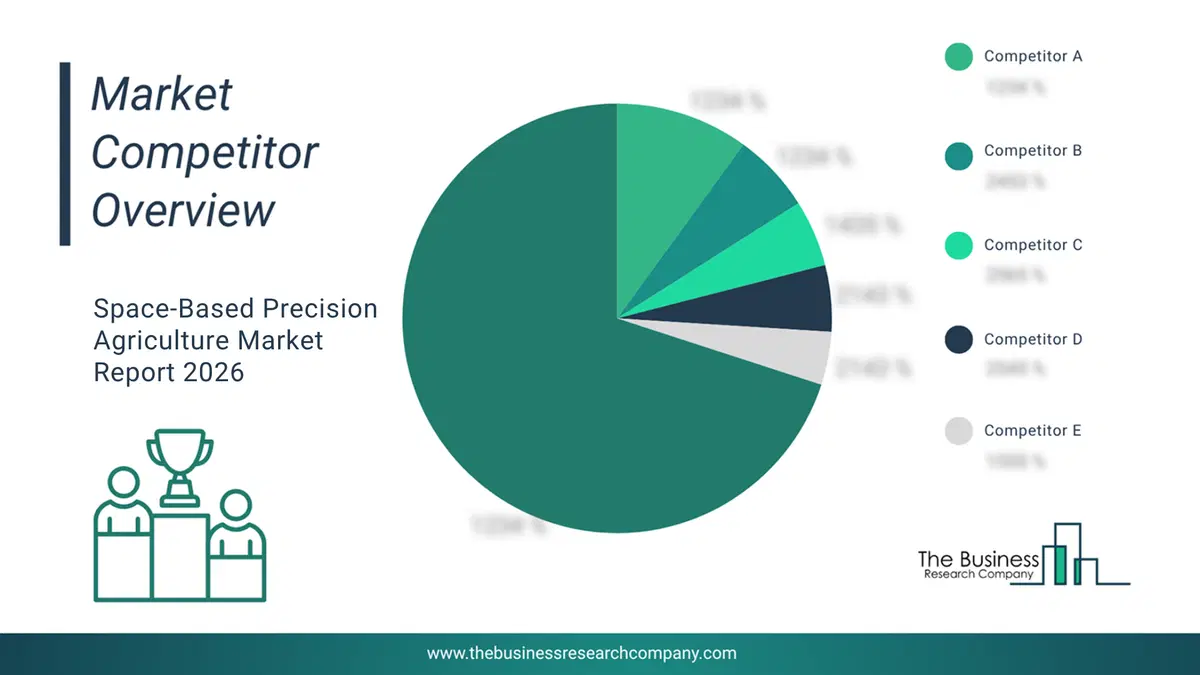
This chart is for illustrative purposes; the full report includes a detailed competitor analysis and comprehensive overview of the top 10 companies in the market.
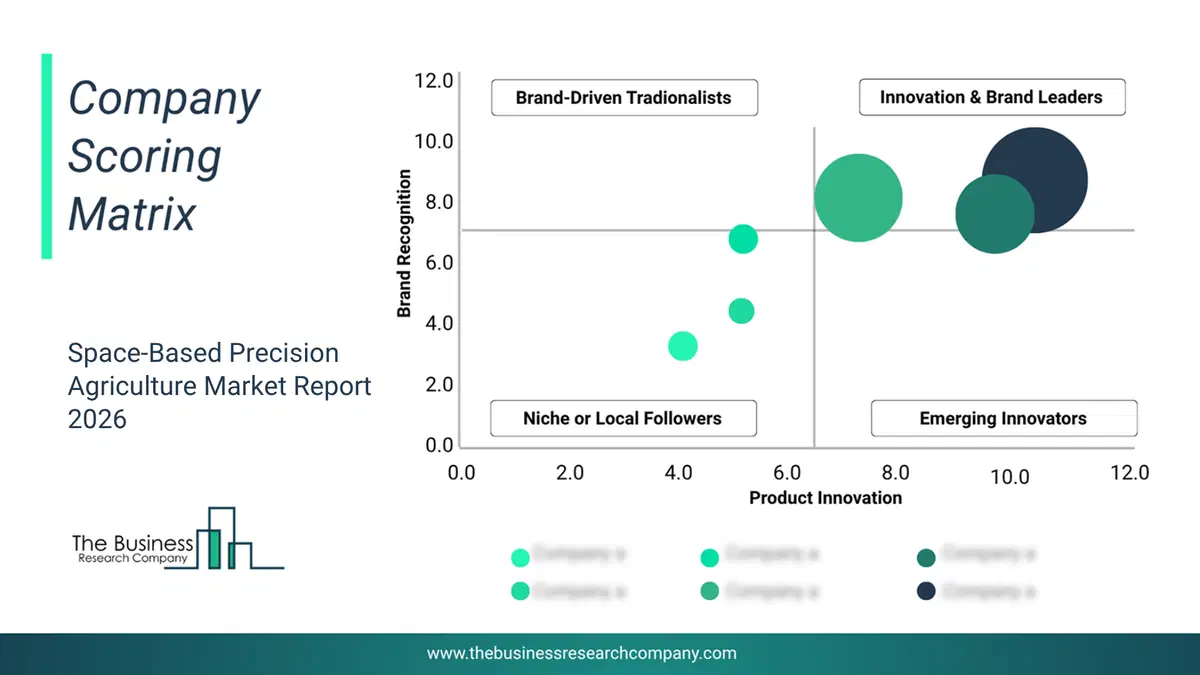
This chart maps companies by product innovation and brand strength, with bubble size indicating relative revenue, helping identify market leaders, challengers, and niche players. This is an illustrative chart; the full report provides a complete and accurate competitive analysis.
Global Space-Based Precision Agriculture Market Trends and Insights
Major companies operating in the space-based precision agriculture market are focused on developing advanced product innovations, such as global navigation satellite system (GNSS) receivers, to enhance field mapping accuracy and boost yields while reducing input costs. A global navigation satellite system (GNSS) receiver is a device that captures satellite signals to pinpoint exact location and timing, providing precise navigation and positioning essential for applications such as precision agriculture. For instance, in April 2025, PTx Trimble, a US-based provider of connected precision farming solutions, introduced NAV-960, a next-generation guidance controller. It is designed for precision autoguidance in agriculture, offering significant upgrades over its predecessor, the NAV-900, such as enhanced processing power, improved positioning accuracy (up to 50% better vehicle positioning and line following), and robust performance in harsh environments. Key features include advanced inertial sensors, the latest GNSS engine, onboard Trimble ProPoint and IonoGuard technology for resistance to solar interference, centimeter-level accuracy with correction signals, and full compatibility with existing PTx Trimble steering systems and GFX displays.What Are Latest Mergers And Acquisitions In The Space-Based Precision Agriculture Market? AGCO Partnered With Trimble To Launch PTx Trimble To Revolutionize Precision Agriculture
In September 2023, AGCO Corporation, a US-based agricultural machinery company, partnered with Trimble Inc. to form a new company called PTx Trimble. The partnership aims to create an industry-leading, mixed-fleet precision agriculture platform by combining Trimble’s precision ag business and AGCO’s JCA Technologies, enabling farmers worldwide to access advanced, next-generation precision agriculture tools and solutions, thus accelerating innovation and supporting greater productivity, profitability, and sustainability in farming. Trimble Inc. is a US-based company involved in space-based precision agriculture through its GNSS (Global Navigation Satellite System) technology and related services.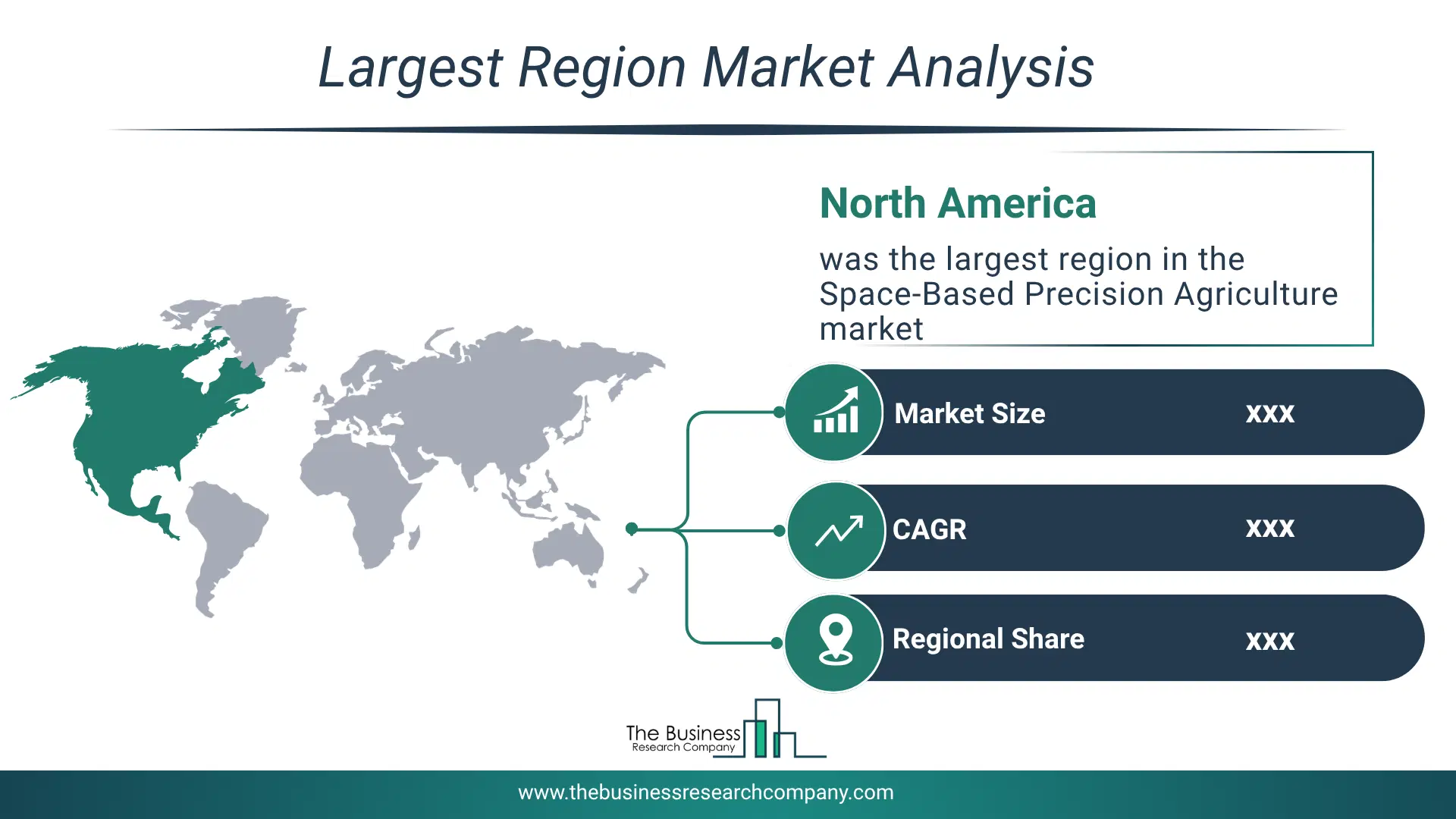
Regional Outlook
North America was the largest region in the space-based precision agriculture market in 2025. Asia-Pacific is expected to be the fastest-growing region in the forecast period. The regions covered in this market report are Asia-Pacific, South East Asia, Western Europe, Eastern Europe, North America, South America, Middle East, Africa. The countries covered in this market report are Australia, Brazil, China, France, Germany, India, Indonesia, Japan, Taiwan, Russia, South Korea, UK, USA, Canada, Italy, SpainWhat Defines the Space-Based Precision Agriculture Market?
The space-based precision agriculture market consists of revenues earned by entities providing services such as pest and disease detection, nutrient management, weather forecasting and climate monitoring and carbon sequestration monitoring. The market value includes the value of related goods sold by the service provider or included within the service offering. The space-based precision agriculture market includes sales of earth observation satellites, global navigation satellite system (GNSS) -enabled devices, satellite receivers, and integrated sensors used in agricultural equipment. Values in this market are ‘factory gate’ values, that is, the value of goods sold by the manufacturers or creators of the goods, whether to other entities (including downstream manufacturers, wholesalers, distributors, and retailers) or directly to end customers. The value of goods in this market includes related services sold by the creators of the goods.How is Market Value Defined and Measured?
The market value is defined as the revenues that enterprises gain from the sale of goods and/or services within the specified market and geography through sales, grants, or donations in terms of the currency (in USD unless otherwise specified). The revenues for a specified geography are consumption values that are revenues generated by organizations in the specified geography within the market, irrespective of where they are produced. It does not include revenues from resales along the supply chain, either further along the supply chain or as part of other products.
This chart presents market attractiveness based on a quantitative evaluation of growth, competition, strategic alignment, and risk, offering a clear view of opportunity areas for decision-making. This chart is for illustrative purposes; the full report contains the complete analysis.

This chart highlights the Total Addressable Market (TAM) by estimating the maximum revenue opportunity using an assumption-driven approach, supporting strategic planning and opportunity sizing across markets. The chart is illustrative; the full report provides a more comprehensive analysis.
What Key Data and Analysis Are Included in the Space-Based Precision Agriculture Market Report 2026?
The space-based precision agriculture market research report is one of a series of new reports from The Business Research Company that provides market statistics, including industry global market size, regional shares, competitors with the market share, detailed market segments, market trends and opportunities, and any further data you may need to thrive in the space-based precision agriculture industry. The market research report delivers a complete perspective of everything you need, with an in-depth analysis of the current and future state of the industry.Space-Based Precision Agriculture Market Report Forecast Analysis
| Report Attribute | Details |
|---|---|
| Market Size Value In 2026 | $6.15 billion |
| Revenue Forecast In 2030 | $9.16 billion |
| Growth Rate | CAGR of 10.5% from 2026 to 2030 |
| Base Year For Estimation | 2025 |
| Actual Estimates/Historical Data | 2020-2025 |
| Forecast Period | 2026 - 2030 |
| Market Representation | Revenue in USD Billion and CAGR from 2026 to 2030 |
| Segments Covered | Component, Technology, Application, End-User |
| Regional Scope | Asia-Pacific, Western Europe, Eastern Europe, North America, South America, Middle East, Africa |
| Country Scope | The countries covered in the report are Australia, Brazil, China, France, Germany, India, Indonesia, Japan, Taiwan, Russia, South Korea, UK, USA, Canada, Italy, Spain |
| Key Companies Profiled | Airbus SE, John Deere, CNH Industrial, Maxar Technologies Inc., Planet Labs Inc., ICEYE Ltd., Spire Global Inc., BlackSky Technology Inc., AG Leader Technology, Taranis Inc, CropX Inc., SatSure, OneSoil, Satelligence, Agremo, Gamaya SA, AgriEdge, GeoOptics Inc., Eos Data Analytics, Climate FieldView, Farmonaut Technologies Pvt. Ltd. |
| Customization Scope | Request for Customization |
| Pricing And Purchase Options | Explore Purchase Options |