
Space-Based Solar Arrays Market Report 2026
Global Outlook – By Component (Solar Panels, Power Transmission Systems, Energy Storage Systems, Other Components), By Deployment (Low Earth Orbit, Medium Earth Orbit, Geostationary Orbit, Other Deployments ), By Application (Commercial, Defense, Other Applications), By End-User (Government, Private Sector, Other End-Users) – Market Size, Trends, Strategies, and Forecast to 2030
Space-Based Solar Arrays Market Overview
• Space-Based Solar Arrays market size has reached to $3.31 billion in 2025 • Expected to grow to $5.88 billion in 2030 at a compound annual growth rate (CAGR) of 12.1% • Growth Driver: Rising Demand For Sustainable Energy Solutions Fueling The Growth Of The Market Due To Increasing Climate Awareness And Renewable Energy Adoption • Market Trend: Advancements in Space-Based Solar Power Transmission Technologies • North America was the largest region in 2025 and Asia-Pacific is the fastest growing region.What Is Covered Under Space-Based Solar Arrays Market?
Space-based solar arrays refer to solar power generation systems located in space (typically in Earth orbit) that capture solar energy and transmit it wirelessly to Earth for use as electricity. Space-based solar arrays utilize orbiting satellites equipped with solar panels to capture uninterrupted solar energy in space and transmit it wirelessly, typically via microwave or laser beams, to ground-based receiving stations, where it is converted into usable electricity. The main components of space-based solar arrays are solar panels, power transmission systems, energy storage systems, and others. Solar panels, composed of photovoltaic (PV) cells, serve as the primary energy-harvesting units by converting sunlight into direct current (DC) electricity. These arrays can be deployed in various orbits, including low Earth orbit (LEO), medium Earth orbit (MEO), geostationary orbit (GEO), and others. Their applications are in commercial, defense, and other areas and are utilized by governments, private enterprises, and others.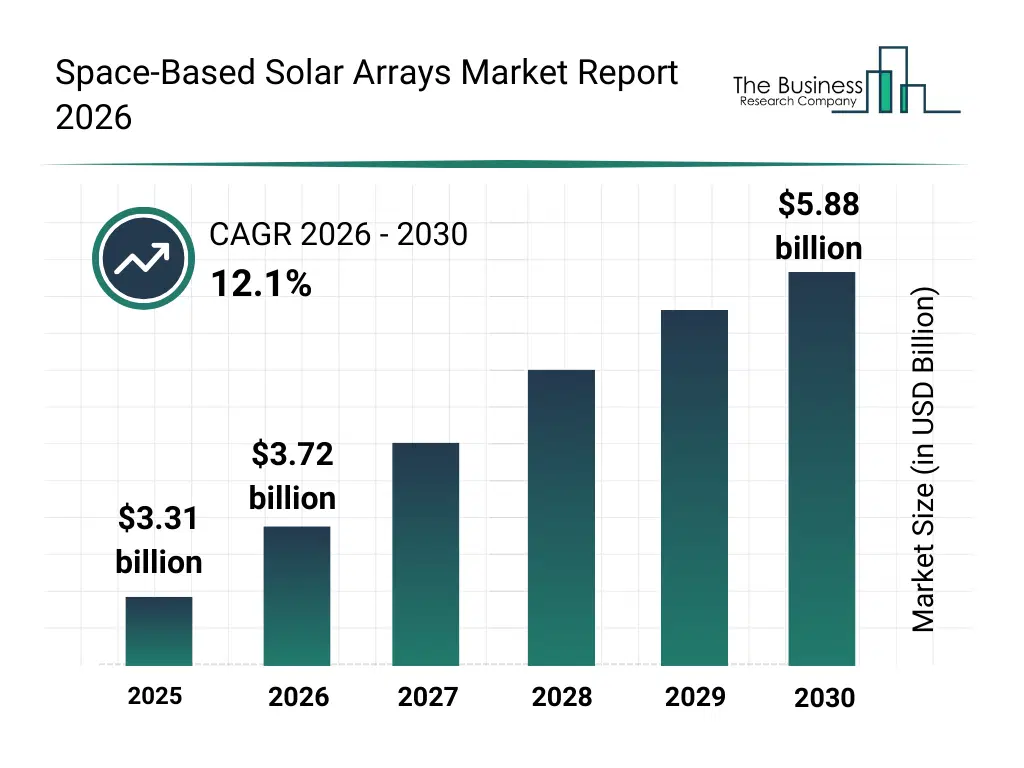
What Is The Space-Based Solar Arrays Market Size and Share 2026?
The space-based solar arrays market size has grown rapidly in recent years. It will grow from $3.31 billion in 2025 to $3.72 billion in 2026 at a compound annual growth rate (CAGR) of 12.4%. The growth in the historic period can be attributed to early research on space-based solar power concepts, development of prototype space power satellites (SPS), advancements in high-efficiency solar modules for orbital deployment, government and institutional funding for wireless power transmission research, initial experiments with microwave power beaming to ground-based rectennas.What Is The Space-Based Solar Arrays Market Growth Forecast?
The space-based solar arrays market size is expected to see rapid growth in the next few years. It will grow to $5.88 billion in 2030 at a compound annual growth rate (CAGR) of 12.1%. The growth in the forecast period can be attributed to expansion of commercial space-based solar array deployments, rising demand for continuous and renewable power supply, development of advanced microwave and laser power transmission systems, growth in electrification of remote areas and grid stabilization applications, increased collaboration between aerospace firms and energy companies for large-scale space solar power projects. Major trends in the forecast period include wireless power transmission advancement, high-efficiency multi-junction solar cells development, expansion of space-based energy services, integration with defense and military applications, ground-based rectenna infrastructure growth.
Global Space-Based Solar Arrays Market Segmentation
1) By Component: Solar Panels, Power Transmission Systems, Energy Storage Systems, Other Components 2) By Deployment: Low Earth Orbit, Medium Earth Orbit, Geostationary Orbit, Other Deployments 3) By Application: Commercial, Defense, Other Applications 4) By End-User: Government, Private Sector, Other End-Users Subsegments: 1) By Solar Panels: Monocrystalline Solar Panels, Polycrystalline Solar Panels, Thin-Film Solar Panels, Multi-Junction Solar Cells 2) By Power Transmission Systems: Microwave Transmission Systems, Laser Transmission Systems, Wireless Power Transmission (WPT) Modules 3) By Energy Storage Systems: Lithium Ion Batteries, Solid State Batteries, Capacitor Based Storage, Thermal Energy Storage 4) By Other Components: Deployment Mechanisms, Control and Monitoring Systems, Antenna Systems, Structural Support MaterialsWhat Is Driver Of The Space-Based Solar Arrays Market?
The increasing demand for sustainable energy solutions is expected to propel the growth of the space-based solar arrays market going forward. Sustainable energy solutions refer to energy systems and technologies that meet the needs of the present without compromising the ability of future generations to meet their own needs. The increasing demand for sustainable energy solutions is driven by greater public awareness of climate change, motivating consumers and businesses to adopt cleaner, renewable energy sources. Space-based solar arrays help advance sustainable energy solutions by capturing abundant solar energy in space, where sunlight is constant and far more intense than on Earth’s surface, and then wirelessly transmitting that energy to ground stations for use as clean electricity. For instance, in June 2025, according to the U.S. Energy Information Administration, a US-based semi-independent agency, total regional solar electricity generation in the U.S. was 217.3 billion kilowatt-hours in 2024 and is projected to increase to 350.4 billion kilowatt-hours by 2026. Therefore, the increasing demand for sustainable energy solutions is driving the space-based solar arrays industry.Key Players In The Global Space-Based Solar Arrays Market
Major companies operating in the space-based solar arrays market are The Boeing Company, Airbus SE, Northrop Grumman Corporation, Thales Alenia Space SAS, OHB SE, Rocket Lab USA Inc., Spectrolab Inc., GomSpace A/S, NanoAvionics LLC, SolAero Technologies Corp., Innovative Solutions In Space B.V. (ISISPACE), DHV Technology S.L., Pumpkin Inc., MMA Design LLC, Virtus Solis, ARTEMIS Innovation Management Solutions LLC, Orbital Composites Inc., 3K SpaceTech Pvt Ltd., Aetherflux Inc., lvior Technologies Inc.
This chart is for illustrative purposes; the full report includes a detailed competitor analysis and comprehensive overview of the top 10 companies in the market.
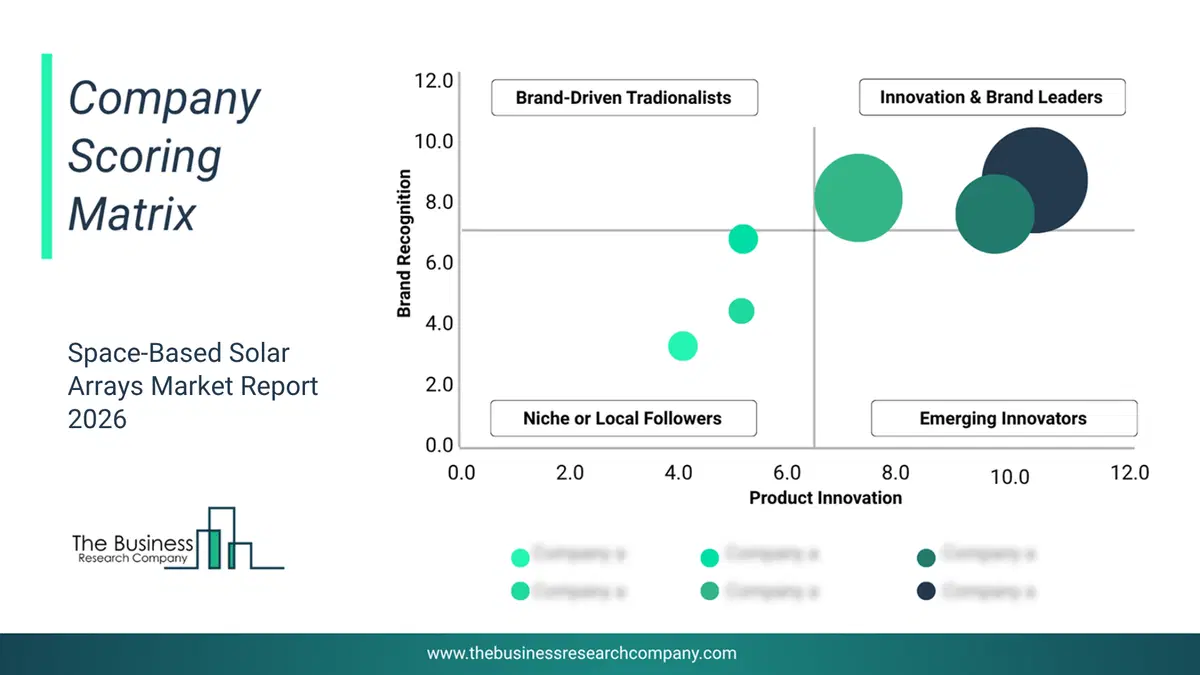
This chart maps companies by product innovation and brand strength, with bubble size indicating relative revenue, helping identify market leaders, challengers, and niche players. This is an illustrative chart; the full report provides a complete and accurate competitive analysis.
Global Space-Based Solar Arrays Market Trends and Insights
Major companies operating in the space-based solar arrays market are focusing on technological advancements such as space-based solar power (SBSP) transmission simulation tests to enhance clean energy generation by wirelessly transmitting solar energy from space to Earth, potentially revolutionizing the global renewable energy landscape. Space-based solar power (SBSP) transmission simulation test refers to a controlled experiment or trial designed to replicate the process of collecting solar energy in space and transmitting it wirelessly, typically using microwave or laser beams, to a receiver on Earth. For instance, in April 2024, Space Solar, a UK-based space energy company, introduced its HARRIER 360° wireless power-transmission demonstrator, which featured 360-degree beam steering that enables wireless energy transmission in all directions without mechanical movement, a retrodirective control system for accurate beam alignment, and beam-form validation against mathematical models to ensure precision and stability. This advancement marked a significant step toward commercializing space-based solar power technologies within the global renewable energy landscape.What Are Latest Mergers And Acquisitions In The Space-Based Solar Arrays Market? Pixxel Collaborates With DHV Technology To Power Firefly Satellites With Advanced Solar Panels
In February 2025, Pixxel Space Technologies Pvt. Ltd., an India-based space data company, collaborated with DHV Technology to power Pixxel’s Firefly hyperspectral satellites with advanced solar panels, enabling high-resolution Earth observation for environmental and resource monitoring. The collaboration aimed to develop custom solar panel solutions tailored to Pixxel’s satellite requirements. It focused on ensuring long-term reliability, precision engineering, and timely delivery to support Earth observation operations. DHV Technology is a Spain-based aerospace company that specializes in space-based solar arrays.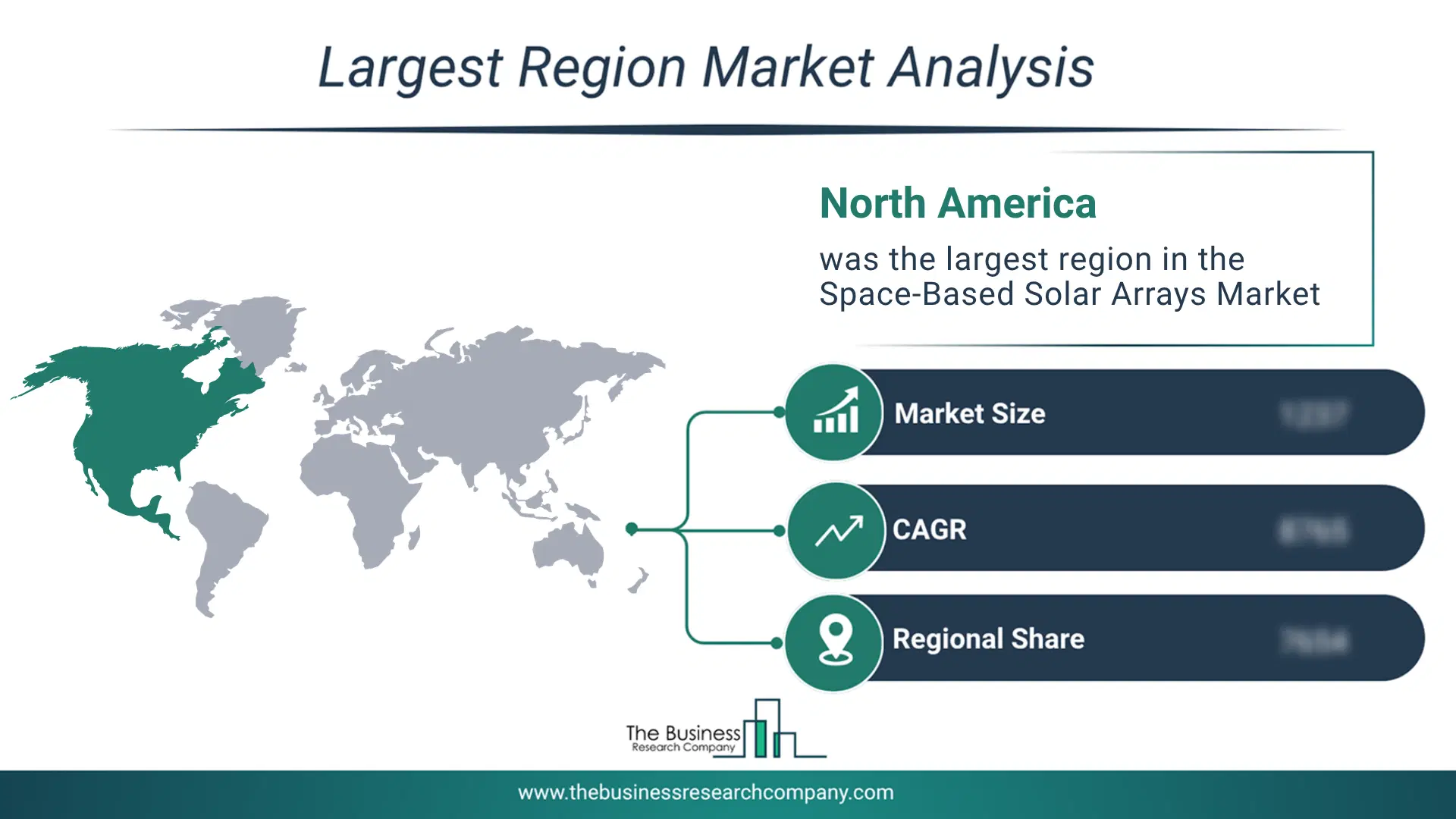
Regional Insights
North America was the largest region in the space-based solar arrays market in 2025. Asia-Pacific is expected to be the fastest-growing region in the forecast period. The regions covered in the space-based solar arrays market report are Asia-Pacific, South East Asia, Western Europe, Eastern Europe, North America, South America, Middle East, Africa. The countries covered in the space-based solar arrays market report are Australia, Brazil, China, France, Germany, India, Indonesia, Japan, Taiwan, Russia, South Korea, UK, USA, Canada, Italy, SpainWhat Defines the Space-Based Solar Arrays Market?
The space-based solar arrays market consists of revenues earned by entities by providing services such as continuous power supply, remote area electrification, grid stabilization and backup power, military and defense support, and space missions power supply. The market value includes the value of related goods sold by the service provider or included within the service offering. The space-based solar arrays market also includes sales of wireless transmitted electricity, high-efficiency solar modules, microwave power transmission systems, ground-based rectennas (receiving antennas), and space power satellites (SPS). Values in this market are ‘factory gate’ values, that is, the value of goods sold by the manufacturers or creators of the goods, whether to other entities (including downstream manufacturers, wholesalers, distributors, and retailers) or directly to end customers. The value of goods in this market includes related services sold by the creators of the goods.How is Market Value Defined and Measured?
The market value is defined as the revenues that enterprises gain from the sale of goods and/or services within the specified market and geography through sales, grants, or donations in terms of the currency (in USD unless otherwise specified). The revenues for a specified geography are consumption values that are revenues generated by organizations in the specified geography within the market, irrespective of where they are produced. It does not include revenues from resales along the supply chain, either further along the supply chain or as part of other products.
This chart presents market attractiveness based on a quantitative evaluation of growth, competition, strategic alignment, and risk, offering a clear view of opportunity areas for decision-making. This chart is for illustrative purposes; the full report contains the complete analysis.

This chart highlights the Total Addressable Market (TAM) by estimating the maximum revenue opportunity using an assumption-driven approach, supporting strategic planning and opportunity sizing across markets. The chart is illustrative; the full report provides a more comprehensive analysis.
What Key Data and Analysis Are Included in the Space-Based Solar Arrays Market Report 2026?
The space-based solar arrays market research report is one of a series of new reports from The Business Research Company that provides market statistics, including industry global market size, regional shares, competitors with the market share, detailed market segments, market trends and opportunities, and any further data you may need to thrive in the space-based solar arrays industry. The market research report delivers a complete perspective of everything you need, with an in-depth analysis of the current and future state of the industry.Space-Based Solar Arrays Market Report Forecast Analysis
| Report Attribute | Details |
|---|---|
| Market Size Value In 2026 | $3.72 billion |
| Revenue Forecast In 2030 | $5.88 billion |
| Growth Rate | CAGR of 12.1% from 2026 to 2030 |
| Base Year For Estimation | 2025 |
| Actual Estimates/Historical Data | 2020-2025 |
| Forecast Period | 2026 - 2030 |
| Market Representation | Revenue in USD Billion and CAGR from 2026 to 2030 |
| Segments Covered | Component, Deployment, Application, End-User |
| Regional Scope | Asia-Pacific, Western Europe, Eastern Europe, North America, South America, Middle East, Africa |
| Country Scope | The countries covered in the space-based solar arrays market report are Australia, Brazil, China, France, Germany, India, Indonesia, Japan, Taiwan, Russia, South Korea, UK, USA, Canada, Italy, Spain |
| Key Companies Profiled | The Boeing Company, Airbus SE, Northrop Grumman Corporation, Thales Alenia Space SAS, OHB SE, Rocket Lab USA Inc., Spectrolab Inc., GomSpace A/S, NanoAvionics LLC, SolAero Technologies Corp., Innovative Solutions In Space B.V. (ISISPACE), DHV Technology S.L., Pumpkin Inc., MMA Design LLC, Virtus Solis, ARTEMIS Innovation Management Solutions LLC, Orbital Composites Inc., 3K SpaceTech Pvt Ltd., Aetherflux Inc., lvior Technologies Inc. |
| Customization Scope | Request for Customization |
| Pricing And Purchase Options | Explore Purchase Options |