
Space Battery Market Report 2026
Global Outlook – By Type (Nickel-Based Battery, Lithium-Based Battery, Silver-Zinc Battery, Other Type), By Platform (Communication, Earth Observation, Military Surveillance, Science, Navigation, Other Platforms), By Energy Type (Less Than 100 Wh/kg, 100–150 Wh/kg, More Than 150 Wh/kg), By Orbit Type (Low Earth Orbit (LEO), Medium Earth Orbit (MEO), Geosynchronous Orbit (GEO), Other Orbit Types), By Application (Satellite, Launch Vehicle, Other Applications) – Market Size, Trends, Strategies, and Forecast to 2030
Space Battery Market Overview
• Space Battery market size has reached to $3.99 billion in 2025 • Expected to grow to $5.61 billion in 2030 at a compound annual growth rate (CAGR) of 7% • Growth Driver: Space Exploration Expansion Accelerates Market For Advanced Space Batteries • Market Trend: Strategic Partnerships Driving Innovation And Advanced Battery Development For Space Missions • North America was the largest region in 2025.Market Gains By 2030 – Top Opportunities By Segment
Market Gain identifies the most promising market opportunities by highlighting the segments or products expected to generate the highest incremental revenue growth over the next five years.
What Is Covered Under Space Battery Market?
A space battery is a high-performance power source designed for use in space missions. It provides reliable energy storage for spacecraft and satellites, often using advanced technologies to withstand extreme conditions. These batteries are crucial for maintaining operations in the vacuum of space and can include types such as lithium-ion or advanced solid-state designs. The main types of space battery are nickel-based battery, lithium-based battery, silver-zinc battery, and others. A nickel-based battery is a type of rechargeable battery that uses nickel compounds as a key component in its electrochemical reactions, commonly including nickel-cadmium (NiCd) or nickel-metal hydride (NiMH) types. These batteries are used in platforms such as communication, earth observation, military surveillance, science, navigation, and others. They come in various energy densities, such as less than 100 Wh/kg, 100–150 Wh/kg, and more than 150 Wh/kg, and are suitable for different orbits including low earth orbit (LEO), medium earth orbit (MEO), geosynchronous orbit (GEO), and others. Applications include satellites, launch vehicles, and others.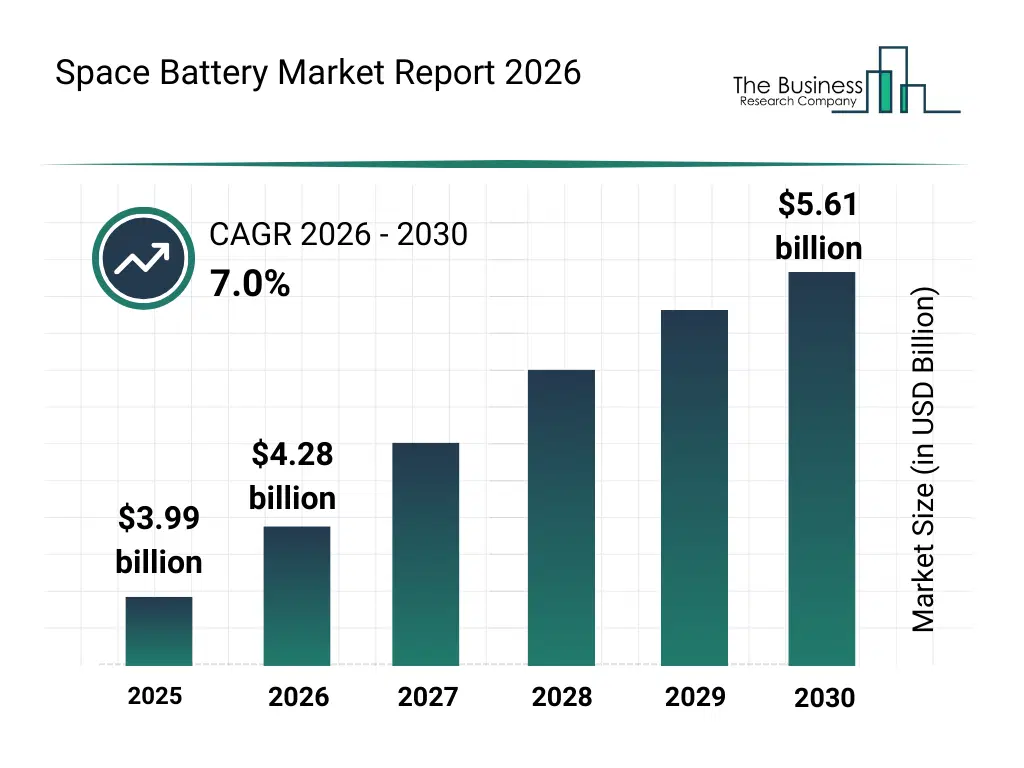
What Is The Space Battery Market Size and Share 2026?
The space battery market size has grown strongly in recent years. It will grow from $3.99 billion in 2025 to $4.28 billion in 2026 at a compound annual growth rate (CAGR) of 7.3%. The growth in the historic period can be attributed to use of nickel-cadmium batteries in early satellites, adoption of lithium-ion batteries for spacecraft, development of high-reliability battery systems, growth in long-duration space missions, integration with satellite power management systems.What Is The Space Battery Market Growth Forecast?
The space battery market size is expected to see strong growth in the next few years. It will grow to $5.61 billion in 2030 at a compound annual growth rate (CAGR) of 7.0%. The growth in the forecast period can be attributed to emergence of lithium-sulfur batteries, adoption of advanced solid-state batteries, development of high-energy-density solutions, integration with deep-space missions, growth in reusable satellite power systems. Major trends in the forecast period include increased adoption of radiation-resistant battery chemistries, growth in long-duration energy storage for deep-space missions, rising use of modular and lightweight battery systems, increased investment in high-power systems for launch vehicles, growing demand from small satellite constellations.
Global Space Battery Market Segmentation
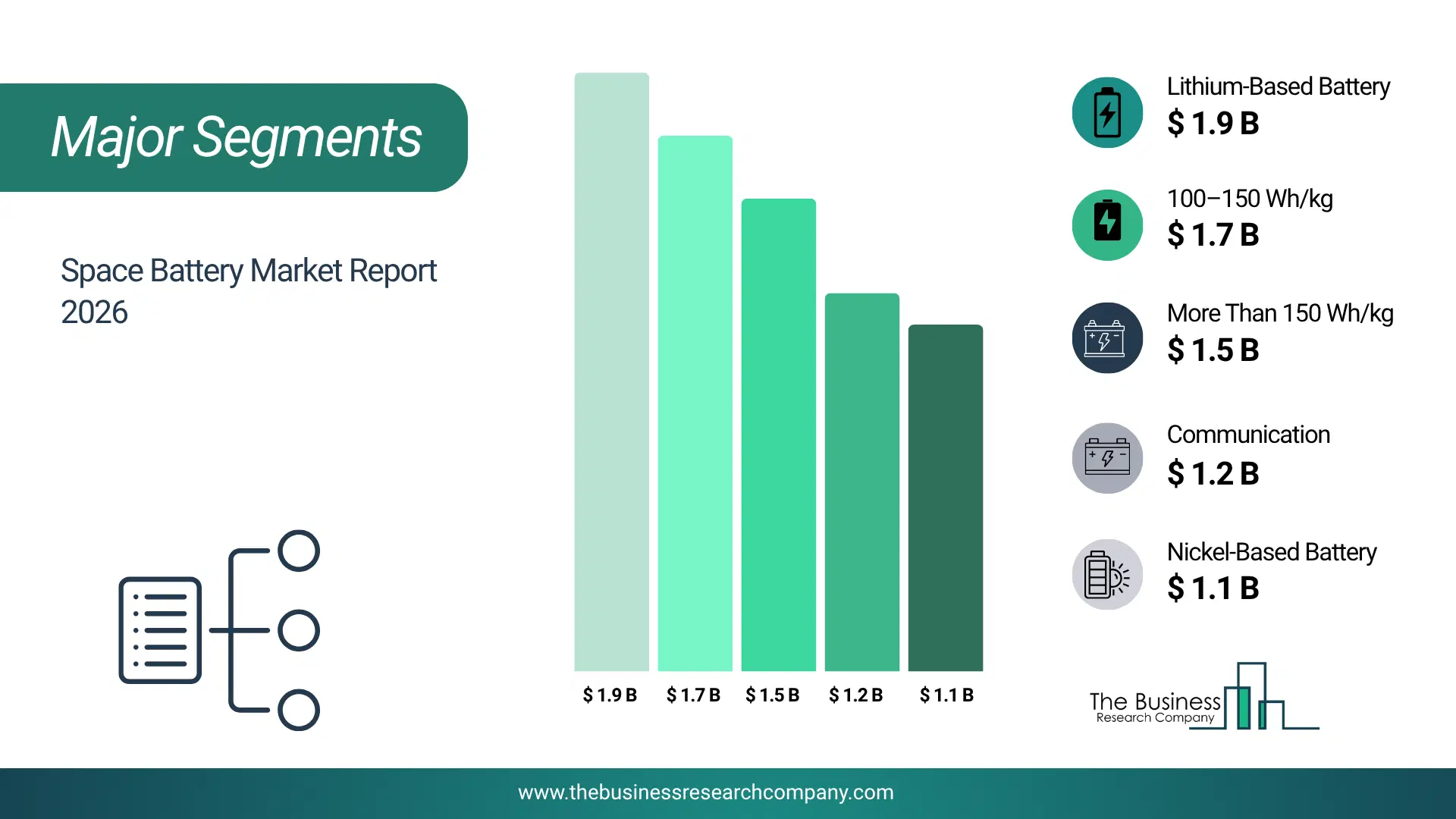
1) By Type: Nickel-Based Battery, Lithium-Based Battery, Silver-Zinc Battery, Other Type 2) By Platform: Communication, Earth Observation, Military Surveillance, Science, Navigation, Other Platforms 3) By Energy Type: Less Than 100 Wh/kg, 100–150 Wh/kg, More Than 150 Wh/kg 4) By Orbit Type: Low Earth Orbit (LEO), Medium Earth Orbit (MEO), Geosynchronous Orbit (GEO), Other Orbit Types 5) By Application: Satellite, Launch Vehicle, Other Applications Subsegments: 1) Nickel-Based Battery: Nickel-Cadmium Battery, Nickel-Metal Hydride Battery 2) Lithium-Based Battery: Lithium-Ion Battery, Lithium-Polymer Battery 3) Silver-Zinc Battery: Primary Silver-Zinc Battery, Rechargeable Silver-Zinc Battery 4) Other Type: Lead-Acid Battery, Solid-State Battery, Flow Battery The top segments in the space battery market will be: • Lithium-Based Battery will reach $1984.5 Million by 2025. • 100–150 Wh/kg will reach $1769.72 Million by 2025. • More Than 150 Wh/kg will reach $1514.62 Million by 2025. • Communication will reach $1287.51 Million by 2025. • Nickel-Based Battery will reach $1154.99 Million by 2025.What Is Driver Of The Space Battery Market?
The increase in demand for space exploration is expected to propel the growth of the space battery market going forward. Space exploration involves studying and uncovering the mysteries of outer space using advanced technologies to advance scientific understanding and support human and robotic missions beyond Earth. Space exploration is rising due to growing government and private investments that foster technological innovation, making missions more advanced and cost-effective. Space batteries provide critical energy storage for powering spacecraft systems and instruments during space exploration missions, especially in environments where solar power is unavailable. For instance, in April 2024, a report from the World Economic Forum, a Switzerland-based non-governmental organization, stated that by 2035, the global space economy is projected to hit $1.8 trillion, rising from $630 billion in 2023, with an average annual growth rate of 9%, far outpacing the global GDP growth rate. Therefore, the rise in space exploration activities is driving the growth of the space battery industry.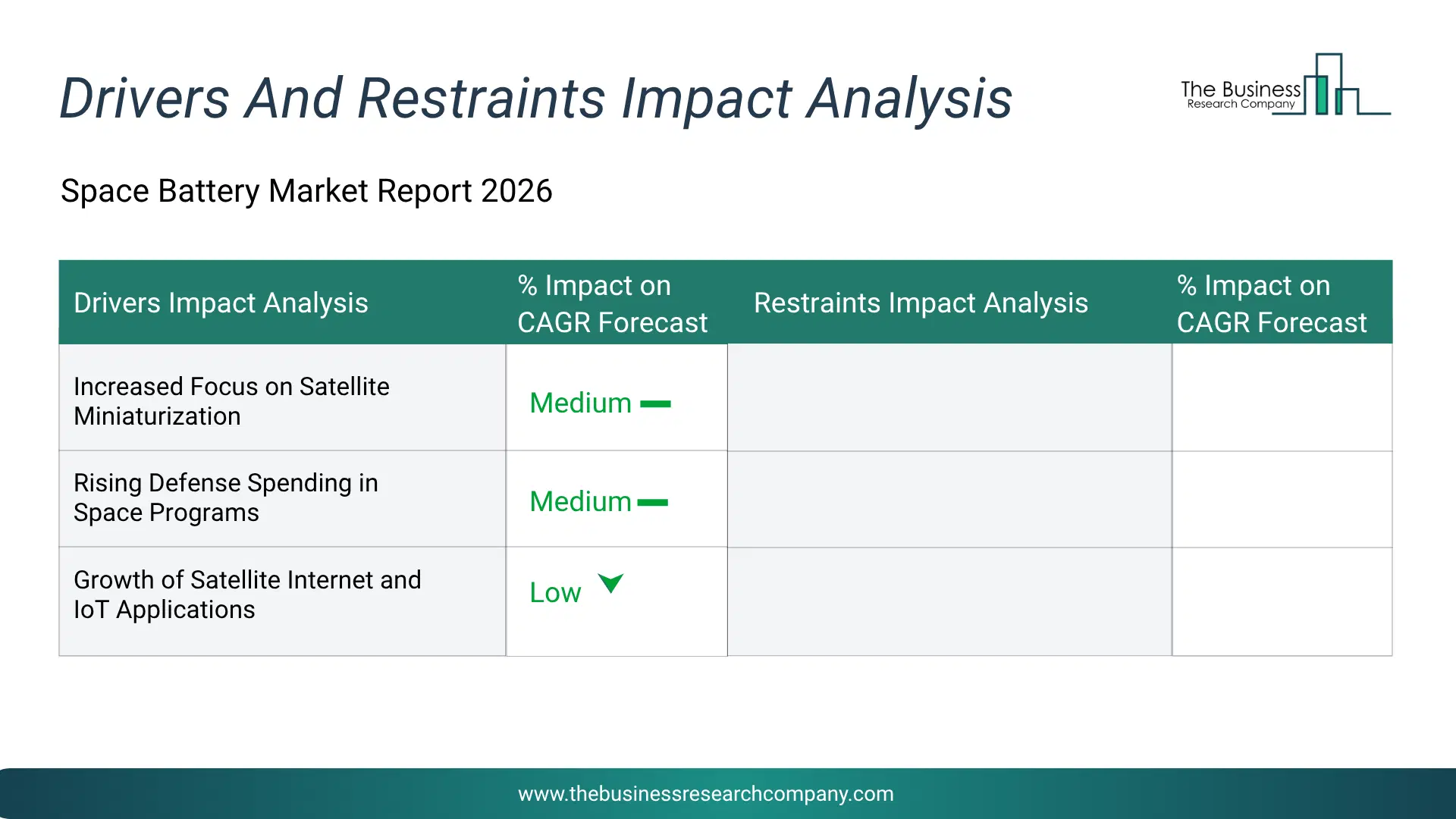
Infographic Chart Showing Key Market Drivers Analysis And Restraints For Space Battery Market
The chart presents an impact analysis of key drivers and restraints, quantifying their relative influence on the market's growth rate and helping assess the balance between growth enablers and limiting factors. This chart offers a high-level perspective; the full report contains more detailed insights.
How Will The Drivers Impact Growth In The Global Space Battery Market?
• Increased Focus on Satellite Miniaturization (Medium) – The increased focus on satellite miniaturization will become a key driver of growth in the space battery market by 2030. The increased focus on satellite miniaturization boosts demands for compact, lightweight, and high-energy-density space batteries. Smaller satellites, such as CubeSats and nanosatellites, require efficient power sources that can deliver optimal performance within tight space and weight constraints. This pushes battery manufacturers to innovate in materials and designs, such as using lithium-ion or solid-state technologies. As a result, the increased focus on satellite miniaturization is anticipated to contributing to a 2.0% annual growth in the market. • Rising Defense Spending in Space Programs (Medium) – The rising defence spending in space programs will emerge as a major factor driving the expansion of the space battery market by 2030. Increasing defence spending in space programs drives demand for advanced and reliable power systems, including high-performance space batteries, to support critical missions such as surveillance, communication, and navigation. These programs require batteries that can operate in extreme environments and deliver high energy density with long operational life. As military satellites and space-based defence systems expand, investments in space battery research and production scale up to meet stringent performance and safety standards. This, in turn, accelerates innovation and commercialization in the space battery market. Consequently, the rising defence spending in space programs is projected to contributing to a 1.5% annual growth in the market. • Growth of Satellite Internet and IoT Applications (Low) – The growth of satellite and IoT applications as a major factor driving the expansion of the space battery market by 2030. The rise of satellite internet and IoT applications drives demand for advanced space batteries by requiring longer-lasting, high-efficiency power sources to support continuous operation in orbit. Satellite constellations for global internet coverage, such as those from Starlink and OneWeb, need reliable batteries to maintain performance during eclipse periods when solar energy is unavailable. Similarly, IoT sensors deployed in space for Earth observation or tracking applications rely on compact, lightweight batteries with high energy density. Consequently, growth of satellite and IoT applications is projected to contributing to a 1.0% annual growth in the market. • Focus on Sustainability and End-of-Life Satellite Management (Low) – The focus on sustainability and end-of-life satellite management will emerge as a major factor driving the expansion of the space battery market by 2030. The increasing focus on sustainability and end-of-life satellite management is driving demand for space batteries that are not only high-performing but also environmentally responsible. Manufacturers are developing batteries with longer lifespans, higher efficiency, and minimal hazardous materials to reduce orbital debris and ease satellite decommissioning. Recyclable components and energy-efficient production processes are also gaining importance in battery design. This trend aligns with global efforts to ensure cleaner, more sustainable space operations. Consequently, the focus on sustainability and end-of-life satellite management are projected to contributing to a 0.5% annual growth in the market.How Will The Restraints Impact Growth In The Global Space Battery Market?
• Limited Reusability and Repair Options (Medium) – Limited Reusability and Repair Options will restrict the growth of the Space Battery market during the forecast period. Space batteries are typically designed for single-use missions with limited reusability and repair options. Battery failures in space cannot be easily repaired or replaced, creating reliability and mission continuity concerns. The limited serviceability of space batteries increases mission risk and may affect the adoption of certain battery technologies. • Space Mission Failures and Launch Abortions (Medium) – Space Mission Failures and Launch Abortions will restrict the growth of the Space Battery market during the forecast period. Space missions face risks of launch failures, deployment issues, and spacecraft anomalies that can result in the loss of battery systems. Mission failures can lead to significant financial losses and affect confidence in space battery technologies. The risk of mission failure may discourage investment in advanced battery technologies and affect market growth. • Impact of Trade War and Tariffs (Low) – Impact of Trade War and Tariffs will restrict the growth of the Space Battery market during the forecast period. Space batteries rely on specialized materials and components sourced from global suppliers. Trade tariffs and restrictions can increase costs and affect the availability of critical battery materials. Trade barriers may also affect international space collaboration and satellite deployment, impacting market growth.Key Players In The Global Space Battery Market
Major companies operating in the space battery market are Lockheed Martin Corporation, Airbus SE, Northrop Grumman Corporation, Mitsubishi Electric Corporation, NEC Corporation, Teledyne Technologies Incorporated, GS Yuasa International Ltd., Enersys, Moog Inc., Aerojet Rocketdyne Holdings, Inc., Blue Origin LLC, Saft Groupe S.A., Eagle-Picher Technologies LLC, HBL Power Systems Limited, Arotech Corporation, Lyten Inc., Space Vector Corporation, Nanoavionics Ltd., AAC Clyde Space AB, E-One Moli Energy Corp., Epsilor Electric Fuel Ltd., Berlin Space Technologies GmbH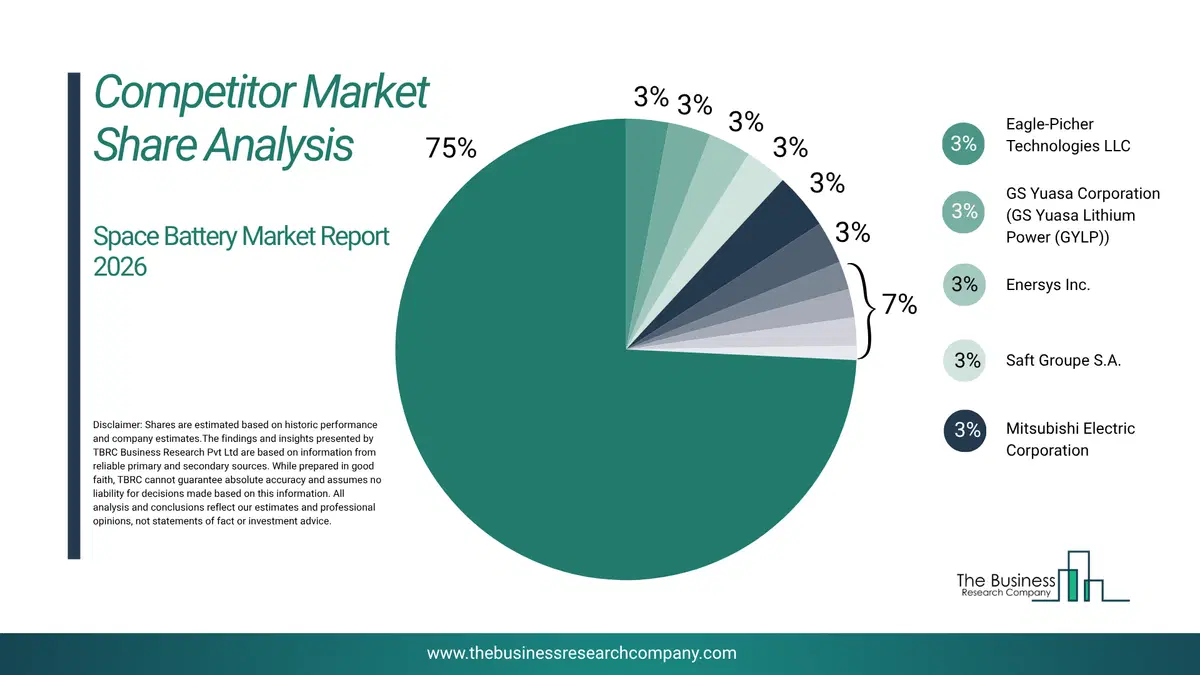
This chart is for illustrative purposes; the full report includes a detailed competitor analysis and comprehensive overview of the top 10 companies in the market.
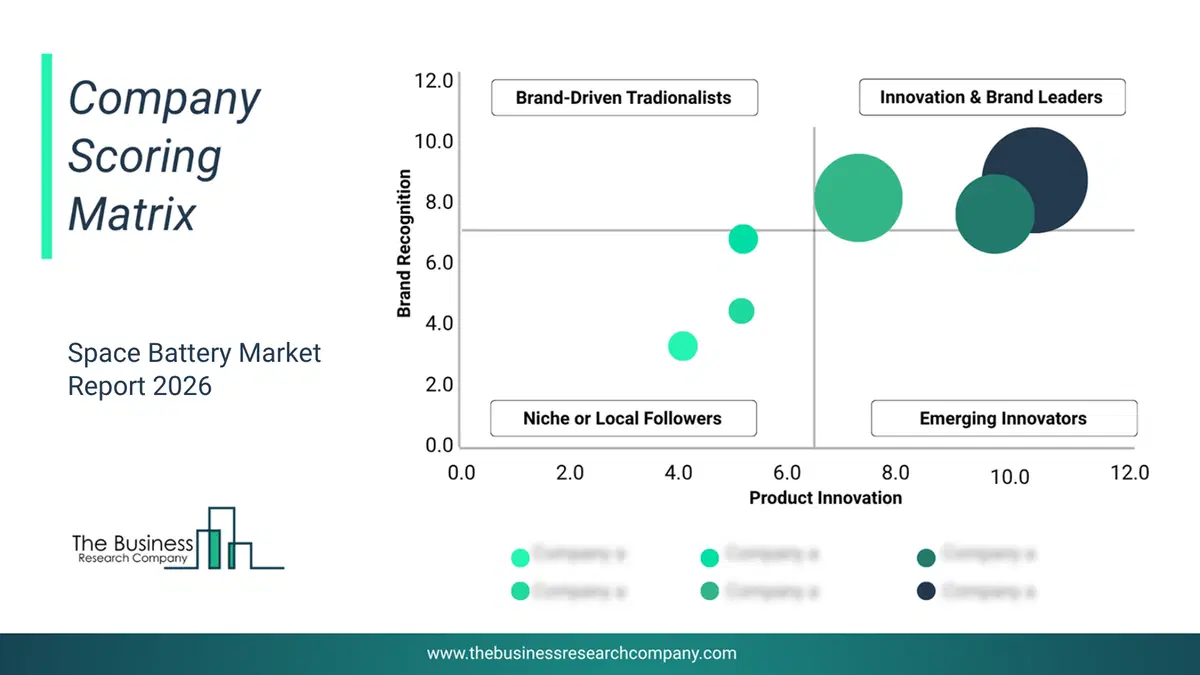
This chart maps companies by product innovation and brand strength, with bubble size indicating relative revenue, helping identify market leaders, challengers, and niche players. This is an illustrative chart; the full report provides a complete and accurate competitive analysis.
Global Space Battery Market Trends and Insights
Major companies operating in the space battery market are adopting strategic partnerships to provide innovative solutions and improve their technological capabilities, ensuring reliable and efficient power sources for space missions. Strategic partnerships refer to a process in which companies leverage each other's strengths and resources to achieve mutual benefits and success. For instance, in March 2024, KULR Technology Group, Inc., a US-based provider of advanced thermal-management and battery-systems technologies, partnered with Nanoracks, a US-based space services company, to develop, test, and produce a specialized space battery designed to enhance Voyager's CubeSat applications. Under this contract worth over US$865,000, KULR is accelerating the development, testing, and early production of batteries for CubeSat use, delivering the first prototype by the end of 2023, and deploying a platform based on its lithium-ion battery safety and thermal management technologies.What Are Latest Mergers And Acquisitions In The Space Battery Market? Advik Hi-Tech Expands ESS Footprint With Acquisition Of Aceleron Energy Assets
In April 2024, Advik Hi-Tech Pvt Ltd, an India-based automotive and power unit company, acquired Aceleron Energy Ltd’s business assets for an undisclosed amount. The acquisition has broadened Advik's presence in the electric vehicle (EV) and energy storage system (ESS) sectors. By integrating Aceleron's assets, Advik aims to enhance its product portfolio and expand its customer base, with a strategic emphasis on developing cutting-edge energy storage solutions. Aceleron Energy Ltd. is a UK-based advanced lithium-ion battery technology company.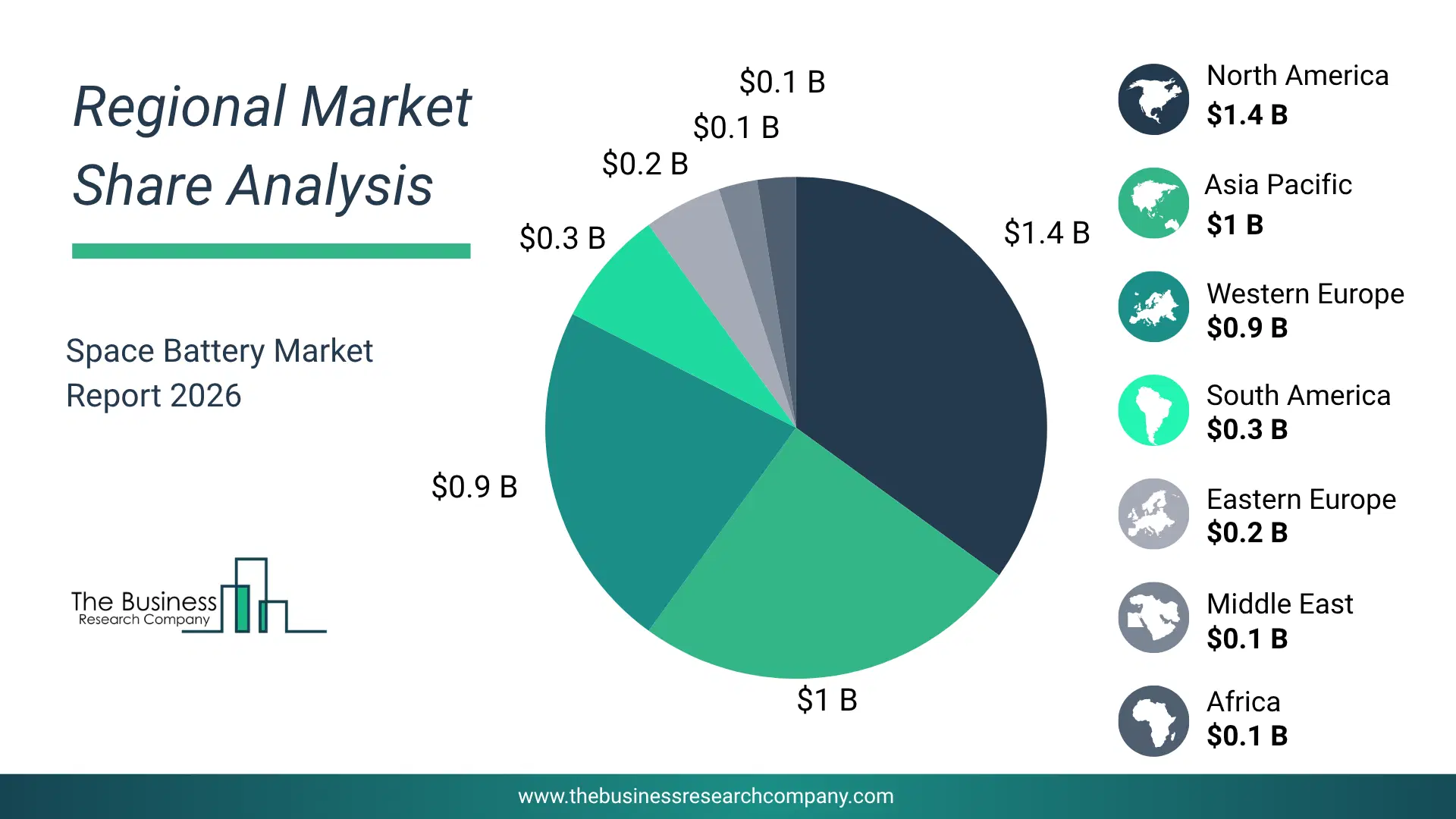
Regional Insights
North America was the largest region in the space battery market in 2025. The regions covered in this market report are Asia-Pacific, South East Asia, Western Europe, Eastern Europe, North America, South America, Middle East, Africa. The countries covered in this market report are Australia, Brazil, China, France, Germany, India, Indonesia, Japan, Taiwan, Russia, South Korea, UK, USA, Canada, Italy, SpainWhat Defines the Space Battery Market?
The space battery market consists of sales of nickel-cadmium (NiCd) batteries, lithium-sulfur (Li-S) batteries, and silver-zinc (Ag-Zn) batteries. Values in this market are ‘factory gate’ values, that is the value of goods sold by the manufacturers or creators of the goods, whether to other entities (including downstream manufacturers, wholesalers, distributors and retailers) or directly to end customers. The value of goods in this market includes related services sold by the creators of the goods.How is Market Value Defined and Measured?
The market value is defined as the revenues that enterprises gain from the sale of goods and/or services within the specified market and geography through sales, grants, or donations in terms of the currency (in USD unless otherwise specified). The revenues for a specified geography are consumption values that are revenues generated by organizations in the specified geography within the market, irrespective of where they are produced. It does not include revenues from resales along the supply chain, either further along the supply chain or as part of other products.
This chart presents market attractiveness based on a quantitative evaluation of growth, competition, strategic alignment, and risk, offering a clear view of opportunity areas for decision-making. This chart is for illustrative purposes; the full report contains the complete analysis.

This chart highlights the Total Addressable Market (TAM) by estimating the maximum revenue opportunity using an assumption-driven approach, supporting strategic planning and opportunity sizing across markets. The chart is illustrative; the full report provides a more comprehensive analysis.
What Key Data and Analysis Are Included in the Space Battery Market Report 2026?
The space battery market research report is one of a series of new reports from The Business Research Company that provides market statistics, including industry global market size, regional shares, competitors with the market share, detailed market segments, market trends and opportunities, and any further data you may need to thrive in the space battery industry. The market research report delivers a complete perspective of everything you need, with an in-depth analysis of the current and future state of the industry.Space Battery Market Report Forecast Analysis
| Report Attribute | Details |
|---|---|
| Market Size Value In 2026 | $4.28 billion |
| Revenue Forecast In 2030 | $5.61 billion |
| Growth Rate | CAGR of 7.3% from 2026 to 2030 |
| Base Year For Estimation | 2025 |
| Actual Estimates/Historical Data | 2020-2025 |
| Forecast Period | 2026 - 2030 |
| Market Representation | Revenue in USD Billion and CAGR from 2026 to 2030 |
| Segments Covered | Type, Platform, Energy Type, Orbit Type, Application |
| Regional Scope | Asia-Pacific, Western Europe, Eastern Europe, North America, South America, Middle East, Africa |
| Country Scope | The countries covered in the report are Australia, Brazil, China, France, Germany, India, Indonesia, Japan, Taiwan, Russia, South Korea, UK, USA, Canada, Italy, Spain. |
| Key Companies Profiled | Lockheed Martin Corporation, Airbus SE, Northrop Grumman Corporation, Mitsubishi Electric Corporation, NEC Corporation, Teledyne Technologies Incorporated, GS Yuasa International Ltd., Enersys, Moog Inc., Aerojet Rocketdyne Holdings, Inc., Blue Origin LLC, Saft Groupe S.A., Eagle-Picher Technologies LLC, HBL Power Systems Limited, Arotech Corporation, Lyten Inc., Space Vector Corporation, Nanoavionics Ltd., AAC Clyde Space AB, E-One Moli Energy Corp., Epsilor Electric Fuel Ltd., Berlin Space Technologies GmbH |
| Customization Scope | Request for Customization |
| Pricing And Purchase Options | Explore Purchase Options |