
Space Debris Monitoring And Removal Market Report 2026
Global Outlook – By Debris Size Range (1mm To 1cm Debris Size, 1cm To 10cm Debris Size, Greater Than 10 cm), By Orbit Type (Low Earth Orbit (LEO), Medium-Earth Orbit (MEO), Geostationary Earth Orbit (GEO)), By End User (Commercial, Defense) – Market Size, Trends, Strategies, and Forecast to 2030
Space Debris Monitoring And Removal Market Overview
• Space Debris Monitoring And Removal market size has reached to $1.31 billion in 2025 • Expected to grow to $1.84 billion in 2030 at a compound annual growth rate (CAGR) of 7% • Growth Driver: Impact Of Satellite Launches On The Space Debris Monitoring And Removal Market • Market Trend: Commercial Debris Inspection Demonstration Satellites Advancing Space Situational Awareness • North America was the largest region in 2025 and Asia-Pacific is the fastest growing region.What Is Covered Under Space Debris Monitoring And Removal Market?
Space debris monitoring and removal refer to the processes of detecting, tracking, and mitigating space debris objects circling the Earth, as well as their disposal to reduce the risk of collision with functioning satellites and spacecraft. It is essential for protecting space assets, ensuring the safety of space operations, and supporting sustainable space activities. The main types of debris size range involved in space debris monitoring and removal are 1mm to 1cm debris size, 1cm to 10cm debris size, and greater than 10 cm. 1 mm to 1 cm of debris refers to space debris with sizes ranging from 1 millimeter to 1 centimeter, which can threaten satellites and spacecraft due to their potential for collisions and damage in space debris management. Various types of orbit include low earth orbit (LEO) and geostationary earth orbit (GEO) and are used by various end users, such as commercial and defense.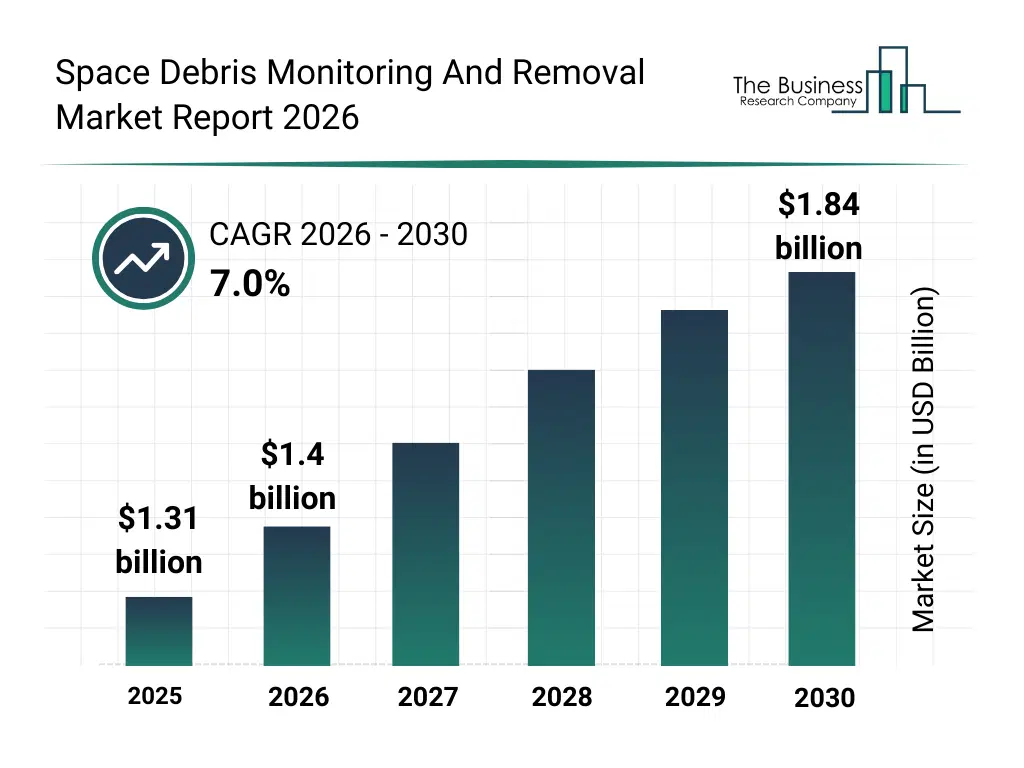
What Is The Space Debris Monitoring And Removal Market Size and Share 2026?
The space debris monitoring and removal market size has grown strongly in recent years. It will grow from $1.31 billion in 2025 to $1.4 billion in 2026 at a compound annual growth rate (CAGR) of 7.1%. The growth in the historic period can be attributed to increasing number of active satellites leading to higher risk of collisions, technological advancements in space-based sensors and tracking systems, rising awareness of space sustainability and debris hazards, government initiatives and regulations promoting space situational awareness, early adoption of space debris cataloging and orbital analysis services.What Is The Space Debris Monitoring And Removal Market Growth Forecast?
The space debris monitoring and removal market size is expected to see strong growth in the next few years. It will grow to $1.84 billion in 2030 at a compound annual growth rate (CAGR) of 7.0%. The growth in the forecast period can be attributed to development of advanced debris removal and remediation technologies, integration of ai and machine learning for predictive collision avoidance, rising investments in space traffic management and monitoring services, increasing demand for commercial space debris mitigation solutions, expansion of international collaborations for coordinated space debris tracking and removal. Major trends in the forecast period include growth in real-time orbital debris tracking and prediction solutions, adoption of advanced debris removal technologies (e.g., robotic capture, nets, harpoons), development of space situational awareness platforms integrating multiple sensor sources, expansion of space debris cataloging and database management services, increasing need for collision avoidance and maneuver planning solutions for satellites.
Global Space Debris Monitoring And Removal Market Segmentation
1) By Debris Size Range: 1mm To 1cm Debris Size, 1cm To 10cm Debris Size, Greater Than 10 cm 2) By Orbit Type: Low Earth Orbit (LEO), Medium-Earth Orbit (MEO), Geostationary Earth Orbit (GEO) 3) By End User: Commercial, Defense Subsegments: 1) By 1mm to 1cm Debris Size: Micrometeoroid and Orbital Debris (MMOD) Monitoring, Small Object Tracking and Removal Technologies 2) By 1cm to 10cm Debris Size: Small-Scale Orbital Debris Removal, Laser Ablation for Debris Removal, Tether-based Debris Removal Systems 3) By Greater Than 10 cm Debris Size: Large Object Tracking and Removal, Robotic Capture and De-orbiting Solutions, Net or Harpoon-based Debris Capture SystemsWhat Is Driver Of The Space Debris Monitoring And Removal Market?
The increasing number of satellite launches is expected to propel the growth of the space debris monitoring and removal market going forward. Satellite launches involve the deployment of artificial satellites into space using launch vehicles or rockets for various purposes, such as communication, Earth observation, and scientific research. The rise in the number of satellite launches is driven by increasing demand for global connectivity, earth observation, scientific research, commercial applications, and a growing interest in space exploration. Space debris monitoring helps satellite operators and launch providers identify and track debris objects that could pose a collision risk to satellites during launch and deployment. Also, space debris removal efforts aim to reduce the overall population of debris in orbit, thereby decreasing the likelihood of collisions with operational satellites. For example, in June 2024, as reported by the Satellite Industry Association, a US-based organization, the commercial satellite industry in 2023 witnessed record-breaking growth, launching 2,781 satellites a 20% rise from 2022. The space industry also achieved a new milestone with 190 total launches, the highest ever recorded. By the end of the year, the number of operational satellites reached 9,691, reflecting a 361% increase over the past five years. Therefore, the increasing number of satellite launches is driving the growth of the space debris monitoring and removal industry.Key Players In The Global Space Debris Monitoring And Removal Market
Major companies operating in the space debris monitoring and removal market are Raytheon Technologies, The Boeing Company, Lockheed Martin Corporation, Airbus SE, Mitsubishi Electric Corporation, Northrop Grumman Corporation, British Aerospace systems, L3Harris Technologies Inc., IHI Corporation, Teledyne Technologies, Thales Alenia Space, Ball Aerospace & Technologies Corp., Maxar Technologies Inc, Japan Aerospace Exploration Agency, The Aerospace Corporation, Kratos Defense & Security Solutions, Electro Optic Systems Holdings Limited, Rocket Lab Limited, Surrey Satellite Technology Limited, ClearSpace SA, Tethers Unlimited, Kongsberg Satellite Services
This chart is for illustrative purposes; the full report includes a detailed competitor analysis and comprehensive overview of the top 10 companies in the market.
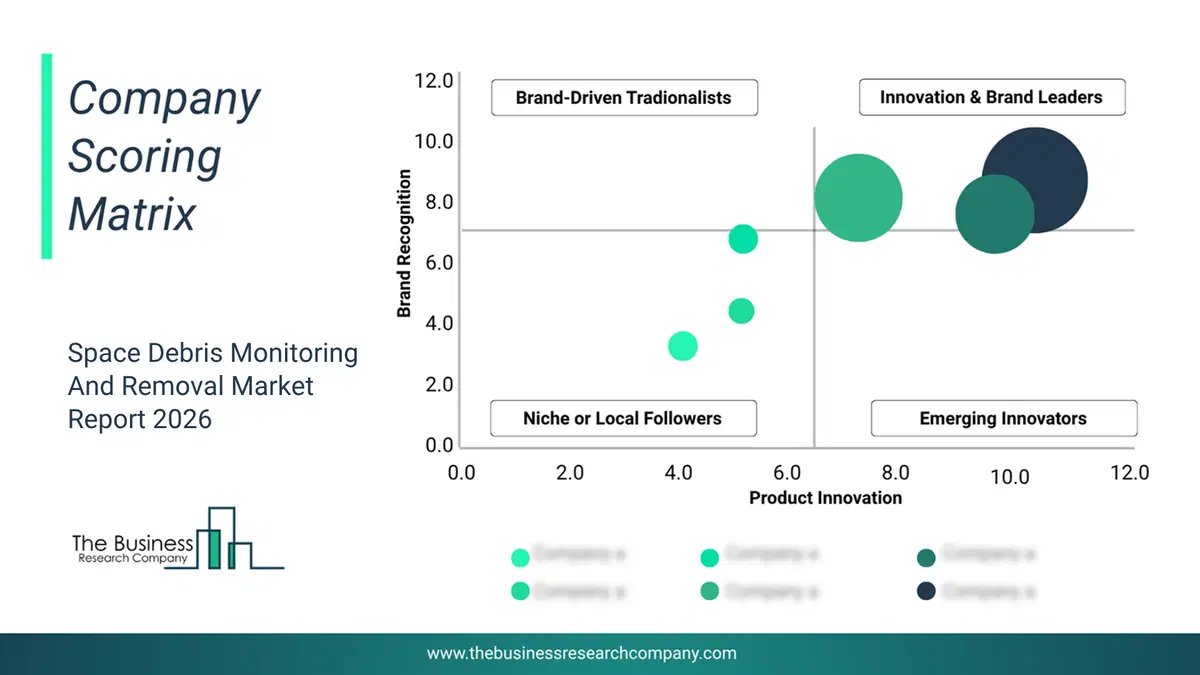
This chart maps companies by product innovation and brand strength, with bubble size indicating relative revenue, helping identify market leaders, challengers, and niche players. This is an illustrative chart; the full report provides a complete and accurate competitive analysis.
Global Space Debris Monitoring And Removal Market Trends and Insights
Major companies operating in the space debris monitoring and removal market are focusing on the development of innovative solutions, such as commercial debris inspection demonstration satellites, to enhance space situational awareness and promote sustainable space operations. These satellites aim to showcase advanced technologies for monitoring and managing space debris, contributing to space sustainability and safer orbital environments. For instance, in February 2024, Astroscale Japan Inc., a Japan-based aerospace company, launched the world’s first debris inspection spacecraft, ADRAS-J. The ADRAS-J mission is the world's first attempt to safely approach, characterize, and survey an existing piece of massive debris using RPO (Rendezvous and Proximity Operations) capabilities. ADRAS-J is designed to connect with a Japanese H2A upper-stage rocket body, perform proximity operations, and collect photos to examine the rocket body's movement and structural condition. The mission will showcase the most complex RPO capabilities required for on-orbit services. It demonstrates challenging RPO capabilities crucial for on-orbit services by showcasing proximity operations, gathering images, and assessing the rocket body’s movement and structural condition.What Are Latest Mergers And Acquisitions In The Space Debris Monitoring And Removal Market? ClearSpace SA And LeoLabs Partner To Forge Safer And Greener Skies
In April 2023, ClearSpace SA, a Switzerland-based aerospace company that provides failed satellite and debris removal services, partnered with LeoLabs. Through this partnership, they aim to advance a safer and more sustainable space environment by leveraging their shared vision for a safe and sustainable space ecosystem, which signifies a significant step in developing effective solutions to mitigate the risks posed by space debris and enhance space safety. LeoLabs is a US-based aerospace company that specializes in monitoring and tracking space debris in Low Earth Orbit (LEO) using a network of ground-based radar systems.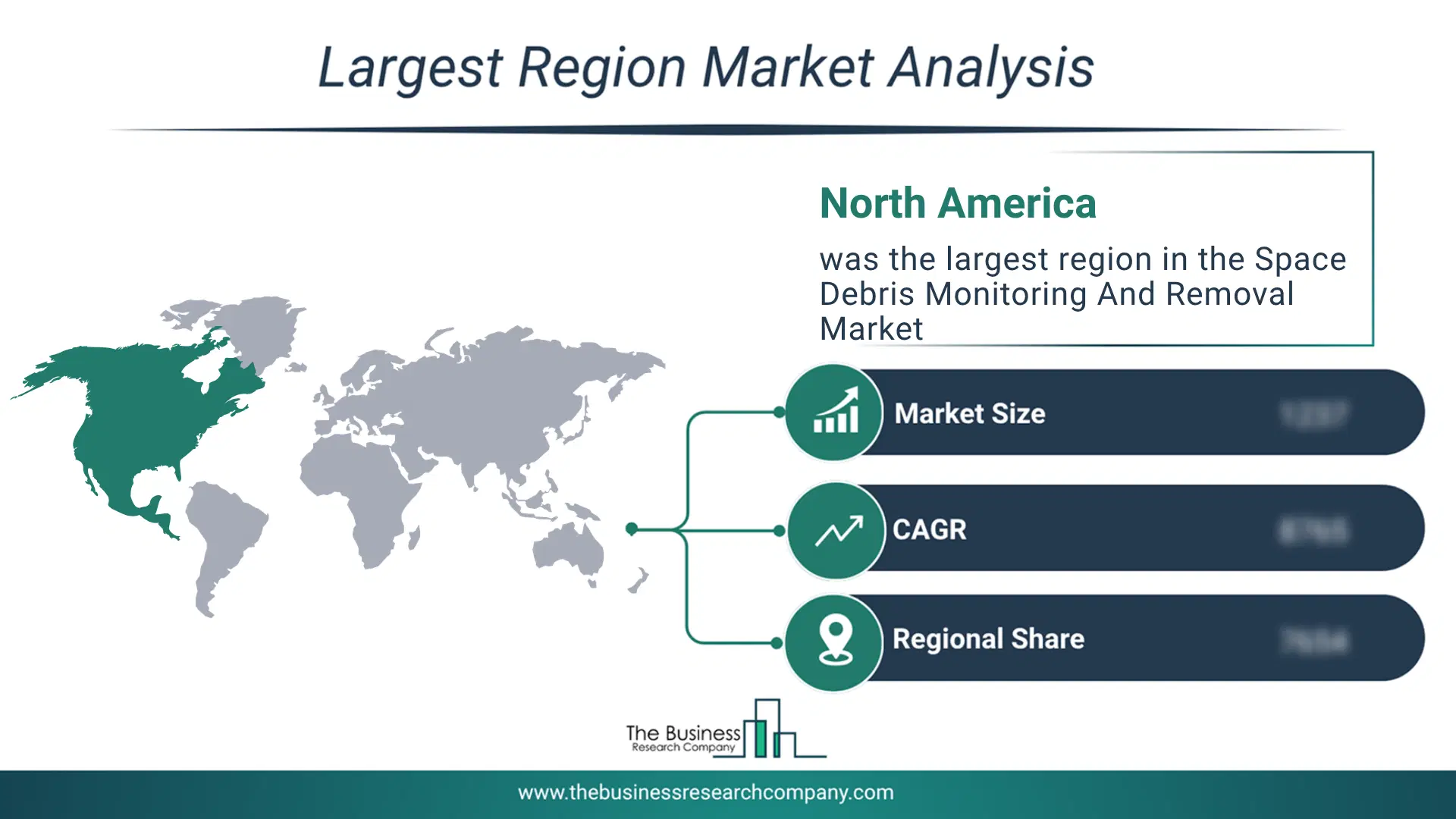
Regional Insights
North America was the largest region in the space debris monitoring and removal market in 2025. Asia-Pacific is expected to be the fastest-growing region in the forecast period. The regions covered in this market report are Asia-Pacific, South East Asia, Western Europe, Eastern Europe, North America, South America, Middle East, Africa. The countries covered in this market report are Australia, Brazil, China, France, Germany, India, Indonesia, Japan, Taiwan, Russia, South Korea, UK, USA, Canada, Italy, SpainWhat Defines the Space Debris Monitoring And Removal Market?
The space debris monitoring and removal market consists of revenues earned by entities by providing services such as orbital analysis and prediction, space debris remediation consultation, debris cataloging, space surveillance, database management, and space debris tracking. The market value includes the value of related goods sold by the service provider or included within the service offering. The space debris monitoring and removal market also includes sales of space-based sensors, collision avoidance software tools, space situational awareness tools, tracking systems, spacecraft maneuvering systems, and space traffic management systems. Values in this market are ‘factory gate’ values, that is, the value of goods sold by the manufacturers or creators of the goods, whether to other entities (including downstream manufacturers, wholesalers, distributors, and retailers) or directly to end customers. The value of goods in this market includes related services sold by the creators of the goods.How is Market Value Defined and Measured?
The market value is defined as the revenues that enterprises gain from the sale of goods and/or services within the specified market and geography through sales, grants, or donations in terms of the currency (in USD unless otherwise specified). The revenues for a specified geography are consumption values that are revenues generated by organizations in the specified geography within the market, irrespective of where they are produced. It does not include revenues from resales along the supply chain, either further along the supply chain or as part of other products.
This chart presents market attractiveness based on a quantitative evaluation of growth, competition, strategic alignment, and risk, offering a clear view of opportunity areas for decision-making. This chart is for illustrative purposes; the full report contains the complete analysis.

This chart highlights the Total Addressable Market (TAM) by estimating the maximum revenue opportunity using an assumption-driven approach, supporting strategic planning and opportunity sizing across markets. The chart is illustrative; the full report provides a more comprehensive analysis.
What Key Data and Analysis Are Included in the Space Debris Monitoring And Removal Market Report 2026?
The space debris monitoring and removal market research report is one of a series of new reports from The Business Research Company that provides market statistics, including industry global market size, regional shares, competitors with the market share, detailed market segments, market trends and opportunities, and any further data you may need to thrive in the space debris monitoring and removal industry. The market research report delivers a complete perspective of everything you need, with an in-depth analysis of the current and future state of the industry.Space Debris Monitoring And Removal Market Report Forecast Analysis
| Report Attribute | Details |
|---|---|
| Market Size Value In 2026 | $1.4 billion |
| Revenue Forecast In 2030 | $1.84 billion |
| Growth Rate | CAGR of 7% from 2026 to 2030 |
| Base Year For Estimation | 2025 |
| Actual Estimates/Historical Data | 2020-2025 |
| Forecast Period | 2026 - 2030 |
| Market Representation | Revenue in USD Billion and CAGR from 2026 to 2030 |
| Segments Covered | Debris Size Range, Orbit Type, End User |
| Regional Scope | Asia-Pacific, Western Europe, Eastern Europe, North America, South America, Middle East, Africa |
| Country Scope | The countries covered in the space debris monitoring and removal market report are Australia, Brazil, China, France, Germany, India, Indonesia, Japan, Taiwan, Russia, South Korea, UK, USA, Canada, Italy, Spain |
| Key Companies Profiled | Raytheon Technologies, The Boeing Company, Lockheed Martin Corporation, Airbus SE, Mitsubishi Electric Corporation, Northrop Grumman Corporation, British Aerospace systems, L3Harris Technologies Inc., IHI Corporation, Teledyne Technologies, Thales Alenia Space, Ball Aerospace & Technologies Corp., Maxar Technologies Inc, Japan Aerospace Exploration Agency, The Aerospace Corporation, Kratos Defense & Security Solutions, Electro Optic Systems Holdings Limited, Rocket Lab Limited, Surrey Satellite Technology Limited, ClearSpace SA, Tethers Unlimited, Kongsberg Satellite Services |
| Customization Scope | Request for Customization |
| Pricing And Purchase Options | Explore Purchase Options |