
Space Economy Market Report 2026
Global Outlook – By Type (Satellite Industry, Satellite Launch, Satellite Services, Satellite Manufacturing, Satellite Ground Equipment), By Sector (Upstream Sector, Downstream Sector, Non-Satellite Sector), By Price Range (Low, Medium, Premium), By Distribution Channel (Direct Contracts, Online Services And Platforms, Partnerships And Collaborations, Other Distribution Channels), By End User (Government, Private Companies, Research Institutes, Educational Institutions, Other End Users) – Market Size, Trends, Strategies, and Forecast to 2030
Space Economy Market Overview
• Space Economy market size has reached to $431.09 billion in 2025 • Expected to grow to $646.60 billion in 2030 at a compound annual growth rate (CAGR) of 8.4% • Growth Driver: Rising Demand For Satellite-Based Communication Services Fueling The Growth Of The Market Due To Expanding Connectivity Needs • Market Trend: Advancing Commercial In?Space Manufacturing And Re?Entry Logistics To Generate Economic Value From Orbital Activities • North America was the largest region in 2025 and Asia-Pacific is the fastest growing region.Market Gains By 2030 – Top Opportunities By Segment
Market Gain identifies the most promising market opportunities by highlighting the segments or products expected to generate the highest incremental revenue growth over the next five years.
What Is Covered Under Space Economy Market?
Space economy refers to all the economic activities that create value from space-related products, services, infrastructure, and technological innovation across both upstream and downstream segments. Its purpose is to enable scientific advancement, commercial growth, and societal benefits by leveraging space-based capabilities such as communication, navigation, Earth observation, and space exploration. The main types of space economy are satellite industry, satellite launch, satellite services, satellite manufacturing, and satellite ground equipment.Satellite industry refers to the sector involved in the development, production, and utilization of satellites for various commercial, scientific, and governmental purposes. The sectors include upstream sector, downstream sector, and non-satellite sector. The price ranges include low, medium, and premium. The distribution channels include direct contracts, online services and platforms, partnerships and collaborations, and others and the end users including government, private companies, research institutes, educational institutions, and others.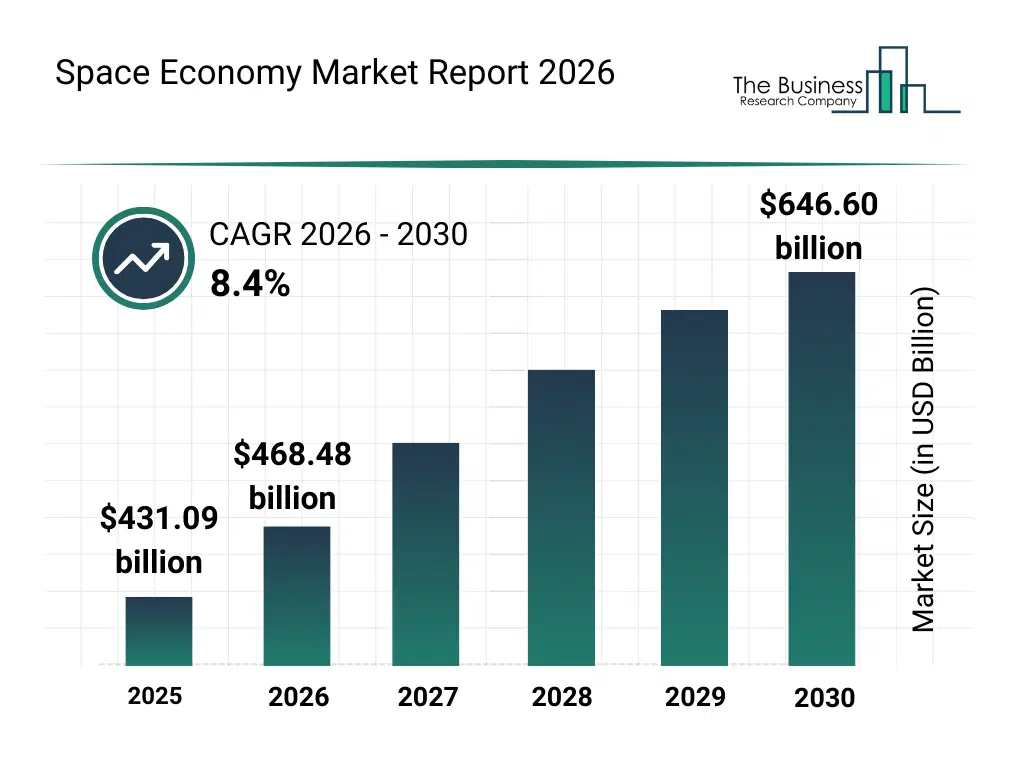
What Is The Space Economy Market Size and Share 2026?
The space economy market size has grown strongly in recent years. It will grow from $431.09 billion in 2025 to $468.48 billion in 2026 at a compound annual growth rate (CAGR) of 8.7%. The growth in the historic period can be attributed to increasing satellite launches, growing government space budgets, rising demand for earth observation, expanding commercial satellite services, and increasing investment in space infrastructure.What Is The Space Economy Market Growth Forecast?
The space economy market size is expected to see strong growth in the next few years. It will grow to $646.60 billion in 2030 at a compound annual growth rate (CAGR) of 8.4%. The growth in the forecast period can be attributed to growing adoption of reusable rockets, rising demand for space-based internet services, increasing private sector participation, expanding commercial space tourism activities, growing investment in deep space missions, and Major trends in the forecast period include technology advancements in satellite systems, innovations in reusable launch technologies, developments in space robotics, research and development in propulsion systems, and advancements in in-orbit servicing technologies.
Global Space Economy Market Segmentation
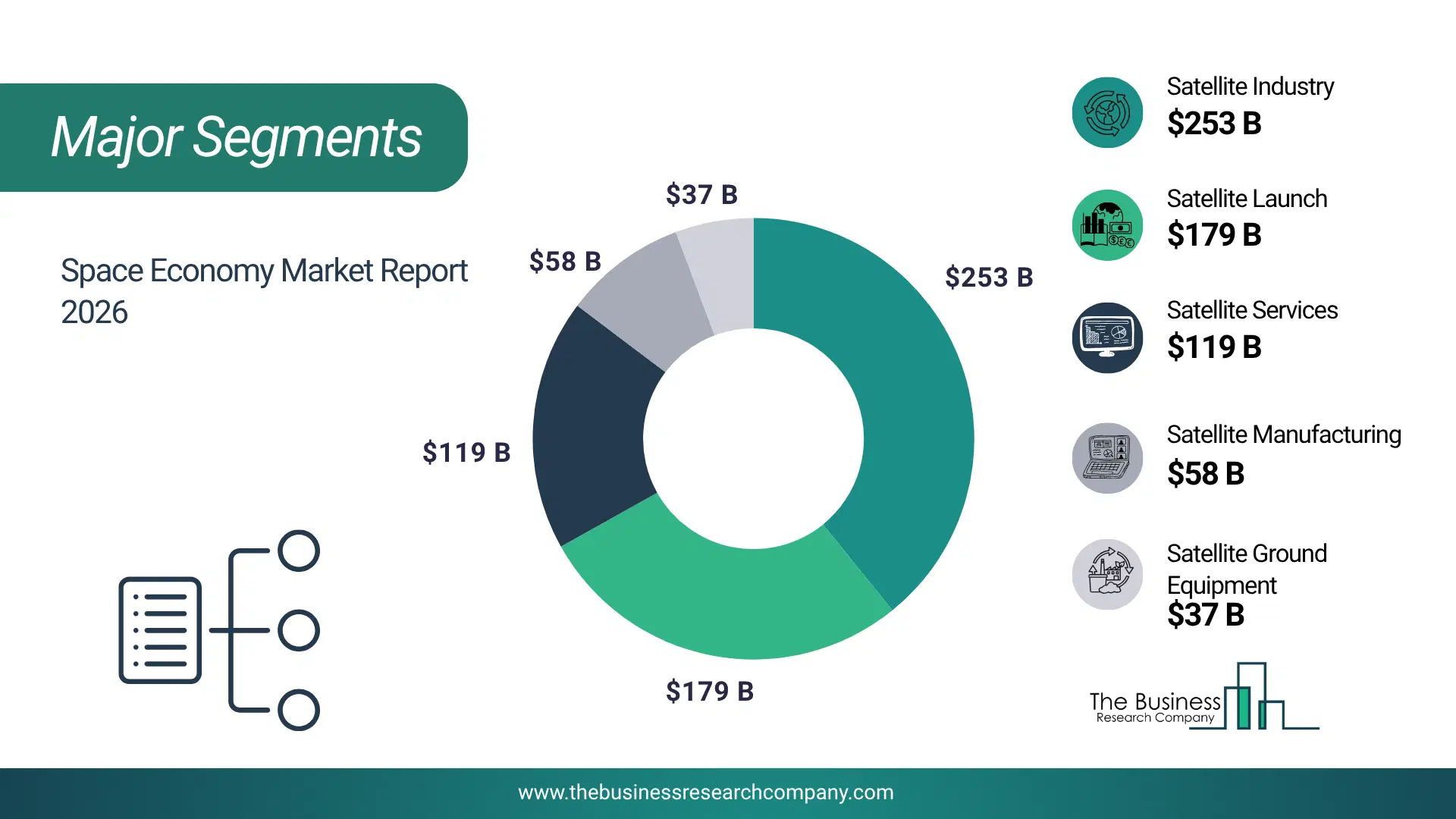
1) By Type: Satellite Industry, Satellite Launch, Satellite Services, Satellite Manufacturing, Satellite Ground Equipment 2) By Sector: Upstream Sector, Downstream Sector, Non-Satellite Sector 3) By Price Range: Low, Medium, Premium 4) By Distribution Channel: Direct Contracts, Online Services And Platforms, Partnerships And Collaborations, Other Distribution Channels 5) By End User: Government, Private Companies, Research Institutes, Educational Institutions, Other End Users Segmentations: 1) By Satellite Industry: Earth Observation Satellites, Communication Satellites, Navigation Satellites, Scientific Research Satellites, Small Satellite Systems 2) By Satellite Launch: Launch Vehicles, Launch Services, Reusable Rocket Systems, Heavy Lift Launch Systems, Small Payload Launch Solutions 3) By Satellite Services: Remote Sensing Services, Communication And Broadcast Services, Navigation And Positioning Services, Data Analytics Services, Satellite Internet Services 4) By Satellite Manufacturing: Satellite Assembly, Payload Development, Satellite Component Manufacturing, Propulsion System Manufacturing, Spacecraft Structure Manufacturing 5) By Satellite Ground Equipment: Ground Antenna Systems, Control Station Equipment, User Terminal Equipment, Tracking And Telemetry Systems, Ground Communication Infrastructure The top segments in the space economy market will be: • Satellite Industry will reach $252.88 Billion by 2030. • Satellite Launch will reach $179.32 Billion by 2030. • Satellite Services will reach $118.76 Billion by 2030. • Satellite Manufacturing will reach $57.9 Billion by 2030. • Satellite Ground Equipment will reach $36.56 Billion by 2030.What Is The Driver Of The Space Economy Market?
The rising demand for satellite?based communication services is expected to propel the growth of the space economy market going forward. Satellite?based communication services involve transmitting data, voice, and broadband connectivity through satellites orbiting Earth rather than through terrestrial networks, enabling global coverage and connectivity in remote or underserved regions. The demand for satellite?based communication services is increasing as individuals, businesses, and governments require reliable high?speed connectivity where ground infrastructure cannot feasibly reach, particularly for broadband internet and data services. The space economy supports this rising demand by expanding investments in satellite manufacturing, launch services, and satellite network operations that deliver these communication services. For instance, in May?2025, according to the Satellite Industry Association, a US?based satellite industry trade association, commercial satellite deployments reached 2,781 units in 2023, reflecting a 20% year on year increase, while satellite broadband performance strengthened with revenue rising by 40% and subscriber numbers growing by 27%. Therefore, the rising demand for satellite?based communication services is driving the growth of the space economy industry.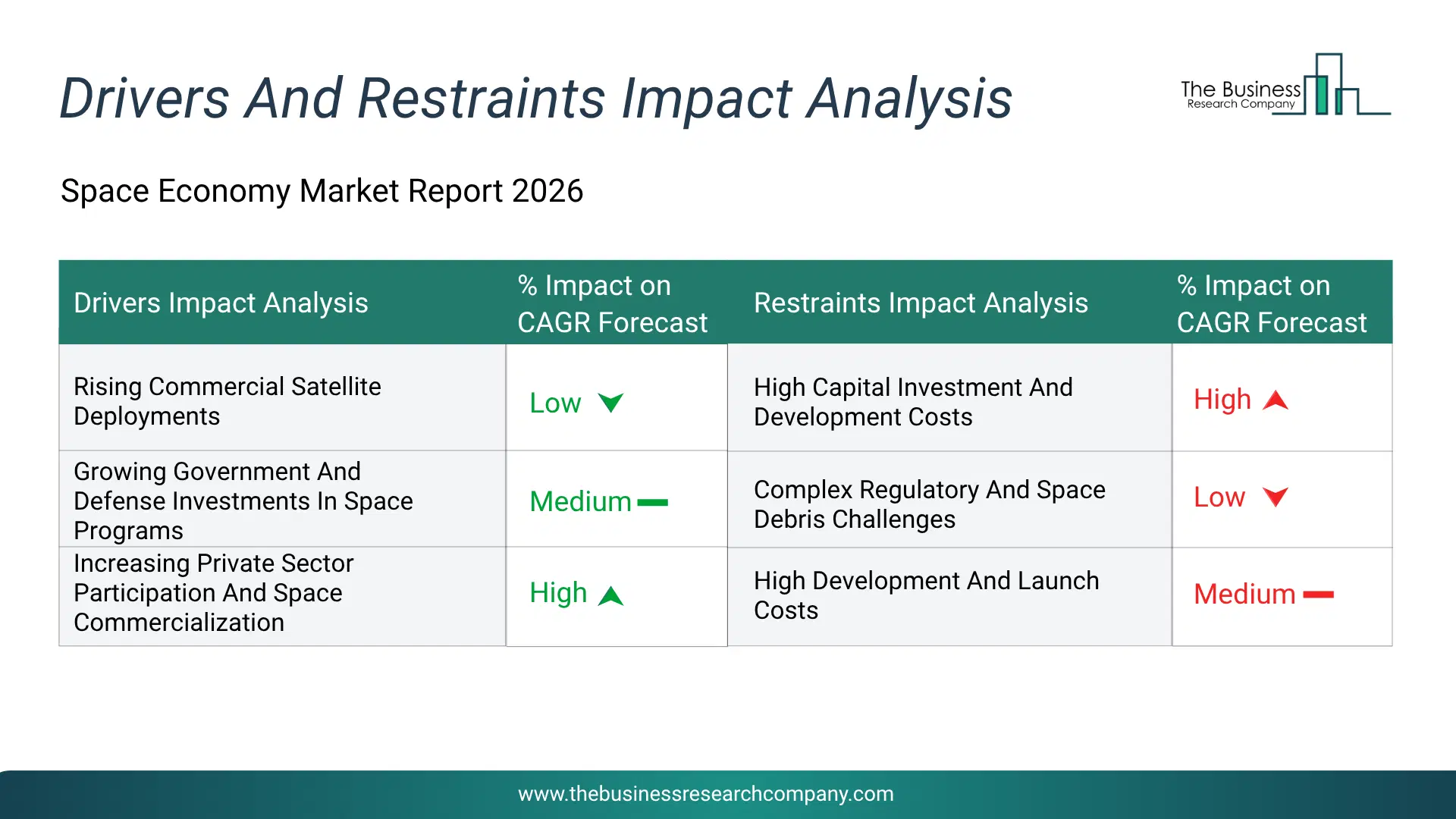
Infographic Chart Showing Key Market Drivers Analysis And Restraints For Space Economy Market
The chart presents an impact analysis of key drivers and restraints, quantifying their relative influence on the market's growth rate and helping assess the balance between growth enablers and limiting factors. This chart offers a high-level perspective; the full report contains more detailed insights.
How Will The Drivers Impact Growth In The Global Space Economy Market?
• Rising Commercial Satellite Deployments (Low) – During the forecast period, the rising commercial satellite deployments are expected to become a key growth driver for the space economy market by 2030. The increasing deployment of commercial satellites is driving the space economy market by expanding the availability of satellite-based communication, Earth observation, navigation, and data services. Commercial organizations use satellites to collect large volumes of geospatial, environmental, and operational data, while advanced space-based technologies convert this information into actionable insights. These solutions help improve connectivity, support real-time monitoring, enhance navigation capabilities, and create new revenue opportunities across industries. • Growing Government And Defense Investments In Space Programs (Medium) – During the forecast period, growing government and defense investments in space programs are expected to become a key growth driver for the space economy market by 2030. The increasing investment in space exploration, satellite systems, national security, and defense capabilities is driving the space economy market by accelerating the development and deployment of advanced space technologies and infrastructure. Governments and defense organizations invest in satellites, launch systems, space-based surveillance, and research programs to strengthen national security and expand scientific and technological capabilities. These investments help enhance space situational awareness, improve communication and intelligence capabilities, support technological innovation, and create growth opportunities for space-related businesses. • Increasing Private Sector Participation And Space Commercialization (High) – During the forecast period, increasing private sector participation and space commercialization are expected to become key growth drivers for the space economy market by 2030. The growing involvement of private companies in satellite deployment, launch services, space exploration, and space-based applications is driving the space economy market by expanding commercial activities and increasing investment in innovative space technologies. Private companies develop cost-effective launch systems, commercial satellites, and space-based services to meet the growing demand from governments, businesses, and consumers. These initiatives help reduce the cost of accessing space, accelerate technological innovation, expand the availability of space-based services, and create new revenue opportunities across the space industry.How Will The Restraints Impact Growth In The Global Space Economy Market?
• High Capital Investment And Development Costs (Low) – During the forecast period, the high capital investment and development costs are restraining the growth of the space economy market due to the substantial financial resources required for spacecraft development, satellite deployment, launch services, and space infrastructure. Organizations often face high expenses associated with research and development, advanced manufacturing, specialized equipment, testing, and mission operations. Small and medium-sized enterprises may struggle to secure sufficient funding for large-scale space projects and long-term technology development. The high costs associated with launch failures, mission risks, and maintaining space-based assets further increase financial pressures. These financial challenges can limit private sector participation and slow the development and commercialization of space-based technologies and services. • Complex Regulatory And Space Debris Challenges (Medium) – During the forecast period, complex regulatory and space debris challenges are restraining the growth of the space economy market due to the increasing difficulty of complying with diverse national and international regulations while ensuring the safe operation of space assets. Space organizations must navigate complex requirements related to satellite licensing, spectrum allocation, launch approvals, orbital operations, and international coordination. The growing accumulation of space debris also increases the risk of collisions and damage to operational satellites and spacecraft. Organizations may require additional investments in space situational awareness, collision avoidance technologies, and end-of-life disposal measures. These regulatory and operational challenges can increase project costs, extend deployment timelines, and limit the expansion of commercial space activities. • High Development And Launch Costs (High) – During the forecast period, the high development and launch costs restrain the growth of the space economy market due to the substantial investments required for spacecraft design, satellite manufacturing, launch services, ground infrastructure, and mission operations. Space missions involve extensive research and development, rigorous testing, and compliance with stringent safety and reliability standards, significantly increasing project costs. Smaller companies and emerging space startups often face difficulties securing sufficient funding for large-scale projects. The financial risks associated with launch failures and long development cycles further discourage investments. These high capital requirements limit market participation and slow the commercialization of space-based services.Key Players In The Global Space Economy Market
Major companies operating in the space economy market are Airbus Defence and Space GmbH, Lockheed Martin Corporation, Northrop Grumman Corporation, Space Exploration Technologies Corp., Blue Origin LLC, Viasat Inc., SES S.A., Eutelsat Communications S.A., Iridium Communications Inc., Arianespace S.A., United Launch Alliance LLC, Virgin Galactic Holdings Inc., Telesat, Sierra Space Corporation, Relativity Space Inc., Rocket Lab Inc., ICEYE Ltd., Planet Labs PBC, Axiom Space Inc., Astroscale Holdings Inc., Spire Global Inc., Firefly Aerospace Inc., BlackSky Global Inc., ispace inc., Capella Space Corp.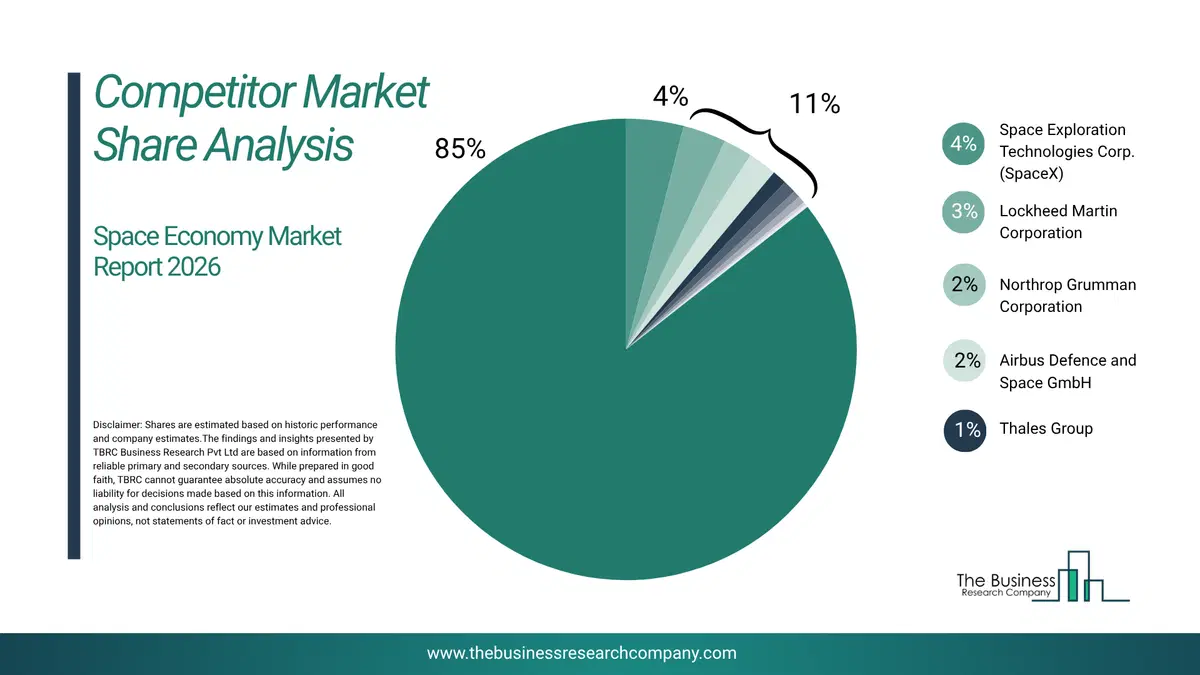
This chart is for illustrative purposes; the full report includes a detailed competitor analysis and comprehensive overview of the top 10 companies in the market.
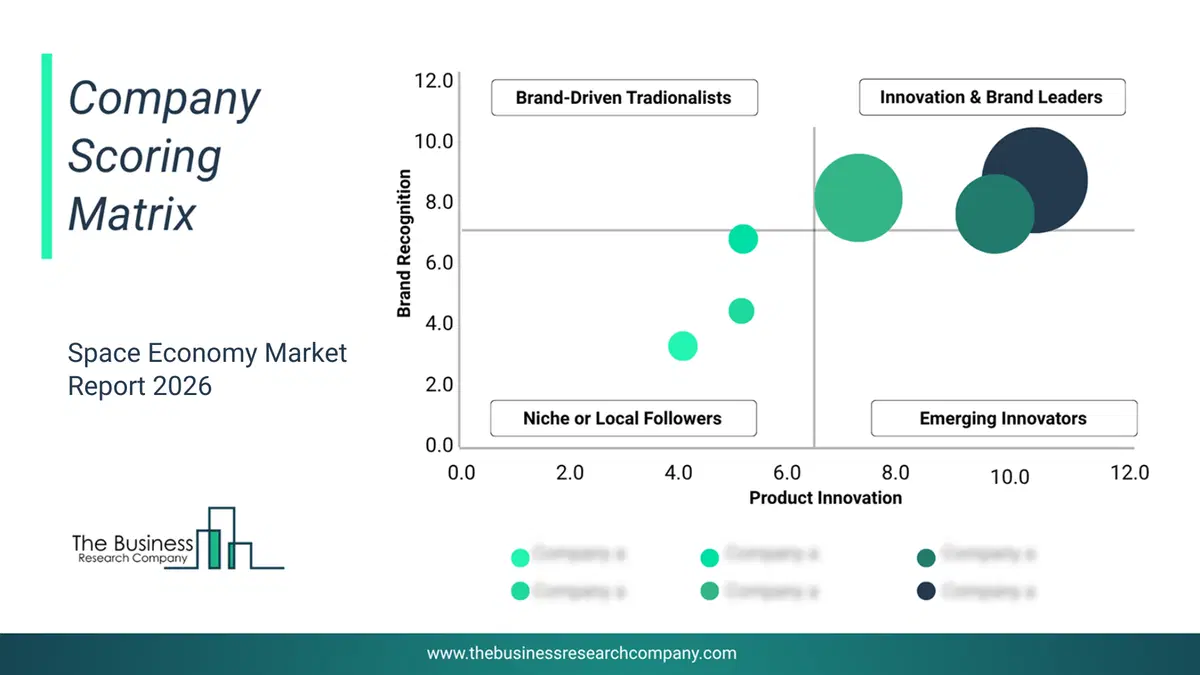
This chart maps companies by product innovation and brand strength, with bubble size indicating relative revenue, helping identify market leaders, challengers, and niche players. This is an illustrative chart; the full report provides a complete and accurate competitive analysis.
Global Space Economy Market Trends and Insights
Major companies operating in the space economy market are focusing on developing advanced space capabilities, such as orbital manufacturing and reentry testing, to enable payload experimentation, materials testing, and in‑space manufacturing. Orbital manufacturing and reentry analytics refers to the ability to produce, analyze, and return payloads from orbit, while capturing high‑fidelity data in extreme reentry environments to inform next‑generation aerospace solutions. For instance, in January 2025, Varda Space Industries Inc., a US‑based space manufacturing and logistics company, launched its second orbital processing and reentry capsule, W‑2, aboard the Transporter‑12 rideshare mission with SpaceX. The capsule carries payloads from partners, including the Air Force Research Laboratory, featuring the Optical Sensing of Plasmas in the Reentry Environment payload, which captures the first in situ optical emission measurements of reentry plasma past Mach 15. The W‑2 capsule also integrates an advanced thermal protection system developed with NASA, alongside Varda’s expanded pharmaceutical reactor for in‑orbit manufacturing.What Are Latest Mergers And Acquisitions In The Space Economy Market?
In July 2025, SES S.A., a Luxembourg‑based provider of satellite communications services and multi‑orbit space network solutions, acquired Intelsat Holdings S.a.r.l. for $3.1 billion (€2.8 billion). With this acquisition, SES aims to create a stronger multi‑orbit operator capable of serving global connectivity needs by expanding its satellite fleet, enhancing network resilience, and broadening its suite of integrated satellite‑based products and services to better compete in high‑growth markets including government, mobility, and broadband communications. Intelsat is a US‑based satellite operator offering communications services through a large fleet of geostationary satellites and related infrastructure to commercial and government customers worldwide.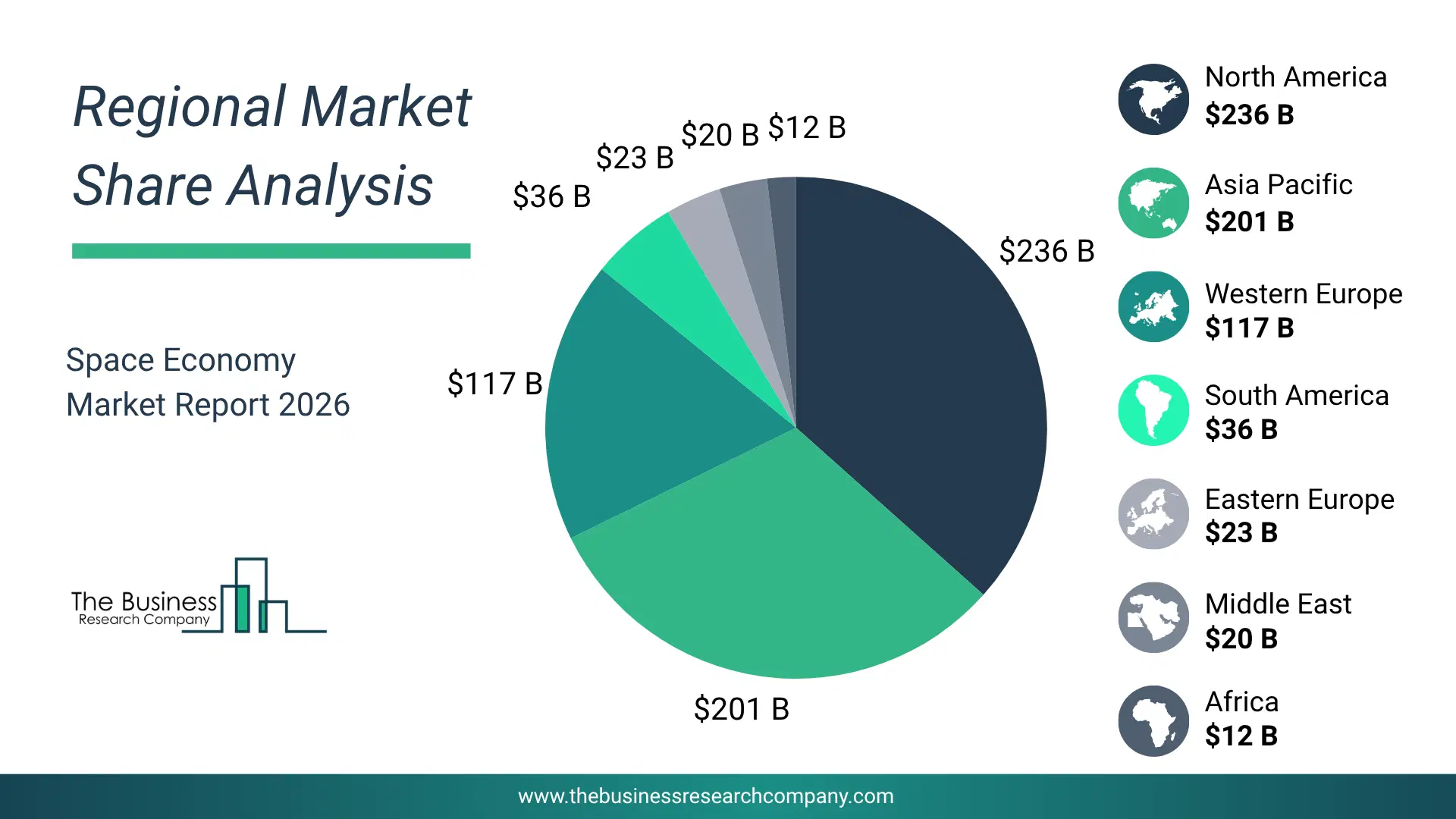
Regional Insights
North America was the largest region in the space economy market in 2025. Asia-Pacific is expected to be the fastest-growing region in the forecast period. The regions covered in this market report are Asia-Pacific, South East Asia, Western Europe, Eastern Europe, North America, South America, Middle East, Africa. The countries covered in this market report are Australia, Brazil, China, France, Germany, India, Indonesia, Japan, Taiwan, Russia, South Korea, UK, USA, Canada, Italy, Spain.What Defines the Space Economy Market?
The space economy market consists of revenues earned by entities by providing services such as satellite communication services, earth observation services, navigation and positioning services, space data analytics services, satellite broadband services, in-orbit servicing, space tourism services, launch services, space consulting services, and remote sensing services. The market value includes the value of related goods sold by the service provider or included within the service offering. The space economy market includes satellites, launch vehicles, space probes, space rovers, space habitats, ground station equipment, satellite antennas, spacecraft components, space suits, and propulsion systems. Values in this market are ‘factory gate’ values, that is, the value of goods sold by the manufacturers or creators of the goods, whether to other entities (including downstream manufacturers, wholesalers, distributors, and retailers) or directly to end customers. The value of goods in this market includes related services sold by the creators of the goods.How is Market Value Defined and Measured?
The market value is defined as the revenues that enterprises gain from the sale of goods and/or services within the specified market and geography through sales, grants, or donations in terms of the currency (in USD unless otherwise specified). The revenues for a specified geography are consumption values that are revenues generated by organizations in the specified geography within the market, irrespective of where they are produced. It does not include revenues from resales along the supply chain, either further along the supply chain or as part of other products.
This chart presents market attractiveness based on a quantitative evaluation of growth, competition, strategic alignment, and risk, offering a clear view of opportunity areas for decision-making. This chart is for illustrative purposes; the full report contains the complete analysis.

This chart highlights the Total Addressable Market (TAM) by estimating the maximum revenue opportunity using an assumption-driven approach, supporting strategic planning and opportunity sizing across markets. The chart is illustrative; the full report provides a more comprehensive analysis.
What Key Data and Analysis Are Included in the Space Economy Market Report 2026?
The space economy market research report is one of a series of new reports from The Business Research Company that provides market statistics, including industry global market size, regional shares, competitors with the market share, detailed market segments, market trends and opportunities, and any further data you may need to thrive in the space economy industry. The market research report delivers a complete perspective of everything you need, with an in-depth analysis of the current and future state of the industry.Space Economy Market Report Forecast Analysis
| Report Attribute | Details |
|---|---|
| Market Size Value In 2026 | $468.48 billion |
| Revenue Forecast In 2030 | $646.60 billion |
| Growth Rate | CAGR of 8.7% from 2026 to 2030 |
| Base Year For Estimation | 2025 |
| Actual Estimates/Historical Data | 2020-2025 |
| Forecast Period | 2026 - 2030 |
| Market Representation | Revenue in USD Billion and CAGR from 2026 to 2030 |
| Segments Covered | Type, Sector, Price Range, Distribution Channel, End User, Satellite Industry, Satellite Launch, Satellite Services, Satellite Manufacturing, Satellite Ground Equipment |
| Regional Scope | Asia-Pacific, Western Europe, Eastern Europe, North America, South America, Middle East, Africa |
| Country Scope | The countries covered in the report are Australia, Brazil, China, France, Germany, India, ... |
| Key Companies Profiled | Airbus Defence and Space GmbH, Lockheed Martin Corporation, Northrop Grumman Corporation, Space Exploration Technologies Corp., Blue Origin LLC, Viasat Inc., SES S.A., Eutelsat Communications S.A., Iridium Communications Inc., Arianespace S.A., United Launch Alliance LLC, Virgin Galactic Holdings Inc., Telesat, Sierra Space Corporation, Relativity Space Inc., Rocket Lab Inc., ICEYE Ltd., Planet Labs PBC, Axiom Space Inc., Astroscale Holdings Inc., Spire Global Inc., Firefly Aerospace Inc., BlackSky Global Inc., ispace inc., Capella Space Corp. |
| Customization Scope | Request for Customization |
| Pricing And Purchase Options | Explore Purchase Options |