
Space Habitat Technology Market Report 2026
Global Outlook – By Component (Life Support Systems, Habitat Structures, Power Systems, Thermal Control Systems, Communication Systems, Other Components), By Habitat Type (Orbital, Surface), By Application (Commercial, Government, Research) – Market Size, Trends, Strategies, and Forecast to 2030
Space Habitat Technology Market Overview
• Space Habitat Technology market size has reached to $1.87 billion in 2025 • Expected to grow to $4.49 billion in 2030 at a compound annual growth rate (CAGR) of 19.1% • Growth Driver: Increasing Investments In Space Exploration Fueling The Growth Of The Market Due To Strategic And Geopolitical Priorities • Market Trend: Innovative Designs Drive Scalable And Affordable Living Solutions For Outer Space • North America was the largest region in 2025.What Is Covered Under Space Habitat Technology Market?
Space habitat technology refers to designing and developing systems and structures that enable humans to live and work in space for extended periods. It encompasses life support, radiation shielding, thermal control, and structural design tailored for microgravity or planetary surfaces. The main purpose of this technology is to ensure human survival, safety, and comfort in outer space environments during long-duration missions. The main components of space habitat technology are life support, structural systems, power supply, thermal regulation, communication systems, and other essential subsystems. Life support refers to the systems in space habitat technology that provide and maintain essential conditions for human survival, including air, water, temperature, and waste management. These habitats are classified by types into orbital and surface-based, and are utilized across various applications, including commercial, governmental, and research-oriented missions.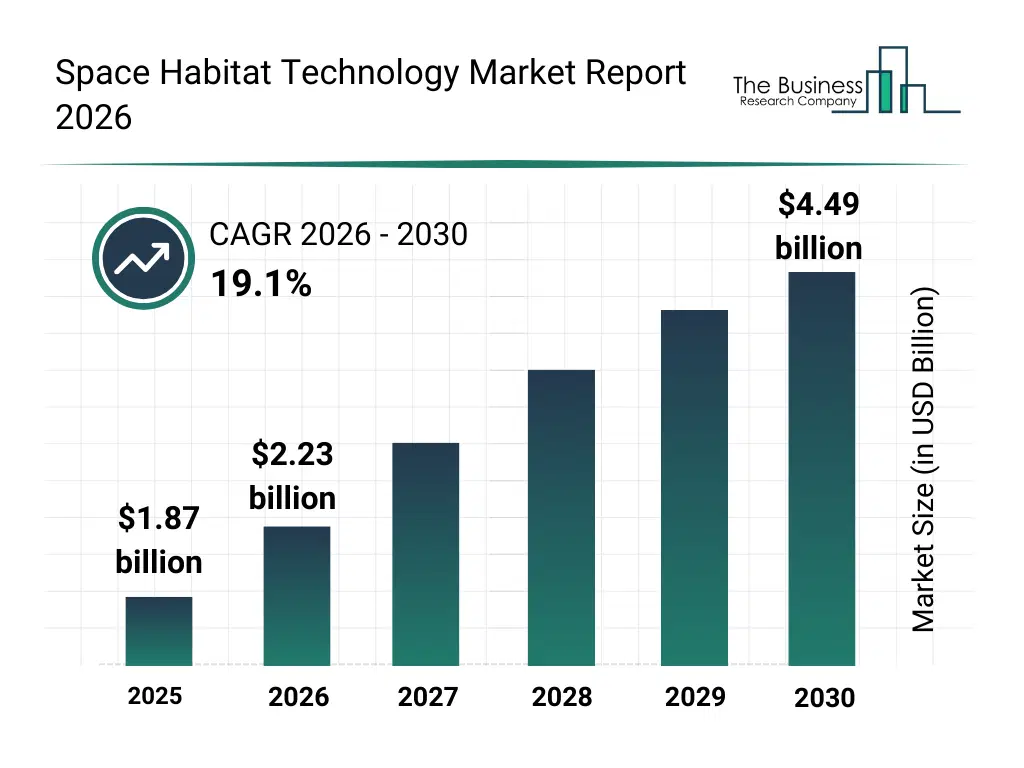
What Is The Space Habitat Technology Market Size and Share 2026?
The space habitat technology market size has grown rapidly in recent years. It will grow from $1.87 billion in 2025 to $2.23 billion in 2026 at a compound annual growth rate (CAGR) of 19.3%. The growth in the historic period can be attributed to early development of life support and thermal control systems for long-duration space missions, initial adoption of inflatable habitat modules for compact launch and in-orbit expansion, advancements in radiation shielding materials to protect crew in deep space, foundational research in robotic construction and maintenance for extraterrestrial structures, increased use of 3d printing technologies for habitat component fabrication.What Is The Space Habitat Technology Market Growth Forecast?
The space habitat technology market size is expected to see rapid growth in the next few years. It will grow to $4.49 billion in 2030 at a compound annual growth rate (CAGR) of 19.1%. The growth in the forecast period can be attributed to growing investment in modular habitat systems for lunar and martian surface operations, development of high-efficiency power generation units to support long-term habitation, expansion of commercial habitat simulation and testing services for mission readiness, advancements in autonomous construction technologies enabling large-scale off-earth structures, rising demand for transportation and logistics support as human presence in space increases. Major trends in the forecast period include advanced materials for space habitat construction, enhanced radiation shielding technologies, sustainable life support systems, modular and inflatable habitat expansion, space habitat simulation and testing innovations.
Global Space Habitat Technology Market Segmentation
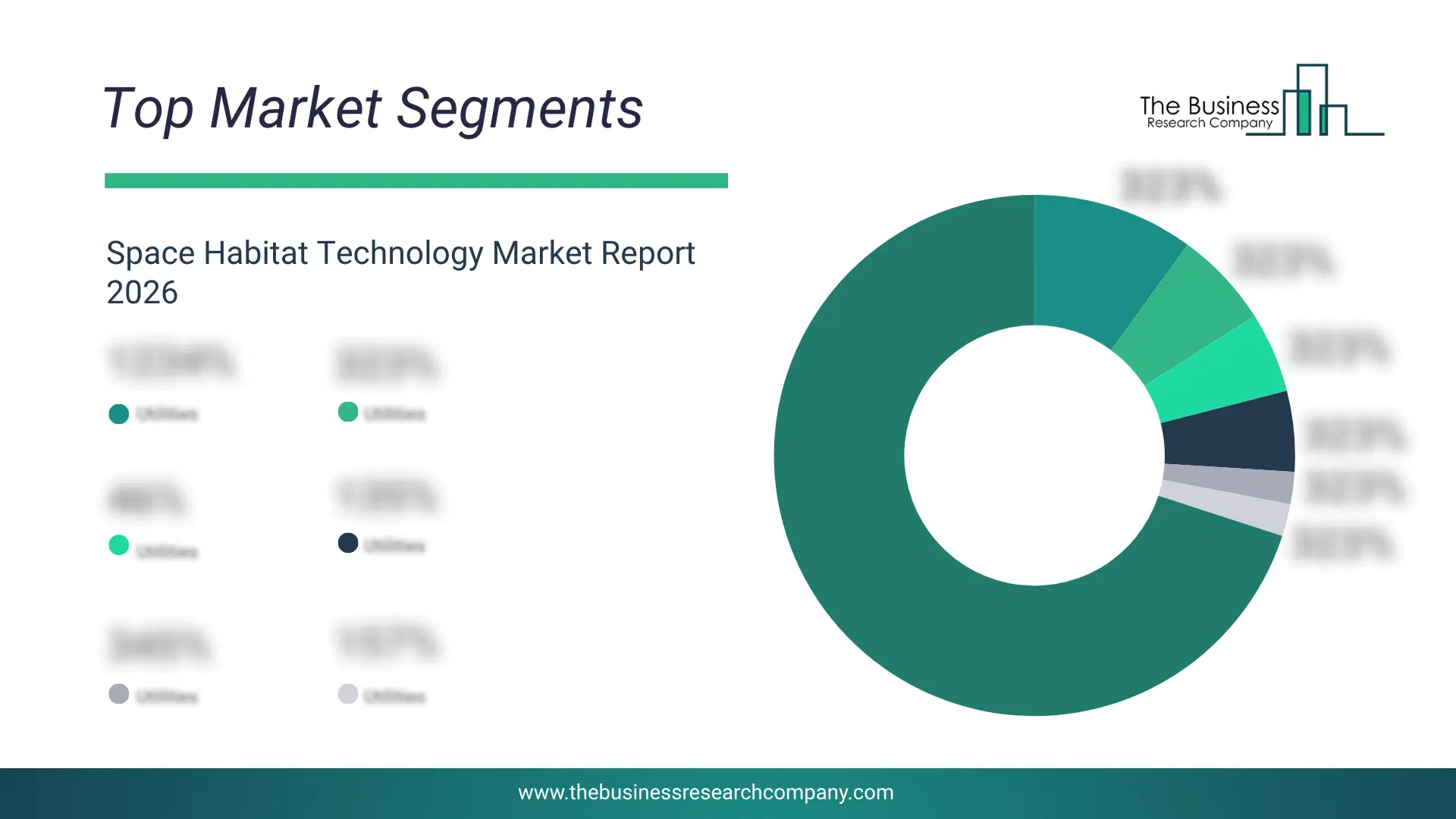
1) By Component: Life Support Systems, Habitat Structures, Power Systems, Thermal Control Systems, Communication Systems, Other Components 2) By Habitat Type: Orbital, Surface 3) By Application: Commercial, Government, Research Subsegments: 1) By Life Support Systems: Atmosphere Control And Supply, Water Recycling And Management, Waste Management Systems, Food Production Systems, Environmental Monitoring Systems 2) By Habitat Structures: Modular Habitat Units, Inflatable Habitat Structures, Radiation Shielding Materials, Structural Frames And Panels, Interior Furnishings And Layout 3) By Power Systems: Solar Power Generation, Energy Storage Systems, Power Distribution Units, Backup Power Systems, Thermal-To-Electric Conversion Systems 4) By Thermal Control Systems: Active Thermal Control, Passive Thermal Control, Thermal Monitoring Sensors, Phase Change Materials, Heat Rejection Systems 5) By Communication Systems: Satellite Communication Terminals, Wireless Communication Networks, Data Transmission Equipment, Antennas And Transceivers, Communication Software And Protocols 6) By Other Components: Navigation And Guidance Systems, Robotics And Automation Components, Safety And Emergency Systems, Environmental Sensors And Instruments, Maintenance And Repair ToolsWhat Is Driver Of The Space Habitat Technology Market?
The increasing investments in space exploration are expected to propel the growth of the space habitat technology market going forward. Space exploration refers to investigating and studying outer space through astronomy, robotic spacecraft, and human space missions. The increasing investments in space exploration are primarily due to national security concerns and geopolitical competition, as countries seek strategic advantages in space-based defense, surveillance, and technological dominance. Space habitat technology supports space exploration by enabling sustainable human presence beyond Earth through advanced life support and structural systems. It enhances mission efficiency by ensuring crew safety, comfort, and functionality in harsh space environments. For instance, in September 2023, according to Novaspace, a France-based space governance provider, government spending on space exploration reached $27 billion in 2024 and is anticipated to grow to almost $31 billion by 2034. Therefore, the increasing investments in space exploration are driving the growth of the space habitat technology industry.Key Players In The Global Space Habitat Technology Market
Major companies operating in the space habitat technology market are RTX Corporation, Airbus SE, The Boeing Company, Lockheed Martin Corporation, Northrop Grumman Corporation, Honeywell International Inc., BAE Systems plc, Thales Group, Space Exploration Technologies Corp., ICON Technology Inc., Blue Origin LLC, Maxar Technologies Inc., Sierra Space Corporation, ILC Dover LP, Redwire Corporation, Axiom Space Inc., Bigelow Aerospace LLC, Vast Space LLC, NanoRacks LLC, AI SpaceFactory Inc.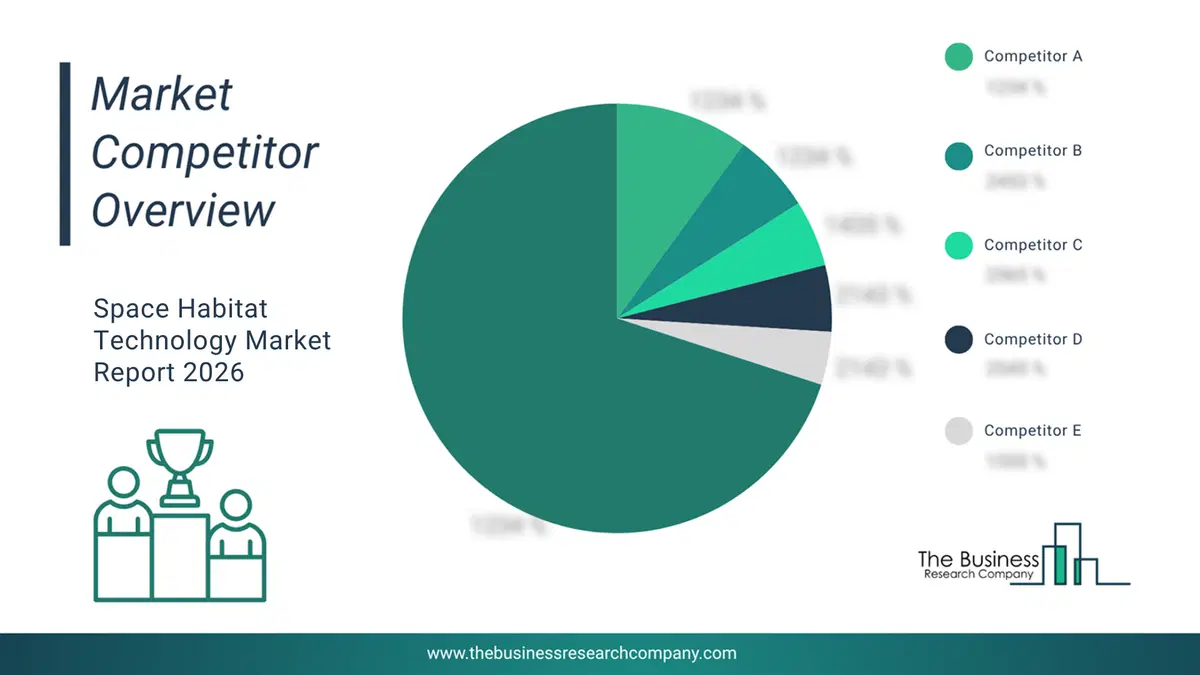
This chart is for illustrative purposes; the full report includes a detailed competitor analysis and comprehensive overview of the top 10 companies in the market.
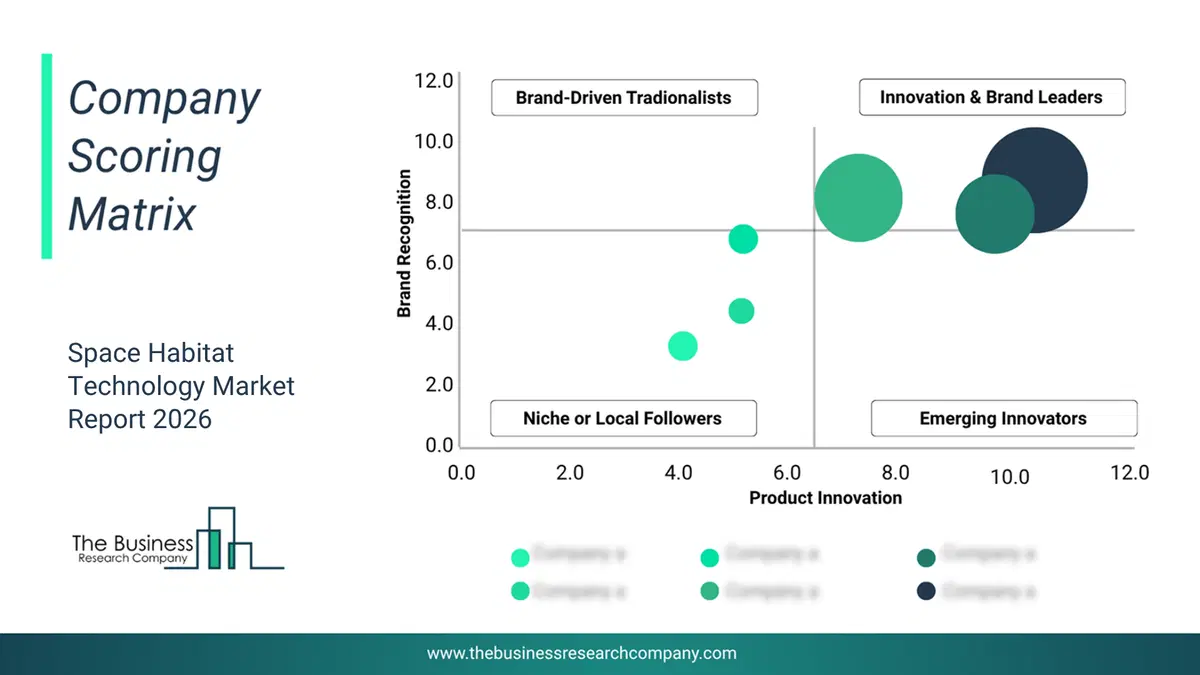
This chart maps companies by product innovation and brand strength, with bubble size indicating relative revenue, helping identify market leaders, challengers, and niche players. This is an illustrative chart; the full report provides a complete and accurate competitive analysis.
Global Space Habitat Technology Market Trends and Insights
Major companies operating in the space habitat technology market are focusing on developing innovative solutions, such as expandable space habitats, to support sustainable and scalable human presence in outer space. Expandable space habitats are inflatable structures that expand once deployed in space, providing astronauts with lightweight, compact, and spacious living environments. For instance, in April 2024, Max Space Inc., a US-based aerospace technology company, launched a proprietary expandable habitat architecture to deliver lightweight, scalable orbital living and working environments. The system utilizes an inflatable, scalable design capable of expanding to stadium-sized or larger volumes while ensuring structural stability and reliability. This innovative approach significantly boosts usable interior space while reducing mass and costs compared to conventional rigid modules, paving the way for mass production and more affordable space habitation.What Are Latest Mergers And Acquisitions In The Space Habitat Technology Market? Voyager Technologies Acquires ZIN Technologies To Boost Space Infrastructure
In March 2023, Voyager Technologies Inc., a US-based aerospace and defense company, acquired ZIN Technologies Inc. for an undisclosed amount. With this acquisition, Voyager Technologies aims to expand its space infrastructure and technology capabilities to further the development of its Starlab commercial space stations. ZIN Technologies Inc. is a US-based aerospace engineering and manufacturing company that develops space habitat systems for lunar and orbital missions.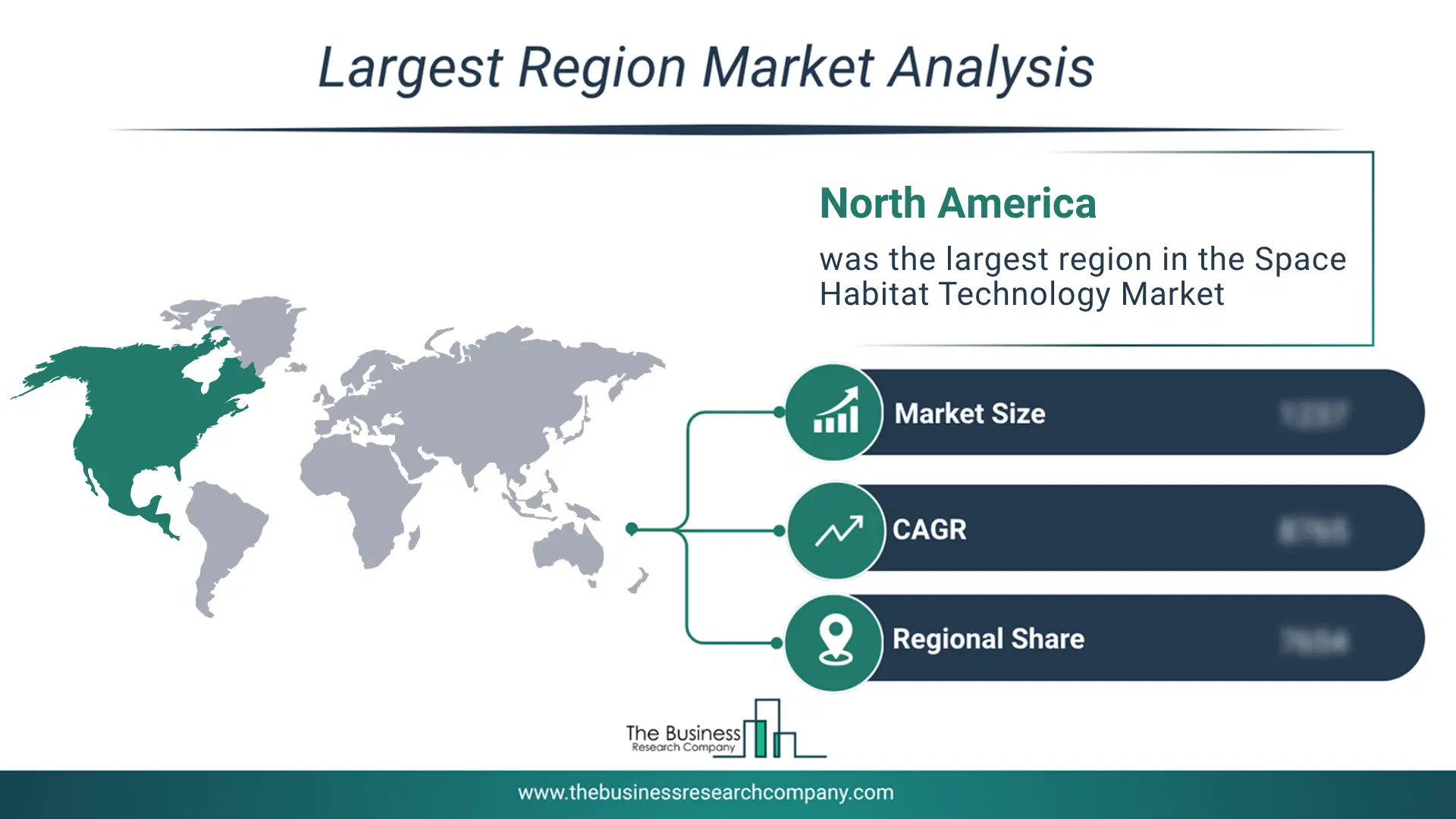
Regional Insights
North America was the largest region in the space habitat technology market in 2025. The regions covered in this market report are Asia-Pacific, South East Asia, Western Europe, Eastern Europe, North America, South America, Middle East, Africa. The countries covered in this market report are Australia, Brazil, China, France, Germany, India, Indonesia, Japan, Taiwan, Russia, South Korea, UK, USA, Canada, Italy, SpainWhat Defines the Space Habitat Technology Market?
The space habitat technology market consists of revenues earned by entities by providing services such as design and engineering services, robotic construction and maintenance, space habitat simulation and testing, and transportation and logistics support. The market value includes the value of related goods sold by the service provider or included within the service offering. The space habitat technology market also includes sales of inflatable habitat modules, radiation shielding materials, 3D printing equipment, power generation units, and habitat structural frames. Values in this market are ‘factory gate’ values, that is, the value of goods sold by the manufacturers or creators of the goods, whether to other entities (including downstream manufacturers, wholesalers, distributors, and retailers) or directly to end customers. The value of goods in this market includes related services sold by the creators of the goods.How is Market Value Defined and Measured?
The market value is defined as the revenues that enterprises gain from the sale of goods and/or services within the specified market and geography through sales, grants, or donations in terms of the currency (in USD unless otherwise specified). The revenues for a specified geography are consumption values that are revenues generated by organizations in the specified geography within the market, irrespective of where they are produced. It does not include revenues from resales along the supply chain, either further along the supply chain or as part of other products.
This chart presents market attractiveness based on a quantitative evaluation of growth, competition, strategic alignment, and risk, offering a clear view of opportunity areas for decision-making. This chart is for illustrative purposes; the full report contains the complete analysis.

This chart highlights the Total Addressable Market (TAM) by estimating the maximum revenue opportunity using an assumption-driven approach, supporting strategic planning and opportunity sizing across markets. The chart is illustrative; the full report provides a more comprehensive analysis.
What Key Data and Analysis Are Included in the Space Habitat Technology Market Report 2026?
The space habitat technology market research report is one of a series of new reports from The Business Research Company that provides market statistics, including industry global market size, regional shares, competitors with the market share, detailed market segments, market trends and opportunities, and any further data you may need to thrive in the space habitat technology industry. The market research report delivers a complete perspective of everything you need, with an in-depth analysis of the current and future state of the industry.Space Habitat Technology Market Report Forecast Analysis
| Report Attribute | Details |
|---|---|
| Market Size Value In 2026 | $2.23 billion |
| Revenue Forecast In 2030 | $4.49 billion |
| Growth Rate | CAGR of 19.1% from 2026 to 2030 |
| Base Year For Estimation | 2025 |
| Actual Estimates/Historical Data | 2020-2025 |
| Forecast Period | 2026 - 2030 |
| Market Representation | Revenue in USD Billion and CAGR from 2026 to 2030 |
| Segments Covered | Component, Habitat Type, Application |
| Regional Scope | Asia-Pacific, Western Europe, Eastern Europe, North America, South America, Middle East, Africa |
| Country Scope | The countries covered in the space habitat technology market report are Australia, Brazil, China, France, Germany, India, Indonesia, Japan, Taiwan, Russia, South Korea, UK, USA, Canada, Italy, Spain |
| Key Companies Profiled | RTX Corporation, Airbus SE, The Boeing Company, Lockheed Martin Corporation, Northrop Grumman Corporation, Honeywell International Inc., BAE Systems plc, Thales Group, Space Exploration Technologies Corp., ICON Technology Inc., Blue Origin LLC, Maxar Technologies Inc., Sierra Space Corporation, ILC Dover LP, Redwire Corporation, Axiom Space Inc., Bigelow Aerospace LLC, Vast Space LLC, NanoRacks LLC, AI SpaceFactory Inc. |
| Customization Scope | Request for Customization |
| Pricing And Purchase Options | Explore Purchase Options |