

Contact Us
  Search
The Business Research Company Logo
Space Insurance Global Market Opportunities And Strategies To 2035
Published :July 2026
Pages :394
Format :PDF
Delivery Time :2-3 Business Days
Why 2-3 days? We update the report with the latest data and news before delivery. Let us know if you need us to expedite.
Report Price :$4,490.00

Space Insurance Global Market Opportunities And Strategies To 2035

By Type Of Insurance (Launch Insurance, In-Orbit Insurance, End-Of-Life Insurance, Third-Party Liability), By Distribution Channel (Direct Sales, Brokers, Reinsurance Companies, Insurance Agents), By Application (Communication Satellites, Earth Observation Satellites, Navigation Satellites, Scientific And Exploration Missions, Space Stations And Habitats), By End-User (Government Space Agencies, Commercial Satellite Operators, Launch Service Providers, Space Tourism Companies, Academic And Research Institutions), And By Region, Opportunities And Strategies – Global Forecast To 2035

Space Insurance Market Definition

Space insurance is a specialized form of coverage designed to protect stakeholders, such as satellite operators, launch providers and space agencies, from financial losses associated with space missions. It typically covers risks across different phases, including pre-launch, launch and in-orbit operations. The primary purpose is to mitigate high-value risks arising from launch failures, satellite malfunctions, or operational disruptions. By transferring these risks to insurers, it enables continued investment and commercial activity in the space sector while improving financial certainty for mission stakeholders. The space insurance market covered in this report includes revenues generated by entities (insurers, reinsurers, brokers and underwriting agencies) through the provision of insurance and risk transfer solutions for space missions and satellite operations. The market encompasses premiums from policies covering pre-launch, launch and in-orbit phases, including protection against launch failure, partial loss and operational anomalies.
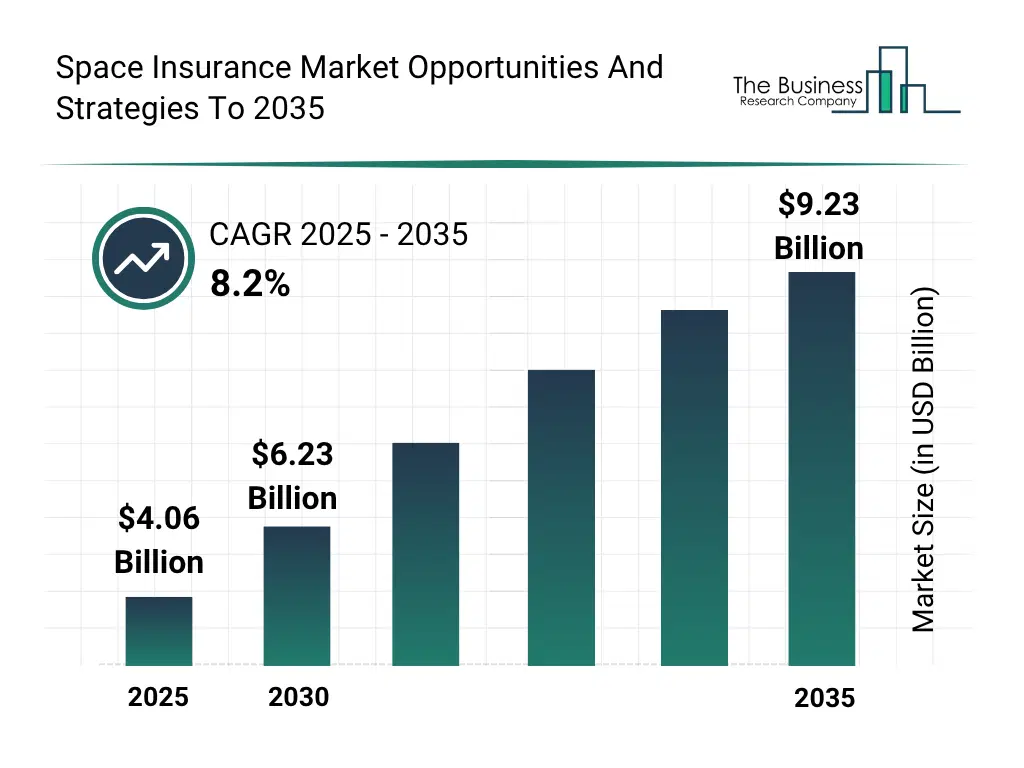
Space Insurance Global Market Opportunities And Strategies To 2035 Market Size and growth rate 2026 to 2030: Graph

Space Insurance Market Size

The global space insurance market reached a value of nearly $4,056.6 million in 2025, having grown at a compound annual growth rate (CAGR) of 9.8% since 2020. The market is expected to grow from $4,056.6 million in 2025 to $6,233.3 million in 2030 at a rate of 9.0%. The market is then expected to grow at a CAGR of 8.2% from 2030 and reach $9,230.6 million in 2035. Growth in the historic period resulted from rising number of satellite launches, rising international collaboration and joint space missions, growth of satellite mega-constellations (LEO networks) and growth in the commercialization of space and newspace ecosystem. Factors that negatively affected growth in the historic period were high cost of underwriting and premiums, high uncertainty and unpredictable space risks. Going forward, rising investments in space infrastructure, growth in earth observation and data analytics demand, expansion of satellite-based services and increasing space debris and collision risks will drive the growth. Factors that could hinder the growth of the space insurance market in the future include regulatory and legal uncertainties, limited historical data for risk modeling and trade war and tariffs.
Research Expert

Book your 30 minutes free consultation with our research experts

Space Insurance Market Segmentation

The space insurance market is segmented by type of insurance, by distribution channel, by application and by end user.

By Type Of Insurance –
The space insurance market is segmented by type of insurance into:
    • a) Launch Insurance
    • b) In-Orbit Insurance
    • c) End-Of-Life Insurance
    • d) Third-Party Liability
The in-orbit insurance market was the largest segment of the space insurance market segmented by type of insurance, accounting for 51.8% or $2,100.6 million of the total in 2025. Going forward, the in-orbit insurance segment is expected to be the fastest-growing segment in the space insurance market segmented by type of insurance, at a CAGR of 9.9% during 2025-2030.

By Distribution Channel –
The space insurance market is segmented by distribution channel into:
    • a) Direct Sales
    • b) Brokers
    • c) Reinsurance Companies
    • d) Insurance Agents
The brokers market was the largest segment of the space insurance market segmented by distribution channel, accounting for 49.9% or $2,025.2 million of the total in 2025. Going forward, the brokers segment is expected to be the fastest-growing segment in the space insurance market segmented by distribution channel, at a CAGR of 10.1% during 2025-2030.

By Application –
The space insurance market is segmented by application into:
    • a) Communication Satellites
    • b) Earth Observation Satellites
    • c) Navigation Satellites
    • d) Scientific And Exploration Missions
    • e) Space Stations And Habitats
The communication satellites market was the largest segment of the space insurance market segmented by application, accounting for 45.3% or $1,836.4 million of the total in 2025. Going forward, the earth observation satellites segment is expected to be the fastest-growing segment in the space insurance market segmented by application, at a CAGR of 11.9% during 2025-2030.

By End User –
The space insurance market is segmented by end user into:
  1. a) Government Space Agencies
  2. b) Commercial Satellite Operators
  3. c) Launch Service Providers
  4. d) Space Tourism Companies
  5. e) Academic And Research Institutions
The commercial satellite operators market was the largest segment of the space insurance market segmented by end user, accounting for 47.7% or $1,935.4 million of the total in 2025. Going forward, the commercial satellite operators segment is expected to be the fastest-growing segment in the space insurance market segmented by end user, at a CAGR of 10.4% during 2025-2030.

By Geography - The space insurance market is segmented by geography into:
      o Asia Pacific
      • China
      • India
      • Japan
      • Australia
      • Taiwan
      • South Korea
      o South East Asia
      • Indonesia
      o North America
      • USA
      • Canada
      o South America
      • Brazil
      o Western Europe
      • France
      • Germany
      • UK
      • Italy
      • Spain
      o Eastern Europe
      • Russia
      o Middle East
      o Africa
North America was the largest region in the space insurance market, accounting for 51.8% or $2,101.5 million of the total in 2025. It was followed by Asia Pacific, Western Europe and then the other regions. Going forward, the fastest-growing regions in the space insurance market will be Asia Pacific and Middle East where growth will be at CAGRs of 11.3% and 10.6% respectively. These will be followed by Western Europe and Africa where the markets are expected to grow at CAGRs of 10.4% and 10.2% respectively.

Space Insurance Market Drivers

The key drivers of the space insurance market include: Rising Investments In Space Infrastructure During the forecast period, the rising investments in space infrastructure is expected to propel the growth of the space insurance market. Governments and private sector players are increasingly allocating capital toward satellite networks, launch facilities, ground stations and space exploration programs. This surge in investment will expand the number and value of space assets, thereby increasing exposure to operational and financial risks. As a result, demand for comprehensive insurance coverage is anticipated to grow. Insurers are likely to respond by enhancing capacity and developing tailored solutions to address evolving risk profiles. The rising investments in space infrastructure growth contribution during the forecast period in 2026 is 1.8%.

Space Insurance Market Restraints

The key restraints on the space insurance market include: Limited Historical Data For Risk Modeling During forecast period, limited historical data for risk modeling is expected to hinder the growth of the space insurance market. The evolving nature of space technologies, mission profiles and operational environments results in insufficient long-term data for accurate risk assessment. This lack of reliable datasets makes it challenging for insurers to develop precise actuarial models and predict potential losses. Consequently, insurers may adopt conservative underwriting approaches, leading to higher premiums and restricted coverage terms. Growth affected by the limited historical data for risk modeling during the forecast period in 2026 is -1.0%.

Space Insurance Market Competitive Landscape

Major Competitors are:

  • AXA XL
  • Munich Re
  • Swiss Re
  • Lloyd's Insurance
  • American International Group (AIG)
  • Other Competitors Include:

  • Allianz SE
  • PartnerRe Ltd.
  • Starr International Company
  • Hannover Re
  • SCOR SE
  • Tokio Marine & Nichido Fire Insurance Co., Ltd.
  • Sompo Japan Insurance Inc.
  • China Reinsurance (Group)
  • Beazley
  • SOMPO Holdings, Inc.
  • Mitsui Sumitomo Insurance Group Holdings, Inc.
  • Marsh McLennan
  • Willis Towers Watson
  • China Pacific Insurance (CPIC)
  • Jiangtai Insurance Brokers
  • China Taiping Insurance Holdings
  • Starr Insurance
  • Hiscox
  • TATA AIG
  • Aon
  • Marsh Risk
  • QBE Insurance Group
  • Howden
  • Relm Insurance
  • Willis Towers Watson (WTW)
  • Lockton Companies
  • Price Forbes
  • Atrium Underwriters
  • Brit Insurance
  • Chubb
  • Amlin
  • IRB(Re) Brasil RE
  • Ingosstrakh
  • SOGAZ Insurance Group
  • AlfaStrakhovanie
  • Qatar Insurance Company
  • Sanlam Limited
  • Hollard Group
  • Munich Re Africa
  • Swiss Re Africa
  • Need data on a specific region in this market?

    Opportunities And Recommendations In The Space Insurance Market

    Opportunities – The top opportunities in the space insurance market segmented by type of insurance will arise in the in-orbit insurance segment, which will gain $1,262.8 million of global annual sales by 2030. The top opportunities in the space insurance market segmented by distribution channel will arise in the brokers segment, which will gain $1,245.8 million of global annual sales by 2030. The top opportunities in the space insurance market segmented by application will arise in the communication satellites segment, which will gain $853.3 million of global annual sales by 2030. The top opportunities in the space insurance market segmented by end user will arise in the commercial satellite operators segment, which will gain $1,240.4 million of global annual sales by 2030. The space insurance market size will gain the most in the USA at $841.6 million. Recommendations- To take advantage of the opportunities, The Business Research Company recommends the space insurance companies to focus on data driven partnerships for space insurance expansion, focus on mission-specific space insurance products for in-orbit liability expansion, focus on in-orbit insurance expansion for high growth space risk coverage, expand in emerging markets, continue to focus on developed markets, focus on strategic partnerships for reusable space insurance and debris risk management, focus on strategic partnerships for data driven microsatellite insurance expansion, focus on data driven pricing strategy for space insurance markets, focus on strategic industry promotion and thought leadership engagement, focus on targeted channel promotion and ecosystem awareness development, focus on broker led space insurance distribution expansion, focus on earth observation satellites for high growth space insurance expansion and focus on commercial satellite operators for space insurance growth.
    Chat with us