
Space Power Systems Market Report 2026
Global Outlook – By Type (Solar Power Systems, Nuclear Power Systems, Fuel Cells, Other Types), By Power Source (Photovoltaic, Radioisotope Thermoelectric Generators, Chemical, Other Power Sources), By Application (Satellites, Spacecraft, Rovers, Space Stations, Other Applications), By End-User (Commercial, Government, Defense) – Market Size, Trends, Strategies, and Forecast to 2030
Space Power Systems Market Overview
• Space Power Systems market size has reached to $2.63 billion in 2025 • Expected to grow to $4.1 billion in 2030 at a compound annual growth rate (CAGR) of 9.2% • Growth Driver: Rising Satellite Launches Driving Growth Of The Market Due To Growing Demand For In-Orbit Energy Solutions • Market Trend: Reliable Power Solutions For Long-Duration Space Operations Boosting Market Growth • North America was the largest region in 2025 and Asia-Pacific is the fastest growing region.What Is Covered Under Space Power Systems Market?
Space power systems refer to the technologies and equipment used to generate, store, manage, and distribute electrical power for spacecraft, satellites, space stations, and other space missions. These systems ensure that space vehicles and instruments have the reliable and efficient energy needed to operate in the harsh environment of space. The main types of space power systems are solar power systems, nuclear power systems, fuel cells, and other types. A solar power system is a setup that converts sunlight into electricity using solar panels, along with supporting components like inverters, batteries, and controllers. There are various power sources, such as photovoltaic cells, radioisotope thermoelectric generators, chemical power sources, and others. These systems are used in various applications, including satellites, spacecraft, rovers, space stations, and more. The key end-users are commercial, government, and defense sectors.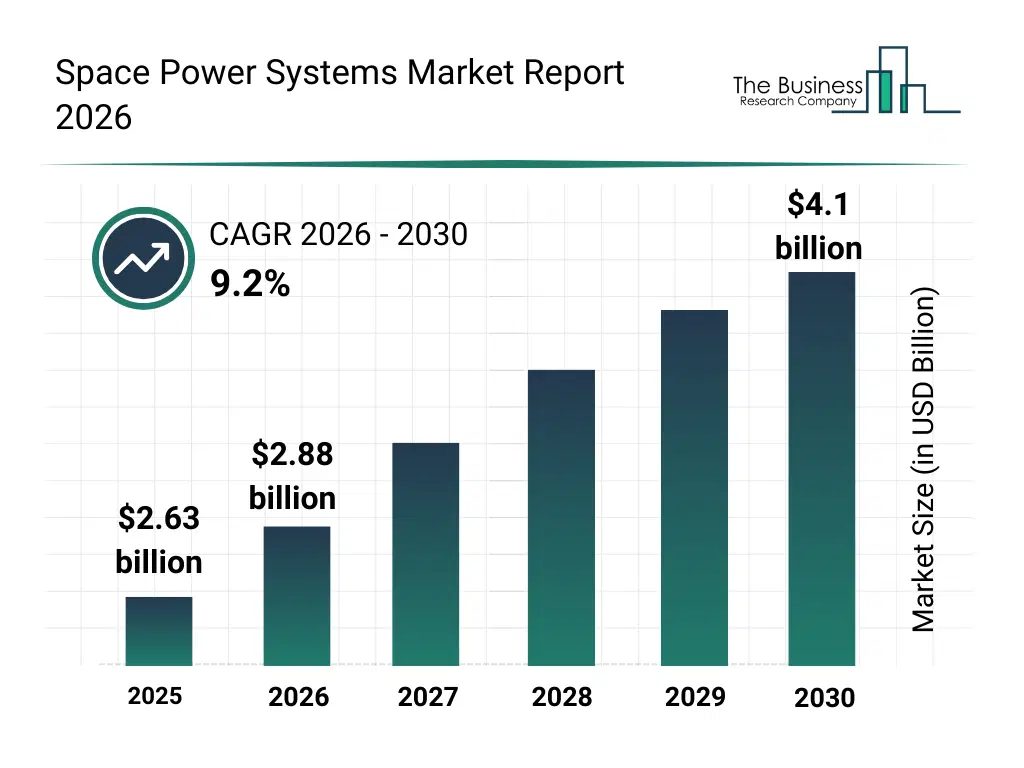
What Is The Space Power Systems Market Size and Share 2026?
The space power systems market size has grown strongly in recent years. It will grow from $2.63 billion in 2025 to $2.88 billion in 2026 at a compound annual growth rate (CAGR) of 9.5%. The growth in the historic period can be attributed to development of radioisotope thermoelectric generators to power deep space missions, early adoption of radioisotope heater units for thermal regulation in extreme environments, initial research into wireless power transmission for space applications, advancements in fuel cell technology for long-duration spacecraft energy supply, increased demand for backup power systems to support mission-critical satellite operations.What Is The Space Power Systems Market Growth Forecast?
The space power systems market size is expected to see strong growth in the next few years. It will grow to $4.1 billion in 2030 at a compound annual growth rate (CAGR) of 9.2%. The growth in the forecast period can be attributed to rising deployment of high-power satellites requiring advanced energy generation systems, expansion of wireless power transmission technologies for lunar and orbital infrastructure, development of next-generation radioisotope systems with higher efficiency and lower mass, increasing use of modular energy storage and distribution units for flexible spacecraft design, growing investment in sustainable space power solutions supporting long-term human and robotic missions. Major trends in the forecast period include advancements in high-efficiency photovoltaic and solar array technologies, increased adoption of radioisotope thermoelectric generators for deep-space missions, growing demand for energy-dense storage solutions for long-duration missions, rising development of modular and scalable spacecraft power architectures, expansion of commercial spacecraft and satellite deployments requiring reliable onboard power.
Global Space Power Systems Market Segmentation
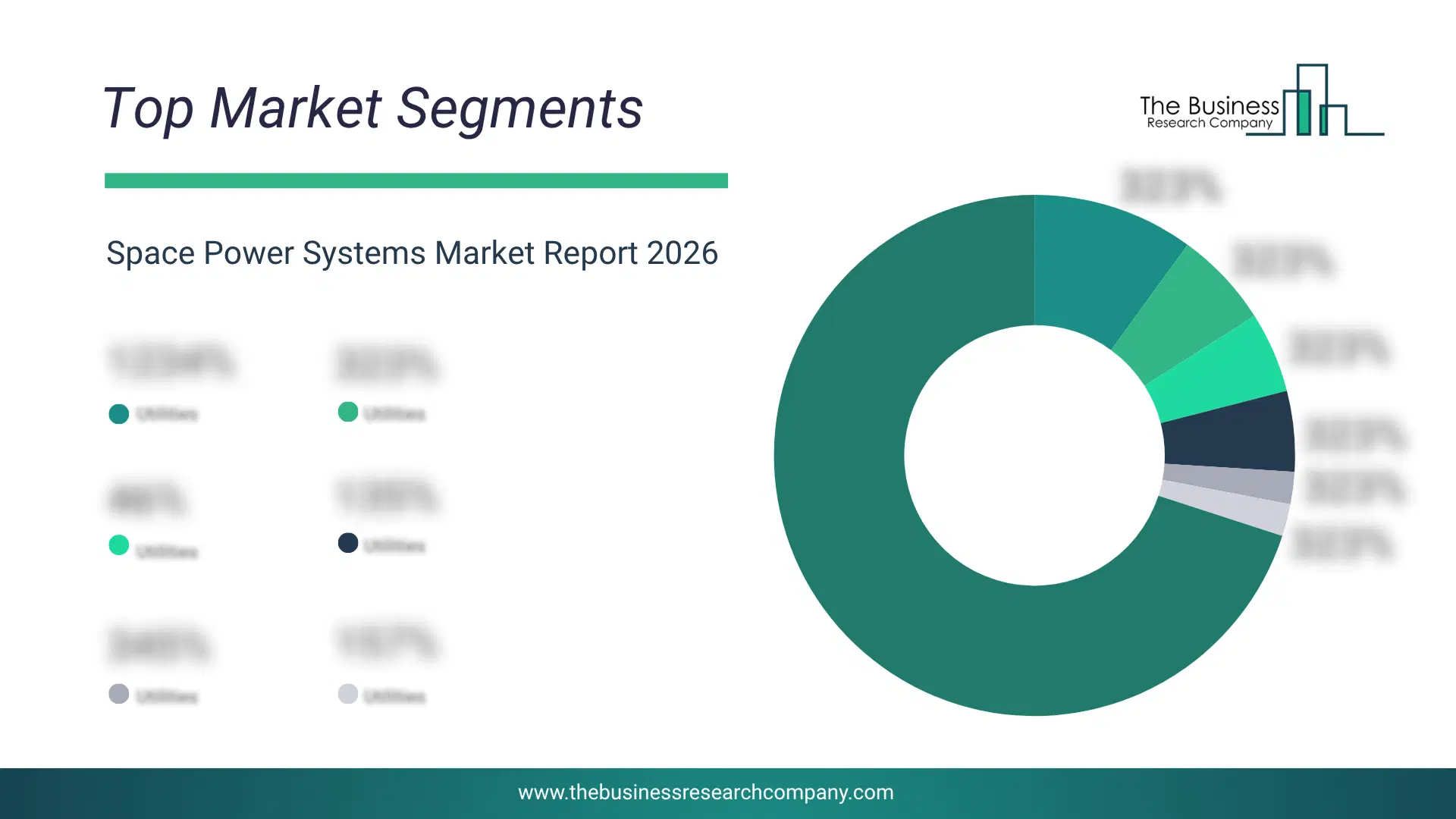
1) By Type: Solar Power Systems, Nuclear Power Systems, Fuel Cells, Other Types 2) By Power Source: Photovoltaic, Radioisotope Thermoelectric Generators, Chemical, Other Power Sources 3) By Application: Satellites, Spacecraft, Rovers, Space Stations, Other Applications 4) By End-User: Commercial, Government, Defense Subsegments: 1) By Solar Power Systems: Photovoltaic (PV) Panels, Solar Arrays, Power Conditioning Units (PCUs), Energy Storage, Solar Tracking Systems 2) By Nuclear Power Systems: Radioisotope Thermoelectric Generators (RTGs), Fission Surface Power Systems, Nuclear Thermal Propulsion Power Units, Dynamic Isotope Power Systems (DIPS) 3) By Fuel Cells: Hydrogen Fuel Cells, Solid Oxide Fuel Cells (SOFC), Proton Exchange Membrane Fuel Cells (PEMFC), Direct Methanol Fuel Cells (DMFC) 4) By Other Types: Chemical Batteries, Flywheel Energy Storage, Hybrid Power Systems, Capacitor-Based SystemsWhat Is Driver Of The Space Power Systems Market?
An increasing number of satellite launches is expected to propel the growth of the space power systems market going forward. Satellite launches refer to the deployment of satellites into orbit using launch vehicles to support applications such as communication, Earth observation, navigation, and scientific research. The surge in satellite launches is primarily driven by the need to expand high-speed internet access worldwide through mega-constellations such as Starlink and OneWeb. Space power systems support satellite launches by providing reliable energy sources that enable satellite operations, propulsion, and communication once deployed in orbit. For instance, in April 2024, according to the Indian Space Research Organisation (ISRO), an India-based space agency, in 2023, a total of 3,143 space objects were added to the orbital environment from 212 launches and on-orbit break-up events, marking a significant increase from the 2,533 objects resulting from 179 launches in 2022. Therefore, the increasing number of satellite launches is driving the growth of the space power systems industry.Key Players In The Global Space Power Systems Market
Major companies operating in the space power systems market are Raytheon Technologies Corporation, Boeing Defense, Space And Security, Lockheed Martin Corporation, Airbus Defence and Space, Northrop Grumman Corporation, Honeywell International Inc., Mitsubishi Electric Corporation, Thales Alenia Space, L3Harris Technologies, Inc., Leonardo S.p.A., SpaceX, Blue Origin, Moog Inc., Maxar Technologies Inc., Sierra Nevada Corporation, OHB SE, TERMA, Rocket Lab USA, Inc., Teledyne Energy Systems, AZUR SPACE Solar Power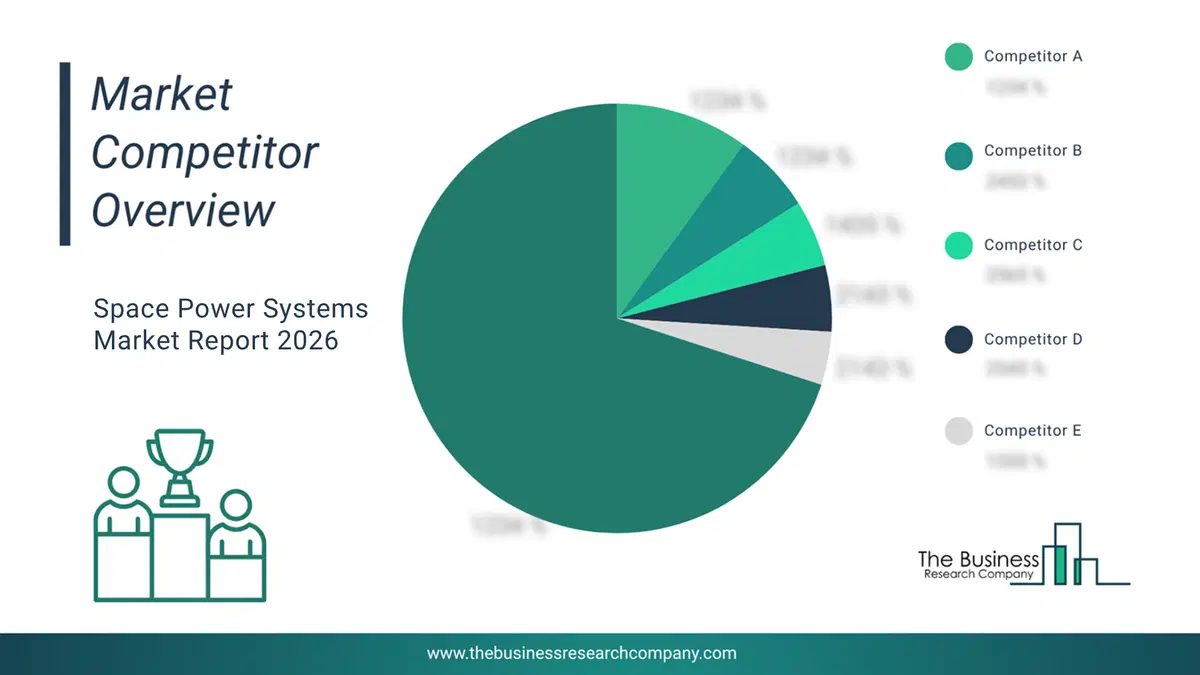
This chart is for illustrative purposes; the full report includes a detailed competitor analysis and comprehensive overview of the top 10 companies in the market.
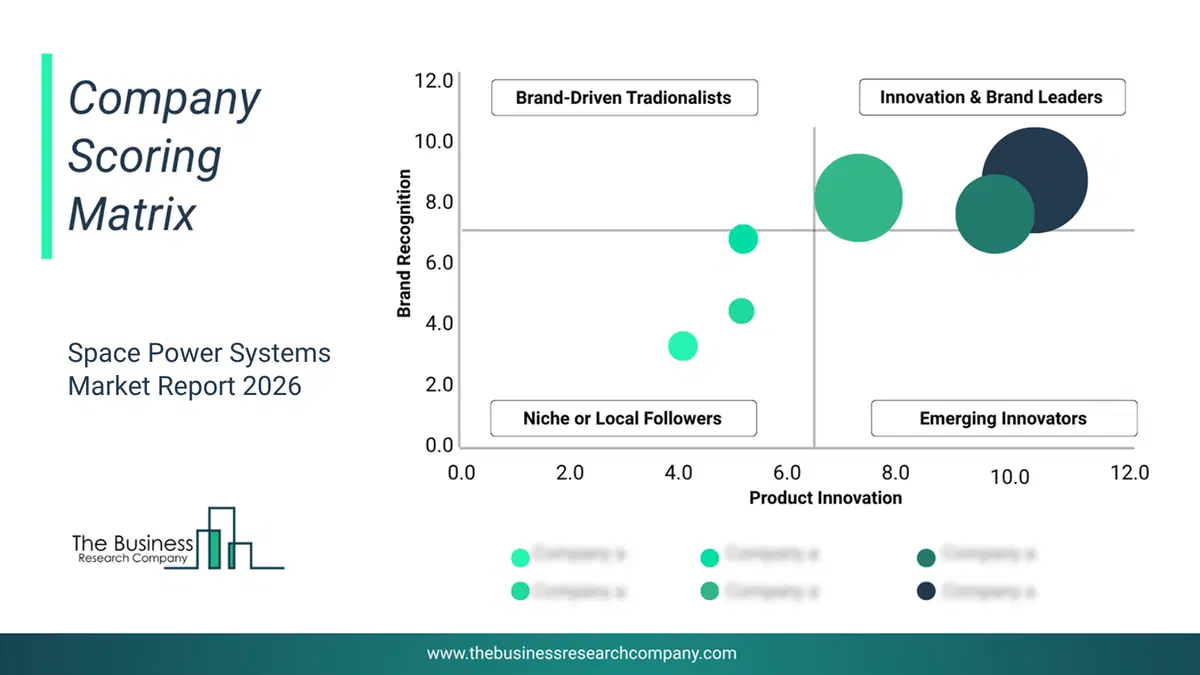
This chart maps companies by product innovation and brand strength, with bubble size indicating relative revenue, helping identify market leaders, challengers, and niche players. This is an illustrative chart; the full report provides a complete and accurate competitive analysis.
Global Space Power Systems Market Trends and Insights
Major companies operating in the space power systems market are focusing on technological advancements such as polymer electrolyte membrane fuel cells to enhance energy efficiency, reduce system weight, and provide reliable power for long-duration space missions. A polymer electrolyte membrane fuel cell (PEMFC) is an energy conversion device that generates electricity through an electrochemical reaction between hydrogen and oxygen, using a solid polymer membrane as the electrolyte and operating efficiently at low temperatures. For instance, in January 2024, the Indian Space Research Organisation (ISRO), an India-based space agency, launched a 100-watt class Polymer Electrolyte Membrane Fuel Cell (PEMFC) power system aboard the orbital platform POEM3, launched on PSLV-C58. This technology, which efficiently converts hydrogen and oxygen into electricity, water, and heat, offers significant advantages over conventional power sources, including higher energy efficiency and clean operation with water as the only byproduct usable for onboard consumption or oxygen generation.What Are Latest Mergers And Acquisitions In The Space Power Systems Market? Stellant Systems Acquires Comtech’s Power Systems Technology Line To Strengthen Space Power And Rf Amplification Capabilities
In November 2023, Stellant Systems, Inc., a US-based manufacturer company, acquired Comtech Telecommunications Corp.'s Power Systems Technology (PST) product line for an undisclosed amount. With the acquisition of Stellant Systems, Inc., the aim is to strengthen and expand Stellant's portfolio of radio frequency (RF) amplification products. Comtech Telecommunications Corp. is a publicly traded technology company that involves power amplification and energy solutions used in space and satellite communication systems.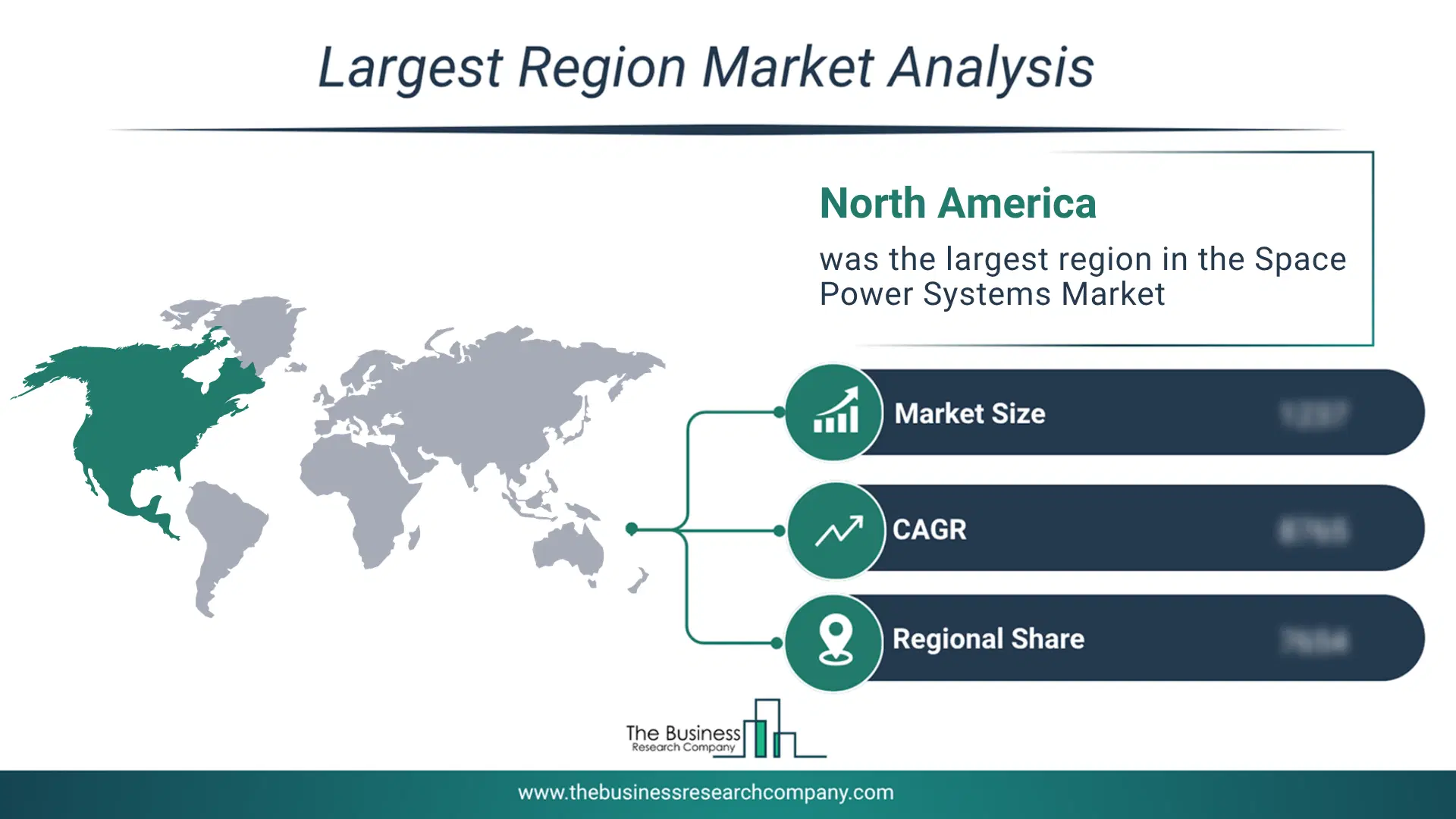
Regional Insights
North America was the largest region in the space power systems market in 2025. Asia-Pacific is expected to be the fastest-growing region in the forecast period. The regions covered in this market report are Asia-Pacific, South East Asia, Western Europe, Eastern Europe, North America, South America, Middle East, Africa. The countries covered in this market report are Australia, Brazil, China, France, Germany, India, Indonesia, Japan, Taiwan, Russia, South Korea, UK, USA, Canada, Italy, SpainWhat Defines the Space Power Systems Market?
The space power systems market consists of sales of radioisotope thermoelectric generators, radioisotope heater units, wireless power transmission devices, fuel cells and backup power systems. Values in this market are ‘factory gate’ values, that is the value of goods sold by the manufacturers or creators of the goods, whether to other entities (including downstream manufacturers, wholesalers, distributors and retailers) or directly to end customers. The value of goods in this market includes related services sold by the creators of the goods.How is Market Value Defined and Measured?
The market value is defined as the revenues that enterprises gain from the sale of goods and/or services within the specified market and geography through sales, grants, or donations in terms of the currency (in USD unless otherwise specified). The revenues for a specified geography are consumption values that are revenues generated by organizations in the specified geography within the market, irrespective of where they are produced. It does not include revenues from resales along the supply chain, either further along the supply chain or as part of other products.
This chart presents market attractiveness based on a quantitative evaluation of growth, competition, strategic alignment, and risk, offering a clear view of opportunity areas for decision-making. This chart is for illustrative purposes; the full report contains the complete analysis.

This chart highlights the Total Addressable Market (TAM) by estimating the maximum revenue opportunity using an assumption-driven approach, supporting strategic planning and opportunity sizing across markets. The chart is illustrative; the full report provides a more comprehensive analysis.
What Key Data and Analysis Are Included in the Space Power Systems Market Report 2026?
The space power systems market research report is one of a series of new reports from The Business Research Company that provides market statistics, including industry global market size, regional shares, competitors with the market share, detailed market segments, market trends and opportunities, and any further data you may need to thrive in the space power systems industry. The market research report delivers a complete perspective of everything you need, with an in-depth analysis of the current and future state of the industry.Space Power Systems Market Report Forecast Analysis
| Report Attribute | Details |
|---|---|
| Market Size Value In 2026 | $2.88 billion |
| Revenue Forecast In 2030 | $4.1 billion |
| Growth Rate | CAGR of 9.2% from 2026 to 2030 |
| Base Year For Estimation | 2025 |
| Actual Estimates/Historical Data | 2020-2025 |
| Forecast Period | 2026 - 2030 |
| Market Representation | Revenue in USD Billion and CAGR from 2026 to 2030 |
| Segments Covered | Type, Power Source, Application, End-User |
| Regional Scope | Asia-Pacific, Western Europe, Eastern Europe, North America, South America, Middle East, Africa |
| Country Scope | The countries covered in the space power systems market report are Australia, Brazil, China, France, Germany, India, Indonesia, Japan, Taiwan, Russia, South Korea, UK, USA, Canada, Italy, Spain |
| Key Companies Profiled | Raytheon Technologies Corporation, Boeing Defense, Space And Security, Lockheed Martin Corporation, Airbus Defence and Space, Northrop Grumman Corporation, Honeywell International Inc., Mitsubishi Electric Corporation, Thales Alenia Space, L3Harris Technologies, Inc., Leonardo S.p.A., SpaceX, Blue Origin, Moog Inc., Maxar Technologies Inc., Sierra Nevada Corporation, OHB SE, TERMA, Rocket Lab USA, Inc., Teledyne Energy Systems, AZUR SPACE Solar Power |
| Customization Scope | Request for Customization |
| Pricing And Purchase Options | Explore Purchase Options |