
Space Solar Cells Market Report 2026
Global Outlook – By Type (Monocrystalline Solar Cells, Polycrystalline Solar Cells, Thin-Film Solar Cells, Multi-Junction Solar Cells, Concentrated Photovoltaic Cells (CPV)), By Technology (Silicon-Based Technology, Gallium Arsenide Technology, Organic Photovoltaic Technology, Perovskite Solar Cells), By Functionality (Power Generation, Power Storage Integration, Energy Efficiency Solutions, Thermal Management Systems), By Application (Satellite Power Systems, Spacecraft Power Systems, Space Stations, Robotic Missions, Planetary Exploration), By End-User (Government And Defense Agencies, Aerospace Manufacturers, Research Institutions, Private Space Exploration Companies) – Market Size, Trends, Strategies, and Forecast to 2030
Space Solar Cells Market Overview
• Space Solar Cells market size has reached to $1.38 billion in 2025 • Expected to grow to $2.43 billion in 2030 at a compound annual growth rate (CAGR) of 11.9% • Growth Driver: Increasing Number Of Satellite Launches Fueling The Growth Of The Market Due To Rising Connectivity Demands • Market Trend: Advancing Solar Cell Technologies Through In-Orbit CubeSat Testing • North America was the largest region in 2025 and Asia-Pacific is the fastest growing region.What Is Covered Under Space Solar Cells Market?
Space solar cells are specialized photovoltaic devices designed to convert sunlight into electrical energy in the harsh conditions of outer space. They are engineered to withstand extreme temperatures, radiation, and vacuum environments. It helps to provide reliable and continuous power for spacecraft, satellites, and space stations, enabling long-duration missions and the operation of onboard systems. The main types of space solar cells are monocrystalline solar cells, polycrystalline solar cells, thin-film solar cells, multi-junction solar cells, and concentrated photovoltaic cells (CPV). Monocrystalline solar cells are photovoltaic cells made from a single continuous crystal structure of silicon, known for their high efficiency and long lifespan in converting sunlight into electricity. The various technologies utilized include silicon-based technology, gallium arsenide technology, organic photovoltaic technology, and perovskite solar cells, and provides different functionalities such as power generation, power storage integration, energy efficiency solutions, and thermal management systems. These cells find applications in satellite power systems, spacecraft power systems, space stations, robotic missions, and planetary exploration, serving end users such as government and defense agencies, aerospace manufacturers, research institutions, and private space exploration companies.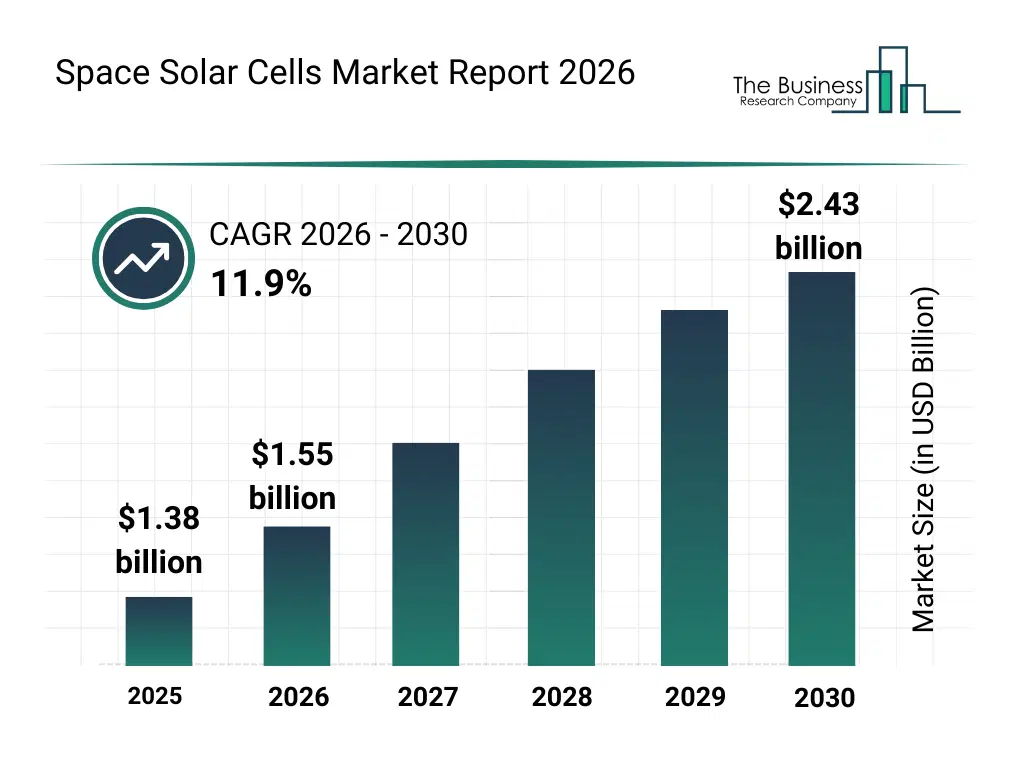
What Is The Space Solar Cells Market Size and Share 2026?
The space solar cells market size has grown rapidly in recent years. It will grow from $1.38 billion in 2025 to $1.55 billion in 2026 at a compound annual growth rate (CAGR) of 12.3%. The growth in the historic period can be attributed to improvements in photovoltaic efficiency, radiation-hardened solar cell development, adoption in satellite and spacecraft power systems, standardization of space-grade panels, integration with power management electronics.What Is The Space Solar Cells Market Growth Forecast?
The space solar cells market size is expected to see rapid growth in the next few years. It will grow to $2.43 billion in 2030 at a compound annual growth rate (CAGR) of 11.9%. The growth in the forecast period can be attributed to development of flexible and lightweight solar panels, expansion in mega satellite constellations, growth in deep-space mission power requirements, integration with energy storage systems, adoption of advanced tracking and optimization technologies. Major trends in the forecast period include high-efficiency photovoltaic innovations, radiation-resistant solar technologies, integrated power management systems, space-grade solar cell testing and qualification, onboard energy storage and thermal management.
Global Space Solar Cells Market Segmentation
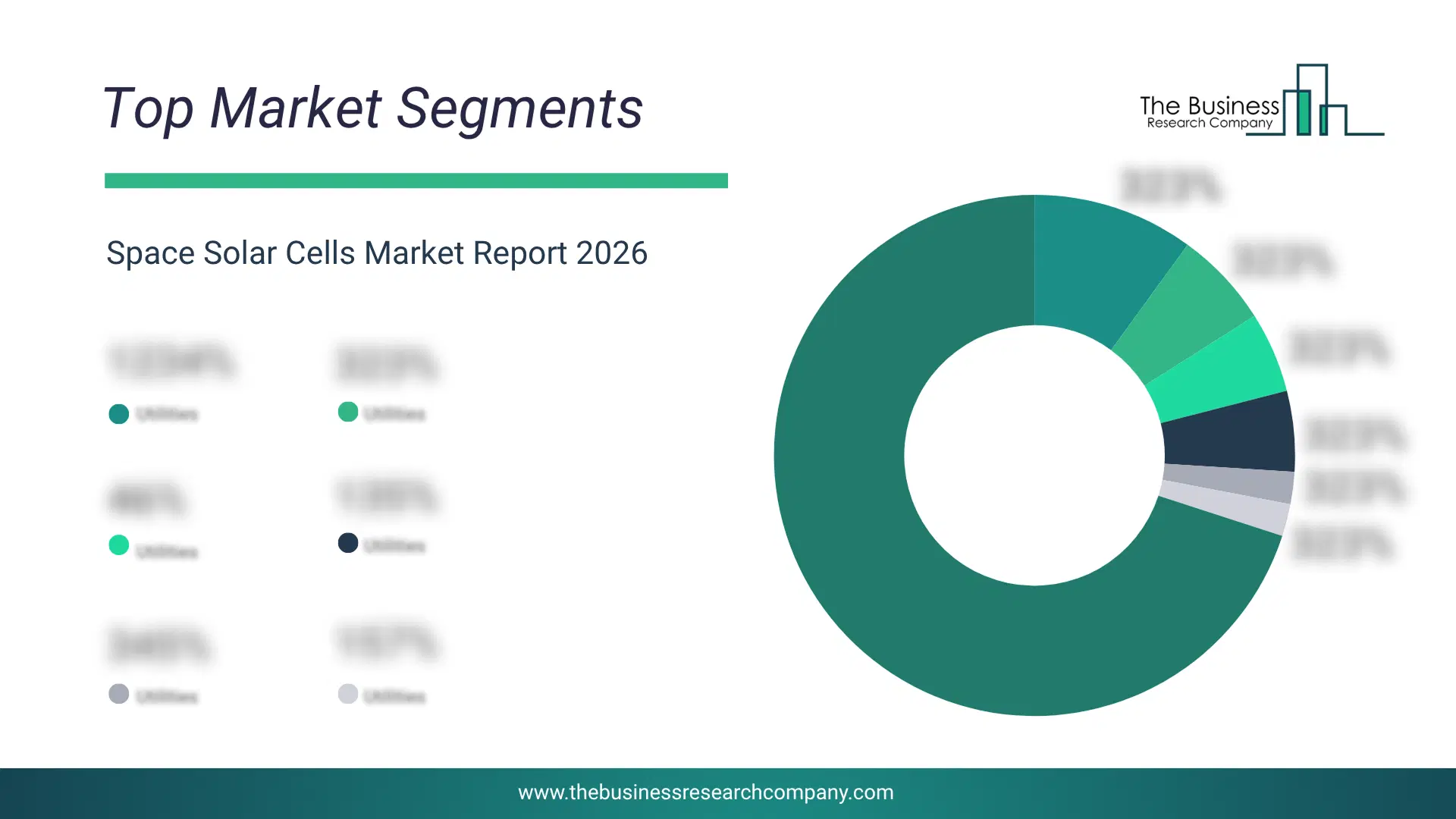
1) By Type: Monocrystalline Solar Cells, Polycrystalline Solar Cells, Thin-Film Solar Cells, Multi-Junction Solar Cells, Concentrated Photovoltaic Cells (CPV) 2) By Technology: Silicon-Based Technology, Gallium Arsenide Technology, Organic Photovoltaic Technology, Perovskite Solar Cells 3) By Functionality: Power Generation, Power Storage Integration, Energy Efficiency Solutions, Thermal Management Systems 4) By Application: Satellite Power Systems, Spacecraft Power Systems, Space Stations, Robotic Missions, Planetary Exploration 5) By End-User: Government And Defense Agencies, Aerospace Manufacturers, Research Institutions, Private Space Exploration Companies Subsegments: 1) By Monocrystalline Solar Cells: High Efficiency, Standard Efficiency, Flexible 2) By Polycrystalline Solar Cells: High Efficiency, Standard Efficiency, Bifacial 3) By Thin-Film Solar Cells: Cadmium Telluride, Copper Indium Gallium Selenide, Amorphous Silicon 4) By Multi-Junction Solar Cells: Two Layer, Three Layer, Four Layer 5) By Concentrated Photovoltaic Cells: Fresnel Lens, Parabolic Reflector, Micro ConcentratorWhat Is Driver Of The Space Solar Cells Market?
The increasing number of satellite launches is expected to propel the growth of the space solar cells market going forward. Satellite launches refer to the process of sending artificial satellites into space using launch vehicles or rockets. The increasing demand for satellite launches is due to the rising need for connectivity as more regions seek reliable internet access through satellite-based broadband services. Space solar cells support satellite launches by providing reliable and continuous power in the harsh environment of space, enabling long-duration missions. They enhance satellite functionality by powering onboard systems, communication devices, and instruments, improving mission efficiency and operational reliability. For instance, in May 2025, according to the Satellite Industry Association (SIA), a US-based trade association, a total of 259 launches (including 224 commercially procured) were conducted in 2024 and worldwide commercial launch revenues increased to $9.3 billion, an increase of 30 percent compared with 2023. Therefore, the increasing number of satellite launches is driving the growth of the space solar cells industry.Key Players In The Global Space Solar Cells Market
Major companies operating in the space solar cells market are The Boeing Company, Airbus Group, Northrop Grumman Corporation, Mitsubishi Electric Corporation, Thales Group, Bharat Electronics Ltd., Hanergy Thin Film Power Group Ltd., Redwire Corporation, 5N Plus Inc., Aetherflux Inc., SoliTek Cell, EnduroSat AD, MicroLink Devices Inc., DHV Technology, Solestial Inc., MMA Design LLC, Caelux Inc., Space Solar (UK) Ltd., Stion Corporation, Ascent Solar Technologies Inc.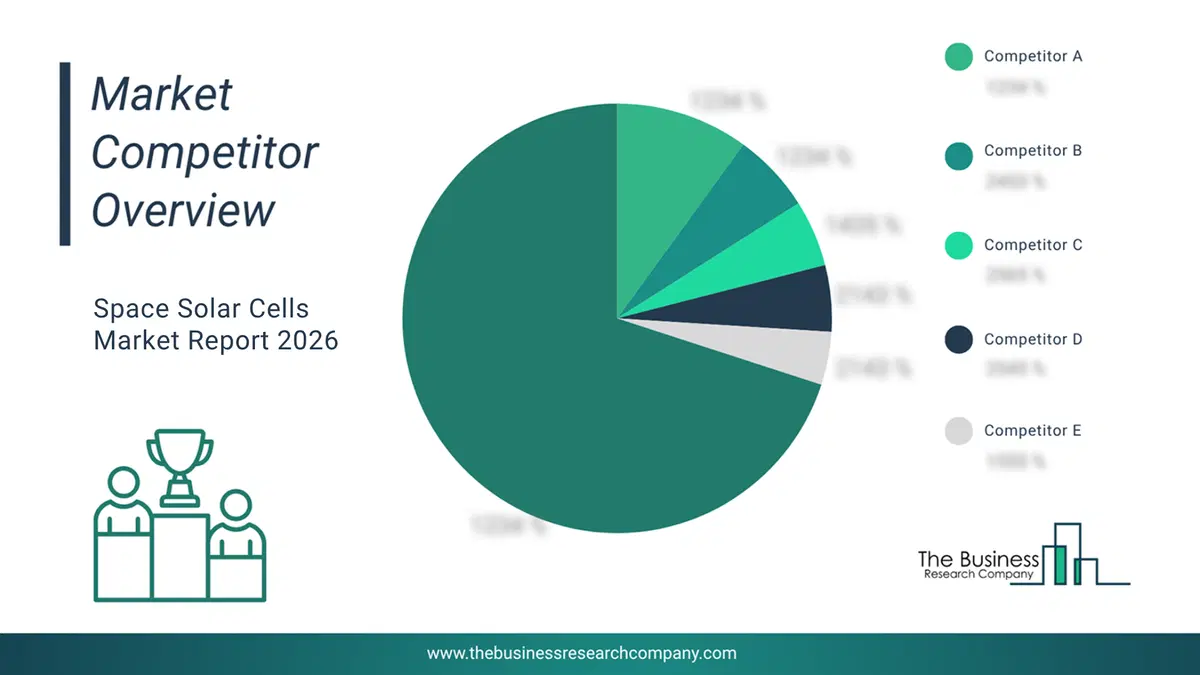
This chart is for illustrative purposes; the full report includes a detailed competitor analysis and comprehensive overview of the top 10 companies in the market.
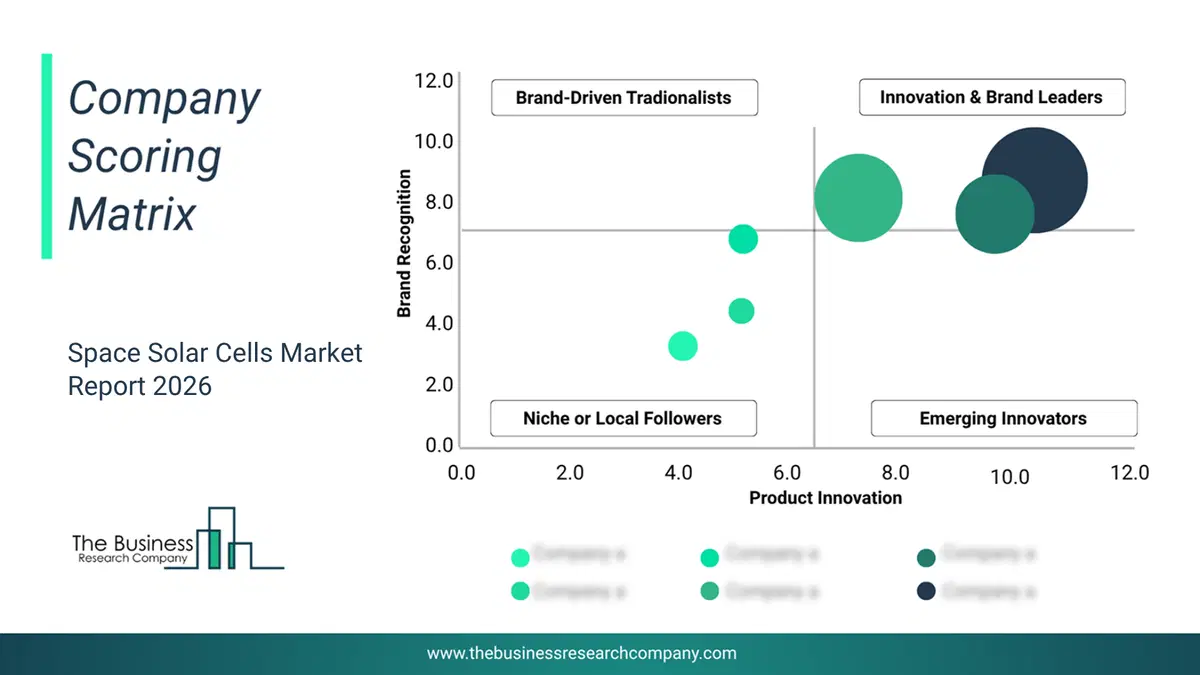
This chart maps companies by product innovation and brand strength, with bubble size indicating relative revenue, helping identify market leaders, challengers, and niche players. This is an illustrative chart; the full report provides a complete and accurate competitive analysis.
Global Space Solar Cells Market Trends and Insights
Major companies operating in the space solar cells market are focusing on developing innovative products, such as CubeSats for in-orbit testing, to provide reliable validation of solar cell technologies, enhance efficiency, and expand their presence in the growing space solar power segment. CubeSats are small, modular spacecraft designed to carry experimental photovoltaic (PV) cells, deployable solar arrays, and wireless power systems into orbit, providing an efficient and cost-effective way to evaluate solar technologies under real space conditions. For instance, in January 2023, the California Institute of Technology (Caltech), a US-based company that develops technology for harnessing solar power in space, launched the 50-kg Space Solar Power Demonstrator (SSPD) aboard a Momentus Vigoride spacecraft via a SpaceX Transporter-6 mission. The SSPD tested deployable structures (DOLCE), 32 types of photovoltaic cells (ALBA), and a flexible microwave power array (MAPLE) for wireless energy transmission in orbit. These demonstrations allow companies and research institutes to assess efficiency, durability, deployment mechanics, and power transmission, making CubeSats a critical tool for advancing space solar cell technologies and enabling scalable deployment in future space missions.What Are Latest Mergers And Acquisitions In The Space Solar Cells Market? KIER And Flexell Space Co., Ltd. Partner To Develop Next-Generation Space Solar Cells
In August 2025, the Korea Institute of Energy Research (KIER), a South Korea-based research institute, partnered with Flexell Space Co., Ltd. to develop ultra-light, flexible CIGS solar cells for space applications. With this partnership, the companies aim to develop ultra-light, flexible CIGS solar cells for small satellites, enhancing performance, durability, and mass production potential, supporting Korea’s competitiveness in the global space solar cell market, and promoting sustainable, efficient power solutions for future space missions. Flexell Space Co. Ltd. is a South Korea-based manufacturing company that specializes in providing space solar cells.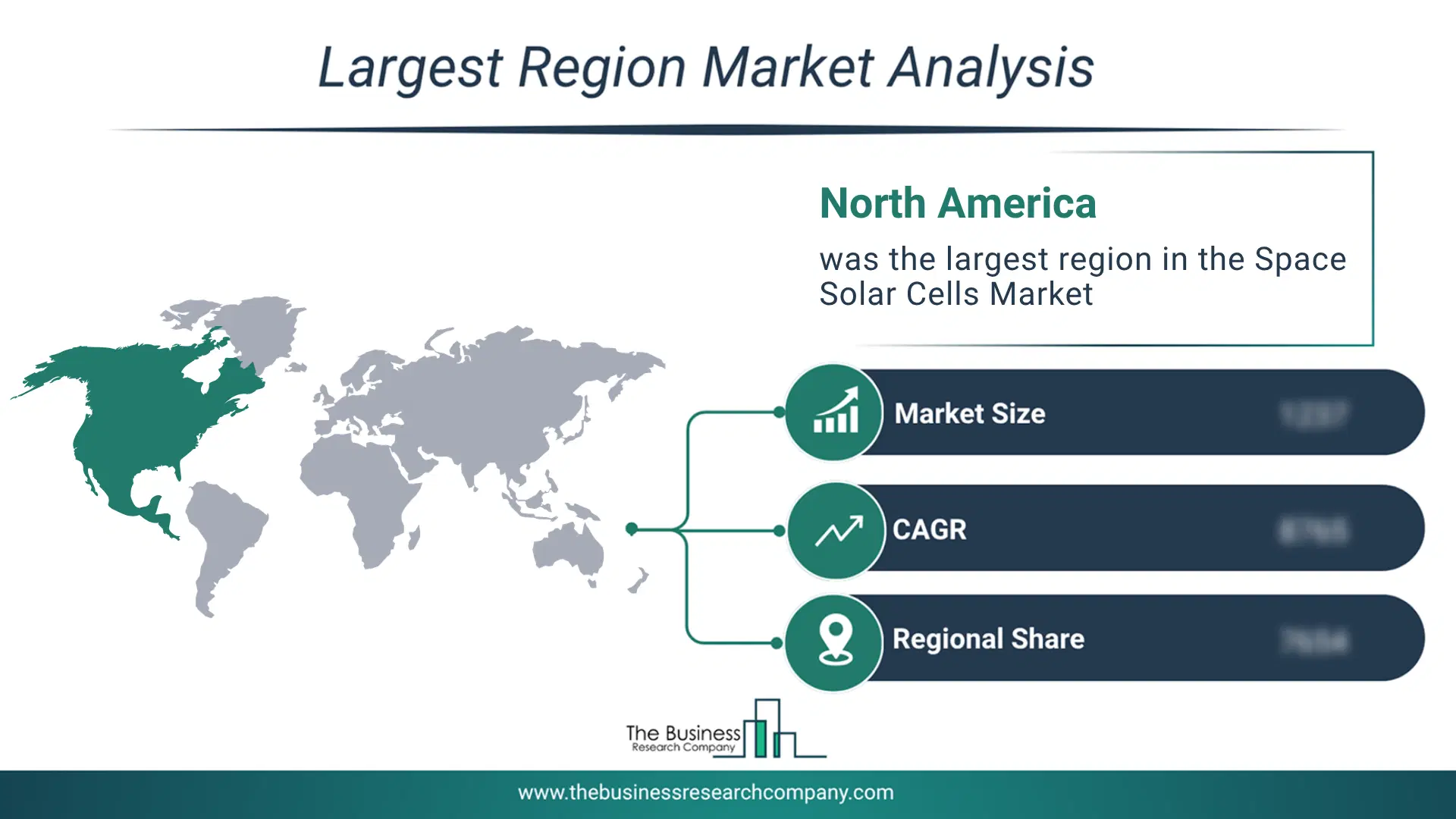
Regional Insights
North America was the largest region in the space solar cells market in 2025. Asia-Pacific is expected to be the fastest-growing region in the forecast period. The regions covered in this market report are Asia-Pacific, South East Asia, Western Europe, Eastern Europe, North America, South America, Middle East, Africa. The countries covered in this market report are Australia, Brazil, China, France, Germany, India, Indonesia, Japan, Taiwan, Russia, South Korea, UK, USA, Canada, Italy, SpainWhat Defines the Space Solar Cells Market?
The space solar cells market consists of revenues earned by entities by providing services such as space-grade solar cell design and customization, testing and qualification for space environments, installation and integration on satellites or spacecraft, maintenance and performance monitoring, and consulting or support for space power systems. The market value includes the value of related goods sold by the service provider or included within the service offering. The space solar cells market also includes sales of solar panels, mounting structures, power management systems, and tracking systems. Values in this market are ‘factory gate’ values, that is the value of goods sold by the manufacturers or creators of the goods, whether to other entities (including downstream manufacturers, wholesalers, distributors and retailers) or directly to end customers. The value of goods in this market includes related services sold by the creators of the goods.How is Market Value Defined and Measured?
The market value is defined as the revenues that enterprises gain from the sale of goods and/or services within the specified market and geography through sales, grants, or donations in terms of the currency (in USD unless otherwise specified). The revenues for a specified geography are consumption values that are revenues generated by organizations in the specified geography within the market, irrespective of where they are produced. It does not include revenues from resales along the supply chain, either further along the supply chain or as part of other products.
This chart presents market attractiveness based on a quantitative evaluation of growth, competition, strategic alignment, and risk, offering a clear view of opportunity areas for decision-making. This chart is for illustrative purposes; the full report contains the complete analysis.

This chart highlights the Total Addressable Market (TAM) by estimating the maximum revenue opportunity using an assumption-driven approach, supporting strategic planning and opportunity sizing across markets. The chart is illustrative; the full report provides a more comprehensive analysis.
What Key Data and Analysis Are Included in the Space Solar Cells Market Report 2026?
The space solar cells market research report is one of a series of new reports from The Business Research Company that provides market statistics, including industry global market size, regional shares, competitors with the market share, detailed market segments, market trends and opportunities, and any further data you may need to thrive in the space solar cells industry. The market research report delivers a complete perspective of everything you need, with an in-depth analysis of the current and future state of the industry.Space Solar Cells Market Report Forecast Analysis
| Report Attribute | Details |
|---|---|
| Market Size Value In 2026 | $1.55 billion |
| Revenue Forecast In 2030 | $2.43 billion |
| Growth Rate | CAGR of 11.9% from 2026 to 2030 |
| Base Year For Estimation | 2025 |
| Actual Estimates/Historical Data | 2020-2025 |
| Forecast Period | 2026 - 2030 |
| Market Representation | Revenue in USD Billion and CAGR from 2026 to 2030 |
| Segments Covered | Type, Technology, Functionality, Application, End-User |
| Regional Scope | Asia-Pacific, Western Europe, Eastern Europe, North America, South America, Middle East, Africa |
| Country Scope | The countries covered in the space solar cells market report are Australia, Brazil, China, France, Germany, India, Indonesia, Japan, Taiwan, Russia, South Korea, UK, USA, Canada, Italy, Spain |
| Key Companies Profiled | The Boeing Company, Airbus Group, Northrop Grumman Corporation, Mitsubishi Electric Corporation, Thales Group, Bharat Electronics Ltd., Hanergy Thin Film Power Group Ltd., Redwire Corporation, 5N Plus Inc., Aetherflux Inc., SoliTek Cell, EnduroSat AD, MicroLink Devices Inc., DHV Technology, Solestial Inc., MMA Design LLC, Caelux Inc., Space Solar (UK) Ltd., Stion Corporation, Ascent Solar Technologies Inc. |
| Customization Scope | Request for Customization |
| Pricing And Purchase Options | Explore Purchase Options |