
Space Station Robotic Arms Market Report 2026
Global Outlook – By Type (Large Robotic Arms, Small Robotic Arms, Modular Robotic Arms), By Component (Manipulator, End Effector, Control System, Sensors, Other Components), By Payload Capacity (Light-Duty, Medium-Duty, Heavy-Duty), By Application (Assembly, Maintenance, Cargo Handling, Scientific Research, Other Applications), By End User (Government Space Agencies, Commercial Space Companies, Research Institutions, Other End Users) – Market Size, Trends, Strategies, and Forecast to 2035
Space Station Robotic Arms Market Overview
• Space Station Robotic Arms market size has reached to $1 billion in 2025 • Expected to grow to $1.57 billion in 2030 at a compound annual growth rate (CAGR) of 9.5% • Growth Driver: Increasing Satellite Launch Activities Driving The Market Growth Due To Rising Demand For Advanced Space Robotics Solutions • Market Trend: Advancements In Robotic Arm Technology Enhance Space Station Maintenance And Operational Reliability • North America was the largest region in 2025 and Asia-Pacific is the fastest growing region.What Is Covered Under Space Station Robotic Arms Market?
Space station robotic arms refer to robotic systems designed to perform assembly, maintenance, inspection, cargo handling, and docking support operations in the space environment. These robotic arms are engineered with precision movement capabilities, advanced automation features, and remote operation capabilities to enable accurate handling of objects and equipment under microgravity conditions. They improve operational efficiency, reduce risks associated with human intervention, and support long-duration space missions. The main types of space station robotic arms include large robotic arms, small robotic arms, and modular robotic arms. Large robotic arms refer to robotic manipulation systems designed to handle relatively large payloads and perform complex movement and positioning tasks in space station environments. These robotic arms consist of manipulators, end effectors, control systems, sensors, and other components and are available in light-duty, medium-duty, and heavy-duty configurations. They find application in assembly, maintenance, cargo handling, scientific research, and others, serving end users including government space agencies, commercial space companies, research institutions, and others.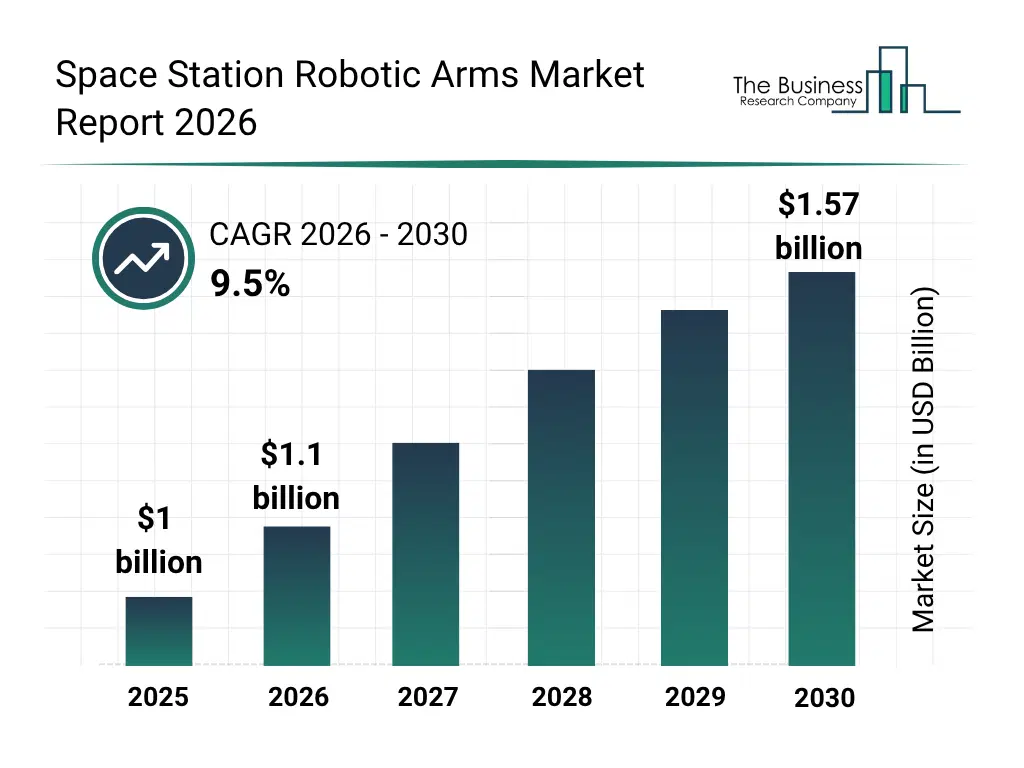
What Is The Space Station Robotic Arms Market Size and Share 2026?
The space station robotic arms market size has grown strongly in recent years. It will grow from $1 billion in 2025 to $1.1 billion in 2026 at a compound annual growth rate (CAGR) of 9.9%. The growth in the historic period can be attributed to increasing deployment of robotic arms for space station maintenance, growing demand for automated cargo handling, rising need for safer space assembly operations, expansion of long-duration space missions, increasing adoption of robotic inspection systems.What Is The Space Station Robotic Arms Market Growth Forecast?
The space station robotic arms market size is expected to see strong growth in the next few years. It will grow to $1.57 billion in 2030 at a compound annual growth rate (CAGR) of 9.5%. The growth in the forecast period can be attributed to increasing construction of commercial space stations, rising demand for autonomous on-orbit servicing, growing deployment of robotic systems for space logistics, increasing demand for robotic docking support, expansion of in-space assembly and manufacturing activities. Major trends in the forecast period include advanced precision manipulation systems, remote-controlled robotic operations, high-reliability robotic arm mechanisms, modular robotic arm architectures, enhanced robotic arm dexterity.Tariff Impact On Space Station Robotic Arms Market
Tariffs are impacting the space station robotic arms market by increasing the cost of precision actuators, sensors, control systems, electronic components, and specialized manufacturing equipment used in robotic arm development. Large robotic arms and heavy-duty systems may face greater cost pressures, particularly in North America, Europe, and Asia-Pacific due to globally distributed aerospace and electronics supply chains. However, tariffs can encourage domestic production, supplier diversification, and investment in localized aerospace component manufacturing, potentially strengthening regional supply-chain resilience and technological capabilities.
Global Space Station Robotic Arms Market Segmentation
2) By Component: Manipulator, End Effector, Control System, Sensors, Other Components 3) By Payload Capacity: Light-Duty, Medium-Duty, Heavy-Duty 4) By Application: Assembly, Maintenance, Cargo Handling, Scientific Research, Other Applications 5) By End User: Government Space Agencies, Commercial Space Companies, Research Institutions, Other End Users Subsegments: 1) By Large Robotic Arms: External Space Station Robotic Arms, Payload Handling Robotic Arms, Assembly And Maintenance Robotic Arms, Cargo Transfer Robotic Arms, High Reach Robotic Arms 2) By Small Robotic Arms: Inspection Robotic Arms, Precision Manipulation Robotic Arms, Research And Experiment Robotic Arms, Tool Handling Robotic Arms, Internal Space Station Robotic Arms 3) By Modular Robotic Arms: Reconfigurable Robotic Arms, Multi-Joint Modular Robotic Arms, Expandable Robotic Arms, Replaceable Component Robotic Arms, Multi-Purpose Modular Robotic ArmsWhat Is The Driver Of The Space Station Robotic Arms Market?
The increasing satellite launch activities are expected to propel the growth of the space station robotic arms market going forward. Satellite launches involve the deployment of artificial satellites into orbit for applications such as communication, navigation, earth observation, scientific research, and defense. Satellite launch activities are growing due to satellite-based services, as increasing demand for communication, navigation, earth observation, and remote sensing applications drives the deployment of more satellites. Rising satellite launch activities drive demand for space station robotic arms by increasing the requirement for precise manipulation, satellite servicing, cargo handling, assembly, and maintenance operations in orbital environments. For instance, in July 2025, according to a report published by the Space Foundation, a US-based non-profit organization, global orbital launch activity reached record levels, with 149 orbital launches recorded during the first half of 2025, making it the busiest first half of a year on record at that time. The launch pace reached approximately one orbital launch every 28 hours, with most launches carrying communications satellites into orbit. Therefore, the increasing satellite launch activities are driving the growth of the space station robotic arms industry.Key Players In The Global Space Station Robotic Arms Market
Major companies operating in the space station robotic arms market are The Boeing Company, Airbus SE, Lockheed Martin Corporation, Northrop Grumman Corporation, Leonardo S.p.A., China Academy of Space Technology, Kawasaki Heavy Industries Ltd., Thales Alenia Space, Blue Origin LLC, MDA Space Ltd., Sierra Space Corporation, Maxar Technologies Inc., Oceaneering International Inc., Redwire Corporation, SENER Ltd., Space Applications Services NV/SA, Astrobotic Technology Inc., GITAI Inc., Arkisys Inc., Motiv Space Systems Inc.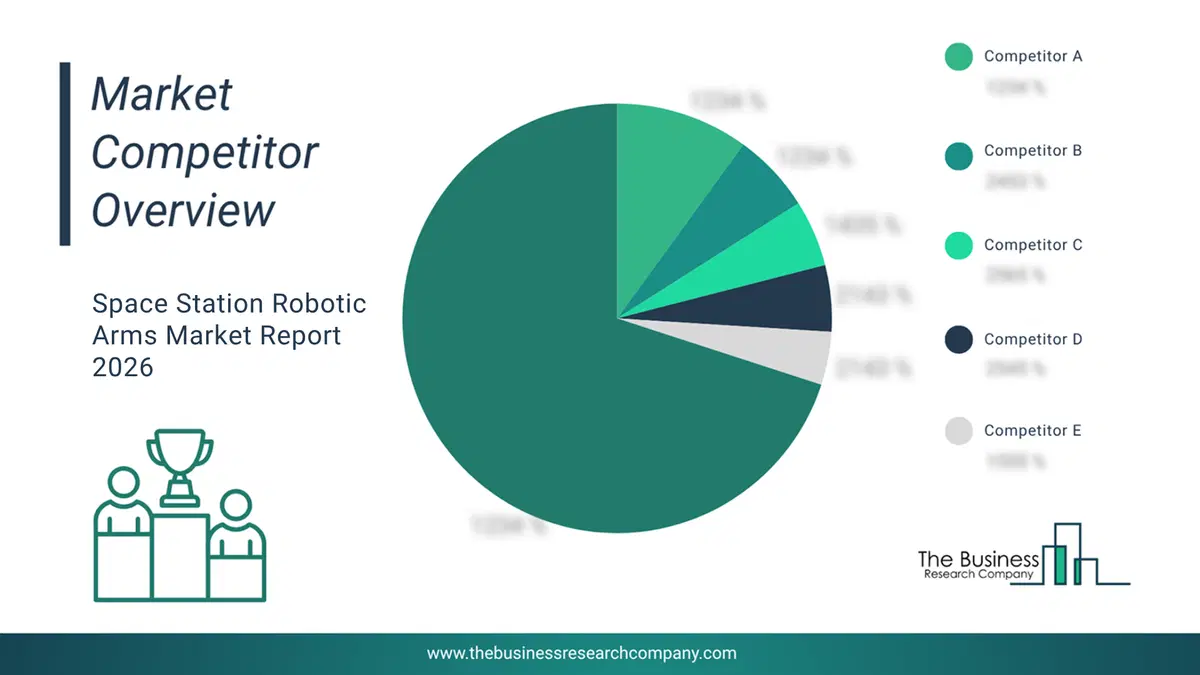
This chart is for illustrative purposes; the full report includes a detailed competitor analysis and comprehensive overview of the top 10 companies in the market.
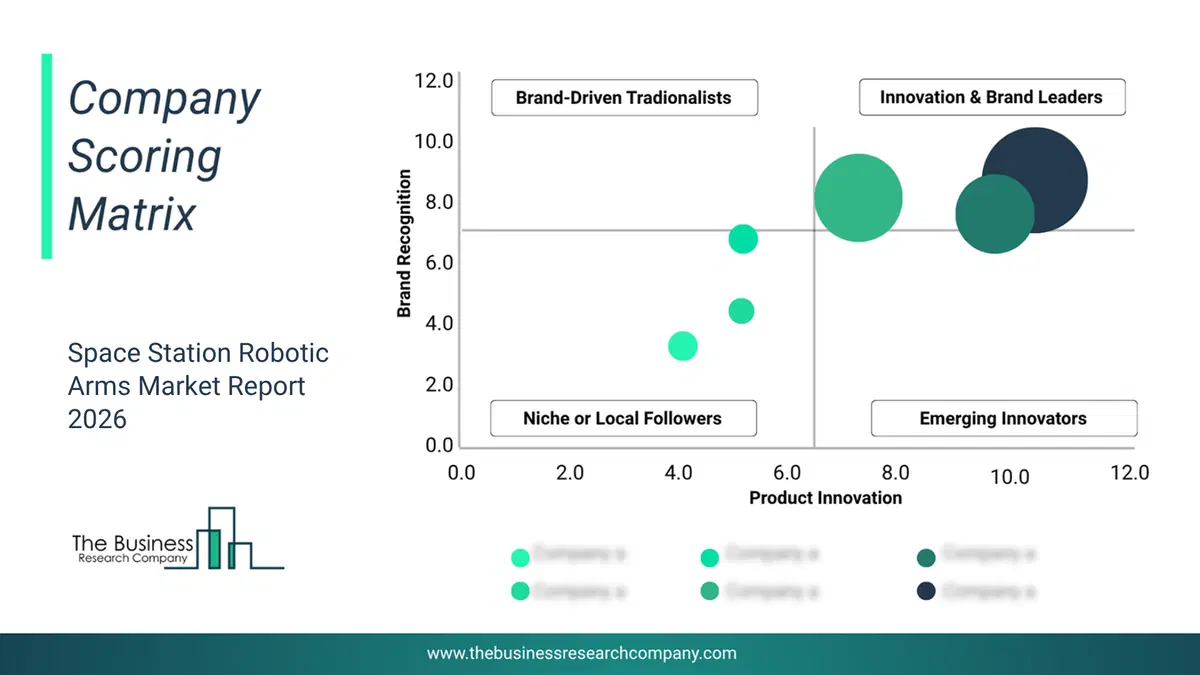
This chart maps companies by product innovation and brand strength, with bubble size indicating relative revenue, helping identify market leaders, challengers, and niche players. This is an illustrative chart; the full report provides a complete and accurate competitive analysis.
Global Space Station Robotic Arms Market Trends and Insights
Major companies operating in the space station robotic arms market are focusing on maintaining and upgrading advanced robotic systems to ensure reliable station operations, support in-orbit maintenance, and extend the operational capabilities of space infrastructure. Maintaining and upgrading advanced robotic systems refers to repairing, enhancing, and modernizing robotic equipment to ensure reliable performance, improve capabilities, and extend operational life. For instance, in June 2026, NASA, a US-based space agency, conducted a spacewalk involving astronauts Chris Williams and Jessica Meir to repair Canadarm2, the robotic arm installed on the International Space Station. The astronauts began the spacewalk to replace a malfunctioning wrist joint that had failed during normal Canadarm2 operations, demonstrating the importance of advanced robotic arms in supporting space station maintenance, equipment handling, and long-term orbital operations.What Are Latest Mergers And Acquisitions In The Space Station Robotic Arms Market?
In June 2026, Lyntris Inc., a US-based defense technology company, acquired Novium Ltd. for an undisclosed amount. Through this acquisition, Lyntris aims to strengthen its space and defense capabilities by integrating Novium’s spaceflight-proven motion systems, including robotic arms and rovers, radiation-hardened motor controllers, gimbals, and associated software and embedded systems, while expanding its precision pointing, stabilization, and communications capabilities for space applications. Novium Ltd. is a US-based developer of high-precision motion systems for space and defense applications, including robotic arms and mechanisms used in demanding human spaceflight missions.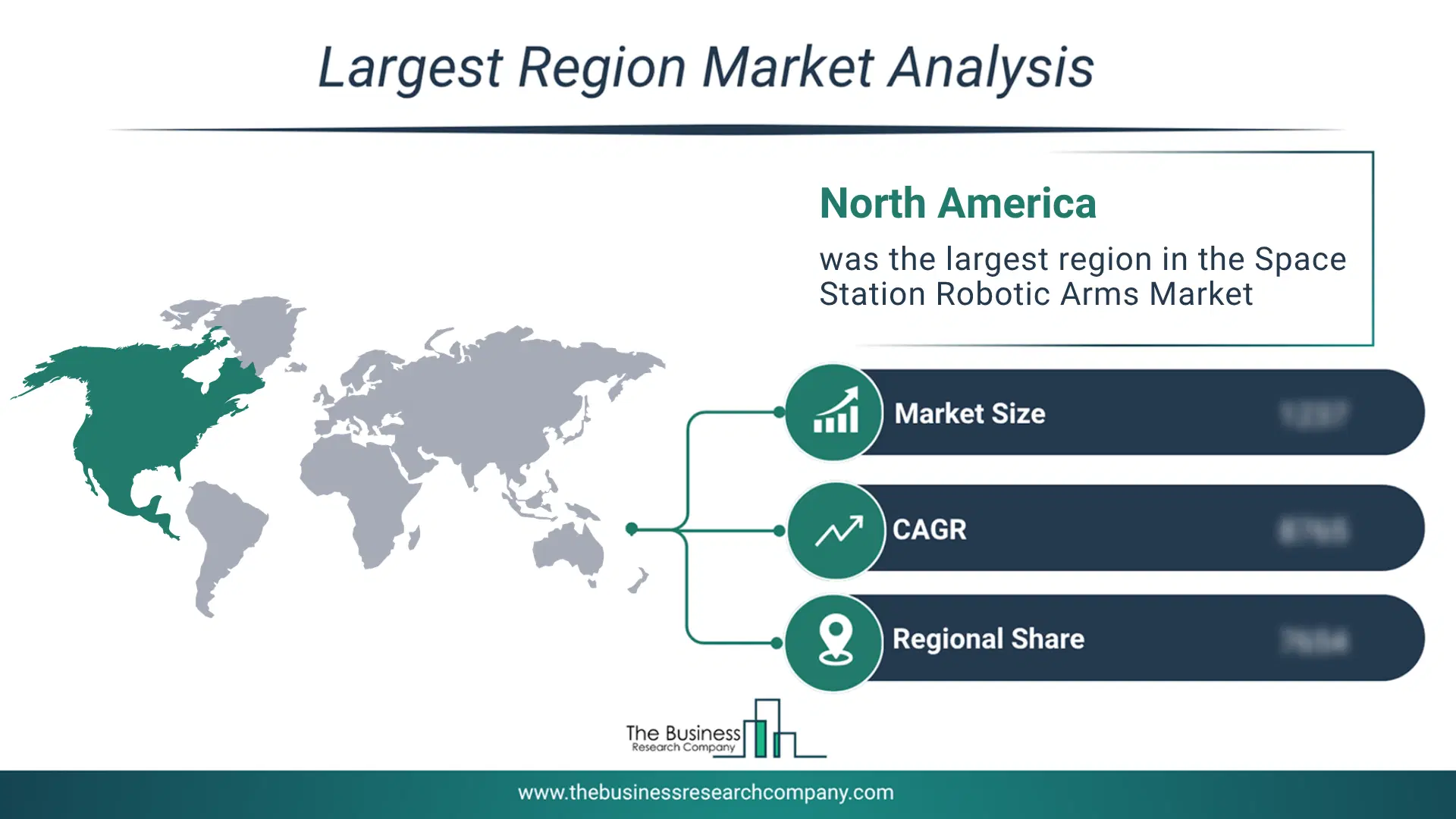
Regional Outlook/Insights
North America was the largest region in the space station robotic arms market in 2025. Asia-Pacific is expected to be the fastest-growing region in the forecast period. The regions covered in this market report are Asia-Pacific, South East Asia, Western Europe, Eastern Europe, North America, South America, Middle East, Africa. The countries covered in this market report are Australia, Brazil, China, France, Germany, India, Indonesia, Japan, Taiwan, Russia, South Korea, UK, USA, Canada, Italy, Spain.What Defines the Space Station Robotic Arms Market?
The space station robotic arms market consists of sales of articulated robotic arms, teleoperated robotic arms, autonomous robotic arms, payload handling robotic arms, inspection robotic arms, and space-based robotic arm systems. Values in this market are ‘factory gate’ values, that is, the value of goods sold by the manufacturers or creators of the goods, whether to other entities (including downstream manufacturers, wholesalers, distributors, and retailers) or directly to end customers. The value of goods in this market includes related services sold by the creators of the goods.How is Market Value Defined and Measured?
The market value is defined as the revenues that enterprises gain from the sale of goods and/or services within the specified market and geography through sales, grants, or donations in terms of the currency (in USD unless otherwise specified). The revenues for a specified geography are consumption values that are revenues generated by organizations in the specified geography within the market, irrespective of where they are produced. It does not include revenues from resales along the supply chain, either further along the supply chain or as part of other products.
This chart presents market attractiveness based on a quantitative evaluation of growth, competition, strategic alignment, and risk, offering a clear view of opportunity areas for decision-making. This chart is for illustrative purposes; the full report contains the complete analysis.

This chart highlights the Total Addressable Market (TAM) by estimating the maximum revenue opportunity using an assumption-driven approach, supporting strategic planning and opportunity sizing across markets. The chart is illustrative; the full report provides a more comprehensive analysis.
What Key Data and Analysis Are Included in the Space Station Robotic Arms Market Report 2026?
The space station robotic arms market research report is one of a series of new reports from The Business Research Company that provides market statistics, including industry global market size, regional shares, competitors with the market share, detailed market segments, market trends and opportunities, and any further data you may need to thrive in the space station robotic arms industry. The market research report delivers a complete perspective of everything you need, with an in-depth analysis of the current and future state of the industry.Space Station Robotic Arms Market Report Forecast Analysis
| Report Attribute | Details |
|---|---|
| Market Size Value In 2026 | $1.1 billion |
| Revenue Forecast In 2030 | $1.57 billion |
| Growth Rate | CAGR of 9.5% from 2026 to 2035 |
| Base Year For Estimation | 2025 |
| Actual Estimates/Historical Data | 2020-2025 |
| Forecast Period | 2026 - 2030 |
| Market Representation | Revenue in USD Billion and CAGR from 2026 to 2030 |
| Segments Covered | Type, Component, Payload Capacity, Application, End User |
| Regional Scope | Asia-Pacific, Western Europe, Eastern Europe, North America, South America, Middle East, Africa |
| Country Scope | The countries covered in the report are Australia, Brazil, China, France, Germany, India, Indonesia, Japan, Taiwan, Russia, South Korea, UK, USA, Canada, Italy, Spain. |
| Customization Scope | Request for Customization |
| Pricing And Purchase Options | Explore Purchase Options |