
Space Traffic Management Market Report 2026
Global Outlook – By Activity (Space Situational Awareness, Space Debris Remediation, Space Orbit Management, Launch Vehicle Operation), By Orbit (LEO, MEO And Elliptical, GEO), By Application (Communication, Earth Observation, Navigation, Global Positioning System And Surveillance, Technology Development And Education, Other Applications), By End Use (Civil And Government, Commercial, Military) – Market Size, Trends, Strategies, and Forecast to 2030
Space Traffic Management Market Overview
• Space Traffic Management market size has reached to $17.66 billion in 2025 • Expected to grow to $28.52 billion in 2030 at a compound annual growth rate (CAGR) of 10.1% • Growth Driver: Growing Space Debris Threat Drives Space Traffic Management Market • Market Trend: Automation and Data Analytics Redefine the Future of Space Traffic Coordination • North America was the largest region in 2025 and Asia-Pacific is the fastest growing region.Market Gains By 2030 – Top Opportunities By Segment
Market Gain identifies the most promising market opportunities by highlighting the segments or products expected to generate the highest incremental revenue growth over the next five years.
What Is Covered Under Space Traffic Management Market?
Space traffic management is a set of technological and regulatory provisions intended to ensure safe entry, operations in space, and return from space to earth free of physical or radio-frequency interference. The space traffic management is used to provide a solid framework for on-orbit coordination of activities to improve the safety, stability, and sustainability of space operations. The main activities of space traffic management are space situational awareness, space debris remediation, space orbit management, and launch vehicle operation. Space situational awareness (SSA) is referred to the process of keeping track of objects in orbit and forecasting their real-time location and is used to track objects in orbit. The orbits include LEO, MEOand elliptical, and GEO. The various applications include communication, earth observation, navigation, global positioning system, and surveillance, technology development and education, and other applications. The end users include civil and government, commercial, and military.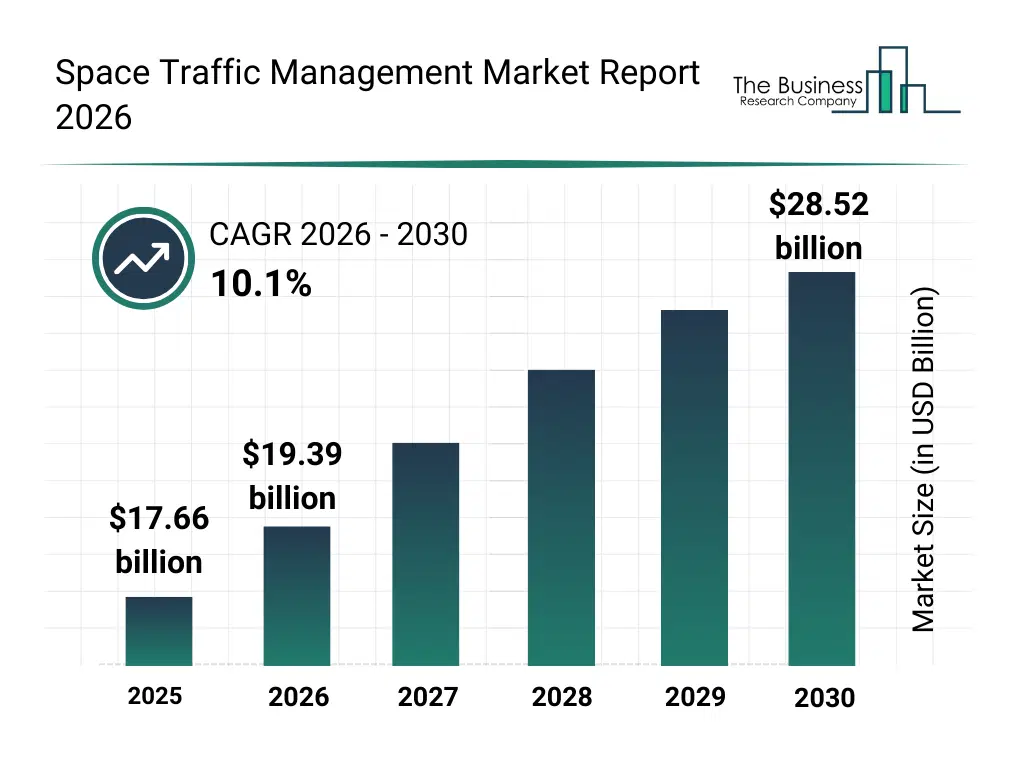
What Is The Space Traffic Management Market Size and Share 2026?
The space traffic management market size has grown strongly in recent years. It will grow from $17.66 billion in 2025 to $19.39 billion in 2026 at a compound annual growth rate (CAGR) of 9.8%. The growth in the historic period can be attributed to increasing satellite deployments driving early adoption of optical thermal and lidar sensors for orbital monitoring, growing governmental initiatives to address radio-frequency interference and orbital safety, development of foundational regulatory frameworks for on-orbit coordination, expansion of ground-based and space-based tracking networks to monitor spacecraft activities, rising demand for collision-risk assessment services as orbital congestion increased.What Is The Space Traffic Management Market Growth Forecast?
The space traffic management market size is expected to see rapid growth in the next few years. It will grow to $28.52 billion in 2030 at a compound annual growth rate (CAGR) of 10.1%. The growth in the forecast period can be attributed to growing requirement for real-time space-traffic monitoring to manage proliferating satellite constellations, advancements in autonomous sensing and tracking technologies for improved orbital precision, increasing integration of multi-sensor data fusion platforms to enhance situational awareness, expansion of international regulatory harmonization to support safe and sustainable space operations, rising commercialization of space traffic management services for private satellite operators. Major trends in the forecast period include increased adoption of advanced lidar and optical sensors for space traffic monitoring, growth in regulatory frameworks for space traffic coordination and deconfliction, expansion of active debris removal and deorbiting services, development of integrated collision prediction and avoidance platforms, implementation of satellite traffic management software for commercial and government use.
Global Space Traffic Management Market Segmentation
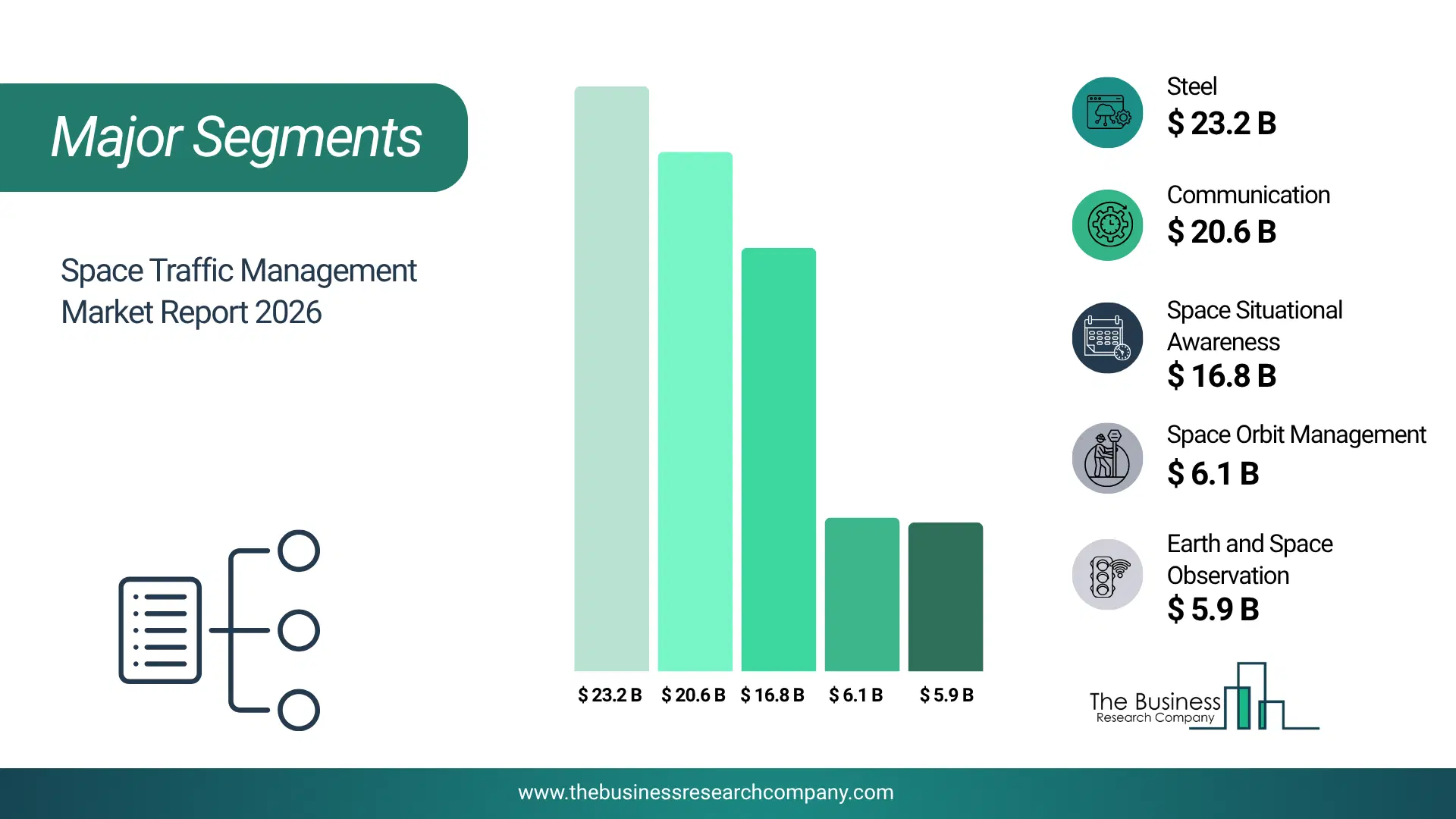
1) By Activity: Space Situational Awareness, Space Debris Remediation, Space Orbit Management, Launch Vehicle Operation 2) By Orbit: LEO, MEO And Elliptical, GEO 3) By Application: Communication, Earth Observation, Navigation, Global Positioning System And Surveillance, Technology Development And Education, Other Applications 4) By End Use: Civil And Government, Commercial, Military Subsegments: 1) By Space Situational Awareness: Collision Prediction and Avoidance, Tracking and Monitoring of Space Objects, Conjunction Assessment and Reporting 2) By Space Debris Remediation: Active Debris Removal, Debris Mitigation Technologies, Deorbiting Services 3) By Space Orbit Management: Orbital Slot Allocation, Satellite Positioning and Maneuvering, Orbit Deconfliction 4) By Launch Vehicle Operation: Launch Scheduling and Coordination, Traffic Management for Launch and Re-entry, Range Safety and Monitoring The top segments in the space traffic management market will be: • LEO will reach $23265.95 Million by 2030. • Communication will reach $20636.89 Million by 2030. • Space Situational Awareness will reach $16802.96 Million by 2030. • Earth and Space Observation will reach $5989.63 Million by 2030. • Space Orbit Management will reach $6163.16 Million by 2030.What Is Driver Of The Space Traffic Management Market?
The rising threat of space debris is expected to drive the growth of the space traffic management market going forward. Space debris refers to the non-functional remains of artificial objects in space, particularly those revolving around the Earth's orbit. Space traffic management helps in monitoring and tracking functional and non-functional satellites, avoiding collisions with space debris and creating less debris, further paving a smooth path for satellites. For instance, in September 2024, according to a report published by the government of the United Kingdom, a UK-based information website, Statistical models suggest that there are roughly one million pieces of space debris ranging from 1 cm to 10 cm in size, along with an astounding 130 million additional pieces measuring between 1 mm and 1 cm in orbit. Of these, approximately 36,500 objects larger than 10 cm are currently being monitored, with over 35,000 of them already cataloged. Thus, the rising threat of space debris is driving the space traffic management industry.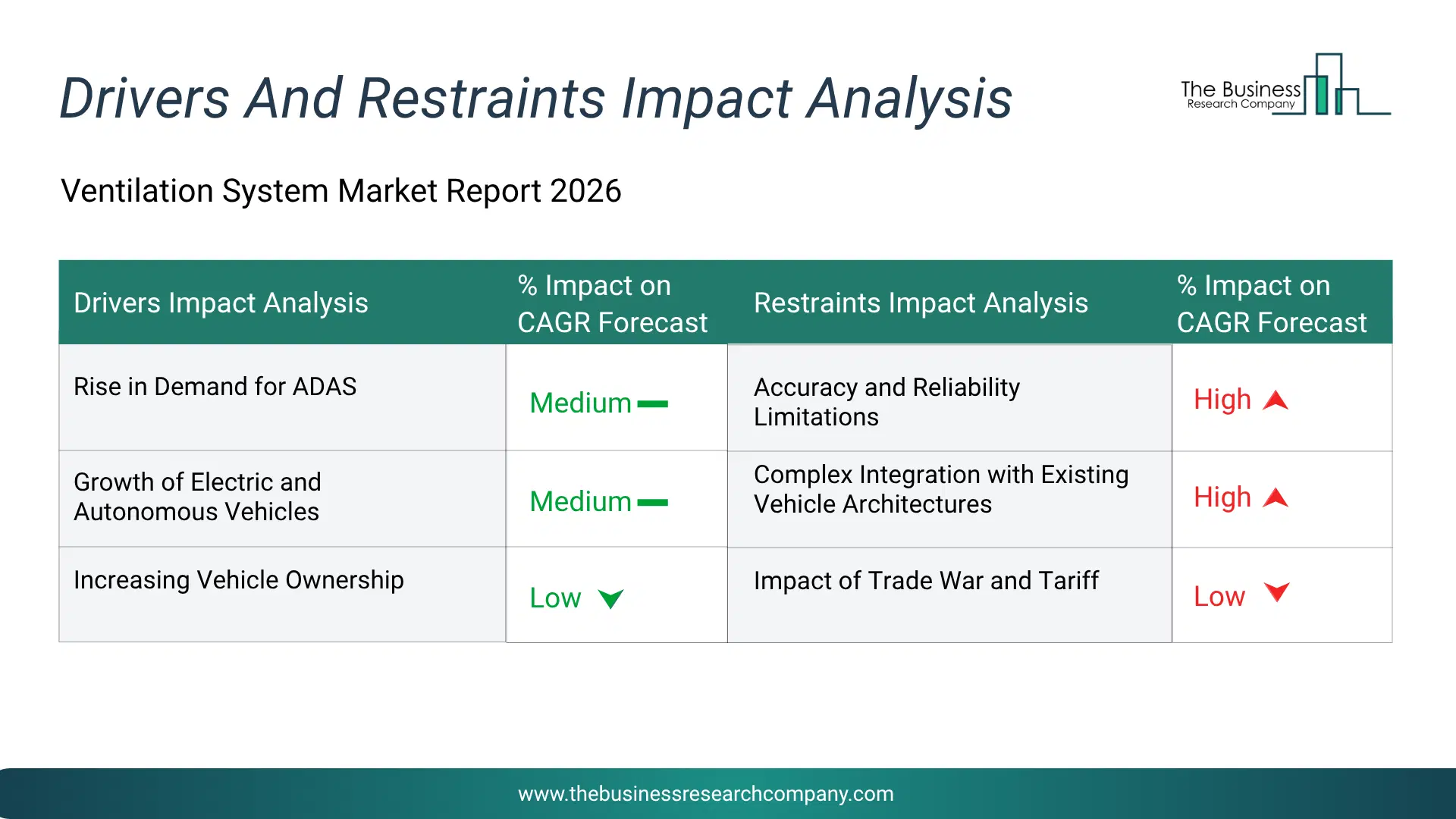
Infographic Chart Showing Key Market Drivers Analysis And Restraints For Space Traffic Management Market
The chart presents an impact analysis of key drivers and restraints, quantifying their relative influence on the market's growth rate and helping assess the balance between growth enablers and limiting factors. This chart offers a high-level perspective; the full report contains more detailed insights.
How Will The Drivers Impact Growth In The Global Space Traffic Management Market?
• Growth in Space And Advanced Aviation Programs (Medium) – During the forecast period, the expansion of space exploration initiatives and next-generation aviation programs will propel the growth of the space traffic management market. as governments and private players accelerate investments in satellite constellations, reusable launch vehicles, hypersonic platforms, and advanced military aircraft, there is a rising demand for lightweight, high-strength, and complex components with shorter production cycles. these programs require rapid prototyping, design optimization, and on-demand manufacturing of mission-critical parts that meet stringent performance and reliability standards. additive manufacturing is increasingly adopted across propulsion systems, airframes, structural components, and tooling to enable faster development, reduced material waste, and enhanced design flexibility, thereby supporting sustained growth of the aerospace and defense additive manufacturing market during the forecast period. as a result, the expansion of space exploration initiatives and next-generation aviation programs is anticipated to contributing to a is 2.0% annual growth in the market. • Growth Of Defense Modernization Programs (Medium) – During the forecast period, the sustained investments in defense modernization programs is expected to propel the growth space traffic management market. sustained investments in defense modernization programs focused on upgrading military capabilities with advanced systems, indigenous production, and cutting-edge technologies—will drive growth across the aerospace and defense ecosystem by creating stable procurement pipelines and stimulating innovation. as governments increase defense spending to enhance readiness, resilience, and technological superiority, the aerospace and defense additive manufacturing market will benefit from these modernisation efforts by enabling rapid production of complex, lightweight components, on-demand spare parts, and enhanced supply-chain flexibility. additive manufacturing’s ability to reduce lead times, material waste, and costs while supporting mission-critical applications positions it as a strategic enabler of defense modernization initiatives throughout the forecast period. consequently, sustained investments in defense modernization programs is projected to contributing to a 1.5% annual growth in the market. • Growth In Aerospace Maintenance, Repair, and Overhaul (MRO) Activities (Low) – During the forecast period, the growth in aerospace maintenance, repair, and overhaul (mro) activities is expected to propel the growth of the space traffic management market. growth in aerospace maintenance, repair, and overhaul (mro) activities, as operators require more frequent inspections, repairs, and overhauls to ensure safety, reliability, and regulatory compliance. technological advancements such as predictive maintenance, digitalization, and the integration of additive manufacturing are further enhancing operational efficiency, reducing turnaround times, and lowering lifecycle costs in mro operations. in parallel, the aerospace and defense additive manufacturing market is projected to grow rapidly, propelled by increasing demand for lightweight, cost-effective, and complex parts that traditional manufacturing cannot easily produce, as well as defense sector adoption for rapid prototyping and on-demand parts production. together, these trends are anticipated to support robust market growth across oems, service providers, and defense agencies throughout the forecast period. therefore, growth in aerospace maintenance, repair, and overhaul (mro) activities is projected to contributing to a 1.0% annual growth in the market. • Increased Adoption Of Additive Manufacturing in Hypersonic Programs (Low) – During the forecast period, the aerospace and defense additive manufacturing market is poised for robust expansion as the increasing adoption of additive manufacturing technologies, especially within hypersonic programs and advanced aerospace systems, drives demand for lightweight, high-performance, and geometrically complex components that traditional manufacturing cannot efficiently produce. Additive manufacturing’s ability to enable rapid prototyping, reduced material waste, and on-demand production is accelerating its deployment in hypersonic propulsion systems and mission-critical defense applications, supporting faster design iteration and improved performance at extreme conditions. This trend, coupled with growing investments by defense agencies and aerospace OEMs to integrate certified 3D-printed parts into critical platforms, underpins strong market growth throughout the forecast period. The increased adoption of additive manufacturing in hypersonic programs growth contribution during the forecast period in 2025 is 0.5%.How Will The Restraints Impact Growth In The Global Space Traffic Management Market?
• Stringent Certification Requirements (Medium) – During the forecast period, stringent certification requirements are restraining the growth of the aerospace and defense additive manufacturing market during the forecast period. additively manufactured aerospace and defense components must comply with rigorous airworthiness, safety, material traceability, and process validation standards set by aviation authorities and defense agencies. the lengthy qualification cycles, extensive testing, and high compliance costs associated with certifying new materials, printers, and production processes slow technology adoption and delay program timelines. as a result, manufacturers face longer commercialization cycles and higher development risks, limiting the pace of large-scale deployment of additive manufacturing solutions. growth affected by stringent certification requirements during the forecast period in 2025 is -1.5%. • Lack Of Skilled Workforce With Aerospace Additive Manufacturing (Medium) – During the forecast period, the lack of a skilled workforce is restraining the growth of the aerospace and defense additive manufacturing market during the forecast period. aerospace-grade additive manufacturing requires highly specialized expertise in materials science, design for additive manufacturing (dfam), process qualification, and certification standards, which limits the availability of trained engineers and technicians. this skills gap increases production risks, slows technology adoption, and raises operational costs for aerospace and defense manufacturers. as a result, limited workforce readiness is slowing large-scale deployment of additive manufacturing across aerospace and defense programs in 2025. growth affected by the lack of a skilled workforce during the forecast period in 2025 is -1.3%. • Impact of Trade War and Tariff (Low) – During the forecast period, the impact of trade wars and rising tariffs is restricting the growth of the aerospace and defense additive manufacturing market during the forecast period. higher import duties on metal powders, advanced printers, and critical components are increasing production costs and disrupting cross-border supply chains, while export restrictions are limiting access to global customers. at the same time, a lack of skilled workforce with expertise in aerospace-grade additive manufacturing, materials science, and certification standards is slowing technology adoption and scaling. the combined pressure of trade barriers and talent shortages is reducing manufacturing efficiency, delaying qualification programs, and constraining the pace of industrial deployment. growth affected by trade war, tariffs, and lack of skilled workforce during the forecast period in 2025 is -0.3%.Key Players In The Global Space Traffic Management Market
Major companies operating in the space traffic management market are Thales Group, L3Harris Technologies Inc., The Boeing Company, Airbus Group, BAE Systems plc, Lockheed Martin Corporation, Northrop Grumman Corporation, Raytheon Technologies Corporation, Saab AB, Kayhan Space, Exolaunch GmbH, HyImpulse Technologies GmbH, Slingshot Aerospace, Altitude Angel, Saber Astronautics LLC, Juniper Networks, Starfish Space, Creare Inc., Neuraspace, Transmetrics AD, Voyage Control, OKAPI: Orbits, COMSPOC Corp., ExoAnalytic Solutions, Kellogg Brown & Root Inc., NorthStar Earth & Space Inc., Space Data Association, Altius Space Machines, Analytical Graphics Inc.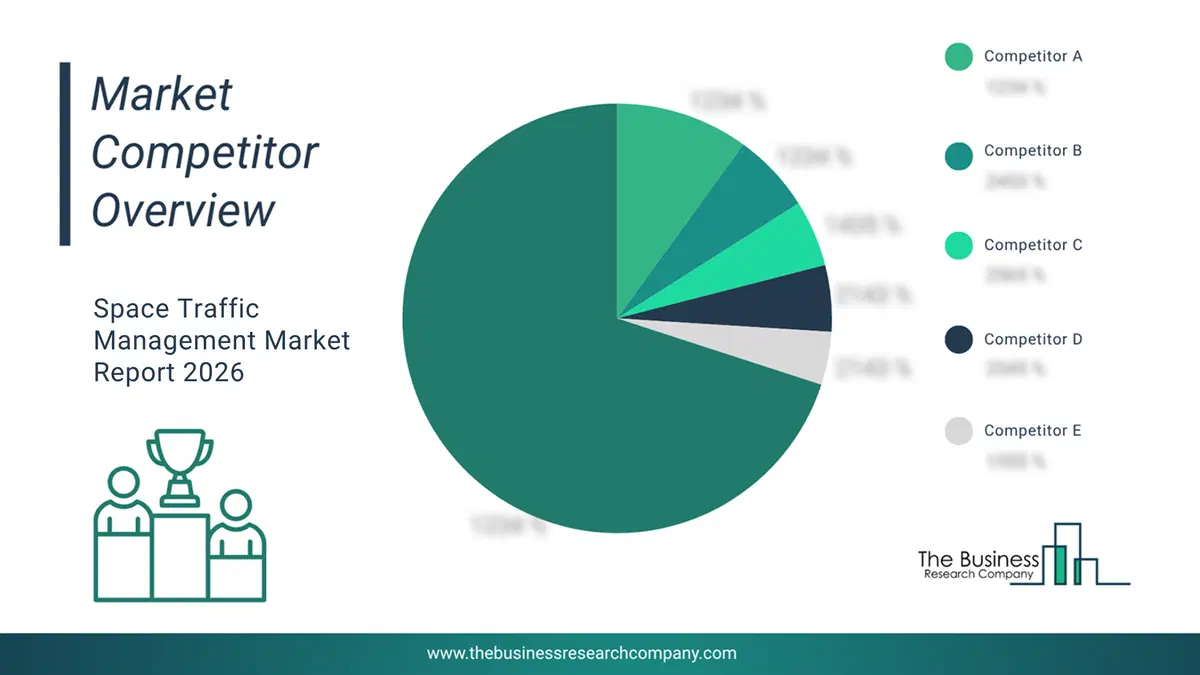
This chart is for illustrative purposes; the full report includes a detailed competitor analysis and comprehensive overview of the top 10 companies in the market.
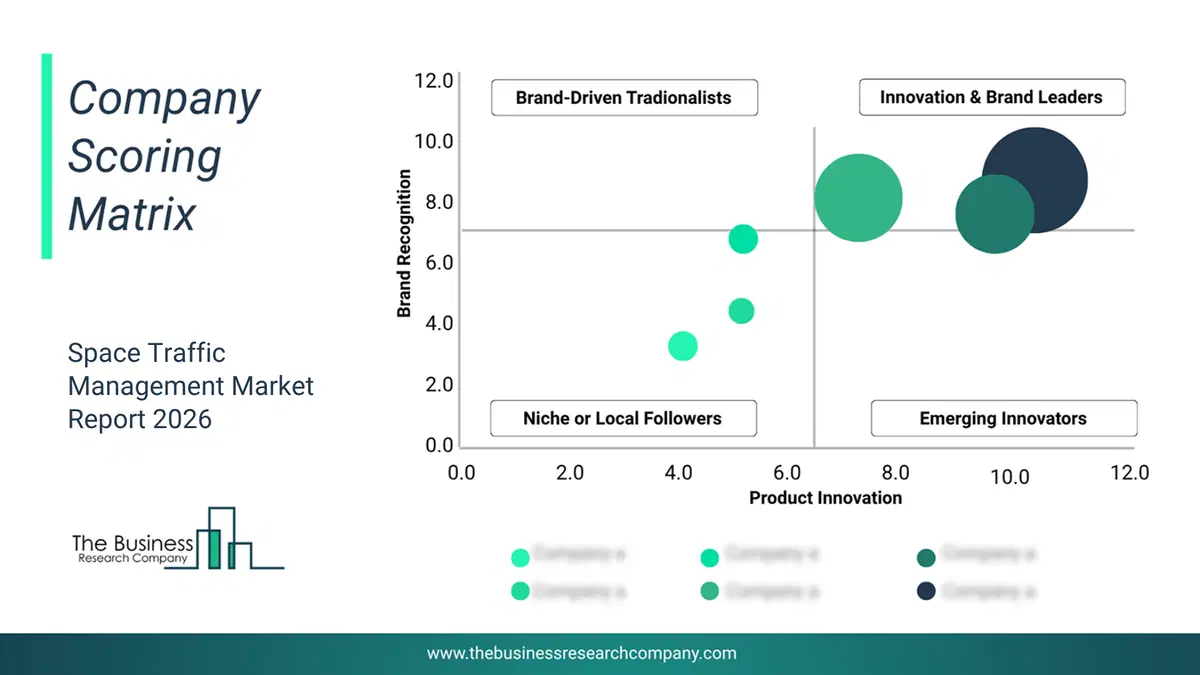
This chart maps companies by product innovation and brand strength, with bubble size indicating relative revenue, helping identify market leaders, challengers, and niche players. This is an illustrative chart; the full report provides a complete and accurate competitive analysis.
Global Space Traffic Management Market Trends and Insights
Major companies operating in the space traffic management market are focusing on developing innovative solutions, such as advanced orbital coordination and collision avoidance systems, to enhance satellite safety and ensure sustainable space operations. Advanced orbital coordination and collision avoidance systems are AI-driven platforms that track satellite positions, predict potential conjunctions, and automate maneuver planning, helping operators prevent collisions, minimize downtime, and maintain safe, efficient orbital operations. For instance, in September 2025, Kayhan Space Inc., a US-based space technology company, launched the upgraded Kayhan Platform, an innovative space traffic management solution. The enhanced platform delivers comprehensive predictive collision avoidance tools, customizable alert thresholds, and automated maneuver recommendations through a scalable, AI-powered framework. It enables satellite operators to proactively safeguard orbital assets, reduce downtime, and comply with emerging space safety regulations. Built with advanced analytics and a user-centric design, the upgraded Kayhan Platform also facilitates seamless data sharing among satellite operators, mission planners, and regulatory bodies, ensuring coordinated responses to potential conjunction events.What Are Latest Mergers And Acquisitions In The Space Traffic Management Market? GMV Strengthens Space Traffic Management Capabilities with Acquisition of Alén Space
In June 2023, GMV Innovating Solutions S.L., a Spain-based technology company, acquired Alén Space S.L. for an undisclosed amount. With this acquisition, GMV aims to accelerate Alén Space’s growth and position the company as a European leader in the small satellite market, leveraging GMV’s extensive technological resources, international presence, and complementary expertise to enhance innovation, competitiveness, and long-term expansion opportunities in the space industry. Alén Space S.L. is a Spain-based aerospace company that specializes in providing space traffic management.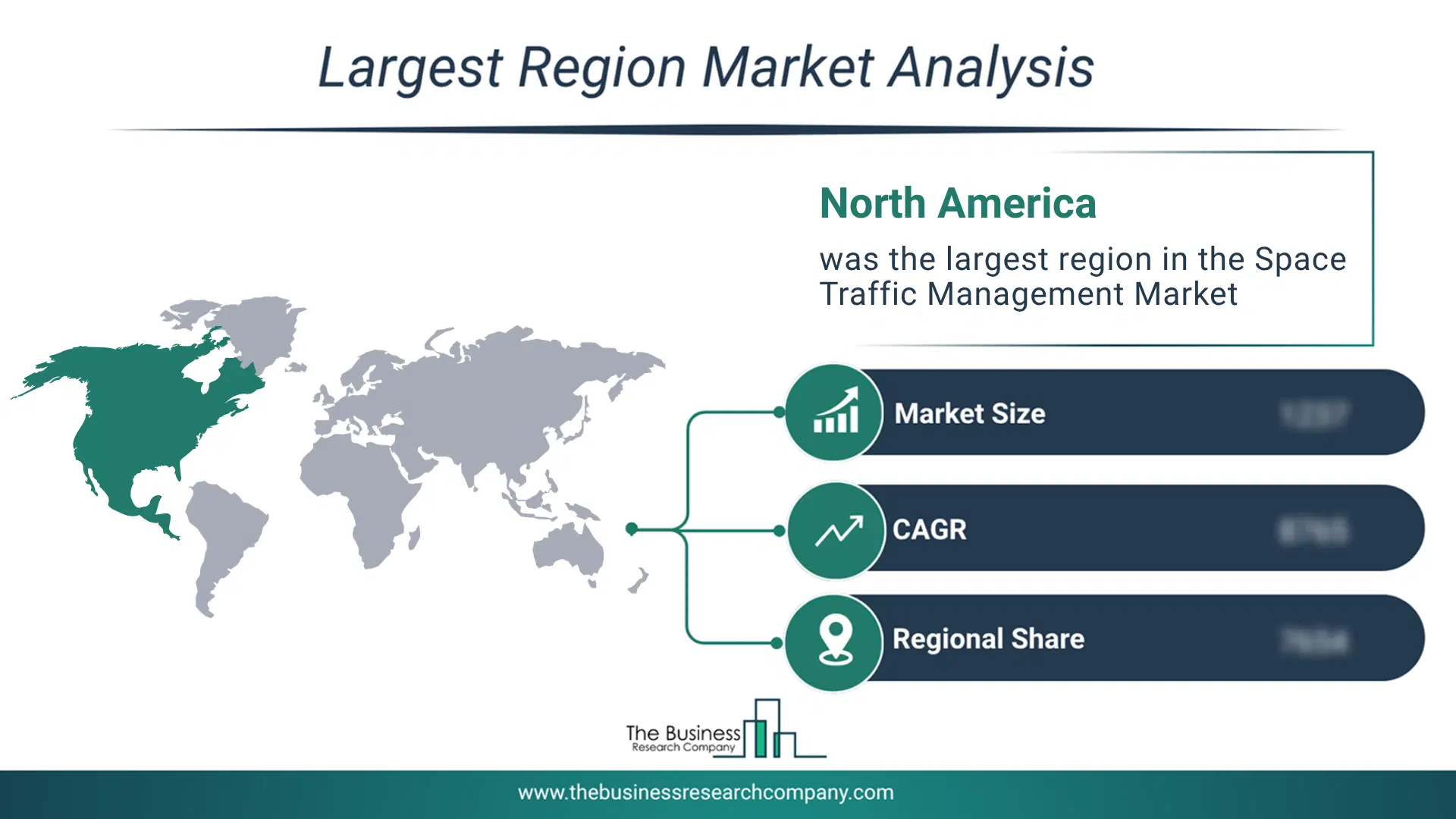
Regional Insights
North America was the largest region in the space traffic management market in 2025. Asia-Pacific is expected to be the fastest-growing region in the space traffic management market share during the forecast period. The regions covered in this market report are Asia-Pacific, South East Asia, Western Europe, Eastern Europe, North America, South America, Middle East, Africa. The countries covered in this market report are Australia, Brazil, China, France, Germany, India, Indonesia, Japan, Taiwan, Russia, South Korea, UK, USA, Canada, Italy, SpainWhat Defines the Space Traffic Management Market?
The space traffic management market consists of sales of space traffic management sensors such as thermal, optical and LIDAR sensors. Values in this market are ‘factory gate’ values, that is the value of goods sold by the manufacturers or creators of the goods, whether to other entities (including downstream manufacturers, wholesalers, distributors, and retailers) or directly to end customers. The value of goods in this market includes related services sold by the creators of the goods.How is Market Value Defined and Measured?
The market value is defined as the revenues that enterprises gain from the sale of goods and/or services within the specified market and geography through sales, grants, or donations in terms of the currency (in USD unless otherwise specified). The revenues for a specified geography are consumption values that are revenues generated by organizations in the specified geography within the market, irrespective of where they are produced. It does not include revenues from resales along the supply chain, either further along the supply chain or as part of other products.
This chart presents market attractiveness based on a quantitative evaluation of growth, competition, strategic alignment, and risk, offering a clear view of opportunity areas for decision-making. This chart is for illustrative purposes; the full report contains the complete analysis.

This chart highlights the Total Addressable Market (TAM) by estimating the maximum revenue opportunity using an assumption-driven approach, supporting strategic planning and opportunity sizing across markets. The chart is illustrative; the full report provides a more comprehensive analysis.
What Key Data and Analysis Are Included in the Space Traffic Management Market Report 2026?
The space traffic management market research report is one of a series of new reports from The Business Research Company that provides market statistics, including industry global market size, regional shares, competitors with the market share, detailed market segments, market trends and opportunities, and any further data you may need to thrive in the space traffic management industry. The market research report delivers a complete perspective of everything you need, with an in-depth analysis of the current and future state of the industry.Space Traffic Management Market Report Forecast Analysis
| Report Attribute | Details |
|---|---|
| Market Size Value In 2026 | $19.39 billion |
| Revenue Forecast In 2030 | $28.52 billion |
| Growth Rate | CAGR of 9.8% from 2026 to 2030 |
| Base Year For Estimation | 2025 |
| Actual Estimates/Historical Data | 2020-2025 |
| Forecast Period | 2026 - 2030 - 2035 |
| Market Representation | Revenue in USD Billion and CAGR from 2026 to 2030 |
| Segments Covered | Activity, Orbit, Application, End Use |
| Regional Scope | Asia-Pacific, Western Europe, Eastern Europe, North America, South America, Middle East, Africa |
| Country Scope | The countries covered in the report are Australia, Brazil, China, France, Germany, India, Indonesia, Japan, Taiwan, Russia, South Korea, UK, USA, Canada, Italy, Spain. |
| Key Companies Profiled | Thales Group, L3Harris Technologies Inc., The Boeing Company, Airbus Group, BAE Systems plc, Lockheed Martin Corporation, Northrop Grumman Corporation, Raytheon Technologies Corporation, Saab AB, Kayhan Space, Exolaunch GmbH, HyImpulse Technologies GmbH, Slingshot Aerospace, Altitude Angel, Saber Astronautics LLC, Juniper Networks, Starfish Space, Creare Inc., Neuraspace, Transmetrics AD, Voyage Control, OKAPI: Orbits, COMSPOC Corp., ExoAnalytic Solutions, Kellogg Brown & Root Inc., NorthStar Earth & Space Inc., Space Data Association, Altius Space Machines, Analytical Graphics Inc. |
| Customization Scope | Request for Customization |
| Pricing And Purchase Options | Explore Purchase Options |