

Space Traffic Management Global Market Opportunities And Strategies To 2035
By Activity (Space Situational Awareness, Space Debris Remediation, Space Orbit Management, Launch Vehicle Operation), By Orbit (LEO, MEO And Elliptical, GEO), By Application (Communication, Earth Observation, Navigation, Global Positioning System And Surveillance, Technology Development And Education, Other Applications), By End Use (Civil And Government, Commercial, Military), And By Region, Opportunities And Strategies – Global Forecast To 2035
Space Traffic Management Market Definition
Space traffic management refers to the range of systems, technologies and services used to monitor, coordinate and control the movement of active and inactive objects in Earth’s orbital space. It is a vital component of the space industry that ensures the safe, sustainable and efficient operation of satellites and other space assets across various orbits. This includes managing satellite positioning, preventing collisions, coordinating launch and orbital activities and mitigating the growing problem of space debris. The space traffic management market consists of sales by entities (organizations, sole traders and partnerships) of space traffic management is utilized by space agencies, commercial satellite operators, defense departments, international space organizations, research institutions and academic entities. It is used throughout the satellite lifecycle from launch and initial orbit insertion to operations and eventual decommissioning or re-entry.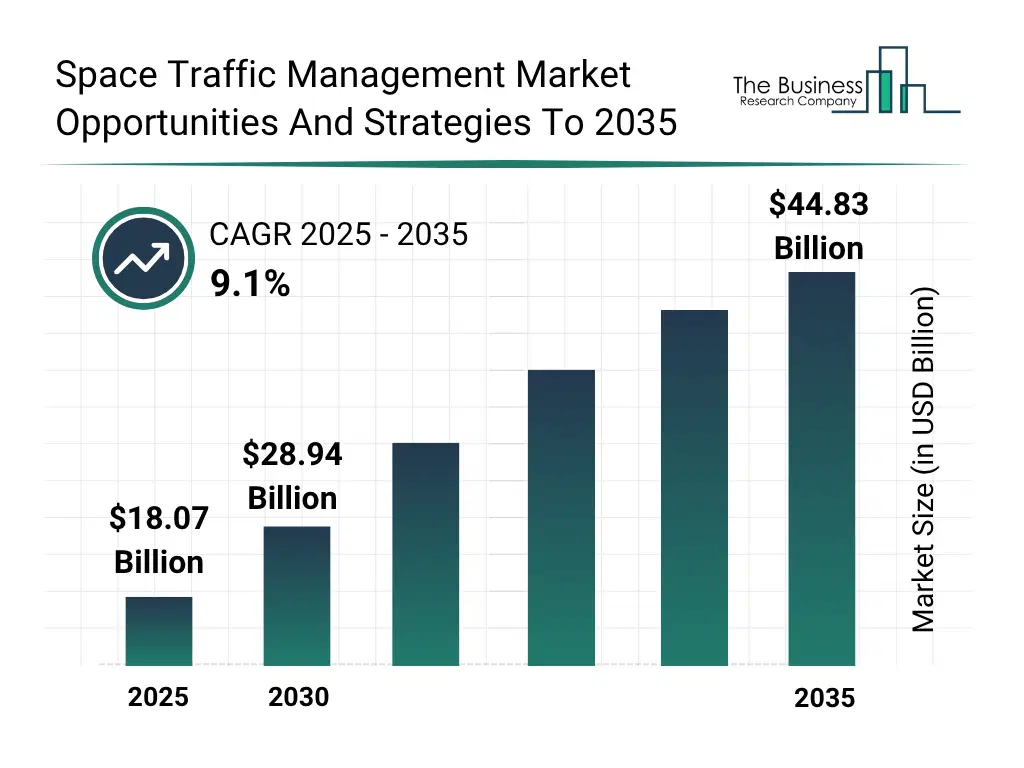
Space Traffic Management Market Size
The global space traffic management market reached a value of nearly $18,065.4 million in 2025, having grown at a compound annual growth rate (CAGR) of 11.0% since 2020. The market is expected to grow from $18,065.4 million in 2025 to $28,944.0 million in 2030 at a rate of 9.9%. The market is then expected to grow at a CAGR of 9.1% from 2030 and reach $44,831.9 million in 2035. Growth in the historic period resulted from increase in demand for space exploration, rising investment in space programs, growing commercial space sector and increase in small satellite deployments. Factors that negatively affected growth in the historic period were limited government budgets for public STM programs and oversight and cybersecurity risks associated with STM data exchange platforms. Going forward, rapid growth of space debris in earth orbits, increasing number of satellite launches, rapid growth of satellite constellations and expansion of low earth orbit (LEO) activities will drive the growth. Factors that could hinder the growth of the space traffic management market in the future include lack of standardized STM protocols and data formats and absence of a globally binding regulatory framework and impact of trade war and tariff.
Space Traffic Management Market Segmentation
The space traffic management market is segmented by activity, by orbit, by application and by end use.By Activity –
The space traffic management market is segmented by activity into:
- a) Space Situational Awareness
- b) Space Debris Remediation
- c) Space Orbit Management
- d) Launch Vehicle Operation
By Orbit –
The space traffic management market is segmented by orbit into:
- a) LEO
- b) MEO And Elliptical
- c) GEO
By Application –
The space traffic management market is segmented by application into:
- a) Communication
- b) Earth Observation
- c) Navigation
- d) Global Positioning System And Surveillance
- e) Technology Development And Education
- f) Other Applications
By End User –
The space traffic management market is segmented by end user into:
- a) Civil And Government
- b) Commercial
- c) Military
By Geography - The space traffic management market is segmented by geography into:
- China
- India
- Japan
- Australia
- Indonesia
- South Korea
- USA
- Canada
- Brazil
- France
- Germany
- UK
- Italy
- Spain
- Russia
-
o Asia Pacific
o Africa