
Space Travel Market Report 2026
Global Outlook – By Travel Type (Suborbital Space Travel, Orbital Space Travel, Lunar Tourism, Deep Space Tourism, Point-To-Point Hypersonic Space Travel), By Passenger Capacity (Single Passenger, 2-6 Passengers, 7-20 Passengers, More Than 20 Passengers), By Propulsion Technology (Chemical Propulsion, Electric Propulsion, Nuclear Propulsion, Hybrid Propulsion, Advanced Or Experimental Propulsion), By Application Type (Space Flights, Space Hotel And Space Station), By End User (Individual Tourists, Government Space Agencies, Commercial Enterprises, Research Institutions, Defense Organizations) – Market Size, Trends, Strategies, and Forecast to 2035
Space Travel Market Overview
• Space Travel market size has reached to $1.12 billion in 2025 • Expected to grow to $3.39 billion in 2030 at a compound annual growth rate (CAGR) of 24.8% • Growth Driver: Rising Demand For Commercial Space Tourism Fueling The Growth Of The Market Due To Increasing Investment In Passenger Spacecraft, Launch Systems, And Space Tourism Infrastructure • Market Trend: Advancements In Commercial Human Spaceflight Through Private Astronaut Missions • North America was the largest region in 2025 and Asia-Pacific is the fastest growing region.What Is Covered Under Space Travel Market?
Space travel refers to the transportation of humans or cargo beyond Earth's atmosphere using spacecraft designed to operate in outer space. Its primary use is to enable space exploration, scientific research, satellite servicing, commercial activities, and increasingly, space tourism for private individuals. The main travel types of space travel include suborbital space travel, orbital space travel, lunar tourism, deep space tourism, and point-to-point hypersonic space travel. Suborbital space travel involves flights that reach space without completing a full orbit around Earth, typically providing passengers with a brief experience of microgravity before returning to Earth. These travel services accommodate single passengers, 2-6 passengers, 7-20 passengers, and more than 20 passengers and use chemical propulsion, electric propulsion, nuclear propulsion, hybrid propulsion, and advanced or experimental propulsion. The various applications involved are space flights and space hotel and space station, and they are utilized by end users including individual tourists, government space agencies, commercial enterprises, research institutions, and defense organizations.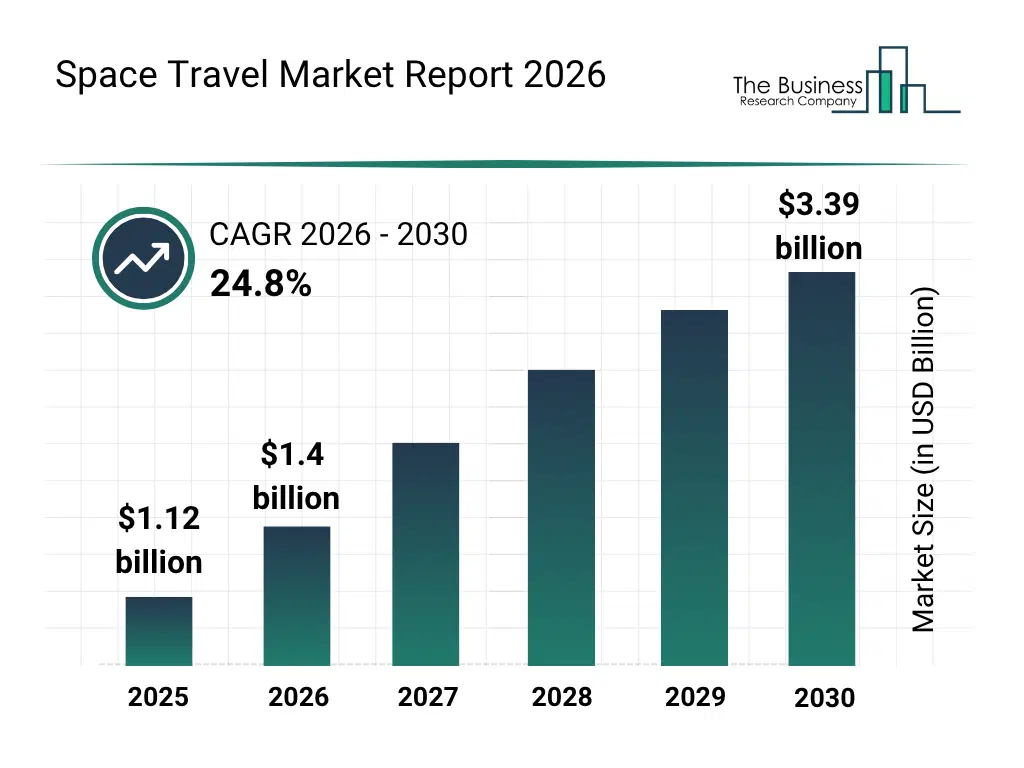
What Is The Space Travel Market Size and Share 2026?
The space travel market size has grown exponentially in recent years. It will grow from $1.12 billion in 2025 to $1.4 billion in 2026 at a compound annual growth rate (CAGR) of 25.2%. The growth in the historic period can be attributed to increasing government investment in space exploration, growing commercial satellite launch activity, rising private-sector participation in space missions, increasing demand for human spaceflight, development of reusable launch vehicles.What Is The Space Travel Market Growth Forecast?
The space travel market size is expected to see exponential growth in the next few years. It will grow to $3.39 billion in 2030 at a compound annual growth rate (CAGR) of 24.8%. The growth in the forecast period can be attributed to rising demand for space tourism experiences, increasing investment in lunar exploration missions, expansion of commercial space stations, growing development of advanced propulsion technologies, increasing demand for point-to-point hypersonic transportation. Major trends in the forecast period include commercial space tourism expansion, reusable spacecraft development, private astronaut missions, lunar tourism development, point-to-point hypersonic space travel.Tariff Impact On Space Travel Market
Tariffs are impacting the space travel market by increasing the cost of spacecraft components, propulsion systems, avionics, electronic components, and specialized aerospace materials sourced through international supply chains. Commercial spaceflight operators, spacecraft manufacturers, and propulsion technology providers may experience greater cost pressures, particularly in North America, Europe, and Asia-Pacific, where aerospace manufacturing networks are globally interconnected. However, tariffs can encourage domestic production, supplier diversification, and greater investment in locally developed spacecraft technologies, potentially strengthening regional space manufacturing capabilities.
Global Space Travel Market Segmentation
2) By Passenger Capacity: Single Passenger, 2-6 Passengers, 7-20 Passengers, More Than 20 Passengers 3) By Propulsion Technology: Chemical Propulsion, Electric Propulsion, Nuclear Propulsion, Hybrid Propulsion, Advanced Or Experimental Propulsion 4) By Application Type: Space Flights, Space Hotel And Space Station 5) By End User: Individual Tourists, Government Space Agencies, Commercial Enterprises, Research Institutions, Defense Organizations Subsegments: 1) By Suborbital Space Travel: Commercial Passenger Flights, Research Flights, Educational Flights, Crew Training Flights 2) By Orbital Space Travel: Private Astronaut Missions, Government Astronaut Missions, Commercial Crew Transportation, Cargo Transportation Missions 3) By Lunar Tourism: Lunar Flyby Missions, Lunar Orbit Missions, Lunar Surface Missions, Luxury Lunar Expeditions 4) By Deep Space Tourism: Mars Flyby Missions, Asteroid Exploration Missions, Deep Space Expedition Missions, Interplanetary Tourism Missions 5) By Point-To-Point Hypersonic Space Travel: Commercial Passenger Transportation, Business Executive Transportation, Government Transportation, Emergency TransportationWhat Is The Driver Of The Space Travel Market?
The rising demand for commercial space tourism is expected to propel the growth of the space travel market going forward. Commercial space tourism refers to paid spaceflight services that allow private individuals to travel beyond Earth’s atmosphere for recreational, experiential, or educational purposes. The demand for commercial space tourism is increasing due to growing interest among high-net-worth individuals seeking unique space experiences and private astronaut opportunities. The demand for commercial space tourism drives space travel by encouraging investment in passenger spacecraft, launch systems, space tourism infrastructure, and related services to provide safe and accessible spaceflight experiences for private individuals. For instance, in February 2026, according to National Aeronautics and Space Administration (NASA), a US-based space agency, private astronaut missions to the International Space Station increased four missions by 2025 (Axiom Missions 1–4), from one mission in 2022 (Axiom Mission 1). Therefore, the rising demand for commercial space tourism is driving the growth of the space travel industry.Key Players In The Global Space Travel Market
Major companies operating in the space travel market are The Boeing Company, Space Exploration Technologies Corp, Blue Origin LLC, Virgin Galactic Holdings Inc, Rocket Lab USA Inc, Sierra Space Corporation, Axiom Space Inc, ispace inc, Vast Space LLC, Relativity Space Inc, Intuitive Machines Inc, Firefly Aerospace Inc, Impulse Space Inc, The Exploration Company, Gravitics Inc, EOS-X Space S.L, Space Adventures Inc, HALO Space S.L., Zephalto SAS, Above Space Development Inc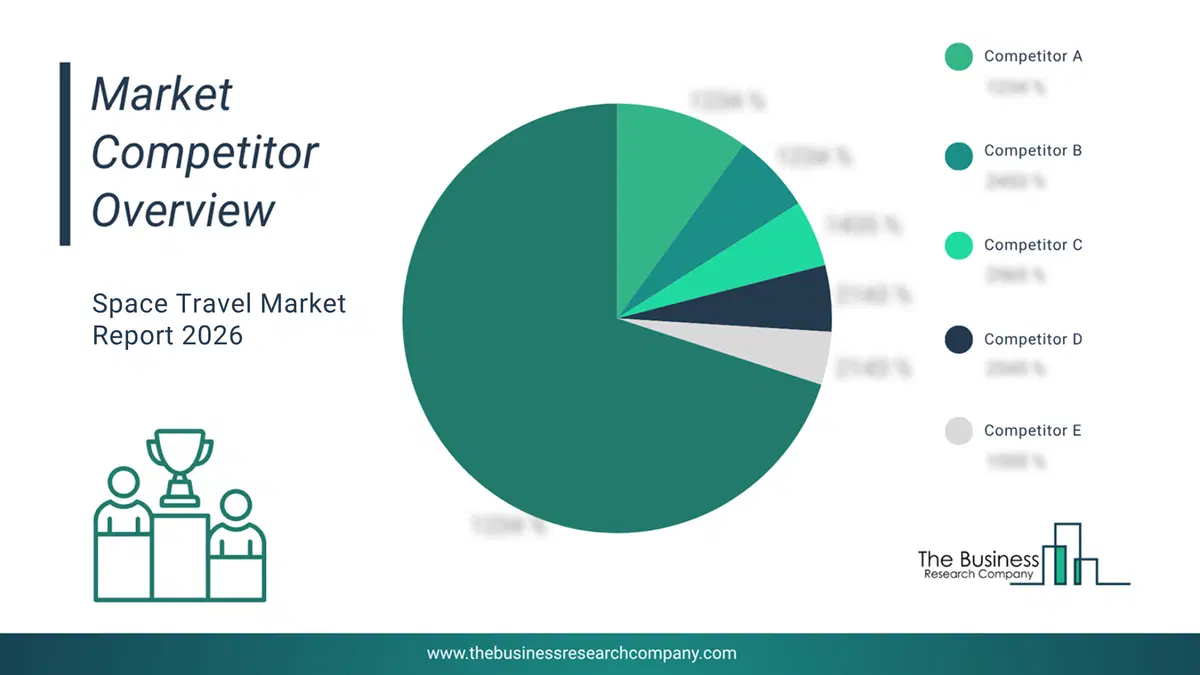
This chart is for illustrative purposes; the full report includes a detailed competitor analysis and comprehensive overview of the top 10 companies in the market.
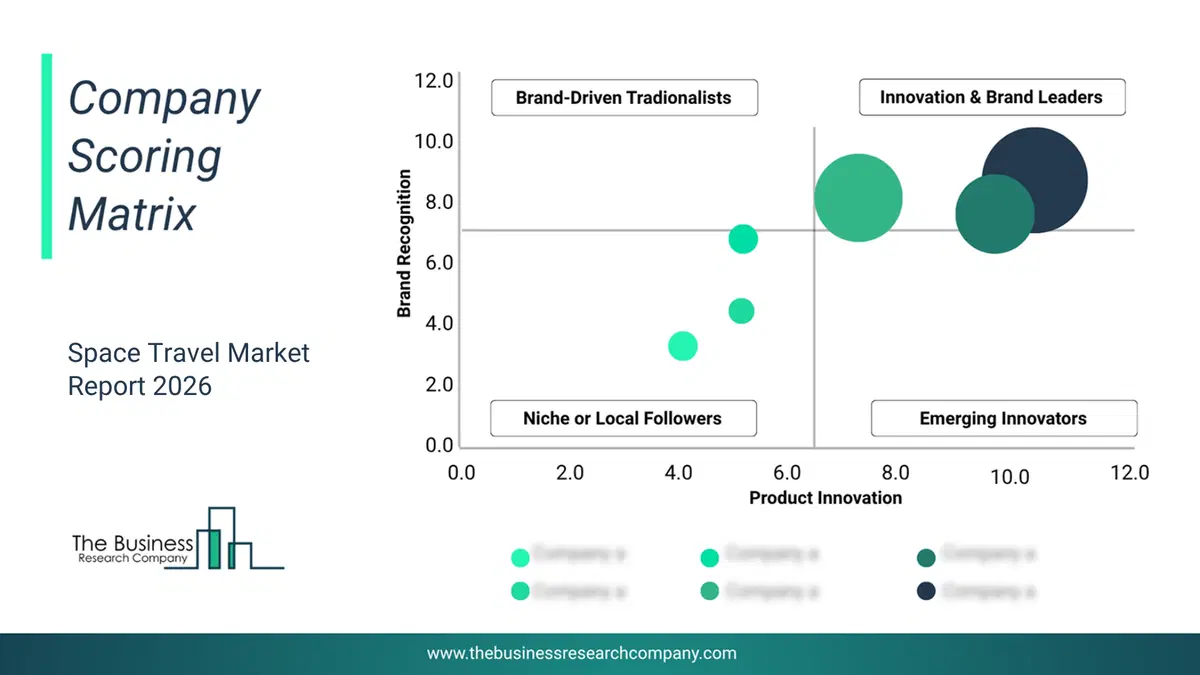
This chart maps companies by product innovation and brand strength, with bubble size indicating relative revenue, helping identify market leaders, challengers, and niche players. This is an illustrative chart; the full report provides a complete and accurate competitive analysis.
Global Space Travel Market Trends and Insights
Major companies operating in the space travel market are focusing on advancements in commercial human spaceflight, such as private astronaut missions, to expand access to space, support orbital research, and enable commercial space travel experiences. Private astronaut missions refer to commercially organized human spaceflights that transport privately sponsored astronauts, researchers, or other participants to orbital destinations using commercial spacecraft and launch systems. For instance, in June 2025, Axiom Space Inc., a US-based commercial spaceflight company, launched Axiom Mission 4 (Ax-4), a private astronaut mission to the International Space Station (ISS), aboard a SpaceX Dragon spacecraft. The mission carried four crew members, including Peggy Whitson, Shubhanshu Shukla, Sławosz Uznański-Wiśniewski, and Tibor Kapu, and supported more than two weeks of orbital activities, including scientific research, technology demonstrations, and commercial human spaceflight operations.What Are Latest Mergers And Acquisitions In The Space Travel Market?
In July 2025, EOS-X Space, a Spain-based private aerospace and near-space tourism company, provider of commercial space tourism services and high-altitude passenger spaceflight experiences, acquired Space Perspective Inc. for an undisclosed amount. Through this acquisition, EOS-X Space aims to strengthen its position in the commercial space tourism market by integrating Space Perspective’s balloon-based spaceflight technology, expanding its operational capabilities in the United States, and accelerating the development of luxury near-space travel experiences. Space Perspective Inc. is a US-based space tourism company that provides high-altitude balloon-powered passenger flights through its Spaceship Neptune capsule, designed to offer customers near-space travel experiences.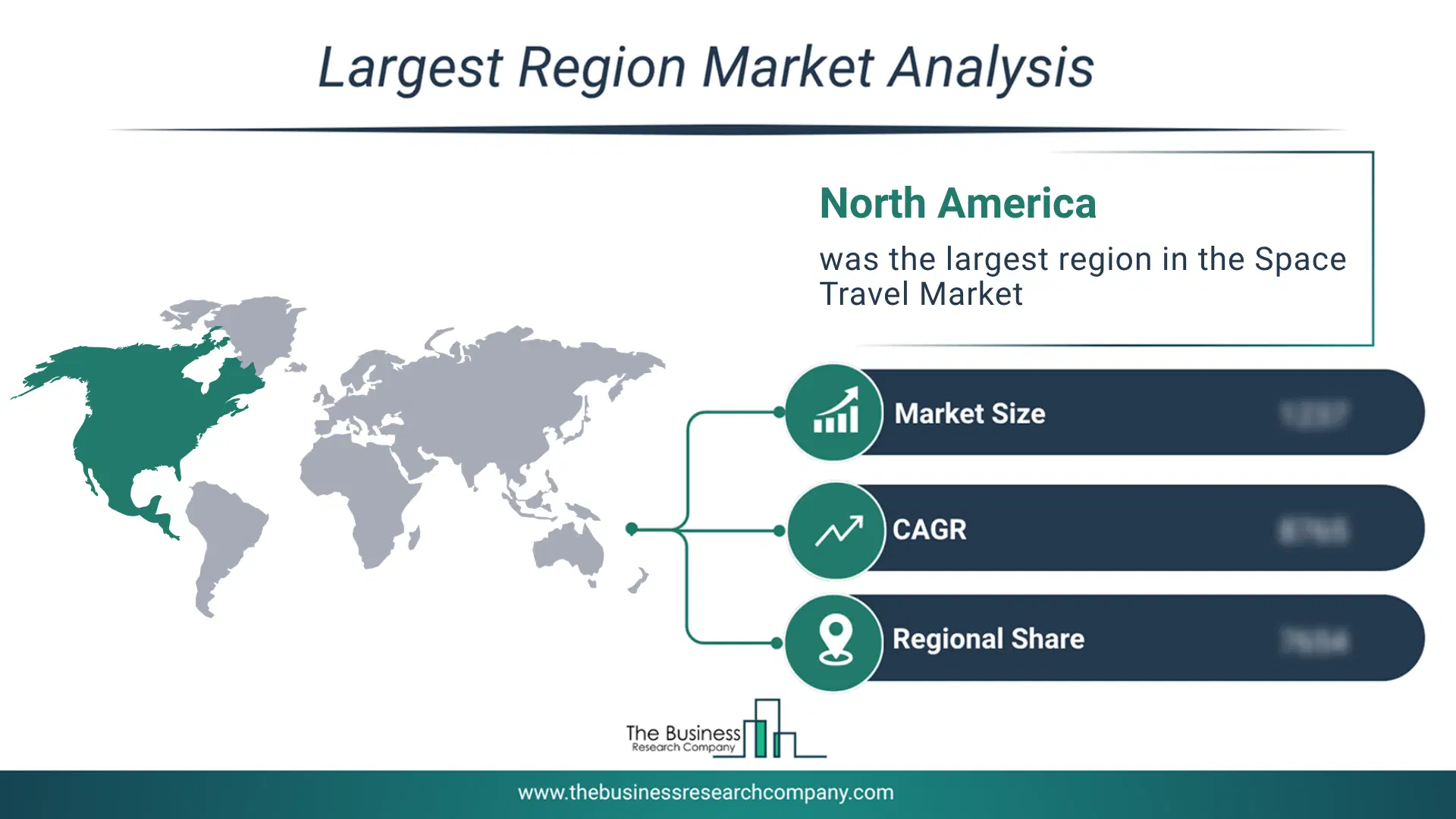
Regional Outlook/Insights
North America was the largest region in the space travel market in 2025. Asia-Pacific is expected to be the fastest-growing region in the forecast period. The regions covered in this market report are Asia-Pacific, South East Asia, Western Europe, Eastern Europe, North America, South America, Middle East, Africa. The countries covered in this market report are Australia, Brazil, China, France, Germany, India, Indonesia, Japan, Taiwan, Russia, South Korea, UK, USA, Canada, Italy, Spain.What Defines the Space Travel Market?
The space travel market consists of revenues earned by entities by providing services such as astronaut training, pre-flight preparation, spaceflight booking and mission planning, passenger medical screening, spacesuit fitting and support, launch and re-entry support, in-flight passenger assistance, accommodation and hospitality support, ground operations, mission control support, and post-flight recovery services. The market value includes the value of related goods sold by the service provider or included within the service offering. Only goods and services traded between entities or sold to end consumers are included.How is Market Value Defined and Measured?
The market value is defined as the revenues that enterprises gain from the sale of goods and/or services within the specified market and geography through sales, grants, or donations in terms of the currency (in USD unless otherwise specified). The revenues for a specified geography are consumption values that are revenues generated by organizations in the specified geography within the market, irrespective of where they are produced. It does not include revenues from resales along the supply chain, either further along the supply chain or as part of other products.
This chart presents market attractiveness based on a quantitative evaluation of growth, competition, strategic alignment, and risk, offering a clear view of opportunity areas for decision-making. This chart is for illustrative purposes; the full report contains the complete analysis.

This chart highlights the Total Addressable Market (TAM) by estimating the maximum revenue opportunity using an assumption-driven approach, supporting strategic planning and opportunity sizing across markets. The chart is illustrative; the full report provides a more comprehensive analysis.
What Key Data and Analysis Are Included in the Space Travel Market Report 2026?
The space travel market research report is one of a series of new reports from The Business Research Company that provides market statistics, including industry global market size, regional shares, competitors with the market share, detailed market segments, market trends and opportunities, and any further data you may need to thrive in the space travel industry. The market research report delivers a complete perspective of everything you need, with an in-depth analysis of the current and future state of the industry.Space Travel Market Report Forecast Analysis
| Report Attribute | Details |
|---|---|
| Market Size Value In 2026 | $1.4 billion |
| Revenue Forecast In 2030 | $3.39 billion |
| Growth Rate | CAGR of 24.8% from 2026 to 2035 |
| Base Year For Estimation | 2025 |
| Actual Estimates/Historical Data | 2020-2025 |
| Forecast Period | 2026 - 2030 |
| Market Representation | Revenue in USD Billion and CAGR from 2026 to 2030 |
| Segments Covered | Travel Type, Passenger Capacity, Propulsion Technology, Application Type, End User |
| Regional Scope | Asia-Pacific, Western Europe, Eastern Europe, North America, South America, Middle East, Africa |
| Country Scope | The countries covered in the report are Australia, Brazil, China, France, Germany, India, Indonesia, Japan, Taiwan, Russia, South Korea, UK, USA, Canada, Italy, Spain. |
| Customization Scope | Request for Customization |
| Pricing And Purchase Options | Explore Purchase Options |