
Spare Parts Manufacturing Market Report 2026
Global Outlook – By Product (Precision Machined Parts, Injection-Molded Parts, Forged Parts, Die-Cast Parts, Custom Fabricated Parts), By Material (Metal, Plastic, Rubber, Ceramics, Composites), By Distribution Channel (Original Equipment Manufacturers (OEMs), Aftermarket), By Application (Repair And Maintenance, Replacement), By End-User Industry (Automotive, Aerospace, Machinery And Equipment, Consumer Electronics, Healthcare, Other End-User Industries) – Market Size, Trends, Strategies, and Forecast to 2030
Spare Parts Manufacturing Market Overview
• Spare Parts Manufacturing market size has reached to $547.11 billion in 2025 • Expected to grow to $732.59 billion in 2030 at a compound annual growth rate (CAGR) of 6.1% • Growth Driver: The Growth Of The Shift Toward Electric Vehicles Is Driving The Market Due To Rising Component Demand • Market Trend: Advanced Truck Parts Enhance Diagnostic Capabilities And Reduce Maintenance Downtime • North America was the largest region in 2025 and Asia-Pacific is the fastest growing region.Market Gains By 2030 – Top Opportunities By Segment
Market Gain identifies the most promising market opportunities by highlighting the segments or products expected to generate the highest incremental revenue growth over the next five years.
What Is Covered Under Spare Parts Manufacturing Market?
Spare parts manufacturing refers to the process of designing, producing, and supplying components that replace worn-out or damaged parts in machinery, vehicles, or equipment. These parts ensure the continuous operation, reliability, and longevity of systems by providing readily available parts for repair or replacement. These parts can be original equipment manufacturer (OEM) components or aftermarket alternatives designed to meet performance and safety standards. The main products of spare parts manufacturing are precision-machined parts, injection-molded parts, forged parts, die-cast parts, and custom-fabricated parts. Precision-machined parts refer to components that are manufactured with high accuracy and tight tolerances using advanced machining processes such as CNC turning, milling, or grinding to meet exact specifications. These products are manufactured using different materials such as metal, plastic, rubber, ceramics, and composites, and are usually applied for various purposes such as repair and maintenance, replacement, and upgrades. These spare parts are distributed through original equipment manufacturers (OEMs) and aftermarket, Catering to various end-user industries such as automotive, aerospace, machinery and equipment, consumer electronics, healthcare, and other end-user industries.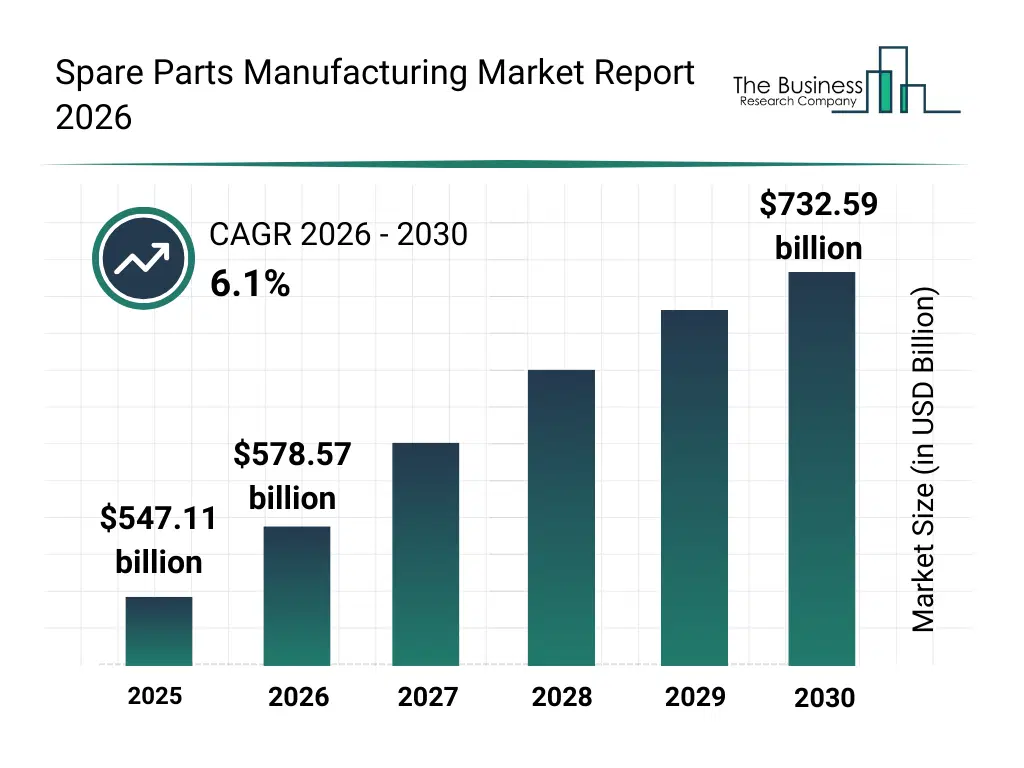
What Is The Spare Parts Manufacturing Market Size and Share 2026?
The spare parts manufacturing market size has grown strongly in recent years. It will grow from $547.11 billion in 2025 to $578.57 billion in 2026 at a compound annual growth rate (CAGR) of 5.8%. The growth in the historic period can be attributed to growth in industrial equipment installed base, rising maintenance and repair activities, expansion of automotive and machinery sectors, availability of precision manufacturing technologies, increasing aftermarket demand.What Is The Spare Parts Manufacturing Market Growth Forecast?
The spare parts manufacturing market size is expected to see strong growth in the next few years. It will grow to $732.59 billion in 2030 at a compound annual growth rate (CAGR) of 6.1%. The growth in the forecast period can be attributed to increasing adoption of additive manufacturing for spares, rising investments in smart factories, expansion of predictive maintenance programs, growing focus on inventory optimization, increasing demand for rapid part availability. Major trends in the forecast period include increasing adoption of digital spare parts manufacturing, rising demand for on-demand production, growing use of advanced machining technologies, expansion of localized manufacturing networks, enhanced focus on supply chain resilience.
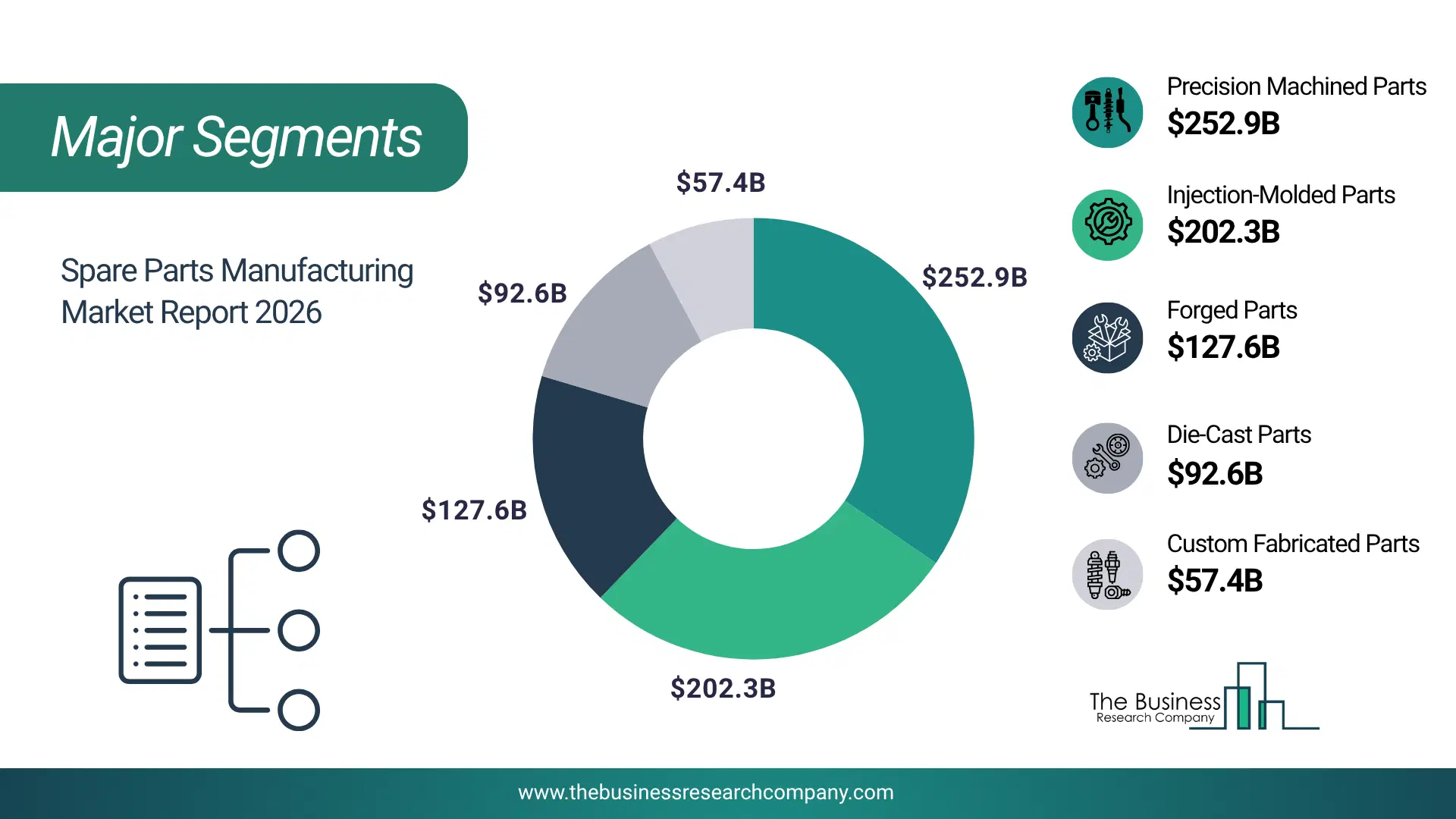
Global Spare Parts Manufacturing Market Segmentation
1) By Product: Precision Machined Parts, Injection-Molded Parts, Forged Parts, Die-Cast Parts, Custom Fabricated Parts 2) By Material: Metal, Plastic, Rubber, Ceramics, Composites 3) By Distribution Channel: Original Equipment Manufacturers (OEMs), Aftermarket 4) By Application: Repair And Maintenance, Replacement 5) By End-User Industry: Automotive, Aerospace, Machinery And Equipment, Consumer Electronics, Healthcare, Other End-User Industries Subsegments: 1) By Precision Machined Parts: Shaft Components, Gear Components, Engine Components, Valve Components 2) By Injection-Molded Parts: Automotive Components, Electronic Housings, Consumer Goods Components, Industrial Components 3) By Forged Parts: Connecting Rods, Crankshafts, Axles, Bolts And Nuts. 4) By Die-Cast Parts: Engine Blocks, Gear Housings, Transmission Components, Pump Housings 5) By Custom Fabricated Parts: Sheet Metal Components, Structural Frames, Tubular Components, Industrial Enclosures The top segments in the spare parts manufacturing market will be: • Precision Machined Parts will reach $252.85 billion by 2030. • Injection-Molded Parts will reach $202.21 billion by 2030. • Forged Parts will reach $127.6 billion by 2030. • Die-Cast Parts will reach $92.59 billion by 2030. • Custom Fabricated Parts will reach $57.34 billion by 2030.What Is The Driver Of The Spare Parts Manufacturing Market?
The growth of the shift toward electric vehicles (EVs) is expected to propel the growth of the spare parts manufacturing market during the forecast period. Electric vehicles (EVs) refer to automobiles that are powered entirely or partially by electricity, using rechargeable batteries instead of traditional internal combustion engines. The growth of the shift toward electric vehicles (EVs) is driven by increasing environmental concerns, government incentives, advancements in battery technology, and rising consumer preference for sustainable and cost-efficient transportation solutions. Spare parts manufacturing supports the growth of the shift toward electric vehicles (EVs) by producing essential components such as batteries, electric motors, and power electronics, ensuring efficient maintenance, reducing downtime, and enabling wider adoption of EV technology. For instance, the International Energy Agency, a France-based intergovernmental organization, reported that in 2024, electric car sales exceeded 17 million units worldwide, marking an increase of over 25%, with an additional 3.5 million vehicles sold compared to 2023. Therefore, the growth of the shift toward electric vehicles (EVs) is driving the growth of the spare parts manufacturing industry.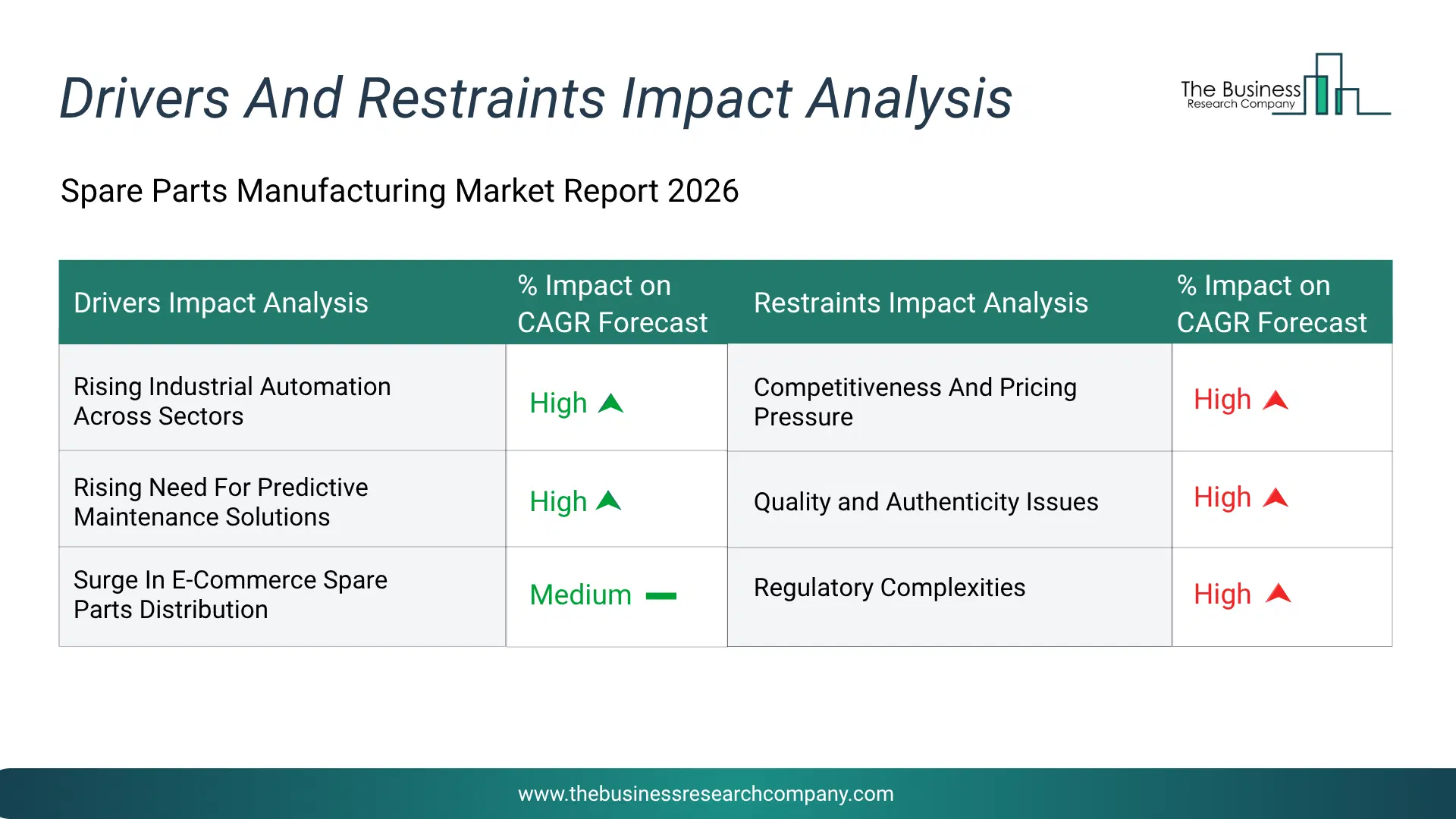
Infographic Chart Showing Key Market Drivers Analysis And Restraints For Spare Parts Manufacturing Market
The chart presents an impact analysis of key drivers and restraints, quantifying their relative influence on the market's growth rate and helping assess the balance between growth enablers and limiting factors. This chart offers a high-level perspective; the full report contains more detailed insights.
How Will The Drivers Impact Growth In The Global Spare Parts Manufacturing Market?
• Rising Industrial Automation Across Sectors (High) – During the forecast period, the rise in industrial automation across sectors is expected to become a key growth driver for the spare parts manufacturing market by 2030. As factories and enterprises increasingly deploy advanced machinery and robotic systems, dependence on automated equipment continues to grow. These systems operate continuously with high precision, leading to increased wear and tear on components such as bearings, filters, and electronic boards. This creates steady demand for dependable replacement parts to reduce downtime and sustain productivity. Furthermore, as automation expands across industries including automotive, electronics, and logistics, the diversity and technical complexity of required spare parts also increase. Consequently, manufacturers are compelled to enhance innovation and scale production to meet rising demand for durable and compatible components. • Rising Need For Predictive Maintenance Solutions (High) – During the forecast period, the growing need for predictive maintenance solutions is expected to emerge as a major factor driving expansion of the spare parts manufacturing market by 2030. The adoption of predictive maintenance technologies stimulates demand for spare parts by enabling timely, data-informed component replacement. Sensors and analytics systems detect potential failures in advance, minimizing operational disruptions. This proactive maintenance model often increases the frequency of part replacement compared to traditional reactive approaches. Accordingly, manufacturers must ensure consistent supply of high-quality and readily available spare parts to support these systems. This alignment between spare parts production and advanced maintenance strategies directly strengthens market growth. • Surge In E-Commerce Spare Parts Distribution (Medium) – During the forecast period, the surge in e-commerce-based spare parts distribution is expected to act as a key growth catalyst for the spare parts manufacturing market by 2030. The expansion of digital platforms has reshaped spare parts procurement, enabling faster and broader access across regions. Online channels offer price transparency, product comparisons, and convenient delivery, improving purchasing efficiency for industrial buyers and individual consumers. This accessibility increases replacement frequency by reducing procurement delays. In turn, spare parts manufacturers gain wider market reach and stronger cross-sector demand. The digital transition also supports customization and small-batch manufacturing, further accelerating market expansion.How Will The Restraints Impact Growth In The Global Spare Parts Manufacturing Market?
• Competitiveness And Pricing Pressure (High) – During the forecast period, the competitiveness and pricing pressure act as a restraint for the spare parts manufacturing market because numerous producers often supply similar components, making it difficult to differentiate on features alone. This intense rivalry forces companies to compete mainly on price, reducing profit margins. With lower margins, manufacturers face limitations in investing in new technologies, quality improvements, or expanding production capacity. Smaller firms, in particular, struggle to match the economies of scale enjoyed by larger players. Over time, this pressure can slow innovation and hinder sustainable growth within the market. • Quality and Authenticity Issues (High) – During the forecast period, the quality and authenticity issues act as a restraint for the spare parts manufacturing market because substandard or fake components can compromise equipment performance and safety. When customers experience failures due to poor-quality parts, trust in manufacturers declines, reducing repeat business. Maintaining strict quality checks and certifications increases production costs, putting pressure on margins. In industries like automotive, aerospace, and healthcare, even minor defects can lead to major risks and regulatory challenges. These factors make it harder for manufacturers to expand confidently while protecting their reputation. • Regulatory Complexities (High) – During the forecast period, the regulatory complexities act as a restraint for the spare parts manufacturing market because different regions impose varying compliance standards and certification requirements. Navigating these regulations increases time, costs, and administrative burdens for manufacturers, especially those operating globally. Delays in approvals or failure to meet standards can prevent products from entering certain markets, limiting growth potential. Smaller firms often struggle more, as they lack the resources to adapt quickly to evolving regulations. This fragmented regulatory environment slows innovation and creates barriers to efficient market expansion.Key Players In The Global Spare Parts Manufacturing Market
Major companies operating in the spare parts manufacturing market are Robert Bosch GmbH, Denso Corporation, Continental AG, ZF Friedrichshafen AG, Aisin Corporation, Magna International Inc., Schaeffler AG, Valeo SA, BorgWarner Inc., Mahle GmbH, Hitachi Astemo Ltd., Tenneco Inc., Dana Incorporated, Thyssenkrupp AG, SKF AB, NTN Corporation, Timken Company, Parker Hannifin Corporation, Eaton Corporation plc, Honeywell International Inc., Cummins Inc., ABB Ltd.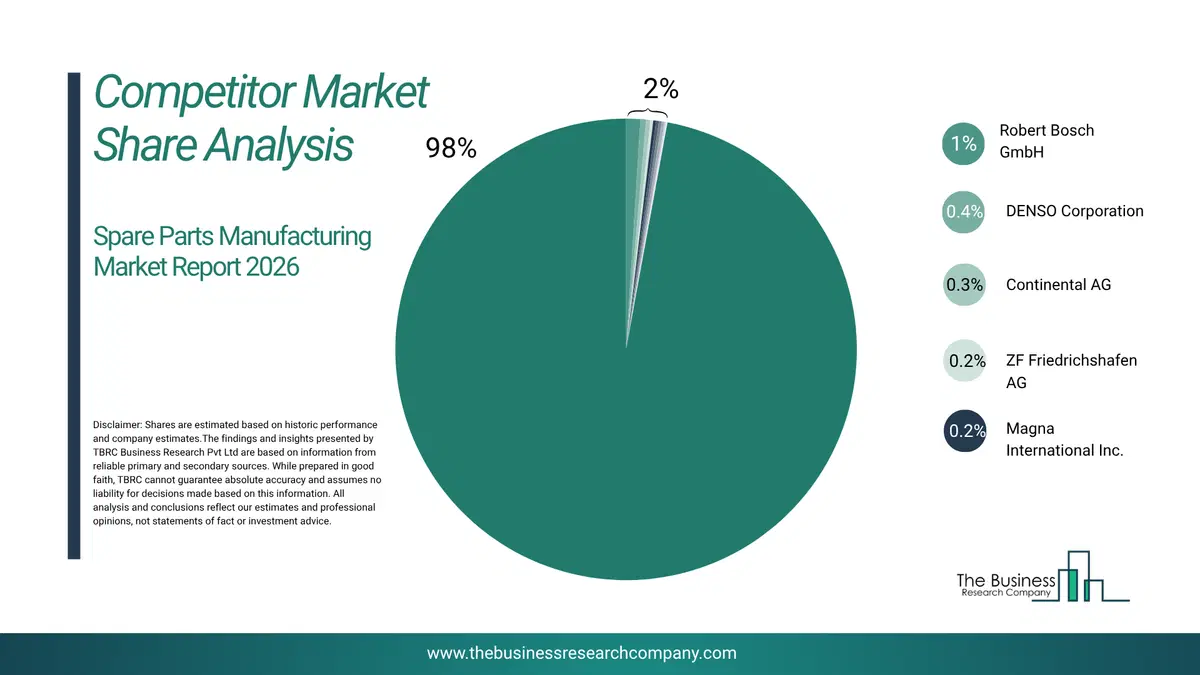
This chart is for illustrative purposes; the full report includes a detailed competitor analysis and comprehensive overview of the top 10 companies in the market.

This chart maps companies by product innovation and brand strength, with bubble size indicating relative revenue, helping identify market leaders, challengers, and niche players. This is an illustrative chart; the full report provides a complete and accurate competitive analysis.
Global Spare Parts Manufacturing Market Trends and Insights
Major companies operating in the spare parts manufacturing market are focusing on developing advanced products, such as sensor-integrated components, to boost vehicle uptime, enhance diagnostic capabilities, and reduce maintenance costs and downtime. Sensor-integrated components refer to truck parts embedded with smart sensors that monitor real-time performance data, such as temperature, pressure, and wear levels. For instance, in April 2024, Trendy Automobile Components, an India-based vehicle spare parts manufacturing and aftermarket supplier company, launched a range of truck electrical and chassis parts specifically designed for commercial vehicles to support reliable repairs and maintenance. The electrical components, including sensor-integrated components along with indicator lights, fuse boxes, wiring harnesses, and alternators, are engineered for high durability and consistent performance, ensuring essential functions such as lighting, signaling, and power distribution operate smoothly. Additionally, the truck chassis parts, such as brake shoe springs, clutch springs, lift axle pins, and water separators, provide robust structural support and safety, built to withstand heavy-duty usage while maintaining vehicle stability and operational efficiency.What Are Latest Mergers And Acquisitions In The Spare Parts Manufacturing Market?
In February 2025, The Carlyle Group Inc., a US-based private equity company, acquired Highway Industries Limited and Roop Automotives Limited for an undisclosed amount. Through this acquisition, Carlyle aims to build a diversified global auto components platform, expand its presence in the advanced manufacturing and automotive components sector, and leverage operating synergies to enhance technological capabilities and customer value. Highway Industries Limited is an India-based manufacturing company, and Roop Automotives Limited is an India-based manufacturing company that offers spare parts manufacturing.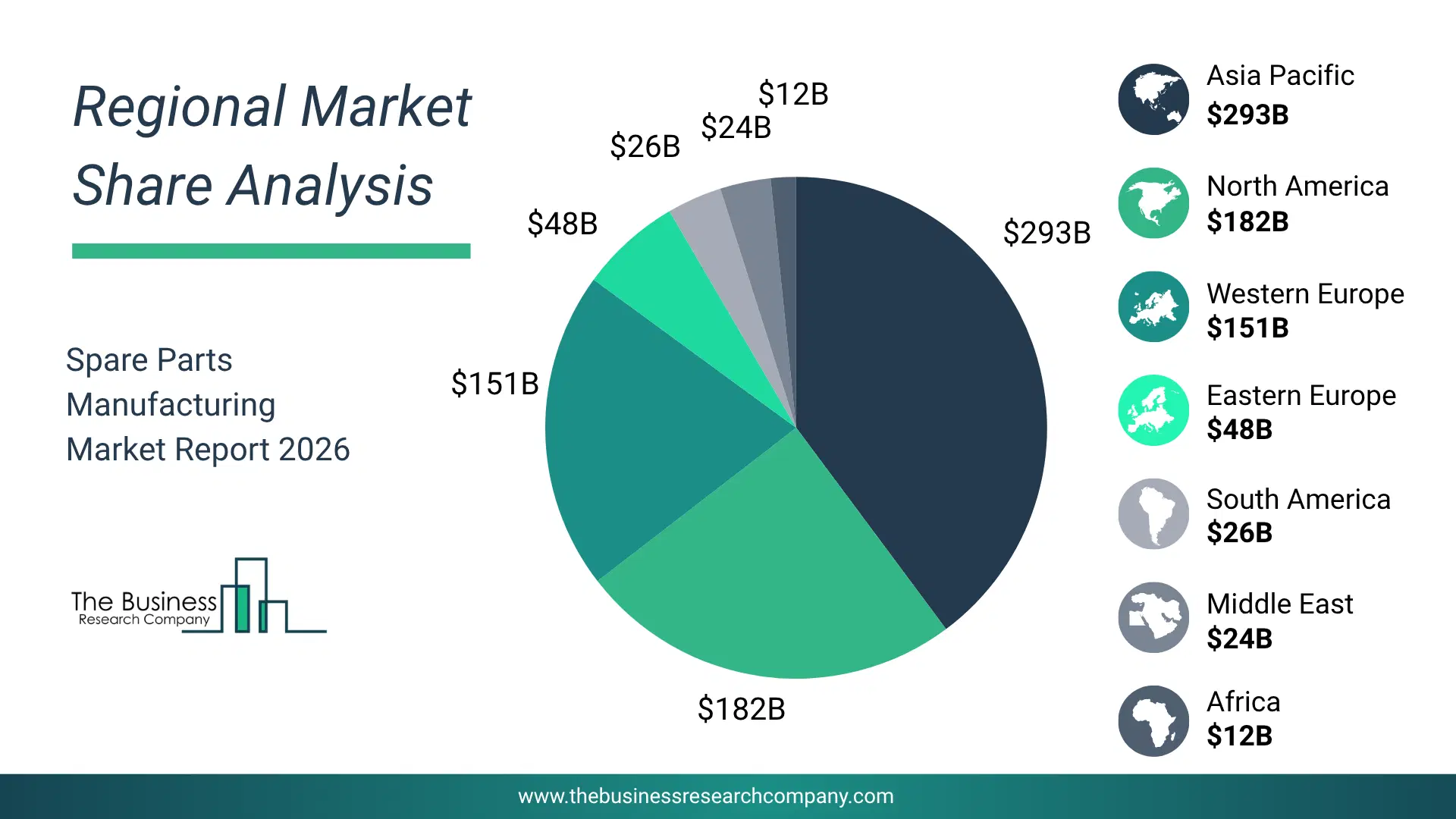
Regional Outlook
North America was the largest region in the spare parts manufacturing market in 2025. Asia-Pacific is expected to be the fastest-growing region in the forecast period. The regions covered in this market report are Asia-Pacific, South East Asia, Western Europe, Eastern Europe, North America, South America, Middle East, Africa The countries covered in this market report are Australia, Brazil, China, France, Germany, India, Indonesia, Japan, Taiwan, Russia, South Korea, UK, USA, Canada, Italy, Spain.What Defines the Spare Parts Manufacturing Market?
The spare parts manufacturing market consists of sales of engine components, transmission parts, brake system components, electrical and electronic parts, and suspension and steering parts. Values in this market are ‘factory gate’ values, that is, the value of goods sold by the manufacturers or creators of the goods, whether to other entities (including downstream manufacturers, wholesalers, distributors, and retailers) or directly to end customers. The value of goods in this market includes related services sold by the creators of the goods.How is Market Value Defined and Measured?
The market value is defined as the revenues that enterprises gain from the sale of goods and/or services within the specified market and geography through sales, grants, or donations in terms of the currency (in USD unless otherwise specified). The revenues for a specified geography are consumption values that are revenues generated by organizations in the specified geography within the market, irrespective of where they are produced. It does not include revenues from resales along the supply chain, either further along the supply chain or as part of other products.
This chart presents market attractiveness based on a quantitative evaluation of growth, competition, strategic alignment, and risk, offering a clear view of opportunity areas for decision-making. This chart is for illustrative purposes; the full report contains the complete analysis.

This chart highlights the Total Addressable Market (TAM) by estimating the maximum revenue opportunity using an assumption-driven approach, supporting strategic planning and opportunity sizing across markets. The chart is illustrative; the full report provides a more comprehensive analysis.
What Key Data and Analysis Are Included in the Spare Parts Manufacturing Market Report 2026?
The spare parts manufacturing market research report is one of a series of new reports from The Business Research Company that provides market statistics, including industry global market size, regional shares, competitors with the market share, detailed market segments, market trends and opportunities, and any further data you may need to thrive in the spare parts manufacturing industry. The market research report delivers a complete perspective of everything you need, with an in-depth analysis of the current and future state of the industry.Spare Parts Manufacturing Market Report Forecast Analysis
| Report Attribute | Details |
|---|---|
| Market Size Value In 2026 | $578.57 billion |
| Revenue Forecast In 2030 | $732.59 billion |
| Growth Rate | CAGR of 6.1% from 2026 to 2030 |
| Base Year For Estimation | 2025 |
| Actual Estimates/Historical Data | 2020-2025 |
| Forecast Period | 2026 - 2030 |
| Market Representation | Revenue in USD Billion and CAGR from 2026 to 2030 |
| Segments Covered | Product, Material, Distribution Channel, Application, End-User Industry |
| Regional Scope | Asia-Pacific, Western Europe, Eastern Europe, North America, South America, Middle East, Africa |
| Country Scope | The countries covered in the report are Australia, Brazil, China, France, Germany, India, ... |
| Key Companies Profiled | Robert Bosch GmbH, Denso Corporation, Continental AG, ZF Friedrichshafen AG, Aisin Corporation, Magna International Inc., Schaeffler AG, Valeo SA, BorgWarner Inc., Mahle GmbH, Hitachi Astemo Ltd., Tenneco Inc., Dana Incorporated, Thyssenkrupp AG, SKF AB, NTN Corporation, Timken Company, Parker Hannifin Corporation, Eaton Corporation plc, Honeywell International Inc., Cummins Inc., ABB Ltd. |
| Customization Scope | Request for Customization |
| Pricing And Purchase Options | Explore Purchase Options |