

Spatial Genomics Market Report 2026
Global Outlook – By Product (Instruments, Consumables And Reagents, Software And Data Analysis Platforms, Services), By Technology (Spatial Transcriptomics, Spatial Proteomics, In Situ Sequencing, Imaging Mass Cytometry, Fluorescence In Situ Hybridization, Spatial Multiomics Platforms, Other Technologies), By Sample Type (Tissue Samples, Blood Samples, Cell Samples, Other Biological Samples), By Application (Oncology, Neuroscience, Immunology, Developmental Biology, Cardiovascular Diseases, Infectious Diseases, Other Applications), By End User (Pharmaceutical And Biotechnology Companies, Academic And Research Institutes, Hospitals And Diagnostic Laboratories, Contract Research Organizations, Government Research Organizations) – Market Size, Trends, Strategies, and Forecast to 2030
Spatial Genomics Market Overview
• Spatial Genomics market size has reached to $0.72 billion in 2025 • Expected to grow to $1.76 billion in 2030 at a compound annual growth rate (CAGR) of 19.5% • Growth Driver: Growing Demand For Precision Medicine Driving The Market Growth Due To Personalized Respiratory Care Advancements • Market Trend: Innovation In High-Plex Spatial Genomics Platforms Advancing Multi-Omics Tissue Profiling And Disease Pathway Discovery • North America was the largest region in 2025 and Asia-Pacific is the fastest growing region.What Is Covered Under Spatial Genomics Market?
Spatial genomics is an advanced genomic analysis technology that enables the visualization and mapping of gene activity within the spatial context of tissues and cells. It combines sequencing technologies, molecular profiling, and imaging techniques to analyze the location, organization, and interaction of genetic material within biological samples. It supports detailed understanding of cellular functions, disease mechanisms, and tissue architecture by preserving spatial information during genomic analysis. The main products of spatial genomics include instruments, consumables and reagents, software and data analysis platforms, and services. Instruments refer to specialized equipment used to capture, analyze, and visualize molecular information within the spatial context of biological samples. These products use technologies such as spatial transcriptomics, spatial proteomics, in situ sequencing, imaging mass cytometry, fluorescence in situ hybridization, spatial multiomics platforms, and other technologies and are applied to sample types including tissue samples, blood samples, cell samples, and other biological samples. The various applications involved are oncology, neuroscience, immunology, developmental biology, cardiovascular diseases, infectious diseases, and others and they are utilized by end users including pharmaceutical and biotechnology companies, academic and research institutes, hospitals and diagnostic laboratories, contract research organizations, and government research organizations.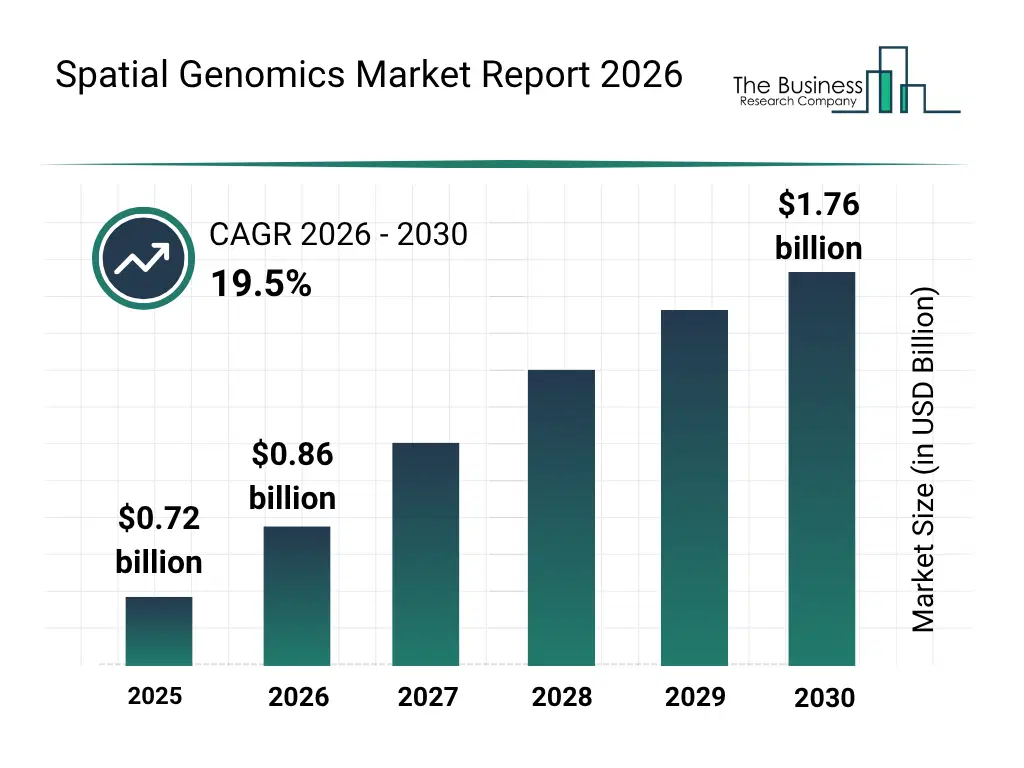
What Is The Spatial Genomics Market Size and Share 2026?
The spatial genomics market size has grown rapidly in recent years. It will grow from $0.72 billion in 2025 to $0.86 billion in 2026 at a compound annual growth rate (CAGR) of 20.0%. The growth in the historic period can be attributed to rising adoption of next generation sequencing technologies, increasing focus on precision medicine research, growth in genomics research funding across academic institutes, expansion of molecular biology laboratories, increasing prevalence of cancer research studies.What Is The Spatial Genomics Market Growth Forecast?
The spatial genomics market size is expected to see rapid growth in the next few years. It will grow to $1.76 billion in 2030 at a compound annual growth rate (CAGR) of 19.5%. The growth in the forecast period can be attributed to advancement in ai powered spatial genomics data analysis, growing demand for personalized medicine and targeted therapies, increasing integration of multiomics research platforms, expansion of cloud based biomedical data ecosystems, rising adoption of spatial biology in drug discovery pipelines. Major trends in the forecast period include increasing adoption of spatial multiomics platforms for high resolution tissue mapping in disease research, rising demand for spatial transcriptomics in oncology and neuroscience applications, growing use of ai driven bioinformatics tools for spatial gene expression interpretation, expansion of cloud based genomic data storage and collaborative research platforms, increasing integration of advanced imaging technologies with sequencing workflows for enhanced tissue analysis.
Global Spatial Genomics Market Segmentation
1) By Product: Instruments; Consumables And Reagents; Software And Data Analysis Platforms; Services 2) By Technology: Spatial Transcriptomics; Spatial Proteomics; In Situ Sequencing; Imaging Mass Cytometry; Fluorescence In Situ Hybridization; Spatial Multiomics Platforms; Other Technologies 3) By Sample Type: Tissue Samples; Blood Samples; Cell Samples; Other Biological Samples 4) By Application: Oncology; Neuroscience; Immunology; Developmental Biology; Cardiovascular Diseases; Infectious Diseases; Other Applications 5) By End User: Pharmaceutical And Biotechnology Companies; Academic And Research Institutes; Hospitals And Diagnostic Laboratories; Contract Research Organizations; Government Research Organizations Subsegments: 1) By Instruments: Spatial Imaging Systems; Sequencing Platforms; Microscopy Instruments; Laser Capture Microdissection Instruments; Automated Slide Processing Systems; Tissue Sectioning Instruments; Barcode Printing And Labeling Systems 2) By Consumables And Reagents: Assay Kits; Barcoding Reagents; Labeling Reagents; Probe Sets; Tissue Preparation Reagents; Sequencing Reagents; Staining Reagents; Microfluidic Chips 3) By Software And Data Analysis Platforms: Bioinformatics Software; Image Analysis Software; Data Visualization Platforms; Multiomics Integration Platforms; Cloud Based Analysis Platforms; Artificial Intelligence Based Analytical Tools; Spatial Data Management Software 4) By Services: Spatial Gene Expression Analysis Services; Bioinformatics Analysis Services; Tissue Imaging Services; Sample Preparation Services; Data Interpretation Services; Multiomics Integration Services; Research Consulting ServicesWhat Is The Driver Of The Spatial Genomics Market?
The rising adoption of precision medicine is expected to propel the growth of the spatial genomics market going forward. Precision medicine refers to a medical approach that customizes treatment based on individual patient characteristics such as genetics, biomarkers, and disease phenotypes. The demand for precision medicine is rising due to advancements in biomarker identification and molecular diagnostics, which enable more accurate classification of respiratory conditions and targeted therapy selection. Spatial genomics enables precision medicine by mapping gene expression and cellular interactions in tissue context to identify biomarkers, understand disease heterogeneity, and develop targeted, individualized therapies. For instance, in February 2024, according to the Personalized Medicine Coalition, a US-based non-profit organization, in 2023, the FDA approved 16 new personalized therapies for patients with rare diseases, marking a substantial rise from the six approvals recorded in 2022. Therefore, the rising adoption of precision medicine is driving the growth of the spatial genomics industry.Key Players In The Global Spatial Genomics Market
Major companies operating in the spatial genomics market are 10x Genomics; Bruker; Illumina; Bio-Techne; Revvity; Thermo Fisher Scientific Inc.; Danaher Corporation; Vizgen; Agilent Technologies Inc.; BGI Genomics Co. Ltd.; MGI Tech Co. Ltd.; Carl Zeiss AG; Nikon Corporation; Resolve Biosciences; RareCyte; Singleron Biotechnologies Ltd.; Pixelgen Technologies AB; Arima Genomics Inc.; BioTuring Inc.; Curio Bioscience; S2 Genomics; Dovetail GenomicsGlobal Spatial Genomics Market Trends and Insights
Major companies operating in the spatial genomics market are focusing on developing innovative solutions such as, high-plex spatial gene expression panels to enhance cellular resolution, biomarker discovery, and tissue-level disease mapping. High-plex spatial gene expression panels are advanced molecular profiling tools that measure the activity of thousands of genes directly within intact tissue sections, preserving spatial context while enabling researchers to analyze cell types, signaling pathways, and cell-to-cell interactions more comprehensively than traditional bulk RNA sequencing or standard single-cell sequencing methods. For instance, in May 2024, 10x Genomics, Inc., a US-based leader in single-cell and spatial biology technologies, launched the Xenium Prime 5K Pan-Tissue and Pathways panel. The platform significantly expands multiplexing capacity to enable detection of up to 5,000 genes with improved sensitivity, specificity, and spatial accuracy within a single tissue slide. It incorporates enhanced chemistry and multimodal cell segmentation to improve data quality and allows researchers to identify molecular pathways, ligand-receptor interactions, and cellular communication patterns across diverse tissue types. Additionally, the system offers rapid turnaround times and high-throughput processing, enabling analysis of large tissue areas within days while maintaining tissue-agnostic workflows.What Are Latest Mergers And Acquisitions In The Spatial Genomics Market?
In May 2024, Bruker Corporation, a US-based technology company, acquired the NanoString business for approximately $392.6 million. With this acquisition, Bruker aimed to strengthen its spatial biology and post-genomic life sciences portfolio by integrating NanoString’s gene expression profiling and spatial transcriptomics platforms, thereby enhancing its capabilities in advanced biological research, translational science, and single-cell analysis. NanoString Technologies Inc. is a US-based life sciences technology company that specializes in providing spatial transcriptomics, gene expression analysis systems, and multiomics platforms used for discovery and clinical research applications in healthcare and biomedical sciences.Regional Outlook
North America was the largest region in the spatial genomics market in 2025. Asia-Pacific is expected to be the fastest-growing region in the forecast period. The regions covered in this market report are Asia-Pacific, South East Asia, Western Europe, Eastern Europe, North America, South America, Middle East, Africa. The countries covered in this market report are Australia, Brazil, China, France, Germany, India, Indonesia, Japan, Taiwan, Russia, South Korea, UK, USA, Canada, Italy, Spain.What Defines the Spatial Genomics Market?
The spatial genomics market consists of revenues earned by entities by providing services such as spatial transcriptomics analysis, tissue profiling, genomic sequencing, bioinformatics analysis, imaging data processing, and molecular mapping services. The market value includes the value of related goods sold by the service provider or included within the service offering. The spatial genomics market also includes sales of sequencing instruments, imaging systems, spatial genomics platforms, reagents, assay kits, consumables, and bioinformatics software. Values in this market are ‘factory gate’ values, that is the value of goods sold by the manufacturers or creators of the goods, whether to other entities (including downstream manufacturers, wholesalers, distributors and retailers) or directly to end customers. The value of goods in this market includes related services sold by the creators of the goods.How is Market Value Defined and Measured?
The market value is defined as the revenues that enterprises gain from the sale of goods and/or services within the specified market and geography through sales, grants, or donations in terms of the currency (in USD unless otherwise specified). The revenues for a specified geography are consumption values that are revenues generated by organizations in the specified geography within the market, irrespective of where they are produced. It does not include revenues from resales along the supply chain, either further along the supply chain or as part of other products.What Key Data and Analysis Are Included in the Spatial Genomics Market Report 2026?
The spatial genomics market research report is one of a series of new reports from The Business Research Company that provides market statistics, including industry global market size, regional shares, competitors with the market share, detailed market segments, market trends and opportunities, and any further data you may need to thrive in the spatial genomics industry. The market research report delivers a complete perspective of everything you need, with an in-depth analysis of the current and future state of the industry.Spatial Genomics Market Report Forecast Analysis
| Report Attribute | Details |
|---|---|
| Market Size Value In 2026 | $0.86 billion |
| Revenue Forecast In 2030 | $1.76 billion |
| Growth Rate | CAGR of 19.5% from 2026 to 2030 |
| Base Year For Estimation | 2025 |
| Actual Estimates/Historical Data | 2020-2025 |
| Forecast Period | 2026 - 2030 |
| Market Representation | Revenue in USD Billion and CAGR from 2026 to 2030 |
| Segments Covered | Product, Technology, Sample Type, Application, End User |
| Regional Scope | Asia-Pacific, Western Europe, Eastern Europe, North America, South America, Middle East, Africa |
| Country Scope | The countries covered in the report are Australia, Brazil, China, France, Germany, India, ... |
| Key Companies Profiled | 10x Genomics; Bruker; Illumina; Bio-Techne; Revvity; Thermo Fisher Scientific Inc.; Danaher Corporation; Vizgen; Agilent Technologies Inc.; BGI Genomics Co. Ltd.; MGI Tech Co. Ltd.; Carl Zeiss AG; Nikon Corporation; Resolve Biosciences; RareCyte; Singleron Biotechnologies Ltd.; Pixelgen Technologies AB; Arima Genomics Inc.; BioTuring Inc.; Curio Bioscience; S2 Genomics; Dovetail Genomics |
| Customization Scope | Request for Customization |
| Pricing And Purchase Options | Explore Purchase Options |